Liber XVII · Islam · Chapter IX: Sufism
Sufism in Islam: The Mystical Path, Its Doctrines and Practice
Sufism in Islam explained: tasawwuf as the path of ihsan, the heart and lower self, dhikr and retreat, fana and the unity of being, and Sufism's critics.

Sufism, in Arabic taṣawwuf, is the inward and mystical dimension of Islam: the discipline by which Muslims seek to purify the soul, remember God constantly and come to know Him directly, or in the words of a famous hadith, to "worship God as though you see Him". It is not a sect but a path practised within Sunni and, in its own forms, Shi'i Islam, with its own psychology of the soul, methods of devotion, chains of masters and a body of doctrine on love, annihilation of the ego and the unity of being.
Defining Sufism: Tasawwuf and the Dimension of Ihsan§
Early Sufi writers offered hundreds of definitions of their path, many of them paradoxical. Al-Junayd of Baghdad (d. 910) is credited with saying that Sufism means that God makes you die to yourself and live in Him; others defined it as good character, or as "taking the realities and despairing of what is in the hands of creatures". The word itself probably comes from ṣūf, wool, after the coarse garments of early ascetics, though Sufis also linked it to ṣafāʾ, purity.
The most common modern Muslim explanation draws on the hadith of Gabriel, in which the Prophet distinguishes three levels of religion: islām, the outward acts of submission; īmān, faith; and iḥsān, "doing what is beautiful", defined as worshipping God as though one sees Him, for even if one does not see Him, He sees you. Jurisprudence governs the first level and theology the second; Sufism presents itself as the science of the third. Its scriptural touchstones include the Qur'an's statement that God is "nearer to him than his jugular vein" (Qaf 50:16) and its repeated commands to remember God. The historical development of the movement, from the early ascetics to Rumi and Ibn Arabi, is told in Sufism: History, Masters and Practices of Mystical Islam; this article concentrates on its inner logic.
The Map of the Path: Sharia, Tariqa and Haqiqa§
Sufi teachers frequently describe religion with three linked terms. The sharīʿa is the revealed law, the broad highway all believers walk. The ṭarīqa, "path", is the narrower way of spiritual discipline taken within that law. The ḥaqīqa, "reality", is the truth that the path leads to, and maʿrifa, experiential knowledge or gnosis, is the knowing of it. An often repeated image compares the law to the shell of a nut, the path to its kernel and the reality to the oil within: without the shell the kernel is lost, and without the kernel the shell is empty.
Classical manuals such as the Risāla of al-Qushayri (d. 1072) and the Kashf al-maḥjūb of al-Hujwiri (d. c. 1072), the earliest Sufi treatise in Persian, insisted that no true Sufi neglects the law, and most Sufis were themselves jurists or hadith scholars. The path is mapped as a sequence of maqāmāt, stations such as repentance, renunciation, patience, trust in God (tawakkul) and contentment, acquired through effort, and aḥwāl, states such as awe, intimacy and longing, which come as gifts and pass.
The Heart and the Lower Self in Sufi Psychology§
Sufi psychology builds on Qur'anic vocabulary. The nafs, the self or soul, is in its untrained condition the "soul that commands to evil" (al-nafs al-ammāra). Through struggle it becomes the "blaming soul" (al-lawwāma) that reproaches itself, and finally the "soul at peace" (al-muṭmaʾinna), which the Qur'an invites to return to its Lord well-pleased. Some later writers expanded this into seven stages. The inner struggle against the ego was called the "greater jihad", after a saying, of debated authenticity, that contrasts it with the lesser jihad of the battlefield.
Opposite the nafs stands the heart (qalb), which in Sufi teaching is not the physical organ but the seat of knowledge of God, a mirror that is polished by remembrance and darkened by sin and heedlessness. Later authors, especially in the Naqshbandi order, mapped subtle centres (laṭāʾif) of the heart, spirit (rūḥ) and secret (sirr) onto points of the body, each associated with a colour and a prophet; readers may compare the Indian systems discussed in History of the Chakras, though the two developed separately. Al-Ghazali's Revival of the Religious Sciences, and his Persian summary The Alchemy of Happiness, made this psychology the basis of an entire programme of Muslim ethical life.
Practices of the Sufi Path: Dhikr, Retreat and Companionship§
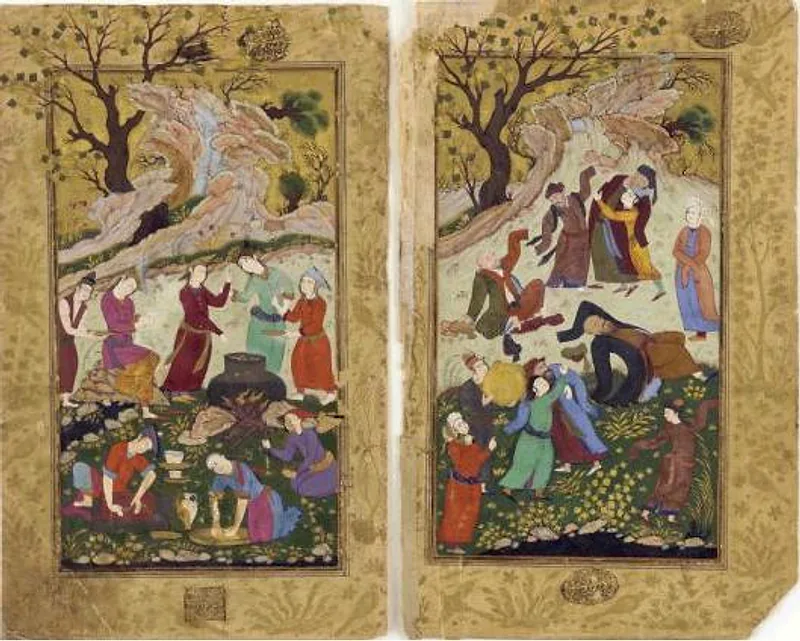
The central practice is dhikr, remembrance: the repetition of God's names, of the shahāda formula lā ilāha illā Allāh or of other phrases, aloud or silently, alone or in a circle (ḥalqa). The Qadiri and many other orders practise vocal dhikr, sometimes with rhythmic breathing and swaying; the Naqshbandis prefer the silent remembrance of the heart. Beside it stand the daily litany (wird) given by the teacher, contemplative watchfulness (murāqaba), recitation of the Qur'an and of blessings on the Prophet, and in some orders samāʿ, listening to music and poetry.
Disciples are traditionally initiated by a shaykh, to whom they give a pledge (bayʿa), and receive a chain of transmission (silsila) leading back to the Prophet. Companionship (ṣuḥba) with the master and fellow seekers is regarded as itself transformative. Some orders prescribe periods of retreat (khalwa), classically of forty days, with fasting, little sleep and continuous remembrance. Sufi teachers always placed such intensive disciplines under close supervision, warning that unguided practice could unsettle the mind; modern practitioners with mental health concerns are generally advised to approach retreat cautiously and with qualified guidance. The institutional life of the orders and the veneration of saints are described in Sufi Orders and Saints.
Key Doctrines: Love, Annihilation and the Unity of Being§
Three ideas recur throughout Sufi thought. The first is love (maḥabba, ʿishq), the conviction, associated with Rabi'a of Basra and celebrated by Persian poets from Sana'i and Attar to Rumi and Hafiz, that God is to be loved for Himself rather than for reward. Sufis cite a ḥadīth qudsī in which God says He was a "hidden treasure" who loved to be known and therefore created the world, a saying that hadith critics do not accept as authentic but that became central to Sufi cosmology.
The second is fanāʾ and baqāʾ: the passing away of the self in God and the subsistence that follows, in which the mystic returns to ordinary life transformed. Al-Junayd's "sober" Sufism made baqāʾ the goal, while "intoxicated" mystics such as al-Hallaj and Bayazid Bistami became known for ecstatic utterances. The third is the unity of being (waḥdat al-wujūd), the name later given to the metaphysics of Ibn Arabi (d. 1240): only God truly exists, and creatures are the loci in which the divine names become manifest. Ibn Arabi also elaborated the doctrine of the "Perfect Human" and of the "Muhammadan Reality", the primordial light of the Prophet from which creation unfolds. In India, Ahmad Sirhindi (d. 1624) of the Naqshbandi order criticised this view and proposed instead the "unity of witnessing" (waḥdat al-shuhūd): the oneness is in the mystic's perception, not in being itself.
In Shi'i Iran, mystical philosophy known as ʿirfān drew deeply on Ibn Arabi while centring devotion on the Imams, and the philosophy of Mulla Sadra, described in Islamic Philosophy, wove the two together.
Sufism, Its Critics and the Modern World§
Sufism has always had critics within Islam. Some medieval jurists objected to music, dancing and ecstatic sayings; the Hanbali scholar Ibn Taymiyya (d. 1328), who respected the early Sufis, condemned Ibn Arabi's monism and practices such as seeking the intercession of saints at tombs. From the eighteenth century the Wahhabi movement in Arabia, and later many Salafi and modernist reformers, attacked shrine veneration and the authority of shaykhs as innovations, while secular nationalists such as the founders of the Turkish Republic closed the Sufi lodges in 1925.
Yet Sufism has also been a force of renewal: orders led resistance to colonial rule in North Africa and the Caucasus, and new movements, such as the Senegalese Muridiyya founded by Ahmadu Bamba (d. 1927), continue to grow. In the West, Sufism became known through translations of Rumi and Hafiz, through the universalist teaching of Inayat Khan, who came to the West in 1910, and through writers such as René Guénon and Frithjof Schuon. Muslim scholars generally stress that, however widely its poetry is read, Sufism is rooted in the Qur'an, the Prophet and Islamic practice.
Frequently asked questions§
Do you have to be Muslim to be a Sufi?§
Historically, Sufism has been understood as a path within Islam, and the traditional orders require observance of Islamic law. Some Western "universal Sufi" groups, such as those descended from Inayat Khan, accept members of any faith, which more traditional Sufis regard as a departure.
Are Sufis Sunni or Shia?§
Most Sufi orders are Sunni, but some, such as the Ni'matullahi order in Iran, are Shi'i, and Shi'i Islam has its own mystical tradition called ʿirfān. Almost all Sufi chains of transmission pass through 'Ali, whom Sufis of both branches revere.
What does "fana" mean in Sufism?§
Fanāʾ means "passing away" or "annihilation". It describes the extinction of the ego's self-centred awareness in the presence of God, and is normally followed by baqāʾ, "subsistence", a return to ordinary life in which the mystic lives through God.
Sources and further reading§
- Mystical Dimensions of Islam — Annemarie Schimmel, 1975
- Sufism: A Short Introduction — William C. Chittick, 2000
- Al-Qushayri's Epistle on Sufism — al-Qushayri, trans. Alexander D. Knysh, 2007
- The Shambhala Guide to Sufism — Carl W. Ernst, 1997
- Sufism: A New History of Islamic Mysticism — Alexander Knysh, 2017
- The Alchemy of Happiness — al-Ghazali, trans. Claud Field, 1909