Liber XVII · Islam · Chapter IX: Sufism
Ibn Arabi: The Greatest Master and the Unity of Being
Ibn Arabi, the Andalusian Sufi called the Greatest Master: his life, the Meccan Revelations, the Bezels of Wisdom, the Unity of Being and his influence.

Muhyi al-Din Ibn al-'Arabi (1165–1240), known to his followers as al-Shaykh al-Akbar, "the Greatest Master", was an Andalusian Sufi whose vast writings gave Islamic mysticism its most elaborate metaphysics. He is chiefly associated with the doctrine later called waḥdat al-wujūd, the "Unity of Being", which holds that only God truly exists and that the world is the ceaseless self-manifestation of the divine names. Admired as a saint by many Muslims and condemned as a heretic by others, he remains one of the most debated figures in Islamic thought.
Life of Ibn 'Arabi: From Murcia to Damascus§
Ibn 'Arabi was born in Murcia, in south-eastern Spain, in July 1165, into an Arab family of some standing that served the Almohad rulers. He grew up mainly in Seville and received the education of a cultivated young man of al-Andalus. In his own account he underwent a decisive spiritual conversion while still young, and he describes a celebrated meeting in Córdoba with the philosopher Averroes (Ibn Rushd), a friend of his father, who was struck by the boy's reputation for spiritual insight. The anecdote, told in the Futūḥāt, is often read as a symbolic encounter between reasoned philosophy and visionary knowledge.
For the next two decades he studied with Sufi masters in Andalusia and the Maghrib, including two women teachers whom he remembered with special respect. Around 1200 he left the West for good. He reached Mecca in 1202, where he began the Futūḥāt and where a learned Persian family introduced him to a young woman, Niẓām, whose beauty and wisdom inspired the love poems of Tarjumān al-ashwāq (The Interpreter of Desires). When critics objected to their apparent worldliness, he wrote a commentary explaining them as allegories of divine knowledge.
He then travelled through Iraq, Syria and Anatolia, where he was received at the Seljuk court and where his stepson and disciple, Ṣadr al-Dīn al-Qūnawī, later became the foremost interpreter of his ideas. Around 1223 he settled in Damascus, surrounded by students, and died there in November 1240. His tomb on the slopes of Mount Qasiyun was rebuilt as a mosque complex by the Ottoman sultan Selim I after the conquest of Syria in 1516–17, and it is still visited today.
The Meccan Revelations and the Bezels of Wisdom§
Several hundred works are attributed to Ibn 'Arabi, many of them authentic. Two stand out.
Al-Futuhat al-Makkiyya§
The Meccan Revelations ("openings" received in Mecca) is an immense compendium in 560 chapters, begun in 1202 and finished in a second, revised recension in Ibn 'Arabi's own hand in the late 1230s. It ranges over cosmology, ritual law, the meaning of the letters of the alphabet, the stations of the spiritual path, the hierarchy of saints and the inner sense of prayer, fasting and pilgrimage. Ibn 'Arabi presents its contents not as speculation but as knowledge "opened" to him by God through unveiling (kashf).
Fusus al-Hikam§
The Bezels of Wisdom, written in Damascus around 1229, is short but dense. Ibn 'Arabi says that the Prophet appeared to him in a dream holding the book and commanded him to make it public. Each of its 27 chapters links a prophet, from Adam to Muhammad, to a particular "wisdom" (ḥikma), like a gem set in a ring. The Fuṣūṣ became the most commented-on of his works, with well over a hundred commentaries in Arabic, Persian and Turkish, and also the most attacked.
Wahdat al-Wujud: The Unity of Being§
For Ibn 'Arabi, wujūd (being, existence, and also "finding") belongs in the true sense to God alone. Everything else is, in itself, nothing; it receives existence at every instant as a loan. Creatures are like images in a mirror or colours cast by light through glass: real as appearances, yet without independent being. The cosmos is God's continuous self-disclosure (tajallī), renewed at every moment, so that no two moments of creation are identical.
He explains this through the divine names. The Qur'an speaks of God's "most beautiful names", the Merciful, the Knowing, the Living and so on. In Ibn 'Arabi's thought each name seeks a locus in which to show its effects, and the world is the sum of those loci. Before creation, things exist as "fixed entities" (aʿyān thābita) in God's knowledge; creation brings them into manifestation through the "Breath of the All-Merciful". Sufis often cited in this connection a saying attributed to God, "I was a hidden treasure and loved to be known", which hadith scholars regard as weak but which became a keynote of mystical cosmology.
The term waḥdat al-wujūd itself does not appear in Ibn 'Arabi as a technical label. It was developed by al-Qūnawī's circle and their successors, and it was popularised as much by critics as by admirers. Ibn 'Arabi was careful to preserve distinctions: God is both incomparable (tanzīh) and similar (tashbīh), and the servant never becomes the Lord. Opponents such as Ibn Taymiyya (d. 1328) nevertheless read the doctrine as pantheism that erased the difference between Creator and creation. The broader setting of these debates is outlined in Sufism in Islam: Path and Doctrine.
The Perfect Human and the Seal of the Saints§
Since every name of God seeks manifestation, only a being that unites all the names can fully mirror the divine. This is the Perfect Human (al-insān al-kāmil), realised supremely in the Prophet Muhammad and, in principle, in the greatest saints. Adam's creation "in God's form", in a well-known hadith, means for Ibn 'Arabi that the human being is a microcosm containing the realities of the cosmos, and that the world itself is a "great human". The theme was developed systematically by the later Sufi 'Abd al-Karīm al-Jīlī (d. around 1408) in a book of the same title.
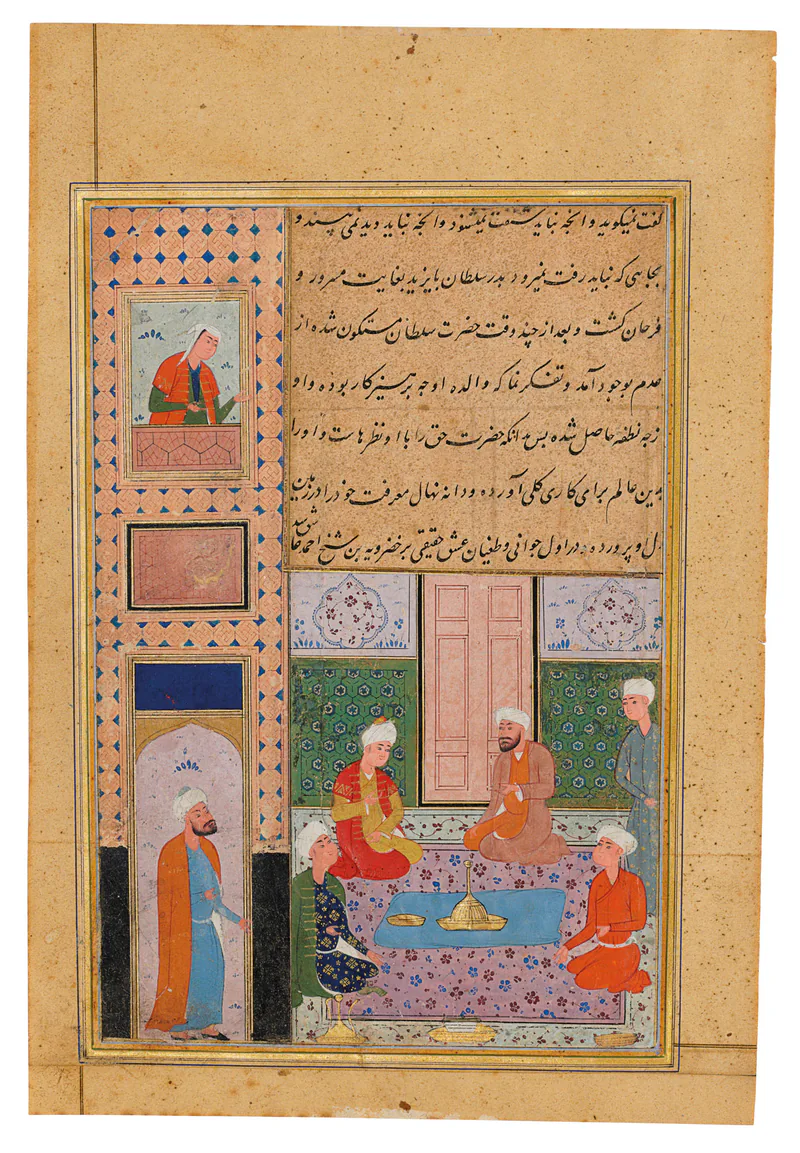
Ibn 'Arabi also elaborated a theory of sainthood (walāya). Prophecy that brings new law ended with Muhammad, the "Seal of the Prophets", but sainthood continues until the end of time. He spoke of a Seal of universal sainthood, identified with Jesus at his return, and a Seal of Muhammadan sainthood, a role he appears to have claimed for himself. The invisible hierarchy of saints, the Pole (quṭb), the pillars and the substitutes (abdāl), received detailed treatment in his work and shaped the language of the Sufi orders and their saints.
Imagination, the Isthmus and the Divine Names§
One of Ibn 'Arabi's most original contributions is his account of imagination (khayāl). Between the purely spiritual and the purely bodily lies an intermediate realm, the barzakh or isthmus, where spirits take on bodily forms and meanings appear as images. Dreams, visions of angels and prophets, the life of the soul after death and the forms in which God discloses himself to the heart all belong to this world of imagination. For Ibn 'Arabi it is not "imaginary" in the sense of unreal, but a genuine level of existence and a means of knowledge.
This idea fascinated the French scholar Henry Corbin, who placed Ibn 'Arabi beside the Persian philosopher Suhrawardi and his Philosophy of Illumination as a master of the mundus imaginalis, the "imaginal world". Later scholars such as William Chittick have stressed instead how closely Ibn 'Arabi's thought is tied to the Qur'an, the hadith and Islamic law, which he followed scrupulously. Like many Sufis he also wrote on the mysteries of the Arabic letters, a field that links his work to the science of letters treated in al-Buni and the Shams al-Ma'arif.
Followers, Critics and Influence East and West§
Ibn 'Arabi's school spread rapidly. Al-Qūnawī in Konya, a contemporary of Rumi, systematised his teachings; commentators such as 'Abd al-Razzāq al-Qāshānī and Dāwūd al-Qayṣarī turned the Fuṣūṣ into a philosophical curriculum. In Persian poetry the influence is felt in Fakhr al-Dīn 'Irāqī and 'Abd al-Raḥmān Jāmī, and in the Ottoman, Safavid and Mughal worlds Ibn 'Arabi's vocabulary became the common language of learned mysticism. The later Persian philosopher Mulla Sadra wove his ideas into a new synthesis described in Islamic Philosophy: Falsafa.
Criticism was equally persistent. Beyond Ibn Taymiyya, the Indian Naqshbandi master Aḥmad Sirhindī (d. 1624) proposed "unity of witnessing" (waḥdat al-shuhūd) as a corrective: the unity is in the mystic's perception, not in being itself. Modern reformist and Salafi movements have often rejected Ibn 'Arabi outright, while many Sufi orders continue to read him with reverence. The Algerian resistance leader Emir 'Abd al-Qādir, who studied his works in exile, was buried beside him in Damascus in 1883 before his remains were moved to Algeria in 1966.
In the West, the Spanish scholar Miguel Asín Palacios drew attention to Ibn 'Arabi in the early twentieth century. Corbin's studies, translations of the Fuṣūṣ and the Futūḥāt, and the Muhyiddin Ibn 'Arabi Society, founded in Oxford in 1977, have since made him one of the most studied Muslim thinkers in Europe and America.
Frequently asked questions§
What does wahdat al-wujud mean?§
Waḥdat al-wujūd means "the Unity of Being" or "Oneness of Existence". It expresses the view that true being belongs to God alone and that creatures exist only as manifestations of the divine names. The phrase was coined by Ibn 'Arabi's successors and critics rather than by Ibn 'Arabi himself.
Was Ibn Arabi a pantheist?§
Critics such as Ibn Taymiyya accused him of pantheism, but most modern scholars think the label is misleading. Ibn 'Arabi insisted that God is both utterly beyond creation and present in it, and that the creature never becomes God. Whether this balance holds is still argued among Muslims.
Which book of Ibn Arabi should I read first?§
Many readers begin with The Bezels of Wisdom in an annotated translation, or with Sufis of Andalusia for his portraits of his teachers. The Meccan Revelations is so large that most readers meet it through selections and studies such as William Chittick's The Sufi Path of Knowledge.
Where is Ibn Arabi buried?§
He is buried in the Salihiyya quarter of Damascus, on the slopes of Mount Qasiyun. The mosque and tomb complex built by Sultan Selim I in the early sixteenth century remains a place of visitation.
Sources and further reading§
- The Bezels of Wisdom — Ibn al-'Arabi, trans. R. W. J. Austin, 1980
- Sufis of Andalusia — Ibn al-'Arabi, trans. R. W. J. Austin, 1971
- The Sufi Path of Knowledge: Ibn al-Arabi's Metaphysics of Imagination — William C. Chittick, 1989
- Quest for the Red Sulphur: The Life of Ibn 'Arabi — Claude Addas, 1993
- Creative Imagination in the Sufism of Ibn 'Arabi — Henry Corbin, 1969
- Ibn 'Arabi in the Later Islamic Tradition: The Making of a Polemical Image in Medieval Islam — Alexander D. Knysh, 1999
- Seal of the Saints: Prophethood and Sainthood in the Doctrine of Ibn 'Arabi — Michel Chodkiewicz, 1993