Liber XVII · Islam · Chapter V: Jinn & the Unseen
Islamic Eschatology: Death, the Grave, Judgment and Paradise
Islamic eschatology explained: death and the barzakh, questioning in the grave, signs of the Hour, the Mahdi and Dajjal, Judgment Day, Paradise and Hell.

Islamic eschatology is the body of Muslim teaching about death, the life of the soul in the grave, the end of the world, the resurrection, the Last Judgment and the eternal abodes of Paradise and Hell. Belief in the Last Day is one of the articles of faith, and the Qur'an returns to it constantly; hadith, creeds and a large devotional literature filled in the details, from the questioning of the dead by two angels to the bridge over Hell that every soul must cross.
Death and the Departure of the Soul§
The Qur'an teaches that every soul will taste death (Al 'Imran 3:185) and that the Angel of Death, who has charge of humankind, takes the souls at their appointed time (as-Sajda 32:11). The Qur'an does not name this angel; later tradition calls him 'Azra'il (see Angels in Islam). A widely cited hadith transmitted from al-Bara' ibn 'Azib describes the death of the believer, whose soul flows out gently like water from a jug and is carried up through the heavens by angels of mercy, and that of the unbeliever, whose soul is torn out and turned back at the gates of heaven.
Muslim funeral practice reflects these beliefs. The dying are encouraged to pronounce the testimony of faith, the body is washed, wrapped in a plain shroud and buried quickly, laid on its right side facing Mecca. In many communities a prayer of "instruction" (talqīn) is recited at the graveside to remind the dead of the answers they will soon be asked, though some jurists regard the practice as unfounded.
The Barzakh and the Questioning in the Grave§
The period between death and resurrection is called the barzakh, "barrier" or "isthmus", from a verse that places a barrier behind the dead "until the day they are raised" (al-Muminun 23:100). Sunni creeds affirm that in the grave the dead are visited by two angels, named in hadith as Munkar and Nakir, who ask three questions: Who is your Lord? What is your religion? Who is this man who was sent to you? The believer answers with God, Islam and Muhammad, and his grave is widened and opened onto Paradise; the hypocrite or unbeliever cannot answer and suffers the "punishment of the grave" (ʿadhāb al-qabr).
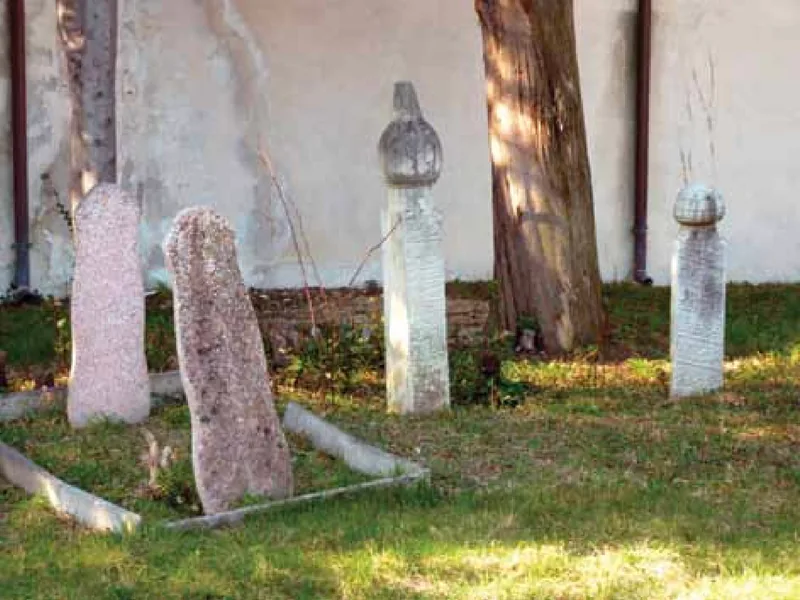
Some rationalist theologians of the Mu'tazila questioned the punishment of the grave, but it became a firm article of Sunni creeds, and the Prophet's prayer for refuge from it is part of the standard devotions after prayer. The barzakh was also imagined as a place where the souls of the dead meet one another and are aware of visitors to their graves, ideas that sustained the practice of visiting the dead and the saints. In Sufi thought, and above all in Ibn 'Arabi, the barzakh became the name of an intermediate world of images between spirit and body, an idea discussed below.
The Signs of the Hour: Dajjal, Jesus and the Mahdi§
The Qur'an insists that knowledge of the Hour belongs to God alone and that it will come suddenly. It also mentions portents: the release of Gog and Magog (al-Kahf 18:94–99; al-Anbiya 21:96), a beast that will come forth from the earth (an-Naml 27:82), a smoke covering the people (ad-Dukhan 44:10) and the splitting of the moon. Hadith literature arranged these into "lesser signs", such as the spread of ignorance and the building of tall towers by herdsmen, and "greater signs" that immediately precede the end, among them the rising of the sun in the west.
At the centre of these traditions stands the Dajjal, the "Deceiver", a false messiah described as blind in one eye, who will lead many astray with apparent miracles. According to hadith in Muslim's collection, Jesus, son of Mary, will then descend near a white minaret in the east of Damascus, slay the Dajjal and rule justly; Muslims believe that Jesus was not crucified but raised to God, so that his return completes his mission. Many Sunni hadith collections, such as that of Abu Dawud, also speak of the Mahdi, a "rightly guided" ruler from the Prophet's family who will fill the earth with justice, though the canonical collections of al-Bukhari and Muslim do not name him. In Twelver Shi'ism the Mahdi is identified with the hidden Twelfth Imam, as described in The Twelve Imams of Shi'a Islam. Across Islamic history many movements were led by claimants to the title, from the Fatimids to Muhammad Ahmad, the Mahdi of the Sudan in the 1880s.
The Trumpet, the Resurrection and the Day of Judgment§
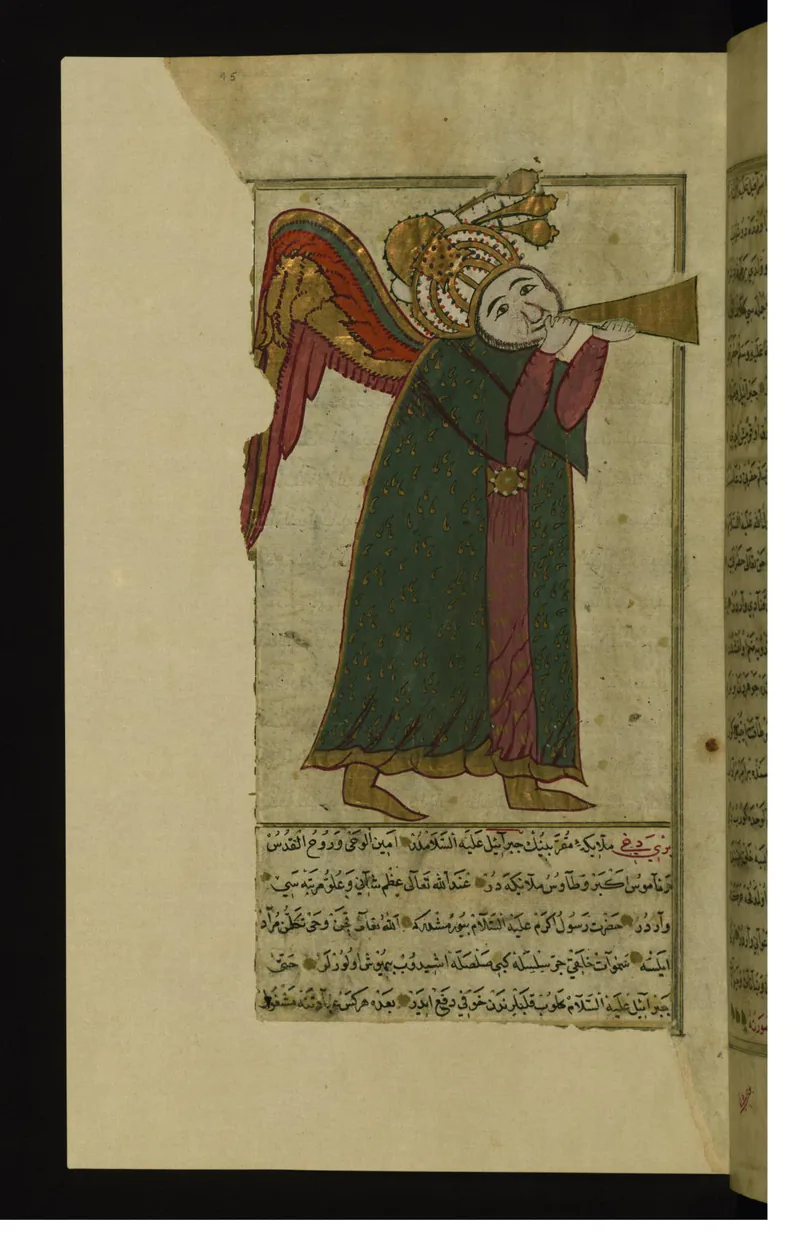
The end begins with the blowing of the trumpet, by tradition the task of the angel Israfil: at the first blast all creatures die, at the second they rise (az-Zumar 39:68). The Qur'an describes the cosmic upheaval in the Meccan suras with great force: the sky split open, the stars scattered, the seas boiling, the mountains like carded wool (at-Takwir 81; al-Qari'a 101). The resurrection is bodily; to those who doubted it the Qur'an answers that the One who created them the first time can create them again.
Humanity is then gathered on a vast plain, standing for a long time under the sun. The record of each person's deeds is handed over, into the right hand of the saved and the left hand of the damned (al-Haqqa 69:19–25); deeds are weighed in the balance (mīzān), where even the weight of a mustard seed counts (al-Anbiya 21:47). Sunni doctrine affirms the intercession (shafāʿa) of the Prophet Muhammad for the sinners of his community, by God's permission, and hadith describe his Pool (ḥawḍ), from which the faithful will drink. The comparison of these scenes with Jewish, Christian and Zoroastrian images of the end is explored in Zoroastrian Eschatology and Zoroastrian Influence on Judaism, Christianity and Islam.
The Bridge, Paradise and Hell§
Hadith describe the ṣirāṭ, a bridge stretched over Hell, finer than a hair and sharper than a sword in many tellings, which all must cross: the righteous pass over at the speed of lightning or of a horse, while others stumble and fall. Between Paradise and Hell the Qur'an mentions "the Heights" (al-Aʿrāf), whose occupants see both (al-A'raf 7:46).
Paradise (al-janna, "the Garden") is described in vivid and concrete terms: gardens beneath which rivers flow, rivers of water, milk, wine that does not intoxicate and honey (Muhammad 47:15), shade, couches, fruits and companions of Paradise. Its highest degree is called Firdaws, and the greatest reward is God's good pleasure and, for Sunni theologians, the vision of God, based on the verse "faces on that day radiant, looking towards their Lord" (al-Qiyama 75:22–23); the Mu'tazilites interpreted this figuratively. Hell (jahannam, "the Fire") has seven gates (al-Hijr 15:44), the bitter tree of Zaqqum and guardian angels. Mainstream Sunni teaching holds that believers who enter Hell for their sins will eventually be brought out, while the punishment of unbelievers is everlasting; a minority of scholars, including Ibn Taymiyya's student Ibn Qayyim al-Jawziyya, discussed whether Hell itself might one day come to an end.
Philosophers, Mystics and the Inner Meaning of the Hereafter§
The vivid imagery of the Qur'an provoked philosophical debate. Avicenna argued that true happiness and misery belong to the rational soul and treated bodily descriptions of the afterlife as images suited to the understanding of the many. Al-Ghazali answered in The Incoherence of the Philosophers that denying the bodily resurrection was one of three doctrines that amounted to unbelief, yet in his own Revival he wrote richly on the inner states of the soul after death. His book on the remembrance of death became a classic of Muslim piety.
Mystics found a middle path. A saying popular among Sufis urges believers to "die before you die", that is, to pass through the death of the ego in this life. Ibn 'Arabi described the barzakh as an imaginal world in which meanings take on forms, so that in the grave and at the resurrection deeds appear as bodies and the soul meets its own states as images; Mulla Sadra later built a philosophical theory of bodily resurrection on similar foundations, interpreted in modern times by Henry Corbin. Popular literature, meanwhile, elaborated tours of the heavens and hells modelled on the Prophet's ascension, described in Isra and Mi'raj; in 1919 the Spanish scholar Miguel Asín Palacios argued that such texts influenced Dante's Divine Comedy, a thesis still debated. For wider comparison see Reincarnation and the Afterlife.
Frequently asked questions§
What is the barzakh in Islam?§
The barzakh is the intermediate state between death and resurrection. The souls of the dead remain in it, questioned in the grave and experiencing a foretaste of reward or punishment, until the Day of Resurrection.
Who are Munkar and Nakir?§
They are the two angels who, according to hadith and Sunni creeds, question the dead in the grave about their Lord, their religion and their prophet. The Qur'an does not name them.
Is the Mahdi mentioned in the Qur'an?§
No. The Mahdi appears in hadith collections such as that of Abu Dawud and in Shi'i tradition, where he is the hidden Twelfth Imam. Some Muslims, especially modernists, doubt the reports concerning him.
Do Muslims believe Hell is eternal?§
Mainstream Sunni teaching holds that sinful believers will eventually leave Hell, while unbelievers remain in it forever. A few medieval scholars discussed whether Hell might ultimately cease, but this remained a minority view.
Sources and further reading§
- The Islamic Understanding of Death and Resurrection — Jane Idleman Smith and Yvonne Yazbeck Haddad, 1981
- The Remembrance of Death and the Afterlife — Abu Hamid al-Ghazali, 1989
- The Precious Pearl — Jane Idleman Smith (trans.), 1979
- Paradise and Hell in Islamic Traditions — Christian Lange, 2016
- Islamic Messianism: The Idea of Mahdi in Twelver Shi'ism — Abdulaziz Abdulhussein Sachedina, 1981
- Islam and the Divine Comedy — Miguel Asín Palacios, 1926