Liber VI · Christianity · Chapter IX: Protestantism
Protestantism and the Reformation: Luther, Calvin and After
Protestantism and the Reformation explained: Luther, Zwingli and Calvin, Anabaptists and Anglicans, core Protestant beliefs and the rise of Pentecostalism.

Protestantism is the branch of Western Christianity that arose from the sixteenth-century Reformation, when Martin Luther, Huldrych Zwingli, John Calvin and others broke with the Roman Catholic Church. Protestants generally hold that the Bible is the supreme authority for faith, that salvation is received by grace through faith rather than earned, and that all believers share in Christ's priesthood; today, in hundreds of denominations from Lutherans and Anglicans to Baptists and Pentecostals, they number somewhere between 800 million and over a billion people.
The Background to the Reformation§
Calls for reform were common in the late medieval Church. The Great Western Schism had weakened the papacy, critics attacked the wealth and worldliness of the clergy, and earlier dissenters such as John Wyclif in England (d. 1384) and Jan Hus in Bohemia, burned at the Council of Constance in 1415, had challenged church authority and appealed to scripture. Renaissance humanists, above all Erasmus, urged a return to the sources and published the Greek New Testament (1516). The printing press allowed new ideas to circulate faster than ever before.
Martin Luther and the Lutheran Reformation§
Martin Luther (1483–1546), an Augustinian friar and professor of theology at Wittenberg in Saxony, became convinced through his study of Paul's letters that sinners are justified — declared righteous before God — by faith in Christ alone, not by their own works. In October 1517 he circulated his Ninety-Five Theses against the sale of indulgences, which promised remission of punishment for sin. The dispute escalated rapidly. Luther was excommunicated in 1521 and, refusing to recant before the emperor Charles V at the Diet of Worms, was declared an outlaw; protected by Frederick the Wise, he translated the New Testament into German in hiding at the Wartburg.
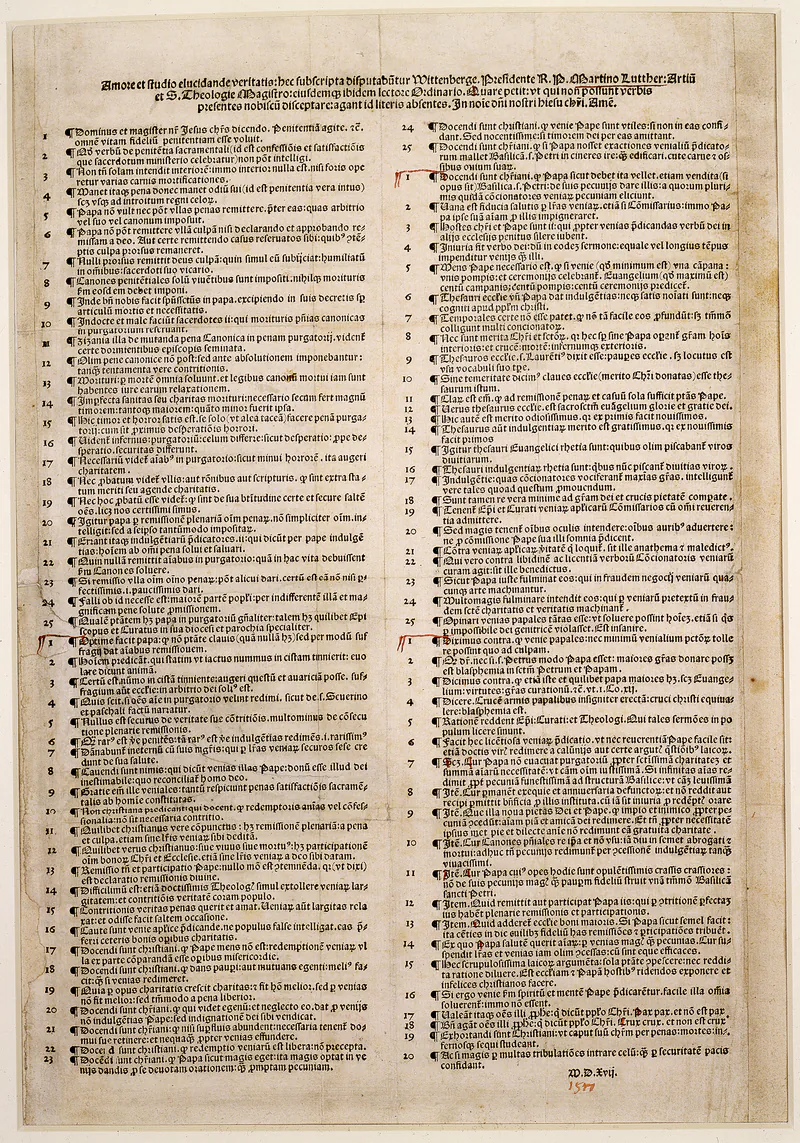
Lutheran churches spread through much of Germany and Scandinavia. Their teaching was summarised in the Augsburg Confession (1530), drafted by Luther's colleague Philip Melanchthon. Lutherans kept much traditional liturgy, believed in the real presence of Christ in the Lord's Supper, and gave a central place to congregational hymn singing. After decades of conflict, the Peace of Augsburg in 1555 allowed each prince of the Holy Roman Empire to choose between Lutheranism and Catholicism for his territory.
Zwingli, Calvin and the Reformed Tradition§
In Zurich, Huldrych Zwingli (1484–1531) led a more radical reform from 1519, removing images from churches and teaching that the Lord's Supper is a memorial. He and Luther failed to agree on this point at the Marburg Colloquy of 1529, and the Reformed and Lutheran traditions developed separately.
John Calvin (1509–1564), a French humanist lawyer, became the leading Reformed theologian. His Institutes of the Christian Religion, first published in 1536 and greatly expanded until 1559, offered a systematic account of Protestant doctrine, stressing the sovereignty of God, the authority of scripture and predestination. In Geneva he organised a church disciplined by elders and pastors. Calvinism spread to France (the Huguenots), the Netherlands, Hungary, Scotland — where John Knox led the Reformation of 1560 that produced the Presbyterian Church — and later to England and North America through the Puritans.
The Radical Reformation and the English Reformation§
Anabaptists§
Some reformers wanted to go further. The Anabaptists ("re-baptisers") held that baptism should be given only to believers who confess their faith, rejected state churches, and often refused to swear oaths or bear arms. Their Schleitheim Confession of 1527 set out these principles. Persecuted by Catholics and Protestants alike, they survived in communities such as the Mennonites, named after Menno Simons, the Hutterites and later the Amish.
Anglicanism§
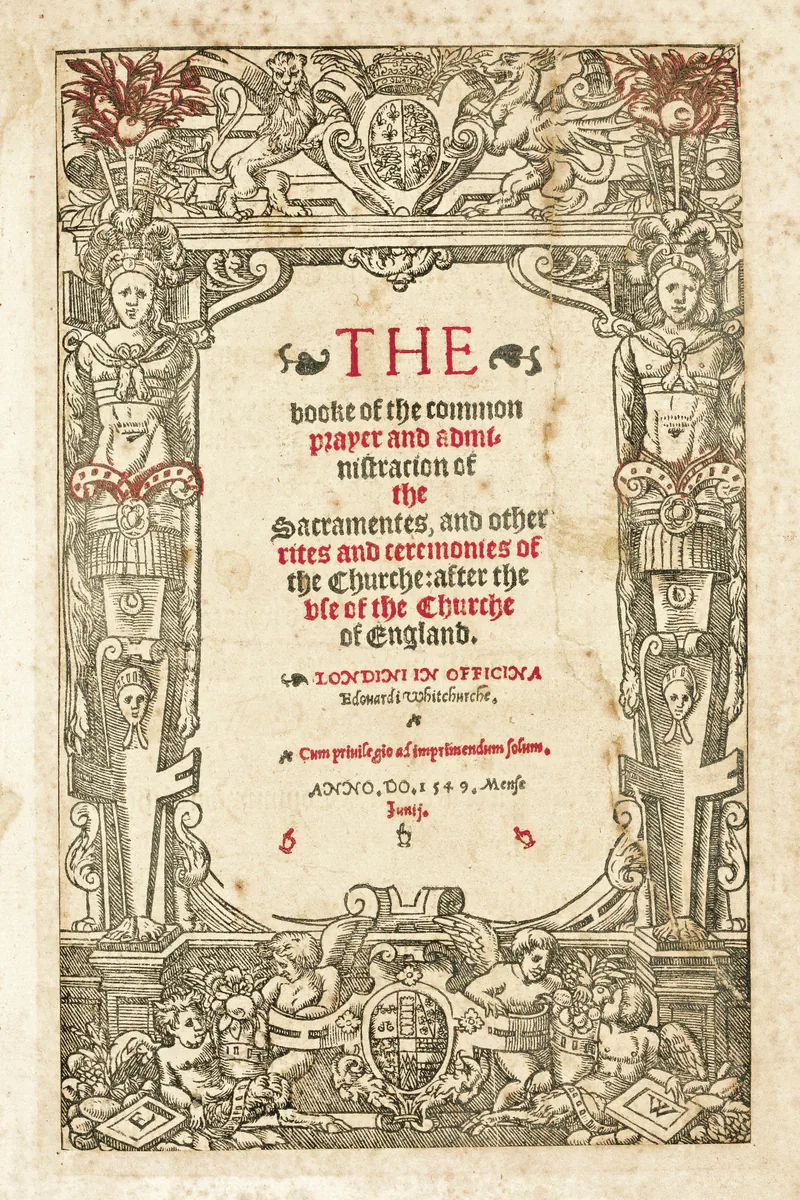
In England the break with Rome began politically, when Henry VIII's Act of Supremacy (1534) made the king head of the Church of England. Under Edward VI, Archbishop Thomas Cranmer introduced the Book of Common Prayer (1549, revised 1552); after a Catholic restoration under Mary I, the Elizabethan Settlement of 1559 established a church Reformed in doctrine but episcopal in structure and traditional in much of its worship. The Anglican Communion that grew from it now spans the world.
Core Protestant Beliefs§
Protestant churches differ widely, but they share several principles, later summarised in Latin slogans:
- Scripture alone (sola scriptura) — the Bible is the supreme authority, above church tradition and councils, though most Protestants respect the ancient creeds. The Reformers also preferred the shorter Hebrew canon, as explained in The Christian Bible and Its Canon.
- Faith alone and grace alone — salvation is God's free gift, received by trust in Christ rather than earned by merit; Paul's argument in Romans 3 was central to Luther.
- The priesthood of all believers — every Christian has direct access to God, and ministers serve rather than mediate.
- Two sacraments — baptism and the Lord's Supper, rather than the seven of Catholic teaching.
The Reformation also had darker consequences. The Wars of Religion in France, the Thirty Years' War (1618–1648) and the wave of European witch trials, which affected Protestant and Catholic lands alike, belong to the same age of confessional conflict. Some historians, following Keith Thomas, have argued that Protestant attacks on Catholic sacramentals as "magic" changed popular religion, a theme discussed in Folk Christianity.
From Pietism to Pentecostalism§
In the seventeenth and eighteenth centuries new movements stressed personal conversion and heartfelt devotion. German Pietism, launched by Philipp Jakob Spener's Pia Desideria (1675), influenced the Moravian community of Herrnhut and, through them, John Wesley, whose experience at Aldersgate in 1738 led to the Methodist movement. The Great Awakenings in Britain and North America made evangelical revivalism a defining feature of Anglo-American Protestantism. Baptists, Quakers (founded by George Fox in the 1650s) and many other groups grew from the Puritan and dissenting traditions.
The Protestant world also produced mystical and esoteric currents: the Lutheran visionary Jacob Boehme, the Rosicrucian manifestos of 1614–1616 that emerged from Lutheran circles (see Rosicrucianism), and later Emanuel Swedenborg.
In the twentieth century the Azusa Street revival in Los Angeles (1906), led by William J. Seymour, launched Pentecostalism, with its emphasis on speaking in tongues, healing and the gifts of the Spirit. Together with charismatic movements in older churches, it has become one of the fastest-growing religious movements in the world, especially in Africa, Latin America and Asia. Meanwhile liberal Protestant theology, from Friedrich Schleiermacher to the social gospel, engaged modern thought, and fundamentalism and neo-orthodoxy, associated with Karl Barth, responded to it in different ways.
Frequently asked questions§
What did Martin Luther protest against?§
Luther's immediate target in 1517 was the sale of indulgences, but his protest grew into a challenge to the papacy's authority and to the medieval understanding of salvation. He taught that people are justified by faith in Christ alone and that scripture is the supreme authority.
Why are they called Protestants?§
The name comes from the "Protestation" of Lutheran princes and cities at the Diet of Speyer in 1529, objecting to measures against the reform movement. It was later applied to all churches arising from the Reformation.
What is the difference between Lutherans and Calvinists?§
Both teach justification by faith and the authority of scripture. They differ chiefly on the Lord's Supper — Lutherans affirm Christ's bodily presence "in, with and under" the bread and wine, while Reformed churches speak of a spiritual presence — and on emphases such as predestination and worship.
Is Anglicanism Protestant or Catholic?§
Anglicans often describe their church as both Reformed and Catholic. Its doctrine was shaped by the Reformation, but it kept bishops, a liturgical tradition and many older customs, and Anglicans range from evangelical to Anglo-Catholic.
Sources and further reading§
- Reformation: Europe's House Divided, 1490–1700 — Diarmaid MacCulloch, 2003
- Here I Stand: A Life of Martin Luther — Roland H. Bainton, 1950
- Institutes of the Christian Religion — John Calvin, 1536
- The Radical Reformation — George Huntston Williams, 1962
- Christianity's Dangerous Idea: The Protestant Revolution — Alister E. McGrath, 2007
- An Introduction to Pentecostalism — Allan Anderson, 2004