Liber VI · Christianity · Chapter IX: Protestantism
Martin Luther: Life, Theology and Legacy of the Reformer
Martin Luther (1483–1546): the monk who sparked the Reformation — his Ninety-Five Theses, break with Rome, German Bible, theology and contested legacy.

Martin Luther (1483–1546) was a German friar, priest and professor of theology whose protest against the sale of indulgences in 1517 set off the Protestant Reformation. His teaching that sinners are made right with God by grace through faith alone, his defiance of pope and emperor, and his translation of the Bible into German transformed Western Christianity and left a legacy that is still celebrated and debated.
Early Life, the Monastery and the Search for a Gracious God§
Luther was born on 10 November 1483 in Eisleben in Saxony and grew up in nearby Mansfeld, where his father Hans prospered in the copper-mining business. Intended for a legal career, he studied at the University of Erfurt, receiving his master's degree in 1505. That summer, caught in a violent thunderstorm near the village of Stotternheim, he vowed to Saint Anne, patron of miners, that he would become a monk. A few weeks later, to his father's dismay, he entered the friary of the Augustinian Hermits in Erfurt.
Luther was a conscientious, even anxious, friar who confessed for hours and fasted, yet found no peace about whether he could satisfy God's justice. His superior and mentor Johann von Staupitz directed him toward study and teaching. Ordained priest in 1507, he visited Rome on his order's business in 1510–11. In 1512 he received his doctorate and took up the chair of Bible at the new University of Wittenberg, founded by the Elector Frederick the Wise.
The "Reformation discovery"§
Lecturing on the Psalms, Romans and Galatians between 1513 and 1518, Luther wrestled with the phrase "the righteousness of God" in Romans 1:17. He came to understand it not as the justice by which God punishes sinners but as the righteousness God gives to those who believe — "The just shall live by faith." Late in life he described this "tower experience" as a rebirth; historians date it anywhere from about 1514 to 1519. Its roots lie in his reading of Paul the Apostle and of Augustine.
The Ninety-Five Theses and the Indulgence Controversy§
In late medieval Catholic teaching, an indulgence remitted the temporal punishment due for sins already forgiven, drawing on the "treasury of merits" of Christ and the saints, and could be applied to souls in purgatory. In 1517 the Dominican preacher Johann Tetzel was selling indulgences near Saxony on behalf of Archbishop Albrecht of Mainz, partly to fund the rebuilding of Saint Peter's Basilica in Rome and partly to repay the archbishop's own debts.
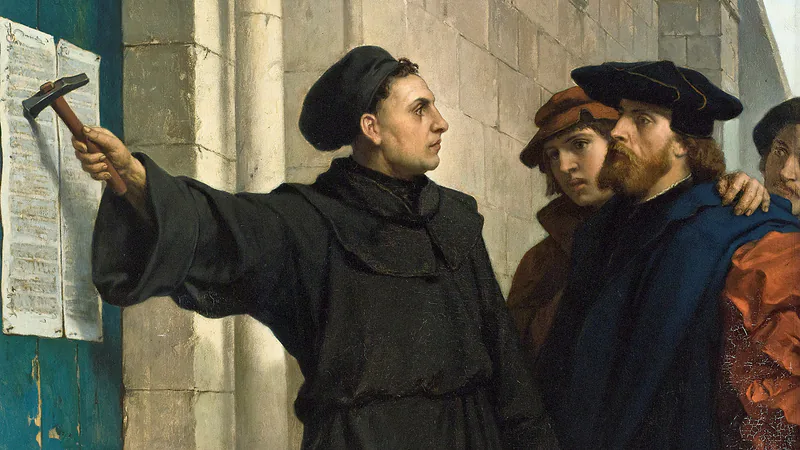
On 31 October 1517 Luther sent Albrecht a letter with ninety-five Latin theses for academic debate, criticising the preaching of indulgences and asserting that the true treasure of the Church is the gospel of God's grace. The famous image of Luther nailing the theses to the door of Wittenberg's Castle Church comes from a later account by Philip Melanchthon; some historians have doubted it, though posting notices on that door was a normal university practice. Either way, printed copies spread through Germany within weeks. Luther became the first author to exploit the printing press on a mass scale.
From Leipzig to Worms: The Break with Rome§
The controversy rapidly widened from indulgences to authority. At the Heidelberg Disputation of 1518 Luther set out his "theology of the cross," contrasting it with a "theology of glory" that presumes to know God through human reason and works. At the Leipzig Disputation of 1519 the theologian Johann Eck pushed him into declaring that popes and councils could err and that the condemned Czech reformer Jan Hus had been right on some points.
In 1520 Luther published three treatises that defined his programme: To the Christian Nobility of the German Nation, calling on lay rulers to reform the Church; The Babylonian Captivity of the Church, which reduced the sacraments from seven to two or three; and The Freedom of a Christian, which declared that a Christian is a free lord, subject to none, through faith, and a dutiful servant of all through love. When Pope Leo X's bull Exsurge Domine threatened him with excommunication, Luther publicly burned it in December 1520; he was excommunicated in January 1521.
Summoned before the young emperor Charles V at the Diet of Worms in April 1521, Luther refused to recant unless convinced by scripture and plain reason, declaring that his conscience was captive to the Word of God. The words "Here I stand, I can do no other," printed in early accounts, may not have been spoken exactly as recorded, but they became the emblem of his stand. The Edict of Worms declared him an outlaw.
The Wartburg and the German Bible§
On his way home Luther was "kidnapped" by agents of Frederick the Wise and hidden in the Wartburg castle above Eisenach, where he lived disguised as a knight, "Junker Jörg." There, in about eleven weeks, he translated the New Testament from Erasmus's Greek text into German. Published in September 1522 and known as the September Testament, it sold thousands of copies in a few months. With a team of Wittenberg scholars he completed the whole Bible, including the Apocrypha, in 1534 and kept revising it until his death.
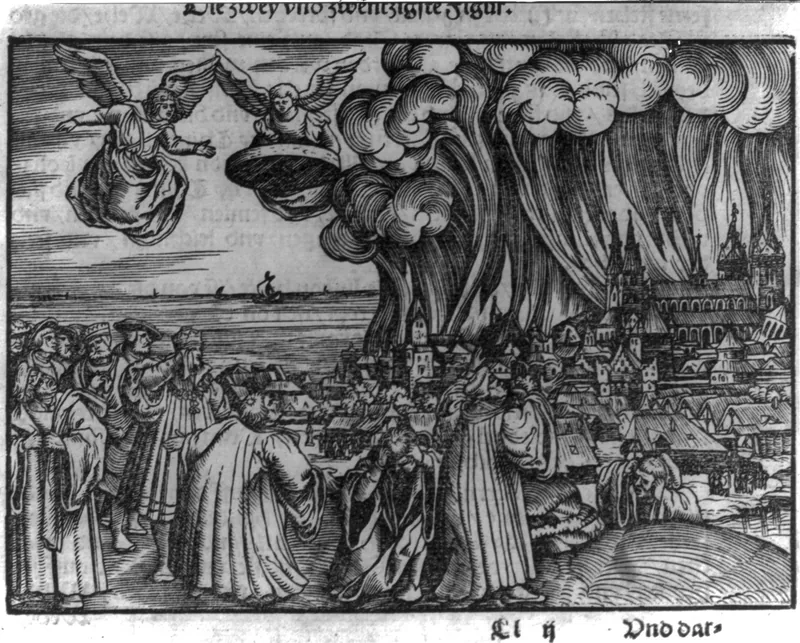
Luther's Bible became a foundation of modern standard German. The popular tale that at the Wartburg he threw an inkpot at the devil is a later legend, but it reflects something real: Luther experienced his struggles as combat with a personal devil, a theme explored in The History of Satan and the Devil.
Luther's Core Theology§
Luther was a biblical professor and pastor rather than a systematic theologian, but certain convictions became the foundation of Lutheranism and much wider Protestantism, as outlined in Protestantism and the Reformation.
- Justification by faith alone. Sinners are declared righteous for Christ's sake, by grace, received through faith, not earned by works; good works follow as the fruit of faith.
- Scripture as the supreme authority. The Bible, centred on Christ, judges church tradition, popes and councils.
- Law and gospel. God's word both condemns (law) and comforts (gospel); the preacher's task is to distinguish them.
- Simul iustus et peccator. The believer is at the same time righteous and a sinner, wholly dependent on grace.
- The priesthood of all believers. Every baptised Christian has direct access to God; clergy hold an office of service, not a higher spiritual estate.
- The sacraments. Luther retained infant baptism and taught the real presence of Christ's body and blood "in, with and under" the bread and wine, rejecting both transubstantiation and the symbolic view of Zwingli, with whom he failed to agree at the Marburg Colloquy of 1529.
Against Erasmus, who defended human free will, Luther wrote The Bondage of the Will (1525), arguing that fallen humans cannot turn to God by their own power. His Small and Large Catechisms (1529), his hymns such as "A Mighty Fortress Is Our God," and the Augsburg Confession drafted by Melanchthon in 1530 gave the new churches their shape.
Marriage, Peasants' War and Later Controversies§
In 1525 Luther married Katharina von Bora, a former nun who had escaped from her convent with Luther's help; their household in the old Wittenberg friary, with six children, students and guests, became a model of the Protestant pastor's family. The same year, the German Peasants' War broke out. Luther first urged both lords and peasants to make peace, then, as the revolt turned violent, published a harsh tract urging princes to crush the rebels.
His later years were marked by illness and increasingly bitter polemics against the papacy, against radical reformers and against the Jews. In 1543, disappointed that Jews had not converted, he published On the Jews and Their Lies, urging the burning of synagogues and the expulsion of Jews. These writings were later exploited by Nazi propagandists, and since the 1980s and 1990s many Lutheran churches, including the Evangelical Lutheran Church in America in 1994, have formally repudiated them. Like most of his contemporaries Luther also accepted that witches should be punished, as discussed in The European Witch Trials. He died on 18 February 1546 in Eisleben, the town of his birth, and is buried in the Castle Church at Wittenberg.
Luther's Legacy and the Luther Rose§
Luther's movement gave rise to Lutheran churches across Germany and Scandinavia and, through emigration and mission, in North America, Africa and Asia; the member churches of the Lutheran World Federation today count more than seventy million people. His influence reaches far beyond them, into Reformed, Anglican and evangelical traditions, German language and music, and modern ideas of conscience.
Relations with Rome have changed profoundly. In 1999 the Lutheran World Federation and the Catholic Church signed the Joint Declaration on the Doctrine of Justification, stating that the mutual condemnations of the sixteenth century no longer apply to the teaching of the partner churches as presented in the declaration.
Luther's personal seal, the Luther Rose, designed in 1530, shows a black cross within a red heart set on a white rose, against a blue field ringed with gold; in a letter he explained each colour as a symbol of faith. Some historians of esotericism have suggested that the seal, together with the cross-and-roses arms of the Lutheran theologian Johann Valentin Andreae, helped shape the rose-cross emblem of the seventeenth-century Rosicrucian manifestos, a possibility discussed in Rosicrucianism.
Frequently asked questions§
What were Martin Luther's Ninety-Five Theses about?§
They were propositions for academic debate, written in Latin in 1517, criticising the sale and preaching of indulgences. Luther argued that true repentance is a lifelong inner change, that the pope had no power over purgatory, and that the Church's real treasure is the gospel of God's grace.
Did Luther want to start a new church?§
Not at first. He aimed to reform the Catholic Church from within, but his excommunication in 1521 and the support of German princes led to separate evangelical churches, later called Lutheran, a name he himself disliked.
What does the Luther Rose mean?§
Luther explained his seal as a summary of his faith: the black cross for Christ's death, the red heart for living faith, the white rose for the joy and peace faith gives, the blue field for heavenly joy, and the gold ring for eternal blessedness.
Sources and further reading§
- Here I Stand: A Life of Martin Luther — Roland H. Bainton, 1950
- Luther: Man Between God and the Devil — Heiko A. Oberman, 1982
- Martin Luther: Renegade and Prophet — Lyndal Roper, 2016
- Brand Luther: 1517, Printing, and the Making of the Reformation — Andrew Pettegree, 2015
- The Freedom of a Christian — Martin Luther, 1520
- The Bondage of the Will — Martin Luther, 1525
- Reformation: Europe's House Divided, 1490–1700 — Diarmaid MacCulloch, 2003