Liber VI · Christianity · Chapter VIII: Monasticism
Hildegard of Bingen: Visionary Abbess, Writer and Composer
Hildegard of Bingen (1098–1179): Benedictine abbess, visionary author of Scivias, composer, healer and Doctor of the Church — her life, works and legacy.

Hildegard of Bingen (1098–1179) was a German Benedictine abbess who recorded a series of extraordinary visions, founded two convents on the Rhine, composed some of the most distinctive music of the Middle Ages, and wrote on theology, cosmology, natural history and medicine. Long venerated as a saint in Germany, she was formally canonised and named a Doctor of the Church by Pope Benedict XVI in 2012.
Who Was Hildegard of Bingen?§
Hildegard was born in 1098 at Bermersheim, near Alzey in the Rhineland, the youngest of ten children of a noble family. As a child she was dedicated to God — later writers called her a tithe offered by her parents — and placed in the care of Jutta of Sponheim, a young noblewoman who lived as an anchoress attached to the Benedictine monastery of Disibodenberg. Hildegard was enclosed with Jutta there, in a ceremony now usually dated to 1112, and made her profession as a nun.
Around Jutta grew a small community of women. When Jutta died in 1136, the nuns elected Hildegard as their leader (magistra). In about 1150, against the resistance of the monks of Disibodenberg, who were reluctant to lose the prestige and endowments of the women's house, she moved her community to a new foundation at Rupertsberg, on the Rhine opposite Bingen. In 1165 she founded a second house across the river at Eibingen, near Rüdesheim, where a Benedictine abbey bearing her name still stands.
Unusually for a woman of her time, Hildegard corresponded with popes, emperors, bishops and abbots — some three hundred and ninety letters survive — and between about 1158 and 1171 she undertook several preaching journeys through the Rhineland and Swabia, speaking to clergy and laity about reform. She died at Rupertsberg on 17 September 1179.
Visions of the Living Light: Scivias§
Hildegard said she had seen visions since early childhood but kept them largely secret. In 1141, at the age of forty-two, she experienced a fiery light that, she wrote, poured into her whole brain and heart, and she heard a command to write down what she saw. She described her visions as received while fully awake, with open eyes, in what she called "the shadow of the living light" (umbra viventis lucis); she distinguished this from a brighter "living light" itself, which she saw only rarely.
With the help of the monk Volmar, her secretary and friend, and the nun Richardis of Stade, she spent ten years writing Scivias (short for Sci vias Domini, "Know the Ways of the Lord"), completed around 1151. Its twenty-six visions, arranged in three books, move from creation and the fall, through redemption and the Church, to the end of time. Each vision is first described and then explained by a heavenly voice. Among the most famous is an image of the universe as a great egg-shaped cosmos of concentric layers of fire, air and water with the earth at its centre.
Hildegard sought approval cautiously. In about 1146 she wrote to Bernard of Clairvaux for reassurance, and at the Synod of Trier in 1147–48 Pope Eugenius III read portions of her work and encouraged her to continue. This papal endorsement gave her an authority rare for any medieval writer, let alone a woman.
A magnificent illuminated copy of Scivias, produced at Rupertsberg probably in Hildegard's lifetime and under her supervision, was taken from Wiesbaden to Dresden for safekeeping during the Second World War and lost in 1945. It survives in a hand-painted facsimile made by the nuns of Eibingen between 1927 and 1933 and in earlier photographs.
Cosmos and Human Being in the Book of Divine Works§
Hildegard's later visionary books extend her vision. The Book of Life's Merits (Liber vitae meritorum, 1158–63) stages a series of debates between personified vices and virtues and describes the purgation of souls. Her final major work, the Book of Divine Works (Liber divinorum operum, about 1163–74), is her most ambitious: it sets the human being at the centre of a cosmos of spheres, winds and elements, held in the embrace of divine Love.
This is one of the clearest medieval expressions of the idea that the human being is a microcosm, a small world reflecting the structure of the great world — a principle that runs through many traditions and is discussed in As Above, So Below. For Hildegard, the winds, planets and seasons act upon the body and soul, and moral life is woven into the fabric of creation. The most famous illustrations of this work appear in a manuscript of the early thirteenth century now in Lucca, which shows the cosmic man with outstretched arms inside a ring of fire and winds.
A key word in Hildegard's writing is viriditas, "greenness" — the life-giving freshness and fertility of God's creation, which she saw in plants, in the human soul and in the Virgin Mary. Modern readers have often seen in this an early ecological spirituality, though scholars caution against reading modern concerns back into a twelfth-century theology of grace.
Music, the Ordo Virtutum and the Unknown Language§
Hildegard is one of the earliest composers in Western history whose name and a large body of work are known. Her songs, gathered under the title Symphonia armonie celestium revelationum ("Symphony of the Harmony of Celestial Revelations"), comprise about seventy-seven antiphons, responsories, sequences and hymns for the liturgy, many in honour of the Virgin Mary, Saint Ursula and her companions, and the Holy Spirit. Her melodies have an unusually wide range and soaring, ornate lines, and her Latin poetry is rich in images of light, greenness and flowering.
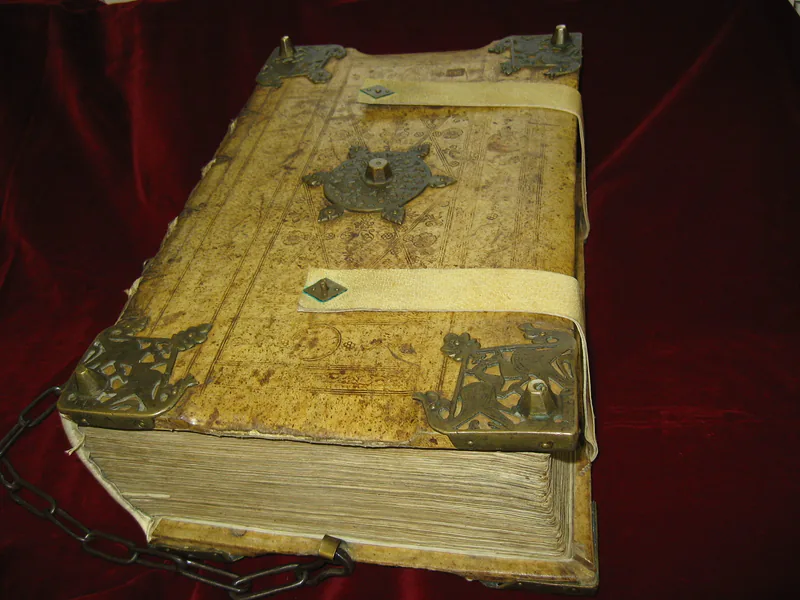
The Ordo Virtutum ("Play of the Virtues"), probably composed around 1151, is a sung drama in which a human soul (Anima) wavers between the Virtues and the Devil before returning repentant. It is often called the earliest surviving morality play. Strikingly, every character sings except the Devil, who can only shout — a dramatic expression of Hildegard's conviction that music belongs to the harmony of heaven. Most of her music survives in the great "Giant Codex" (Riesencodex) now in Wiesbaden, compiled around the end of her life.
Hildegard also devised a Lingua ignota, an "unknown language" of about a thousand invented words, mostly nouns for God, angels, people, plants and objects, with Latin and German glosses, and an alphabet of twenty-three litterae ignotae. Its purpose is unknown; suggestions range from a mystical language for her community to a means of strengthening group identity. It has fascinated later students of constructed and sacred languages.
Physica and Hildegard's Medicine§
Two works on the natural world and healing are attributed to Hildegard, probably composed in the 1150s: the Physica (or Book of Simple Medicine) and Causes and Cures (Causae et curae). The Physica describes the qualities and uses of hundreds of plants, trees, elements, stones, fish, birds, animals and metals, often according to the humoral theory of hot, cold, moist and dry inherited from ancient medicine. Its book on stones includes gems such as the emerald and sapphire, and places her within the medieval lapidary tradition discussed in Crystals, Auras and Energy. Many remedies combine practical herbal knowledge with blessings and words to be spoken, as was common in medieval monastic medicine described in Herbal Magic: A History.
The transmission of these texts is complex. Causes and Cures survives complete in only one thirteenth-century manuscript, and scholars debate how much of both works comes directly from Hildegard and how much from later editing. Since the 1970s, popular "Hildegard medicine," associated especially with the Austrian physician Gottfried Hertzka, has promoted spelt, herbal tonics and gemstone therapies in her name, often going well beyond what the medieval sources say. Historians value the Physica as a window on twelfth-century knowledge of nature; it is not a guide to modern treatment, and its remedies are no substitute for medical advice.
Sainthood, Interpretation and Modern Revival§
Hildegard's final year was clouded by conflict. In 1178 the clergy of Mainz placed her convent under interdict because she had allowed an excommunicated nobleman to be buried in its cemetery, insisting that he had been reconciled before death; she refused to exhume him, and the interdict was lifted only months before she died. Attempts to canonise her began in the thirteenth century but were never completed, although she was venerated locally and listed as a saint in later martyrologies. On 10 May 2012 Pope Benedict XVI extended her cult to the universal Church, and on 7 October 2012 declared her a Doctor of the Church, only the fourth woman to receive that title.
Modern interpreters have read Hildegard in many ways. In 1917 the historian of science Charles Singer suggested that her luminous visions, with their fortifications and falling stars, reflect the visual aura of migraine, a theory later popularised by the neurologist Oliver Sacks; others reply that a medical explanation, even if partly true, says nothing about the meaning she found in them. Feminist scholars, notably Barbara Newman, have explored her theology of the feminine divine and of Wisdom (Sapientia), while musicians since the 1980s have made her chants widely known through recordings. She stands among the major figures surveyed in Christian Mystics and remains one of the most vivid voices of the monastic world described in Christian Monasticism.
Frequently asked questions§
What is Hildegard of Bingen best known for?§
She is best known for her visionary book Scivias, her liturgical music and the Ordo Virtutum, and her writings on nature and healing. She was also a powerful abbess who corresponded with popes and emperors and preached publicly, which was very unusual for a woman of her time.
Was Hildegard of Bingen a saint?§
Yes. She was venerated as a saint in Germany for centuries, although a formal medieval canonisation was never completed. In 2012 Pope Benedict XVI confirmed her as a saint of the universal Church and named her a Doctor of the Church. Her feast day is 17 September.
Did Hildegard of Bingen have migraines?§
Some historians and neurologists, starting with Charles Singer in 1917, have suggested that features of her visions resemble migraine auras. This remains a hypothesis; Hildegard herself described her visions as a divine gift, and many scholars stress that such explanations cannot capture their religious significance.
Sources and further reading§
- Scivias — Hildegard of Bingen, c. 1151
- Physica — Hildegard of Bingen, c. 1155
- Sister of Wisdom: St. Hildegard's Theology of the Feminine — Barbara Newman, 1987
- Hildegard of Bingen, 1098–1179: A Visionary Life — Sabina Flanagan, 1989
- Voice of the Living Light: Hildegard of Bingen and Her World — Barbara Newman, 1998
- Hildegard of Bingen: The Woman of Her Age — Fiona Maddocks, 2001