Liber XI · Hermeticism · Chapter III: Correspondences
As Above, So Below: Meaning and History of the Hermetic Axiom
What does 'as above, so below' mean? The Hermetic axiom of the Emerald Tablet, its ancient roots, alchemical and Renaissance readings and modern uses.
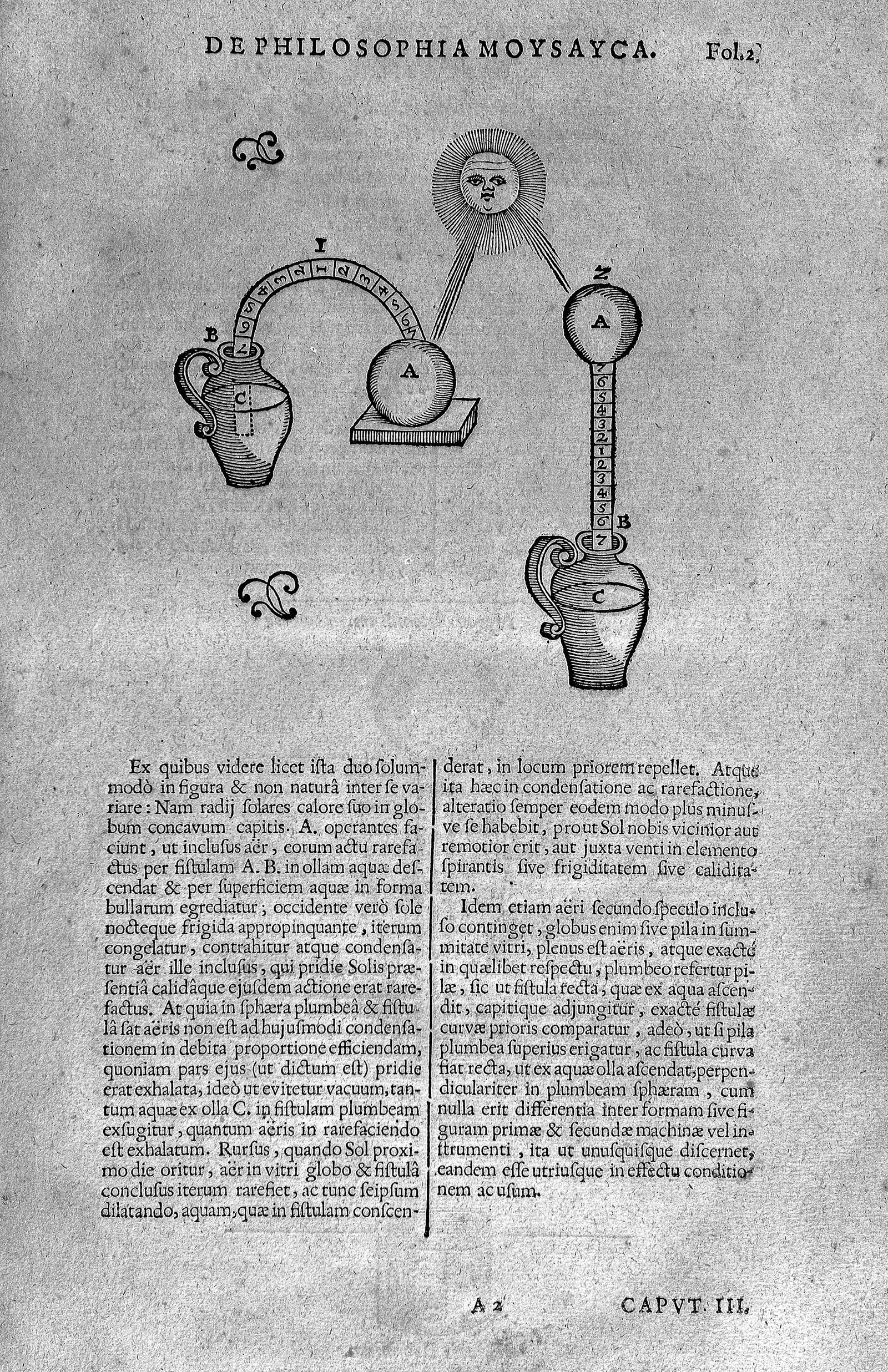
"As above, so below" is the best-known saying of the Hermetic tradition, a modern condensation of a line in the Emerald Tablet that declares what is below to be like what is above. It expresses the idea that the heavens and the earth, the cosmos and the human being, spirit and matter mirror one another, so that knowledge of one level gives knowledge of the others. The axiom has been read as an alchemical instruction, a statement of macrocosm and microcosm, a principle of magic and, in modern times, a general law of analogy.
The Wording in the Emerald Tablet§
The axiom first appears in the Emerald Tablet, a short text attributed to Hermes Trismegistus and preserved in Arabic works of the eighth to tenth centuries, notably the Book of the Secret of Creation attributed to Balinus (Apollonius of Tyana) and the longer versions of the Secretum secretorum. The Arabic versions say, in substance, that what is above is from what is below and what is below is from what is above, a formula that stresses common origin and mutual derivation rather than resemblance.
The medieval Latin vulgate, which became the standard European text, reads quod est inferius est sicut quod est superius, et quod est superius est sicut quod est inferius, ad perpetranda miracula rei unius: "that which is below is like that which is above, and that which is above is like that which is below, to accomplish the miracles of the one thing." The Latin thus turns the relation into one of likeness, and it ties the likeness to a practical purpose, the working of wonders through a single substance. An early English version with the commentary of Hortulanus can be read in the library's Mirror of Alchimy.
The familiar four-word English slogan is a later compression. It reverses the order of the Latin, putting "above" first, and drops the purpose clause, so that a sentence about an alchemical operation became a self-standing statement about the structure of reality.
Ancient Roots: Sympathy, Heavenly Models and the Small Cosmos§
Although the Emerald Tablet is the source of the phrase, the idea behind it is much older and widespread. Greek philosophy offered several versions. Plato's Timaeus describes the cosmos as a living being, ensouled and intelligent, made after an eternal model, and the human body and soul as built on the same principles of proportion. The Stoics taught that the universe is a single organism held together by sympatheia, a mutual affection of all parts, which explained the influence of the moon on the tides and justified divination. The word mikros kosmos, "small world", for the human being is attested from the classical period and became a commonplace.
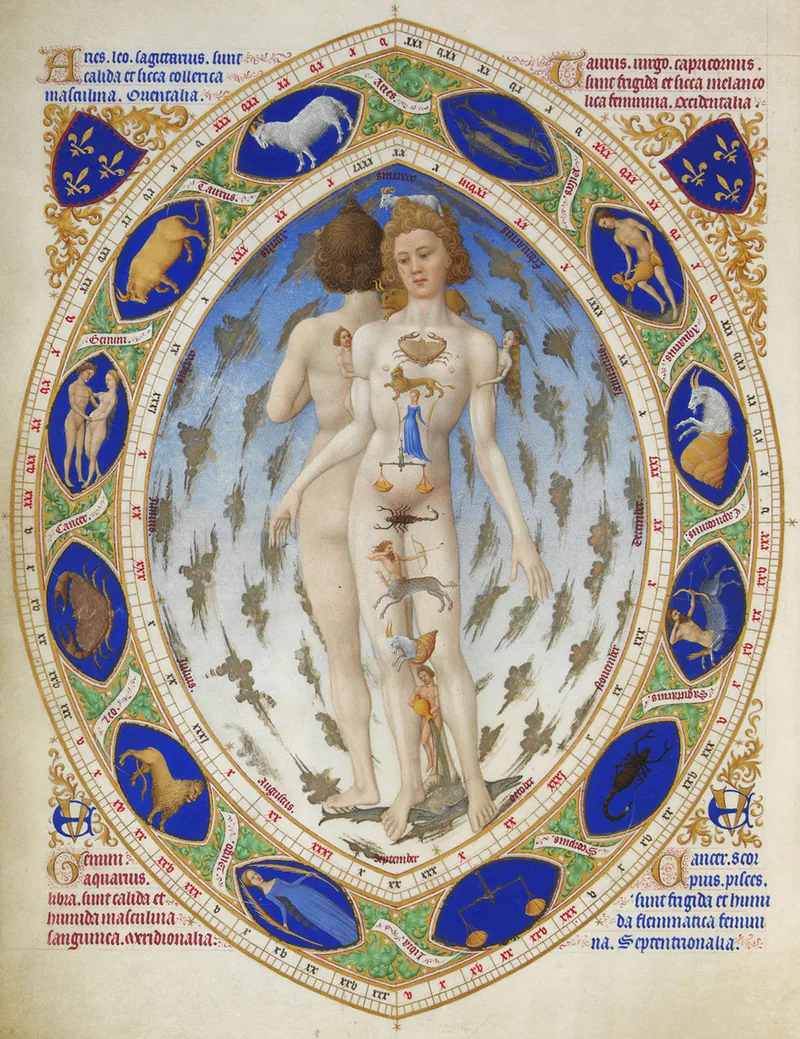
Astrology gave these ideas practical form. Each sign of the zodiac and each planet was assigned to parts of the body, a scheme known as melothesia, and physicians timed treatments by the heavens. The Hermetic treatises themselves describe the human being as a mortal living creature who can encompass the whole cosmos in thought: in Corpus Hermeticum XI, Mind urges the reader to make himself equal to everything in order to understand God (see Corpus Hermeticum).
Biblical and Jewish traditions offered parallels of a different kind. The book of Exodus tells Moses to build the tabernacle according to the pattern shown him on the mountain, and the Letter to the Hebrews describes the earthly sanctuary as a copy and shadow of the heavenly one. The Lord's Prayer asks that God's will be done "in earth, as it is in heaven" (Matthew 6:10, King James Version). These texts are not Hermetic, but they show how natural the language of heavenly model and earthly copy was in the late ancient world.
Alchemical Readings of the One Thing§
Medieval alchemists read the Tablet as a coded description of their work, and the axiom accordingly referred to processes in the vessel. In the fourteenth-century commentary of Hortulanus, the most widely copied Latin gloss, the "one thing" is the philosophers' stone, and the correspondence of above and below describes its parts: the volatile spirit that rises and the fixed body that remains below, which must be separated and reunited. The Tablet's later lines, describing a substance that ascends from earth to heaven and descends again to receive the power of both, were understood as distillation and sublimation repeated until the volatile was fixed and the fixed made volatile.
On this reading, "as above, so below" is less a statement about the universe than a technical maxim: the operations of the laboratory imitate the generation of metals in the earth under celestial influence, and the adept must reproduce, in small, the process by which nature makes gold. Spiritual alchemists of the sixteenth and seventeenth centuries widened the interpretation, treating the purification of matter as a mirror of the purification of the soul. For the broader history see western alchemy.
Macrocosm and Microcosm in Renaissance Philosophy§
In the Renaissance the axiom joined the ancient doctrine of macrocosm and microcosm to become a foundation of occult philosophy. Cornelius Agrippa's Three Books of Occult Philosophy (1533) presented the universe as three worlds, elemental, celestial and intellectual, each governed by the one above it, so that the magician could draw the virtues of higher worlds down through the lower. The human being, containing all levels of creation, was the natural bridge between them.
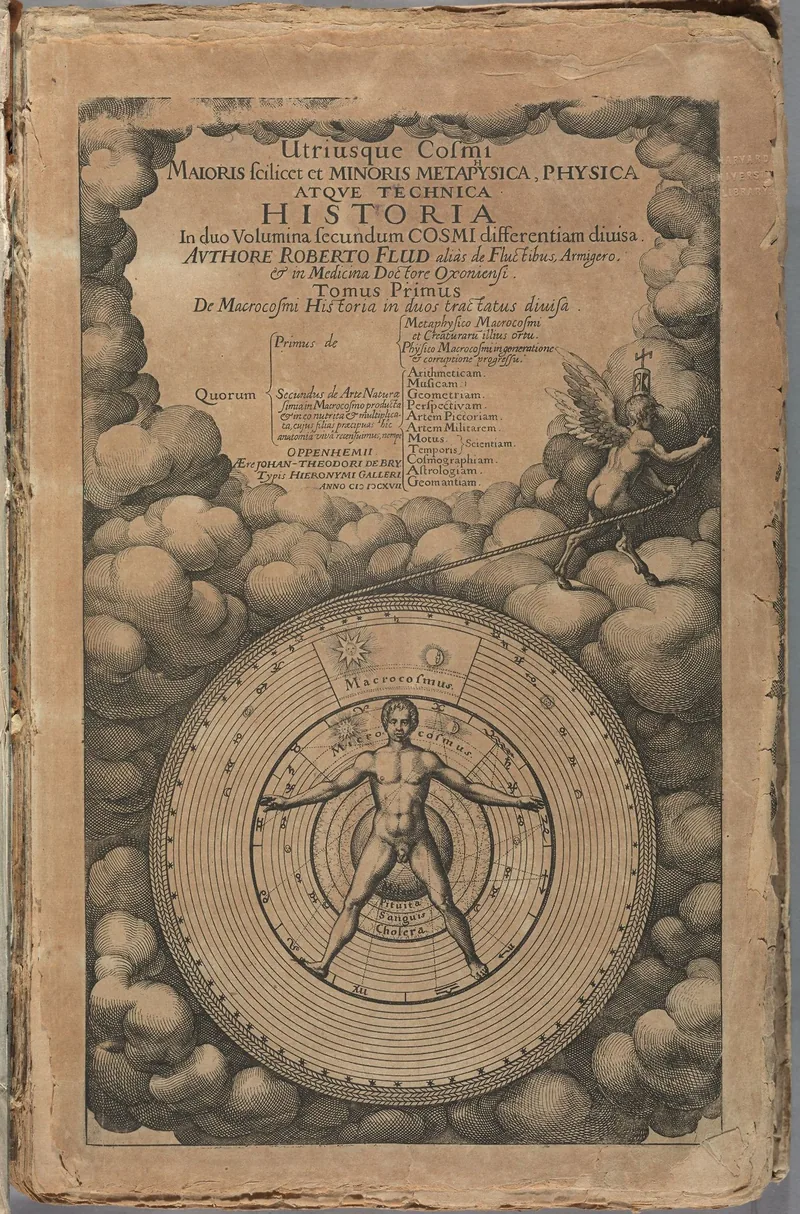
Paracelsus (1493/4–1541) built a medicine on this analogy. The physician, he argued, must understand the heaven and earth within the patient: the human body contains its own firmament, planets and minerals, and diseases correspond to celestial and mineral processes. His followers used the language of an "inner astronomy" and of the "sidereal body". The English physician Robert Fludd went furthest. In his History of the Macrocosm and Microcosm (Utriusque cosmi historia, 1617–1621), illustrated with elaborate engravings, he mapped the human being onto the creation level by level, and his Mosaicall Philosophy, published in English in 1659, defended a cosmos bound together by sympathy and antipathy (Mosaicall Philosophy).
These schemes formed part of what Arthur Lovejoy called the "great chain of being", the hierarchical, continuous universe that dominated European thought until the seventeenth century. The detailed tables of correspondences that fill Renaissance magical books, discussed in our guide to correspondences, are applications of the same principle.
The Modern Occult Revival and the Kybalion§
The decline of the Renaissance cosmos after the scientific revolution did not end the axiom's career. In the nineteenth century Éliphas Lévi made the idea of universal analogy central to his "high magic", and the Hermetic Order of the Golden Dawn built its rituals and correspondences on the premise that the symbols of the temple corresponded to forces in the universe and in the initiate.
The anonymous Kybalion (1908), published by "Three Initiates" and probably written by the New Thought author William Walker Atkinson, turned the saying into the second of seven "Hermetic principles", the Principle of Correspondence. In its formulation, the same laws operate on the physical, mental and spiritual planes, so that one can reason from the known to the unknown. The Kybalion made "as above, so below" a household phrase in modern esotericism, but its principles owe more to American New Thought than to the ancient Hermetic texts.
In the twentieth century C. G. Jung explored the analogy between alchemical images and inner psychological processes, and his idea of synchronicity, meaningful coincidence without a causal link, revived the old language of correspondence in psychological form. Contemporary astrology, ceremonial magic and New Age spirituality continue to use the axiom to justify reading cosmic patterns as reflections of personal life.
Interpreting the Axiom: Analogy and Its Critics§
Historians of esotericism treat "as above, so below" as an expression of a distinctive way of thinking. Antoine Faivre placed "correspondences" first among the characteristics of Western esotericism: the conviction that visible and invisible parts of the universe are linked by symbolic and real correspondences, which can be read like a text. Michel Foucault, in The Order of Things (1966), described resemblance as the organising principle of knowledge in the sixteenth century, before it was displaced by classification and measurement.
Critics, from the natural philosophers of the seventeenth century onward, have argued that analogy is not evidence: that two things resemble each other does not show that one influences the other. Defenders reply that the axiom describes a symbolic or contemplative way of seeing rather than a causal hypothesis. Whatever one's view, the saying condenses into four words one of the oldest ideas in the history of religion and philosophy, that the order of the human being and the order of the cosmos belong together.
Frequently asked questions§
What does "as above, so below" mean?§
It means that the higher and lower levels of reality correspond to and reflect each other: the heavens and the earth, the cosmos and the human being, the spiritual and the material. By studying one level, Hermetic thinkers believed, one could understand and influence the others.
Where does "as above, so below" come from?§
It is a shortened form of a line in the Emerald Tablet, a Hermetic text attributed to Hermes Trismegistus and first known in Arabic. The Latin version reads "that which is below is like that which is above", which later writers condensed into the familiar phrase.
Is "as above, so below" in the Bible?§
No. The phrase comes from the Hermetic Emerald Tablet. The Bible contains related ideas, such as the earthly tabernacle built after a heavenly pattern and the prayer that God's will be done on earth as in heaven, but not this saying.
What is the Principle of Correspondence in the Kybalion?§
It is the second of the seven principles set out in The Kybalion (1908), which restates "as above, so below" as a law that the same patterns apply on physical, mental and spiritual planes. It is a modern formulation influenced by New Thought rather than an ancient Hermetic doctrine.
Sources and further reading§
- Tabula Smaragdina: Ein Beitrag zur Geschichte der hermetischen Literatur — Julius Ruska, 1926
- Access to Western Esotericism — Antoine Faivre, 1994
- The Great Chain of Being — Arthur O. Lovejoy, 1936
- The Order of Things — Michel Foucault, 1966
- Robert Fludd: Hermetic Philosopher and Surveyor of Two Worlds — Joscelyn Godwin, 1979
- Psychology and Alchemy — C. G. Jung, 1944
- The Kybalion — Three Initiates, 1908