Liber XII · Hermeticism · Chapter III: Correspondences
The Doctrine of Signatures: Plants, Paracelsus and Boehme
The doctrine of signatures explained: the belief that plants bear visible signs of their uses, from Paracelsus, Porta and Croll to Jacob Boehme and Coles.

The doctrine of signatures is the belief that God or nature has marked natural things, above all plants, with visible signs that reveal their hidden virtues and uses. A walnut kernel shaped like a brain was thought to help the head, a spotted leaf resembling a diseased lung to treat the chest, and a yellow sap to cure jaundice. Formulated as a doctrine in sixteenth- and seventeenth-century Europe by Paracelsus, Giambattista della Porta, Oswald Croll and Jacob Boehme, it is one of the clearest expressions of the Hermetic belief that the visible world is a readable book of correspondences.
What the Doctrine of Signatures Teaches§
The doctrine rests on a simple premise: the outward form of a thing is not accidental but expresses its inner nature. Because the cosmos was made by a wise creator for human benefit, its creatures carry legible marks that point to their purpose. The task of the physician and the natural philosopher is to learn to read these marks, much as one reads the letters of a book.
Signatures could be found in many features. Shape was the most common: the lobed leaves of liverwort (Hepatica) were linked to the liver, the toothed scales of toothwort to the teeth, and the helmet-shaped flowers of skullcap to the head. Colour was another: red plants for the blood, yellow ones such as greater celandine for jaundice. Texture and markings counted too, as with the spotted leaves of lungwort (Pulmonaria) or the translucent dots on the leaves of St John's wort, which looked like pierced skin and suggested a wound herb. Even habitat could be a sign: saxifrage, whose name means "stone-breaker", grows in cracks in rock and was recommended against stones in the kidney and bladder.
The doctrine is a special case of the broader theory of correspondences: the conviction, expressed in the formula as above, so below, that all levels of creation mirror one another and are bound by sympathy. A plant that resembles the eye shares something with the eye, and that shared quality can be used to heal it.
Ancient and Medieval Roots§
Reasoning from resemblance is very old. Greek and Roman writers on plants and medicine, including Theophrastus, Dioscorides and Pliny the Elder, recorded names and uses that reflect it. The orchid takes its name from the Greek orchis, "testicle", because of its paired tubers, and Dioscorides associated the plant with generation. The mandrake's forked, human-like root inspired a long tradition of lore about its powers (see Mandrake). Similar ideas appear in many medical traditions outside Europe, as in the high value placed in Chinese medicine on ginseng roots shaped like a human figure.
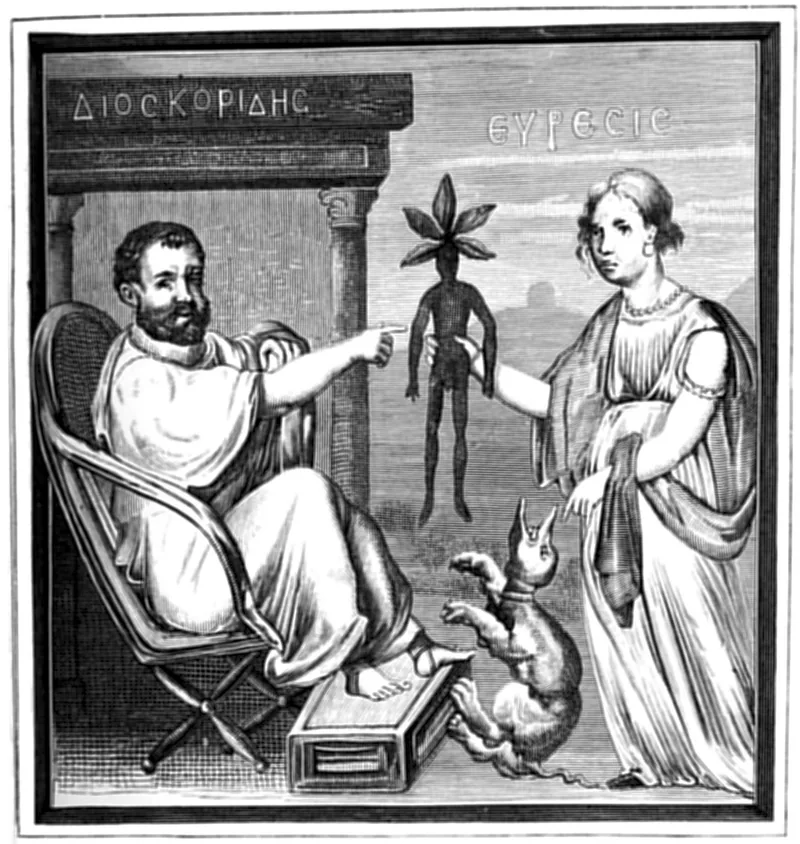
Medieval Europe inherited these associations through herbals and through the art of physiognomy, which read a person's character from the face and body. The Hermetic and astrological literature added a further layer: each planet ruled certain plants, stones and parts of the body, so that a plant's colour, taste and form might reveal its planetary ruler and hence its use (see Planetary and Astrological Herbs). But before the sixteenth century these were scattered associations rather than a unified doctrine with a name.
Paracelsus and the Signs of Nature§
The Swiss physician Paracelsus (1493–1541) gave the idea its programmatic form. He taught that nature, or God working through it, is a "signer" that marks each thing according to its inner virtue, and that nothing is without its sign. The physician must therefore learn the "art of signs" in addition to book learning, reading the outward appearance of herbs, minerals, animals and people as a guide to their hidden properties.
The fullest statement occurs in De natura rerum, a work attributed to Paracelsus and dated 1537, published after his death, whose ninth book is devoted to the signatures of natural things. It treats not only plants but also physiognomy and chiromancy (the reading of hands), the marks on animals and the signs by which experienced people judge the qualities of things. Among its examples are prickly plants, linked to sharp, stabbing internal pains.
For Paracelsus the doctrine was both empirical and theological. It encouraged physicians to observe nature directly instead of relying on Galen and Avicenna, and it expressed his belief that God had placed a remedy for every illness in the world, marked so that humans could find it. His followers spread the idea across German-speaking Europe and beyond.
Porta's Phytognomonica and Croll's Inner Signatures§
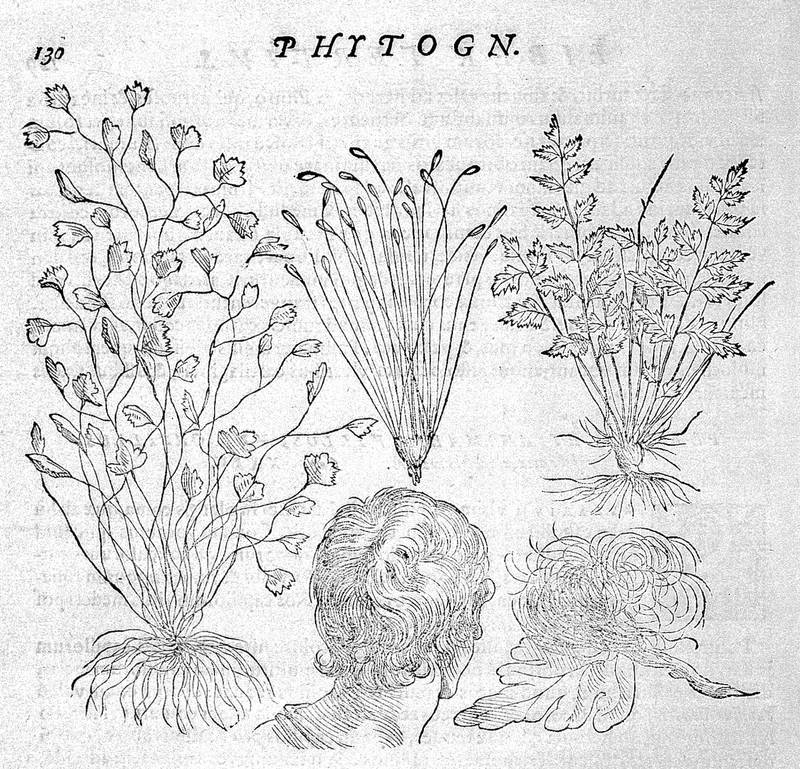
Two works of the late sixteenth and early seventeenth centuries turned the doctrine into an encyclopaedic system. The Neapolitan polymath Giambattista della Porta, already famous for his Natural Magic (see Della Porta's Magia Naturalis), published Phytognomonica in 1588. Its title deliberately echoes physiognomy: just as a face reveals character, the "face" of a plant reveals its virtues. Porta classified plants by their resemblance to human organs, to animals and to the heavens, and the book's woodcuts placed plants beside the eyes, hands, teeth or hearts they were thought to resemble.
The German Paracelsian physician Oswald Croll (c. 1563–1609) added a Treatise on the Internal Signatures of Things to his Basilica chymica (1609), a widely read manual of chemical medicine. Croll gave many of the examples that later became standard, including the walnut, whose shell resembles the skull and whose wrinkled kernel the brain. He also insisted that true signatures were "internal" as well as external: the visible mark points to an invisible virtue implanted by God, which only the illuminated physician can fully understand.
Jacob Boehme: The Signature of All Things§
The doctrine took a mystical turn in the work of the German shoemaker and visionary Jacob Boehme (1575–1624). In De signatura rerum (1622), translated into English in 1651 as The Signature of All Things, Boehme used the term not primarily for medicine but for the expression of the inner essence of every being in its outer form, sound and behaviour.
For Boehme, everything that exists has a hidden "will" or spirit, and this spirit forms an outward body that manifests it, as a bell's sound reveals its metal. The whole visible world is God's self-expression, and its signatures are a kind of language. Adam, before the Fall, spoke the "language of nature" in which the names of things matched their essences. To read signatures was therefore to recover something of that lost knowledge. Boehme's account still includes healing, since a physician who knows the signatures can find in nature the remedy that answers a disease, but its horizon is theological and alchemical: the rebirth of the soul and the restoration of the divine image.
Through Boehme the doctrine passed into later Christian theosophy and Romantic nature philosophy, where the idea of nature as a hieroglyphic text remained influential long after physicians had abandoned it.
Signatures in English Herbals§
In England the doctrine reached a broad public in the seventeenth century. The herbalist William Coles (1626–1662) defended it warmly in The Art of Simpling (1656) and Adam in Eden (1657), arguing that God had stamped plants with marks so that even the unlearned could discover their uses. His books list many plants by the parts of the body they were thought to serve, and they helped make examples such as the walnut and eyebright part of popular lore.
Other herbalists were more cautious. Nicholas Culpeper, whose English Physitian of 1652 became the most popular English herbal (see Culpeper's Complete Herbal), relied mainly on astrological rulership and the Galenic qualities, though signatures appear in some of his entries. By the end of the century, critics in the new scientific societies dismissed the doctrine as fanciful, and the eighteenth-century botany of Linnaeus classified plants by their reproductive organs rather than their resemblances.
Science, Mnemonic and Theology: Assessing the Doctrine§
Modern medicine and pharmacology find no reliable link between a plant's appearance and its effects. Some plants named by signature do contain active compounds, but others are useless for the conditions concerned and some are harmful. Birthwort (Aristolochia), whose flower was thought to resemble the womb and which was long used in childbirth, contains aristolochic acids that cause severe kidney damage and cancer. Historical uses should never be treated as medical advice, and herbal traditions are no substitute for qualified medical care.
Historians have proposed several ways of understanding the doctrine. The ethnobotanist Bradley Bennett has argued that signatures were rarely a means of discovering remedies; more often they served as a memory aid for uses already known from experience, attached to a plant after the fact. Intellectual historians emphasise its theological dimension: in a world understood as God's book, signatures were the letters in which the creator wrote. Michel Foucault, in The Order of Things (1966), made resemblance and signature the key to what he called the sixteenth-century order of knowledge, in which to know a thing was to decipher the marks that linked it to everything else.
Seen in this light, the doctrine of signatures belongs among the great Hermetic ideas of the Renaissance, alongside astral magic and the macrocosm–microcosm analogy. It expresses a vision of nature as meaningful, interconnected and addressed to human understanding, a vision that the new science of the seventeenth century replaced, but that continues to fascinate students of herbal magic and esoteric philosophy.
Frequently asked questions§
What is an example of the doctrine of signatures?§
The best-known example is the walnut, whose kernel resembles the brain and was therefore recommended for ailments of the head. Others include lungwort for the lungs, eyebright for the eyes and yellow-sapped celandine for jaundice.
Who created the doctrine of signatures?§
Reasoning from resemblance is ancient, but the doctrine as a named system was developed in the sixteenth century, above all by Paracelsus and his followers. Della Porta, Oswald Croll, Jacob Boehme and William Coles elaborated it in the following decades.
Is the doctrine of signatures scientifically valid?§
No. A plant's shape or colour does not reliably indicate its medicinal effects, and some plants used by signature are toxic. Historians usually see the doctrine as a memory aid and a theological view of nature rather than a method of discovery.
Sources and further reading§
- De signatura rerum (The Signature of All Things) — Jacob Boehme, 1622
- Phytognomonica — Giambattista della Porta, 1588
- Basilica Chymica — Oswald Croll, 1609
- Adam in Eden, or Natures Paradise — William Coles, 1657
- Paracelsus: An Introduction to Philosophical Medicine in the Era of the Renaissance — Walter Pagel, 1958
- The Order of Things — Michel Foucault, 1966
- The English Physitian — Nicholas Culpeper, 1652