Liber XI · Herbal Magick · Chapter IV: Herbal Magic History
Dioscorides' De Materia Medica: The Herbal That Ruled 1,500 Years
Dioscorides' De materia medica, the first-century Greek herbal: its author, structure, the Vienna Dioscorides, Arabic and Renaissance versions and magic.

De materia medica ("On Medical Material") is a Greek pharmacological work written in the first century CE by Pedanius Dioscorides, a physician from Anazarbus in Cilicia. In five books it describes several hundred plants, together with animal and mineral substances, their appearance, habitat and medical uses. Copied, illustrated, translated into Arabic and Latin and printed in dozens of Renaissance editions, it was the most authoritative book on medicinal plants in Europe and the Islamic world for some fifteen hundred years, and it is a basic source for the history of herbal medicine and plant magic alike.
Pedanius Dioscorides of Anazarbus§
Little is known of Dioscorides beyond what he says in the preface to his work, which is dedicated to Areius, a physician of Tarsus. He came from Anazarbus, a city of Cilicia in what is now southern Turkey, and describes himself as having led a "soldier's life," a phrase that has often been taken to mean he served as a physician with the Roman army, perhaps under Claudius or Nero. That interpretation is plausible but not certain. What the preface does make clear is his method: he claims to have gathered knowledge of plants through his own observation in many lands, and through enquiry among local people, rather than relying on books alone.
He was a near contemporary of Pliny the Elder, whose Natural History (completed in 77 CE) covers much of the same ground. The two do not cite each other, but they share some sources, and their descriptions sometimes run in parallel. Pliny's books on plants are rich in anecdote and magical lore; Dioscorides is more austere, interested above all in identification, preparation and effect.
How De Materia Medica Is Organised§
The work is arranged in five books. In broad terms, the first deals with aromatics, oils, ointments and trees; the second with animals and animal products, cereals, vegetables and pungent herbs; the third and fourth with roots, juices, herbs and seeds, including many of the more dangerous plants; and the fifth with the vine, wines and minerals. Around six hundred plants are described, and the total of distinct drugs is closer to a thousand.
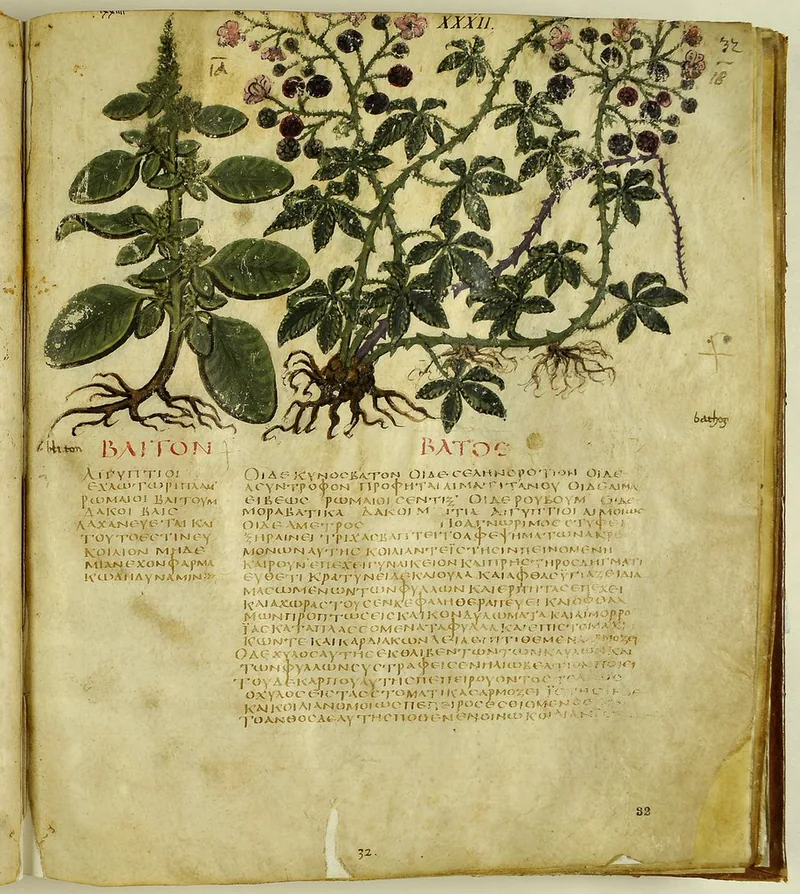
For each substance, Dioscorides typically gives its names, a description of the plant, where it grows, how it is gathered and stored, and its uses against particular conditions. He discusses the opium poppy, mandrake, henbane and hemlock among many others, recording their power to bring sleep or relieve pain while warning of their dangers; his account of mandrake as an anaesthetic before surgery is one of the earliest of its kind, and it is discussed in the mandrake guide. He also gives a recipe for the Egyptian temple incense kyphi, noting its use both for the gods and as a medicine.
The historian of pharmacy John Riddle argued that the order of the work, which puzzled later readers, follows what Dioscorides called a "drug affinity" system: remedies are grouped by their physiological effects, so that substances with similar actions stand together. Later Byzantine copyists, finding this hard to use, rearranged the text alphabetically, and many manuscripts survive in that form.
Root-Cutters, Rival Authors and the Claim of Experience§
Dioscorides wrote within a long Greek tradition of plant knowledge, which the history of herbal magic traces from the rhizotomoi, the professional root-cutters, onward. Theophrastus, Aristotle's successor, had devoted the ninth book of his Enquiry into Plants (c. 300 BCE) to the juices and roots of medicinal plants, reporting with some scepticism the rituals that root-cutters observed: digging at certain hours, facing the wind, drawing circles around a plant, or saying prayers as it was cut.
In his preface Dioscorides names several predecessors, among them Crateuas, physician to Mithridates VI of Pontus, who had written an illustrated herbal, and he criticises others for careless descriptions and for repeating untested claims. This insistence on experience made his work persuasive to readers for centuries. It did not mean that he rejected traditional lore altogether: a number of entries record that a plant is worn as an amulet or hung up for protection, usually reported as what "some say" rather than as his own judgement.
The Vienna Dioscorides and the Illustrated Tradition§
The most famous copy of the work is the Vienna Dioscorides (Austrian National Library, Cod. med. gr. 1), made in Constantinople around 512 for Anicia Juliana, a princess of the imperial family and a great patron of churches. The manuscript contains several hundred full-page plant paintings, some of which appear to derive from much older models, perhaps going back to the illustrated herbal of Crateuas. Its prefatory pages include portraits of famous physicians and a dedication image of Juliana herself.

One of these pages shows Dioscorides receiving a mandrake root from a female figure personifying Discovery (Heuresis), while a dog, tied to the plant, lies dying: an early visual record of the legend that a dog had to be used to pull the mandrake from the earth. The manuscript was later used in Constantinople under Ottoman rule, where Arabic and Turkish plant names were added in its margins, and it was bought for the imperial library in Vienna in the sixteenth century. Other important illustrated copies include the Naples Dioscorides of the seventh century and the tenth-century Byzantine manuscript in the Morgan Library in New York. The illustrated tradition shaped how plants were drawn in herbals for a thousand years.
Arabic, Latin and Renaissance Dioscorides§
In ninth-century Baghdad, De materia medica was translated into Arabic by Stephanos son of Basil and revised by the great translator Hunayn ibn Ishaq. In al-Andalus, a fresh effort followed after a Byzantine embassy brought an illustrated Greek copy to the caliph of Córdoba in the mid-tenth century, and scholars worked to match Dioscorides' Greek names with the plants of Spain. Arabic physicians and pharmacologists, from al-Biruni to Ibn al-Baytar, built on the work, which thus became part of the wider body of Islamic natural science discussed in the article on Islamic occult sciences.
In the Latin West, an early translation circulated from late antiquity, and an alphabetical Latin Dioscorides was widely used in the Middle Ages. A Latin version was printed in 1478 and the Greek text by Aldus Manutius in Venice in 1499. The Renaissance made Dioscorides a field of intense scholarship. Pietro Andrea Mattioli's Italian commentary of 1544, followed by Latin editions with large woodcuts, became one of the bestselling scientific books of the century. The Spanish physician Andrés Laguna published a Castilian translation with commentary in 1555; in a note on nightshades he told the story of a witches' ointment tested on a patient, a passage that became central to the history of flying ointments.
As botanists discovered plants unknown to the ancients, especially from the Americas, and as Dioscorides' plants proved hard to identify in northern Europe, his authority slowly gave way. English readers, who had the herbals of Gerard and later Culpeper, waited until 1934 for a printed translation, when Robert Gunther published the version made by John Goodyer in the 1650s.
Magic, Amulets and the Secret Names of Plants§
For historians of magic, De materia medica matters in two ways. First, it records many beliefs about plant amulets and protective uses that sat comfortably beside medicine in the ancient world. Second, many manuscripts contain lists of synonyms for each plant, giving its name among Romans, Egyptians, Dacians and others, and sometimes the names said to be used by the "prophets," that is, Egyptian priests, or attributed to legendary magi such as Ostanes, Zoroaster and Pythagoras. These synonym lists were probably added from a separate lexicon after Dioscorides' time.
The secret plant names have parallels in the Greek Magical Papyri, where one papyrus explains that temple scribes disguised ordinary herbs under names such as "blood" or "seed" of a god, to keep their knowledge from the uninitiated. Together these sources show how closely pharmacy, priestly learning and magic were intertwined in Roman Egypt. Later readers, including Renaissance magi and modern herbal practitioners, have drawn on Dioscorides for correspondences and lore, though his own book is far more a manual of medicine than of magic, and its remedies are historical documents, not medical advice.
Frequently asked questions§
Who was Dioscorides?§
Pedanius Dioscorides was a Greek physician of the first century CE from Anazarbus in Cilicia. He wrote De materia medica, a five-book survey of medicinal substances based, he says, on his own travels and observation. He may have served as a physician with the Roman army, though this is uncertain.
What is the Vienna Dioscorides?§
It is a lavishly illustrated manuscript of De materia medica made in Constantinople around 512 for the princess Anicia Juliana. It contains hundreds of plant paintings and is now in the Austrian National Library. It is one of the most important surviving manuscripts of ancient science.
How many plants are in De materia medica?§
Dioscorides describes roughly six hundred plants, along with animal and mineral substances, for a total of around a thousand drugs. Some of his plants cannot be identified with certainty today, a problem that occupied Renaissance commentators for generations.
Did Dioscorides write about magic?§
Only in passing. He reports some amuletic and protective uses of plants, usually as what others claim. The lists of secret names attributed to Egyptian prophets and magi in the manuscripts were most likely added after his time.
Sources and further reading§
- De materia medica — Pedanius Dioscorides, c. 70
- Enquiry into Plants — Theophrastus, c. 300 BCE
- Natural History — Pliny the Elder, 77
- The Greek Herbal of Dioscorides — Robert T. Gunther, 1934
- Dioscorides on Pharmacy and Medicine — John M. Riddle, 1985
- Medieval Herbals: The Illustrative Traditions — Minta Collins, 2000
- De materia medica — Lily Y. Beck, 2005