Liber XI · Herbal Magick · Chapter III: Flying Ointments (History)
Witches' Flight in Art: Brooms, Ointment Pots and the Sabbath
How artists pictured witches' flight and the flying ointment, from Le Franc's broom-riders and Molitor's woodcuts to Dürer, Baldung, de Gheyn and Goya.

The image of the witch flying on a broom or a stick, often after anointing herself from a steaming pot, was largely created by artists and printers between the mid-fifteenth and the seventeenth centuries. A marginal drawing of 1451 shows the first broom-riding women; German woodcuts of the 1480s and the prints of Albrecht Dürer and Hans Baldung Grien added goats, forks and ointment vessels; Netherlandish painters turned the preparations for the sabbath into kitchen scenes; and Francisco Goya made witches' flight a vehicle for satire and nightmare. These pictures did as much as any treatise to fix the flying ointment in the European imagination.
The First Flying Witches: Le Franc and Molitor§
The learned stereotype of witches who fly by night to a Devil-worshipping assembly took shape in the western Alps in the 1420s and 1430s, as described in the guide to flying ointments and the history of witchcraft. Images followed quickly. Martin Le Franc, provost of Lausanne and secretary to the anti-pope Felix V, completed his long French poem Le Champion des Dames around 1442 and dedicated it to Philip the Good, Duke of Burgundy. In a passage on the new sect of witches, the poem's adversary of women describes them flying to their gatherings. A manuscript copied in 1451, now in the Bibliothèque nationale de France, illustrates this with a small marginal miniature of two women in the air, one astride a broom and the other on a white stick, labelled Vaudoises, "Waldensians," a name then used in the region for heretics and witches alike. It is the earliest known picture of women riding brooms.
Printed images reached a much wider public. In 1489 the lawyer Ulrich Molitor published at Konstanz a Latin dialogue, De laniis et phitonicis mulieribus ("On Witches and Female Soothsayers"), dedicated to Archduke Sigismund of Austria. Molitor was cautious about some claims, arguing that many experiences of flight were illusions produced by the Devil, but the woodcuts in its many editions told their own story. One shows three witches with the heads of animals riding together through the air on a forked stick; others show a witch raising a storm and a witch embracing a devil disguised as a man. Molitor's pictures circulated across Germany and were copied for decades, making flight a standard element of the witch's image a few years after the Malleus Maleficarum (1486) appeared without any illustrations at all.
Dürer, Baldung and the Ointment Pot§
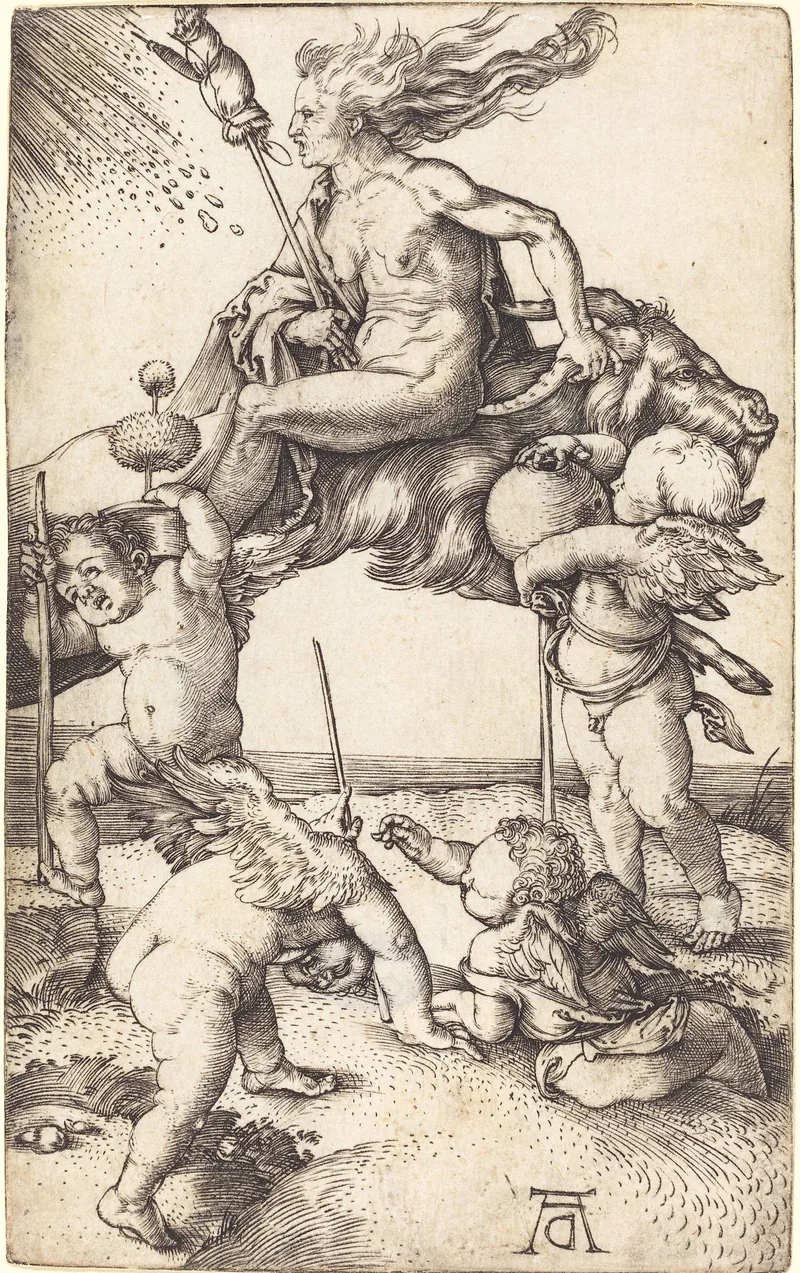
Around 1500 Albrecht Dürer engraved a small print now known as Witch Riding Backwards on a Goat. A naked old woman, her hair streaming against the direction of travel, sits facing backwards on a flying goat and holds a distaff, while four putti play below. Every detail signals inversion: the backwards ride, the distaff (a woman's tool used as a sceptre), the goat associated with lust and the Devil. Historians such as Charles Zika and Stuart Clark have shown how such images expressed the early modern idea of witchcraft as a world turned upside down.
Dürer's former pupil Hans Baldung Grien made witches one of his signature themes. His chiaroscuro woodcut of 1510, usually called the Witches' Sabbath, shows a group of naked women of various ages gathered in a forest around an earthenware vessel from which a thick plume of vapour rises, carrying a jumble of objects into the sky. One woman lifts a lid; another holds aloft a dish; above them a witch rides backwards on a goat, carrying a pot on a forked stick. The steaming vessel became the visual shorthand for the flying ointment and the brew of storms. Baldung returned to the theme in drawings such as the New Year's Greeting with Three Witches of 1514 and, near the end of his life, in the enigmatic woodcut The Bewitched Groom. His witches mix erotic fascination, misogynist satire and genuine unease, a combination that art historians such as Linda Hults have explored.
Kitchens of the Sabbath: Netherlandish Witch Scenes§
In the Low Countries, artists developed a different setting: the witches' kitchen. Pieter Bruegel the Elder's engravings of the legend of Saint James and the Magician Hermogenes (1565) fill the magician's den with monsters and with witches flying out of the chimney on brooms, an image that would become a permanent part of the legend. Around 1600 the Dutch artist Jacques de Gheyn II made a series of highly detailed drawings of witches at work in vaults and ruins, handling corpses, books and pots, among them a celebrated Preparation for the Witches' Sabbath, and an engraving after his design spread the scene widely.
Painters in Antwerp made witches' kitchens a minor genre. Frans Francken the Younger painted several crowded interiors in the first decade of the seventeenth century, in which women of all ages read from grimoires, stir cauldrons, anoint themselves and depart up the chimney, while the Devil and monstrous creatures look on. David Teniers the Younger continued the theme in the mid-century with smaller, more domestic scenes. These pictures show the flying ointment as part of a whole world of household magic, with bottles, jars and herbs that recall the plants described in the article on the witch's garden. They coincided with the height of the European witch trials. Printed illustrations also reached demonological books, most famously Jan Ziarnko's crowded engraving of the sabbath in the 1613 edition of Pierre de Lancre's account of witchcraft in the Basque country, with witches arriving through the air on goats, brooms and demons.
Goya's Witches: Flight, Satire and Nightmare§
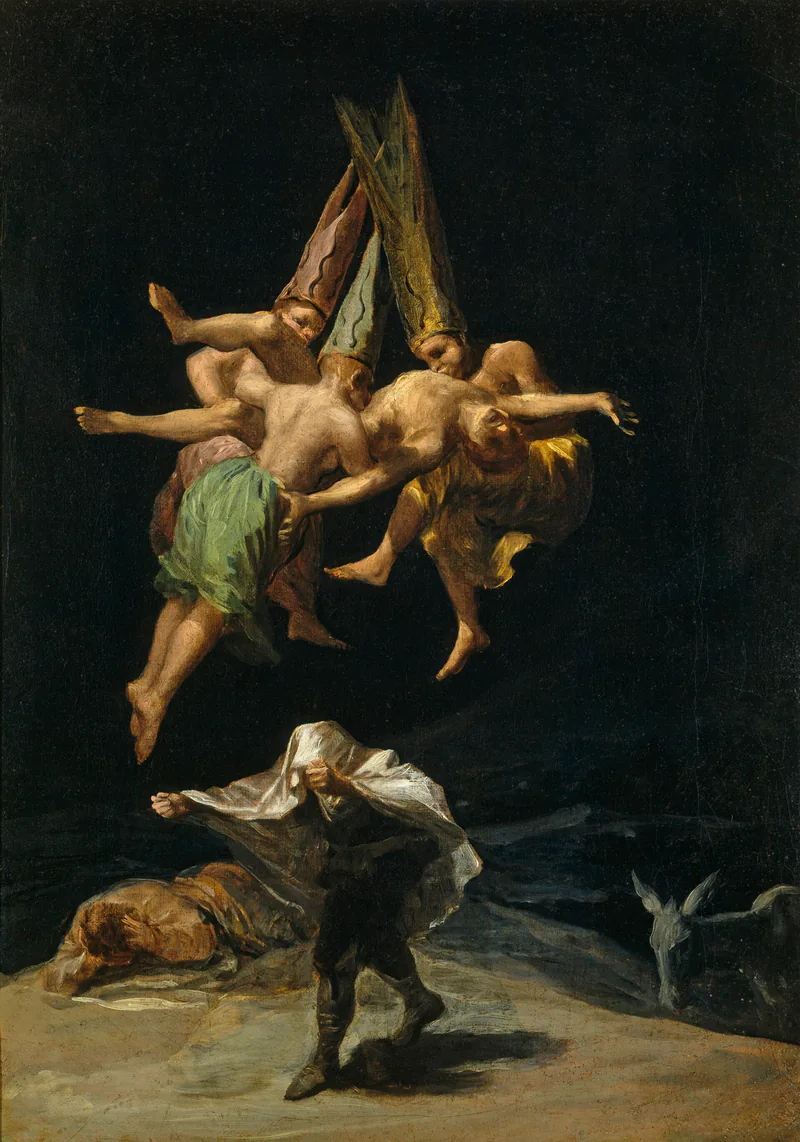
By the late eighteenth century, educated Europeans had largely stopped believing in the sabbath, and the old imagery could be used in new ways. In Spain, Francisco Goya painted a series of small witchcraft pictures in 1797–1798 for the country house of the Duke and Duchess of Osuna. The most striking, Witches' Flight (now in the Prado), shows three half-naked figures in tall pointed caps, like those worn by people condemned by the Inquisition, rising into a dark sky while carrying a struggling man; below, a peasant covers his head and another man hides beneath a white sheet, refusing to see. Another painting of the series, The Witches' Sabbath, shows women offering children to a great he-goat under a crescent moon.
In his etched series Los Caprichos (1799), Goya returned to the theme repeatedly. In the plate titled Linda maestra! ("Pretty teacher!"), an old witch and a young pupil ride a broom together across the night sky, accompanied by an owl. The captions and Goya's circle explained such scenes as attacks on ignorance, superstition and the abuses of the clergy. Two decades later, in the "Black Paintings" on the walls of his own house, the great Witches' Sabbath became a vision of collective madness. Goya's witches no longer illustrate a belief; they illustrate what belief and fear do to human beings.
Why the Broom? Interpreting the Imagery§
Why did witches fly on brooms, sticks and forks? The fifteenth-century texts speak of anointed staffs, chairs and animals, and early images show sticks as often as brooms. The broom, however, was a domestic tool associated with women's work, and the image of a woman riding it carried an obvious sense of disorder, a household object turned to rebellion. Some modern writers have suggested that the broom recalls the application of ointments with a staff, or that it carries sexual symbolism; such readings are speculative and cannot be confirmed from the sources.
The ointment pot played a similar role. In pictures it signalled that flight depended on a substance, and so linked the witch to cooking, medicine and herbal knowledge, all domains in which women were active. For sceptics such as the physicians who wrote on soporific plants like henbane, the pot pointed to a natural explanation in drugged dreams; for demonologists, it was the Devil's sacrament. Images could serve both readings, which helps explain their persistence.
From Woodcut to Halloween: The Modern Image§
The Romantic movement revived the witch as a figure of the uncanny and the rebellious, and nineteenth-century illustrators, especially in books of fairy tales and in popular prints, combined the older motifs into a familiar figure: an old woman in a pointed hat and cloak, riding a broom across the moon with a black cat. Around 1900 this figure became a staple of Halloween postcards in Britain and the United States, and twentieth-century film and animation fixed it worldwide, as the guide to magic in culture describes.
Modern witches and Pagans have reclaimed the broom as a ritual tool for sweeping sacred space and as a symbol in handfasting customs, while some practitioners of traditional witchcraft use the image of flight for visionary journeying. Behind all these uses lie five centuries of pictures. The flying witch is, to a remarkable extent, an artistic creation, built from a few marginal drawings and woodcuts into one of the most recognisable figures in Western culture.
Frequently asked questions§
When were witches first shown riding brooms?§
The earliest known image is a marginal miniature in a 1451 manuscript of Martin Le Franc's poem Le Champion des Dames, showing two women labelled as Waldensian heretics flying, one on a broom and one on a stick. Printed woodcuts of flying witches followed in Ulrich Molitor's treatise of 1489.
What is shown in Hans Baldung Grien's Witches' Sabbath?§
Baldung's chiaroscuro woodcut of 1510 shows naked witches in a forest around a steaming vessel whose vapour rises into the sky, while another witch rides backwards on a goat overhead. The vessel is usually read as the flying ointment or a storm brew, and the print is one of the most influential witchcraft images of the Renaissance.
What does Goya's Witches' Flight mean?§
Goya painted Witches' Flight in 1797–1798 for the Duke and Duchess of Osuna. Its figures wear caps like those of people condemned by the Inquisition, and onlookers cover their eyes. Most scholars read it as a satire on superstition and fear rather than a depiction of real witchcraft.
Did witches really use brooms to fly?§
No one flew, and trial confessions of flight were almost always produced under interrogation. The broom became the witch's vehicle through texts and especially pictures, from fifteenth-century manuscripts and woodcuts to Romantic illustrations and Halloween postcards.
Sources and further reading§
- The Witch in Northern European Art, 1470–1750 — Jane P. Davidson, 1987
- Thinking with Demons: The Idea of Witchcraft in Early Modern Europe — Stuart Clark, 1997
- Witch Craze: Terror and Fantasy in Baroque Germany — Lyndal Roper, 2004
- The Witch as Muse: Art, Gender, and Power in Early Modern Europe — Linda C. Hults, 2005
- The Appearance of Witchcraft: Print and Visual Culture in Sixteenth-Century Europe — Charles Zika, 2007
- Goya — Robert Hughes, 2003