Liber XI · Herbal Magick · Chapter III: Flying Ointments (History)
Flying Ointments: History of the Witches' Salve and Its Legends
The history of the flying ointment, the salve witches were said to use to fly to the sabbath: Apuleius, demonologists, Laguna's test, nightshade theories and modern debate.

The flying ointment, or witches' salve, was an unguent that witches were said to rub on their bodies or on a staff or broom in order to fly to the sabbath. It appears in fifteenth- to seventeenth-century demonology, trial records and medical writings; some sources list poisonous plants of the nightshade family among its ingredients, which led modern writers to propose that real hallucinogenic salves lay behind the legend, a theory that historians still debate.
Ancient Precedents: Ointments of Transformation§
The motif of a magical ointment that grants flight is older than the witch hunts. In Apuleius's Latin novel Metamorphoses, better known as The Golden Ass (second century CE), the narrator Lucius secretly watches the Thessalian witch Pamphile strip, anoint herself from a box of ointment and turn into an owl to fly to her lover. When Lucius tries the same, he picks the wrong box and becomes an ass. The scene combines the classical image of Thessaly as the land of witches with the idea that transformation depends on a physical substance.
Medieval churchmen inherited a different tradition. The Canon Episcopi, a text recorded by Regino of Prüm around 906 and later included in canon law, described women who believed they rode at night on beasts with the goddess Diana, and declared that these journeys were illusions sent by the Devil in dreams. This sceptical position, that night flight happens only in the imagination, would shape later arguments about the ointment.
The Ointment and the Witches' Sabbath in the Fifteenth Century§
The full stereotype of the witches' sabbath, an assembly where witches worship the Devil, feast and plot harm, took shape in the western Alps in the 1420s and 1430s, in texts such as the Errores Gazariorum and Johannes Nider's Formicarius. These describe witches anointing a staff with an ointment so that they can ride it to the gathering, and claim that the ointments are made from the bodies of murdered children. The Malleus Maleficarum (1486) repeated such claims, especially insisting on the use of unbaptised infants.
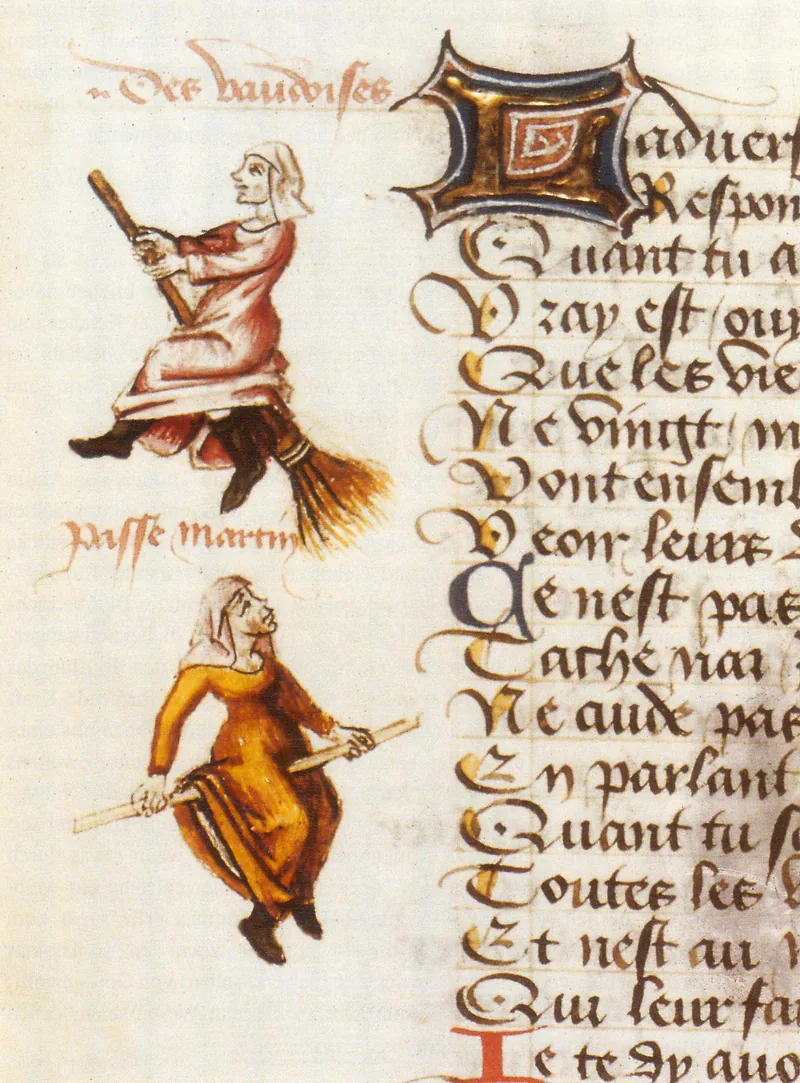
These ingredients belong to the world of accusation and fantasy, echoing much older libels against Jews and heretics. The ointment was also a convenient piece of "evidence": if the confession said witches flew, the ointment explained how. Trial records from the European witch trials contain many such confessions, nearly all obtained under interrogation and often torture, and physical ointments were rarely produced as evidence.
Physicians and Natural Magicians: Laguna, Porta and the Sceptics§
From the mid-sixteenth century, physicians offered a natural explanation. The Spanish physician Andrés Laguna, in his annotated translation of Dioscorides (1555), reported that in 1545 he had obtained a pot of green ointment from the house of an accused couple in Lorraine and used it on a hangman's wife who suffered from insomnia; she slept for some thirty-six hours and, on waking, complained that she had been taken from her husband's arms. Laguna identified the ointment's plants as cold, soporific herbs, among them hemlock, nightshade, henbane and mandrake, and concluded that the witches' flights were dreams.
Giambattista della Porta's Natural Magic (1558) gave ingredient lists for "witches' ointments" that mixed such plants with soot, fats and other substances, also as an argument that their effects were natural. The physician Johann Weyer, in De praestigiis daemonum (1563), and the English sceptic Reginald Scot, in The Discoverie of Witchcraft (1584), used these accounts to argue that supposed witches were deluded or ill rather than in league with the Devil; Scot reprinted Porta's material. See the catalogue entry for Scot's Discoverie for its magical texts. Demonologists replied that the Devil could use natural substances or simply transport witches bodily.
The Plants in the Recipes and Their Dangers§
The plants most often named in historical accounts belong to the nightshade family, henbane, belladonna (deadly nightshade) and mandrake, alongside aconite, hemlock, poplar leaves, parsley and other herbs. The nightshades contain tropane alkaloids such as atropine and scopolamine, which can cause delirium, vivid dreams, a sensation of flying or falling, and loss of memory; they can also cause fatal heart and respiratory failure. Aconite is one of the most poisonous plants in Europe. Poisoning by these plants is a medical emergency.
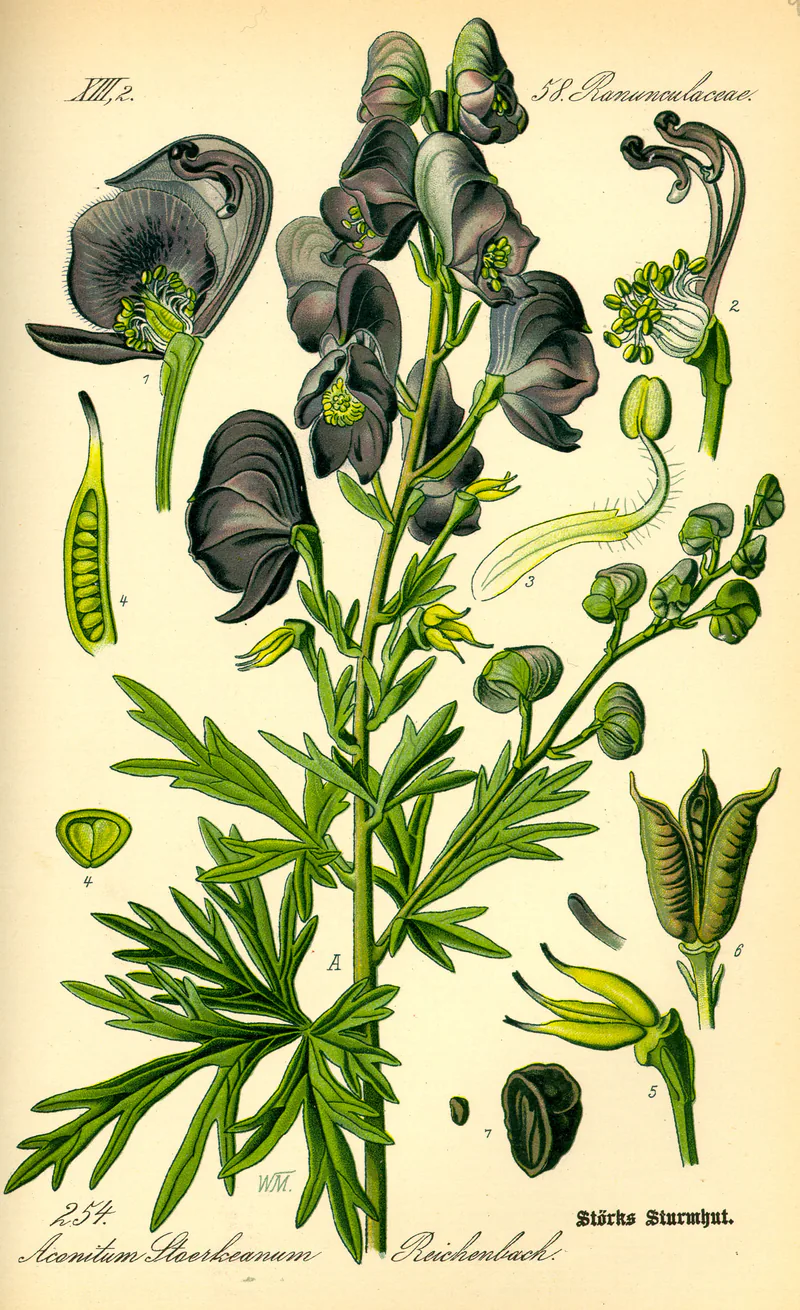
The recipes themselves are inconsistent, mix real and impossible ingredients, and give no reliable indication of what anyone actually made or used. For the folklore of the individual plants, see the witch's garden. This article deliberately does not reproduce formulas or methods.
Modern Theories: Drugged Dreams or Fantasy?§
In the twentieth century the ointment became central to theories about the reality of witchcraft. Margaret Murray's The Witch-Cult in Western Europe (1921) included an appendix by the pharmacologist A. J. Clark on the possible effects of the ingredients. The German folklorist Will-Erich Peuckert reported in 1960 that he had tried an ointment based on Porta's description and experienced vivid dreams of flight, and the anthropologist Michael Harner's essay on hallucinogenic plants in European witchcraft (1973) argued that ointments might explain the sabbath experience. Popular books have since often stated this as fact.
Most historians are more cautious. Carlo Ginzburg's Ecstasies (1989) traced the sabbath to folk traditions of night battles and spirit journeys, like those of the Friulian benandanti, that needed no drug. Emma Wilby's study of the Scottish witch Isobel Gowdie (2010) similarly explores visionary experience without ointments. Ronald Hutton and others point out that the ointment appears mainly in learned and judicial sources, that few ointments were ever found, and that the stereotype could have spread through interrogation alone. The current consensus is that some people may have experimented with soporific salves, but that the flying ointment was primarily a learned construction.
The Flying Ointment in Art and Modern Witchcraft§
Artists fixed the image in popular imagination. Hans Baldung Grien's woodcut Witches' Sabbath (1510) shows naked witches with pots and vapours, and Francisco Goya's Witches' Flight (1798) depicts figures borne through the air. Modern witchcraft has inherited the legend: some practitioners of traditional witchcraft and the "poison path" treat the flying ointment as a symbol of spirit flight, and commercial "flying ointments" are often sold made from harmless herbs. The plants of the historical recipes remain dangerous, and nothing in the folklore makes them safe; see also entheogens and sacred plants for the wider history of visionary plants.
Frequently asked questions§
What was a flying ointment?§
It was a salve that witches were said to apply to their bodies or to a staff or broom in order to fly to the sabbath. It appears in demonology, trial confessions and medical writings from the fifteenth to the seventeenth centuries.
Did witches really fly using ointments?§
No one flew, but some sixteenth-century physicians argued that ointments containing soporific plants produced dreams of flying, which the users mistook for reality. Most historians think the ointment was mainly a learned and judicial stereotype, though some experimentation with such salves cannot be ruled out.
What was in the flying ointment?§
Historical sources list poisonous plants such as henbane, belladonna, mandrake, aconite and hemlock, alongside fats, soot and, in demonological accounts, imaginary ingredients such as the fat of murdered children. These plants are extremely toxic and can be fatal.
Who was Andrés Laguna?§
He was a Spanish physician (c. 1510–1559) who, in his 1555 commentary on Dioscorides, reported testing a supposed witches' ointment on a woman who then slept for about a day and a half. He concluded that witches' flights were drug-induced dreams.
Sources and further reading§
- The Golden Ass — Apuleius, c. 170
- The Hammer of Witches (Malleus Maleficarum) — Heinrich Kramer, 1486
- Natural Magick — Giambattista della Porta, 1558
- De praestigiis daemonum — Johann Weyer, 1563
- The Discoverie of Witchcraft — Reginald Scot, 1584
- The Witch-Cult in Western Europe — Margaret Murray, 1921
- Hallucinogens and Shamanism — Michael J. Harner (ed.), 1973
- Ecstasies: Deciphering the Witches' Sabbath — Carlo Ginzburg, 1989