Liber XVI · Indigenous & Ancient Religions · Chapter X: Shamanism
Shamanism: History, Meaning and the Shaman in World Religion
Shamanism explained: Siberian origins of the word, drums, spirits and journeys, Sámi and Korean traditions, Eliade's theory, its critics and neo-shamanism.

Shamanism is a term scholars use for religious practices in which a ritual specialist, the shaman, enters altered states of consciousness to communicate with spirits on behalf of a community, usually to heal illness, find game, guide the dead or divine the future. The word comes from the Tungusic languages of Siberia, where the shaman was a central figure among peoples such as the Evenki, Buryat and Sakha, and it was later applied, sometimes too freely, to healers and visionaries worldwide. Since the 1960s shamanism has also become a modern spiritual movement in the West, a development scholars distinguish from the indigenous traditions that inspired it.
Origins of the Word "Shaman"§
Russian expansion into Siberia in the seventeenth century brought Europeans into contact with peoples whose religious specialists they called by the Tungusic word šaman. The Archpriest Avvakum, exiled to Siberia, described a shaman's divination in his autobiography of the 1670s. The Dutch statesman Nicolaes Witsen's Noord en Oost Tartarye (1692) printed an engraving of a Tungus shaman wearing antlers and a fringed costume and holding a drum, captioned "priest of the devil", an image that circulated widely. Eighteenth-century explorers employed by the Russian state, such as Johann Georg Gmelin, described shamanic séances in detail, often presenting shamans as tricksters.
The term's origin is debated; one proposal links it to a Tungusic verb meaning "to know", but the evidence is uncertain. Older claims that it derives from the Sanskrit śramaṇa, an ascetic, are now generally rejected. By the nineteenth century "shamanism" was used for the religions of Siberia in general and soon for similar practices in North America, the Arctic and elsewhere.
Siberian Shamans: Drum, Spirits and Journeys§
Siberian peoples, among them the Evenki, Nenets, Khanty, Buryat, Sakha (Yakut), Tuvans and Chukchi, differed greatly, but their shamans shared certain features. Many accounts describe a calling rather than a choice: a future shaman would suffer illness, dreams or visions in which spirits dismembered and remade the body, a crisis resolved only by accepting the role. Training under an older shaman followed.
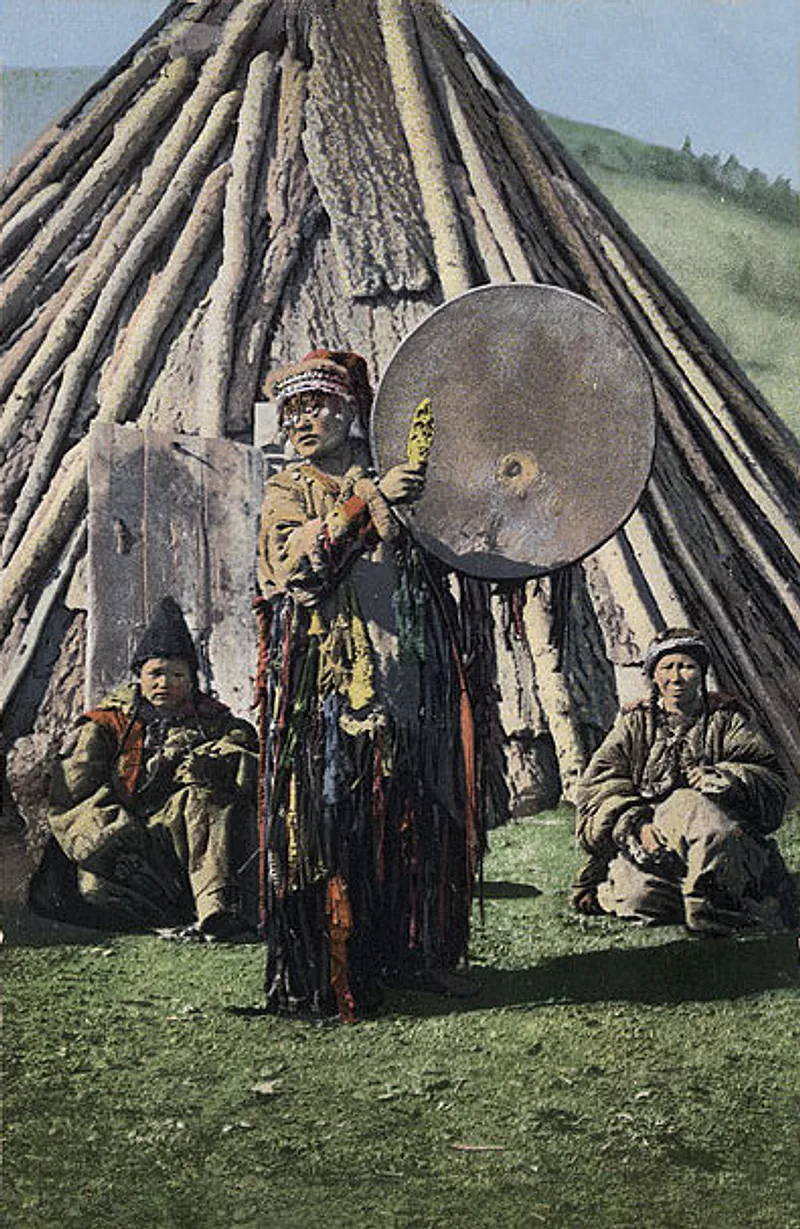
The shaman's drum, often made of reindeer hide and painted with images of the cosmos, served as a mount or vessel for the journey. The costume, hung with iron pendants, mirrors and ribbons, represented a bird, deer or skeleton. During a séance (kamlanie), usually held at night, the shaman drummed, sang and danced into a trance, summoned helping spirits, and travelled through the three-tiered cosmos, upward along the world tree to sky deities or downward to the realm of the dead, to recover a lost soul, escort the dead or negotiate with spirits of game and disease. Some shamans were believed to be possessed by spirits rather than travelling; scholars debate how sharply the two should be distinguished.
Shamans also served as healers, diviners and keepers of oral tradition. Among the Buryat, shamanism coexisted with Tibetan Buddhism and with clan cults of mountains and ancestors.
Sámi, Korean and Other Traditions§
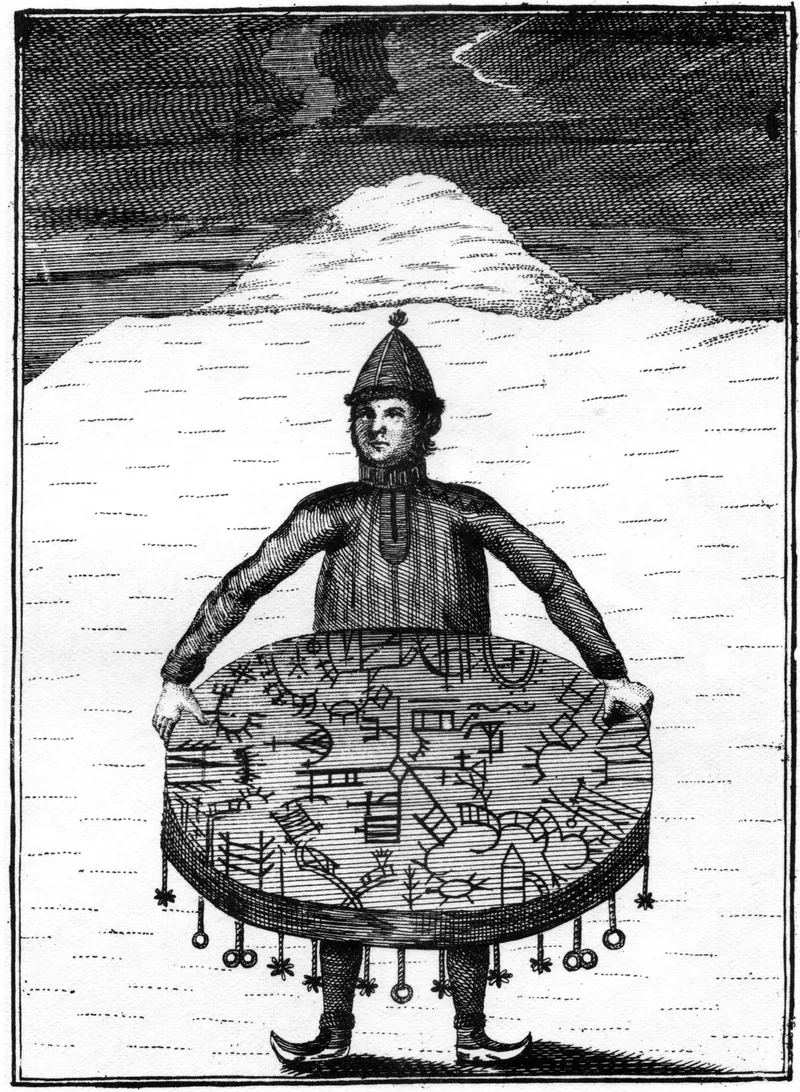
The Sámi of northern Scandinavia and Russia had a specialist called the noaidi, who used a frame drum painted with gods, animals and worlds to divine and to journey in trance. During the seventeenth and eighteenth centuries Lutheran missionaries confiscated and burned drums and prosecuted noaidi; some seventy drums survive in museums. Norse sources describing the magic called seiðr show parallels, which are explored in Norse and Germanic Religion.
In Korea, the mudang, usually women, perform ritual ceremonies called gut, in which they are possessed by gods and ancestors to heal, bless or console. Korean shamanism (musok) survived Confucian disapproval, Japanese colonial suppression and post-war modernisation campaigns, and is now practised in cities and recognised as cultural heritage. Comparable figures include the Manchu and Mongolian shamans, the itako blind mediums of northern Japan, and the healers of many Amazonian peoples, some of whom use sacred plant preparations, which the library describes only historically in Entheogens and Sacred Plants. Whether all these should be called "shamans" is precisely the question scholars debate. Native North American healers and visionaries are discussed in Native American Religions, where many communities prefer their own terms.
Eliade and the Universal Shaman§
The Romanian historian of religion Mircea Eliade turned shamanism into a global category. In Shamanism: Archaic Techniques of Ecstasy (French 1951, English 1964) he defined the shaman as a master of ecstasy whose soul leaves the body to ascend to the sky or descend to the underworld, and he argued that this was among the oldest forms of religious experience, traceable across Asia, the Americas and beyond. His book shaped both scholarship and popular culture.
From the 1970s onward, critics challenged this model. Anthropologists argued that Eliade relied on secondary sources, minimised the social and political roles of shamans, and privileged the soul-journey over possession. Alice Kehoe's Shamans and Religion (2000) warned against treating the Siberian figure as a universal type and against romanticising indigenous peoples as timeless. Ronald Hutton, in Shamans: Siberian Spirituality and the Western Imagination (2001), traced how Western writers constructed shamanism from Siberian materials over three centuries. Many scholars now use "shaman" carefully, for Siberia and comparable cases, rather than as a label for every healer or prophet. Theories that cave art or ancient religions such as those in Indigenous and Ancient Religions were essentially shamanic remain contested.
Suppression and Revival in Siberia and Mongolia§
Soviet authorities persecuted shamans from the late 1920s as exploiters and remnants of superstition; drums were destroyed and many shamans were imprisoned or killed. Knowledge survived in families and in rural areas. After 1991 shamanism revived across Siberia and Mongolia, often in new forms: Tuva's government supported shamanic societies, among them one founded with the folklorist Mongush Kenin-Lopsan, and urban shamanic centres opened in Ulan-Ude, Ulaanbaatar and Yakutsk. Revived shamanism became part of national and ethnic identity, sometimes in competition with Buddhism and Orthodox Christianity.
Neo-Shamanism and Core Shamanism§
In the West, interest grew with the counterculture of the 1960s. Carlos Castaneda's books about a Yaqui sorcerer named don Juan, beginning with The Teachings of Don Juan (1968), were bestsellers; most scholars now regard them as largely fictional. The anthropologist Michael Harner developed what he called core shamanism, set out in The Way of the Shaman (1980), a method of drumming-induced journeying stripped of particular cultural forms and taught through workshops of his Foundation for Shamanic Studies. Neo-shamanism has since become a broad movement overlapping with the New Age, with modern Paganism and with practices of dream and visionary travel discussed in Astral Projection and Dreams.
Critics, including many indigenous people, accuse some neo-shamans of appropriating sacred traditions, selling ceremonies and calling themselves shamans without community recognition. Others see core shamanism as a sincere attempt to recover experiences once common to humanity. Practices involving trance should be approached with care; people with a history of psychosis or severe mental illness are generally advised by clinicians to avoid intensive altered-state work.
Frequently asked questions§
What does a shaman do?§
In Siberian and comparable traditions, a shaman enters a trance to contact spirits on behalf of others: healing illness thought to be caused by soul loss or spirit attack, guiding the souls of the dead, divining, and ensuring good hunting or weather. The role is usually recognised and controlled by the community.
Is shamanism a religion?§
It is better described as a set of practices and a type of specialist found within various religions, rather than a single religion with a founder or creed. Some modern groups, especially in Siberia and Mongolia, now present shamanism as an organised religion.
What is the difference between shamanism and neo-shamanism?§
Shamanism refers to practices embedded in particular indigenous cultures and communities. Neo-shamanism and core shamanism are modern Western movements that adapt or generalise those practices, often through workshops, for individual spiritual growth.
Sources and further reading§
- Shamanism: Archaic Techniques of Ecstasy — Mircea Eliade, 1964
- Shamans: Siberian Spirituality and the Western Imagination — Ronald Hutton, 2001
- Shamans and Religion: An Anthropological Exploration in Critical Thinking — Alice Beck Kehoe, 2000
- The Shaman — Piers Vitebsky, 1995
- Shamanism: A Reader — Graham Harvey (ed.), 2003
- The Way of the Shaman — Michael Harner, 1980
- Shamans, Housewives, and Other Restless Spirits: Women in Korean Ritual Life — Laurel Kendall, 1985