Liber VIII · Eastern Mysticism · Chapter XI: Tibetan Buddhism
Tibetan Buddhism: Vajrayana, Lamas, the Four Schools and Bardo
Tibetan Buddhism explained: its arrival in Tibet, Vajrayana tantra and the guru, the Nyingma, Kagyu, Sakya and Gelug schools, Dzogchen, Mahamudra and the bardo.

Tibetan Buddhism is the form of Buddhism that developed in Tibet from the seventh century onward, combining Mahayana philosophy and monastic discipline with the esoteric methods of Indian Buddhist tantra, known as Vajrayana. It is organised into four main schools, Nyingma, Kagyu, Sakya and Gelug, and is distinguished by initiations from a guru, deity visualisation, the system of reincarnate lamas and teachings on the intermediate state (bardo) between death and rebirth.
How Buddhism Came to Tibet§
Tibetan histories credit King Songtsen Gampo (d. 649) with first welcoming Buddhism, partly through his Nepalese and Chinese queens. Under Trisong Detsen in the eighth century, the Indian abbot Shantarakshita and the tantric master Padmasambhava were invited to Tibet, and the first monastery, Samye, was founded around 779. A debate held at Samye, according to tradition, settled in favour of the gradual Indian approach over the "sudden" teaching of Chinese Chan, a story explored in the guide to Zen and Chan. Padmasambhava, revered as Guru Rinpoche, became in later legend the subduer of Tibet's hostile spirits and the hider of secret teachings.
After the collapse of the Tibetan empire in the mid-ninth century, monastic Buddhism declined for more than a century. A "later diffusion" began in the late tenth and eleventh centuries, as translators such as Rinchen Zangpo travelled to India and the Bengali scholar Atisha arrived in Tibet in 1042. New translations of Indian tantras, many of them from the late Buddhist tantric movement studied by Ronald Davidson, laid the foundations of the newer schools. Those who preserved the earlier translations came to be called Nyingma, "the ancients."
Vajrayana: Tantra, Initiation and the Guru§
Tibetan Buddhists describe three vehicles: the foundational teachings shared with early Buddhism, the Mahayana of the bodhisattva and emptiness, and the Vajrayana, the "diamond" or "thunderbolt" vehicle. Vajrayana is considered a swift path because it takes the result as the path: the practitioner trains to see body, speech and mind as already those of an enlightened deity. This is done through empowerment (wang) from a qualified guru, the recitation of mantras, visualisation of deities and their mandalas, and the keeping of tantric vows (samaya).
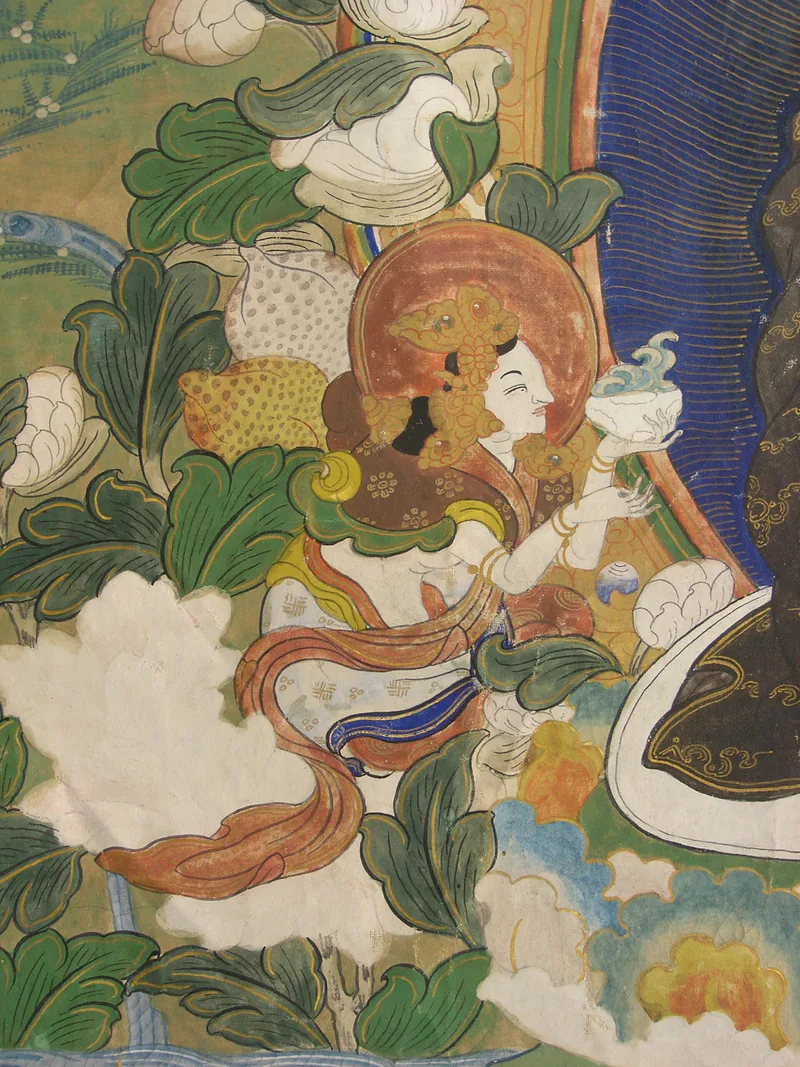
The guru is central. Guru yoga, in which the teacher is visualised as inseparable from the Buddha, is a fundamental practice, and the word lama translates the Sanskrit guru. Deities range from peaceful bodhisattvas such as Avalokiteshvara, whose mantra om mani padme hum is carved on countless stones and turned in prayer wheels, to wrathful protectors and sexual-union (yab-yum) figures that symbolise the union of wisdom and compassion. The wider history of these methods in India is set out in the article on tantra.
The Four Schools: Nyingma, Kagyu, Sakya and Gelug§
The Nyingma traces itself to Padmasambhava and the early translations. It is known for terma, "treasure" texts believed to have been concealed by Padmasambhava and revealed later by visionary "treasure finders," and for Dzogchen, the "Great Perfection." The Kagyu descends from the translator Marpa (eleventh century), his disciple the poet-yogi Milarepa and Milarepa's disciple Gampopa; its many branches include the Karma Kagyu, led by the Karmapas. The Sakya, centred on the monastery founded in 1073 and led by the Khon family, is known for the Lamdre ("path and result") teachings and held political power under the Mongol Yuan dynasty.
The Gelug, founded by the reformer Tsongkhapa (1357–1419), stressed monastic discipline and philosophical study, establishing great monasteries such as Ganden, Drepung and Sera. In 1578 the Mongol ruler Altan Khan gave the Gelug lama Sonam Gyatso the title "Dalai Lama," applied retrospectively to two predecessors. From 1642 the Fifth Dalai Lama headed a government that ruled much of Tibet. Alongside the four Buddhist schools stands Bon, Tibet's indigenous religion in its systematised form, which shares many practices with Buddhism.
Mahamudra, Dzogchen and the Six Yogas of Naropa§
Beyond deity yoga, Tibetan traditions teach direct methods for recognising the nature of mind. Mahamudra, the "great seal," central to the Kagyu, points to the luminous, empty awareness underlying all experience. Dzogchen, central to the Nyingma and Bon, teaches that this primordial awareness (rigpa) is already perfect and needs only to be recognised. Both are often presented as the culmination of practice, though teachers insist on preparation through ethics and foundational practices (ngondro), such as prostrations and mantra recitation.
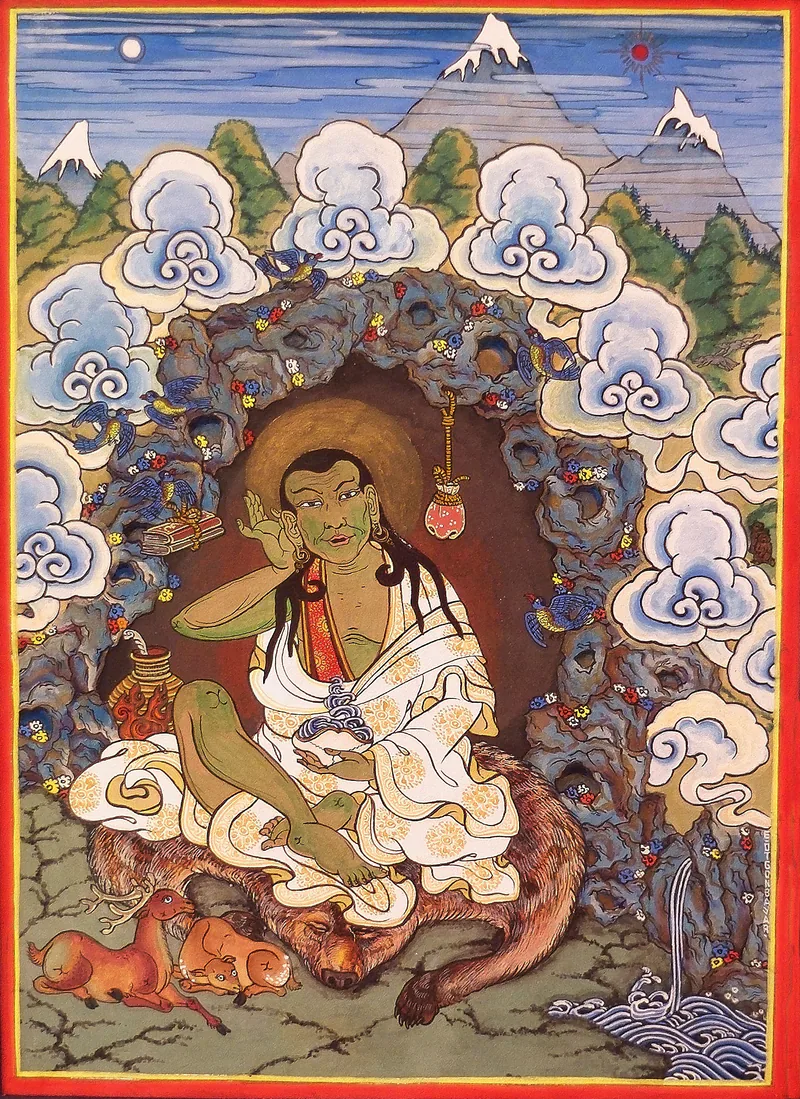
The Kagyu also preserve the "Six Yogas of Naropa," attributed to the Indian master Naropa: inner heat (tummo), illusory body, dream yoga, clear light, the intermediate state and the transference of consciousness (phowa). These use the subtle body of channels, winds and drops, comparable to the Hindu systems discussed in the history of the chakras. Their methods are traditionally taught only after initiation and under close supervision; the summary here is historical, not instructional, and teachers warn that forced breath and energy practices can cause physical and mental imbalance.
Death, Rebirth and the Bardo§
Tibetan Buddhism gives detailed attention to dying. The Bardo Thodol, "Liberation through Hearing in the Intermediate State," is a terma revealed by Karma Lingpa in the fourteenth century. It is read aloud to the dying and dead, describing the clear light at the moment of death, the peaceful and wrathful deities that appear afterwards, and the process of rebirth, while urging the deceased to recognise all these visions as projections of mind. Walter Evans-Wentz's 1927 edition gave it the English title The Tibetan Book of the Dead, inviting comparison with the Egyptian funerary texts.
Belief in rebirth also underlies the tulku system, in which the reincarnations of great teachers are identified as children and enthroned as heads of lineages. The Karmapas are usually regarded as the first such line, from the thirteenth century, and the Dalai and Panchen Lamas are the most famous.
Tibetan Buddhism in Exile and in the West§
Following the Chinese annexation of Tibet in 1950 and the failed uprising of 1959, the Fourteenth Dalai Lama fled to India and established a government in exile at Dharamsala. Thousands of monks and lamas followed, rebuilding monasteries in India and Nepal and, from the late 1960s, teaching in Europe and North America; Chögyam Trungpa founded Naropa Institute in Colorado in 1974. The Dalai Lama's Nobel Peace Prize (1989) made him one of the world's best-known religious figures.
Western images of Tibet are older and often fanciful. Theosophists placed their hidden Mahatmas in Tibet, and "Lobsang Rampa's" The Third Eye (1956), presented as a lama's memoir, was written by an Englishman. Donald Lopez's Prisoners of Shangri-La traces these fantasies. For Tibetan Buddhism's place among other contemplative paths, see meditation in Eastern traditions.
Frequently asked questions§
What is the difference between Tibetan Buddhism and other forms of Buddhism?§
Tibetan Buddhism shares the Mahayana ideals and philosophy of East Asian Buddhism but places tantric (Vajrayana) practice at its centre, with initiation, deity visualisation and the guru. It also has distinctive institutions such as reincarnate lamas and a strong tradition of monastic scholasticism.
What are the four schools of Tibetan Buddhism?§
The Nyingma, Kagyu, Sakya and Gelug. They share core doctrines and monastic codes but differ in lineages, emphasised tantras and meditation systems, such as Dzogchen in the Nyingma and Mahamudra in the Kagyu.
Who is the Dalai Lama?§
The Dalai Lama is the senior incarnate lama of the Gelug school, believed to be an emanation of Avalokiteshvara, the bodhisattva of compassion. The title dates from 1578; the fourteenth Dalai Lama, Tenzin Gyatso, was born in 1935.
Is the Tibetan Book of the Dead really about death?§
Yes, but not only. The Bardo Thodol guides the dying through the intermediate state, yet Tibetan teachers also read it as instruction on recognising the nature of mind in life, since every moment is understood as a kind of transition.
Sources and further reading§
- The Tibetan Book of the Dead — Padmasambhava (attrib.), 2005
- Introduction to Tibetan Buddhism — John Powers, 1995
- The Tibetans — Matthew T. Kapstein, 2006
- Civilized Shamans: Buddhism in Tibetan Societies — Geoffrey Samuel, 1993
- Indian Esoteric Buddhism: A Social History of the Tantric Movement — Ronald M. Davidson, 2002
- Prisoners of Shangri-La: Tibetan Buddhism and the West — Donald S. Lopez Jr., 1998
- The Hundred Thousand Songs of Milarepa — Garma C. C. Chang (trans.), 1962