Liber XI · Herbal Magick · Chapter VI: Mandrake & Plant Lore
Mandrake and Plant Lore: The Legend of the Screaming Root
Mandrake in history and folklore: the Mandragora plant and its toxicity, Genesis and Theophrastus, the dog and the scream, Alraune amulets, fake roots and literature.

The mandrake (Mandragora) is a poisonous Mediterranean plant of the nightshade family whose forked, human-shaped root made it the most famous plant in Western magic and folklore. From the Book of Genesis and the Greek root-cutters to medieval herbals, German Alraune amulets and Shakespeare, it was credited with powers of fertility, sleep, love and fortune, and was said to shriek when pulled from the ground, killing anyone who heard it.
Mandragora: The Plant and Its Toxicity§
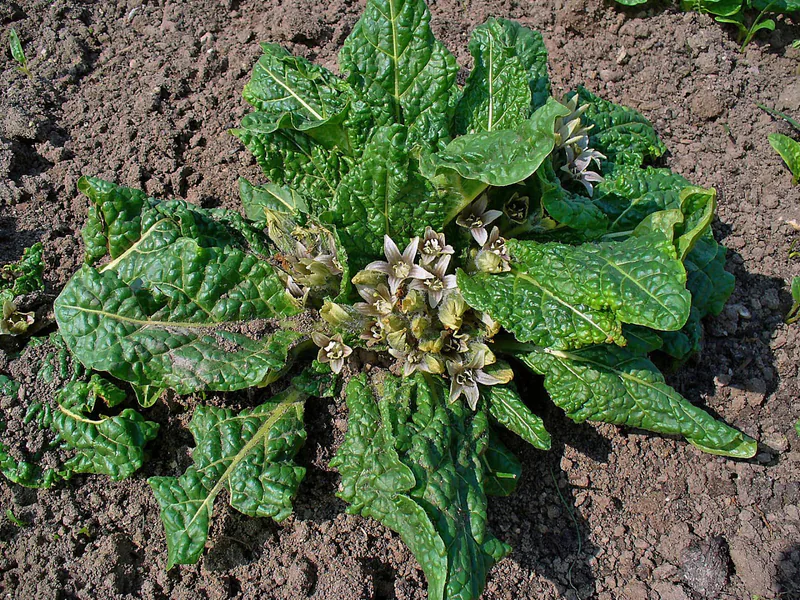
Mandrake is a low, stemless perennial native to the Mediterranean and Near East, with a rosette of broad, wrinkled leaves, bell-shaped flowers and yellow or orange fruits sometimes called "love apples." Its thick taproot often divides into two, suggesting legs, and this resemblance to a human figure underlies most of its folklore. Botanists recognise several species, including Mandragora officinarum and Mandragora autumnalis.
Like henbane and belladonna, mandrake contains alkaloids such as scopolamine and hyoscyamine. Ancient physicians used it to induce sleep and to dull pain during surgery, and its effects in excess, delirium, hallucination and death, were well known. In English the name "mandrake" has also been given to unrelated plants: white bryony was sold as "English mandrake," and the American mayapple (Podophyllum) is still sometimes called mandrake. All are poisonous. This article treats mandrake as history and folklore; it should never be ingested.
Mandrake in the Ancient World: Genesis, Theophrastus and Dioscorides§
The oldest literary appearance of the mandrake is usually identified in Genesis 30, where Reuben finds duda'im in the field during the wheat harvest and the barren Rachel trades a night with Jacob to her sister Leah in exchange for them. Ancient and modern interpreters have understood the duda'im as mandrakes and the story as evidence of their reputation as an aid to conception. The Song of Songs also mentions their fragrance among the delights of love.
Greek sources add ritual and medicine. Theophrastus, in his Enquiry into Plants (c. 300 BCE), records that root-cutters drew three circles around the mandrake with a sword and cut it facing west, while another person danced around the plant speaking of love; he reports these customs with evident scepticism. Dioscorides, in the first century CE, describes mandrake wine given to induce sleep and to prevent pain before cutting or cautery. Aphrodite was sometimes called Mandragoritis, "she of the mandrake," linking the plant with love. These traditions are placed in context in the history of herbal magic.
The medical use continued into the Middle Ages. Surgical manuscripts from the ninth century onward describe the "soporific sponge" (spongia somnifera), a sponge impregnated with soporific plants, among them mandrake, opium poppy and hemlock, whose vapours the patient was meant to inhale before an operation. Surgeons associated with the school of Bologna in the thirteenth century are credited with using it. Its effectiveness is uncertain and its dangers obvious, since the margin between sleep and fatal poisoning with such plants is narrow; it was abandoned long before modern anaesthesia, which began only in the 1840s.
The Dog and the Scream: How the Gathering Legend Grew§
The most famous mandrake legend, that the root shrieks when pulled and that whoever hears it dies, developed gradually. In The Jewish War, written in the 70s CE, the historian Josephus describes a flame-coloured plant called baaras that grew near the fortress of Machaerus: it was dangerous to touch, so a dog was tied to it and made to pull it up, dying in the process, after which the root could be handled and used to expel demons. Josephus does not call it mandrake, but later tradition fused the two.
Illustrated manuscripts of the Herbarius of Pseudo-Apuleius and later medieval herbals show the mandrake as a small human figure, male or female, with a dog tied to it. By the late Middle Ages the root was said to groan or scream as it left the earth, and gatherers were advised to stop their ears. German folklore added that the best roots grew beneath the gallows, from the fluids of a hanged man, hence names such as Galgenmännlein, "little gallows man."
Alraune: Mandrake Amulets and the Trade in Fakes§
In German-speaking lands, a mandrake root, Alraune or Alraun, was kept as a household spirit and luck-bringer. Owners were said to wrap it in cloth, keep it in a box, bathe it in wine or water and consult it, in return for prosperity, success in lawsuits or fertility. Such roots were inherited, sold for high prices and condemned by clergy as idolatrous. At the trial of Joan of Arc in 1431, one of the articles of accusation claimed that she carried a mandrake for good fortune, which she denied.
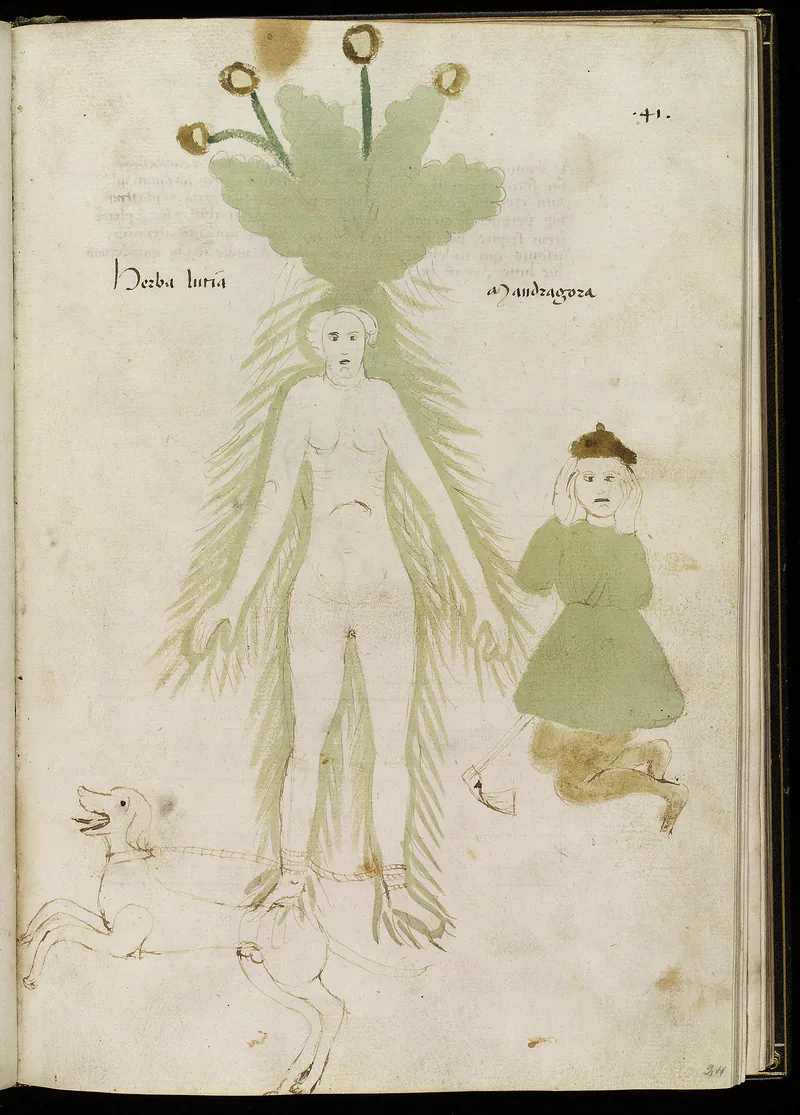
Because true mandrake did not grow in northern Europe, many "mandrakes" were counterfeits carved from bryony or other roots and replanted so that the cuts healed over. The English naturalist William Turner and the herbalist John Gerard (1597) both denounced these fakes and the legends of the shrieking root; Gerard said he and his servants had dug up many mandrakes without harm. Sir Thomas Browne's Pseudodoxia Epidemica (1646) examined the mandrake among the "vulgar errors" of his age. For the plant's alleged role in witches' salves, see flying ointments.
Mandrake in Literature and Modern Culture§
Literature kept the legend alive. In Romeo and Juliet, Juliet imagines waking in the tomb amid "shrieks like mandrakes' torn out of the earth," and in Othello Iago names mandragora among the drowsy syrups of the world. Niccolò Machiavelli's comedy La Mandragola (c. 1518) turns on a supposed mandrake fertility potion used as a ruse. In the twentieth century Hanns Heinz Ewers's novel Alraune (1911) and its film adaptations reimagined the gallows legend as a story of artificial creation, and a screaming mandrake appears in the Harry Potter books and films.
Was Mandrake Really Used in Magic?§
It was, though not always in the ways legend suggests. The evidence is clear that mandrake roots, genuine and counterfeit, were kept as amulets and household charms, that the plant was used medicinally as a narcotic in antiquity and the Middle Ages, and that magical texts and herbals prescribed rituals for gathering it. Claims that witches used mandrake in poisons and ointments come largely from demonologists and later writers and are harder to verify. In modern witchcraft, mandrake is valued mainly as a symbol and amulet, often grown in pots, a role it shares with other plants of the witch's garden.
Frequently asked questions§
Does mandrake really scream?§
No. The scream belongs to legend, which developed from ancient gathering rituals and Josephus's story of the baaras plant pulled by a dog. Herbalists such as John Gerard already ridiculed the idea in the sixteenth century.
Is mandrake poisonous?§
Yes. True mandrake contains tropane alkaloids that can cause hallucinations, a dangerously rapid heartbeat, coma and death. Plants sold as "mandrake," such as white bryony and mayapple, are also poisonous.
What is the mandrake in the Bible?§
In Genesis 30, Rachel obtains duda'im, usually translated "mandrakes," from Leah, apparently hoping they will help her conceive. The Song of Songs also mentions their fragrance. Both passages reflect the plant's ancient association with love and fertility.
What is an Alraune?§
Alraune is the German name for a mandrake root kept as a household luck charm in early modern Europe. Owners treated it almost as a living being, and many such roots were carved fakes.
Sources and further reading§
- Enquiry into Plants — Theophrastus, c. 300 BCE
- De materia medica — Pedanius Dioscorides, c. 70
- The Jewish War — Flavius Josephus, c. 75
- The Herball or Generall Historie of Plantes — John Gerard, 1597
- Pseudodoxia Epidemica — Thomas Browne, 1646
- The Mystic Mandrake — C. J. S. Thompson, 1934
- Witchcraft Medicine: Healing Arts, Shamanic Practices, and Forbidden Plants — Claudia Müller-Ebeling, Christian Rätsch & Wolf-Dieter Storl, 1998