Liber XXIX · Superstitions · Chapter IX: Origins of Superstition
Pseudodoxia Epidemica: Thomas Browne and the Vulgar Errors
Thomas Browne's Pseudodoxia Epidemica (1646), the book of Vulgar Errors: how a Norwich physician tested popular beliefs, from basilisks to spilt salt.

Pseudodoxia Epidemica, first published in 1646 and usually known as Vulgar Errors, is Sir Thomas Browne's long enquiry into "received tenents and commonly presumed truths" that he believed to be false, from the basilisk's killing glance and the elephant without knee joints to the ill luck of spilt salt. Written by a Norwich physician steeped in classical learning and the new experimental philosophy, it is one of the first systematic attempts in English to examine popular beliefs one by one, and a landmark between Renaissance natural history and the modern study of superstition.
Sir Thomas Browne, Physician of Norwich§
Thomas Browne was born in London in 1605, studied at Oxford and then medicine at Montpellier, Padua and Leiden, the best medical schools of the day. By the late 1630s he had settled in Norwich, where he practised as a physician for more than forty years and was knighted by Charles II in 1671. His first book, Religio Medici ("The Religion of a Physician"), circulated in manuscript and was printed without his permission in 1642; an authorised edition followed in 1643. It made him famous across Europe for its meditative prose and its blend of Christian faith, tolerance and curiosity.
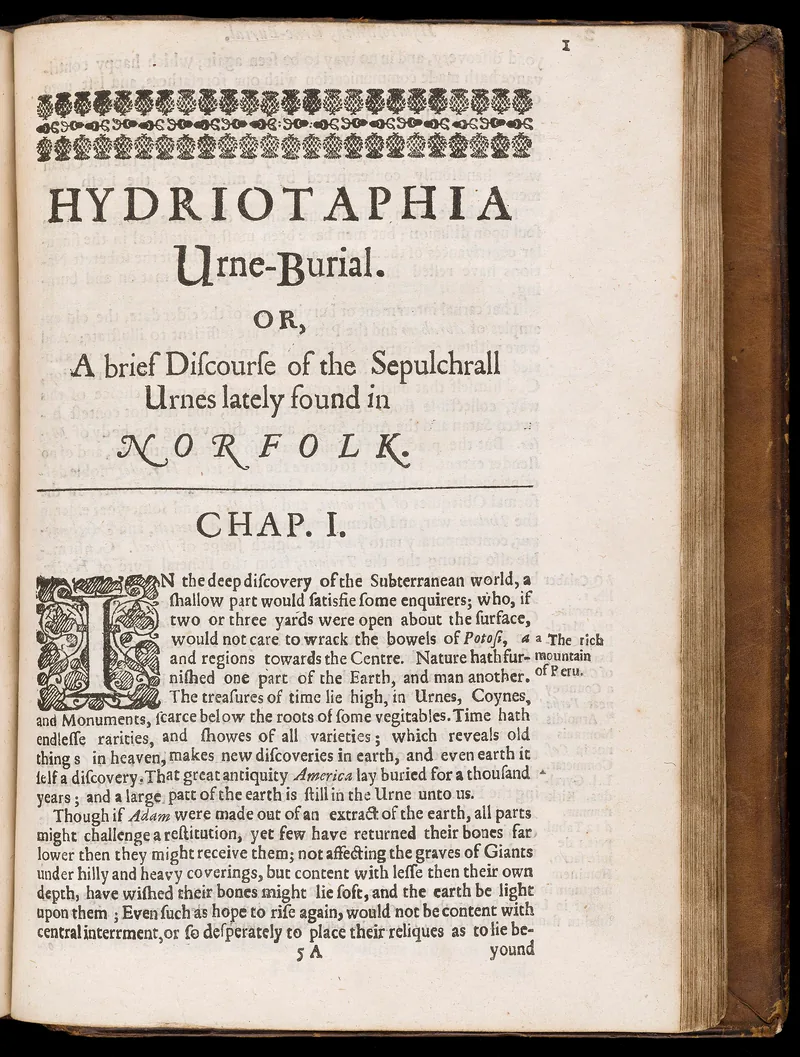
Browne later wrote Hydriotaphia, Urne-Buriall and The Garden of Cyrus (both 1658), which remain classics of English prose. Pseudodoxia Epidemica was by far his longest work and the one most read in his lifetime. Its Greek title means, roughly, "epidemic false opinions": errors that had spread through the population like a disease.
The Book of Vulgar Errors: Title, Editions and Plan§
The full title announces the method: Pseudodoxia Epidemica: or, Enquiries into Very Many Received Tenents and Commonly Presumed Truths. Browne revised and enlarged it for editions of 1650, 1658, 1669 and 1672, adding chapters and new observations. The standard modern edition is Robin Robbins's two-volume text (1981).
The plan has seven books:
- Book I discusses the general causes of error.
- Book II treats minerals and plants: whether crystal is congealed ice, the powers of the magnet, the mandrake's human shape and shriek (see Mandrake Lore), mistletoe and more.
- Book III, the longest, deals with animals, from the beaver said to bite off its own testicles to the bear that licks its shapeless cubs into form.
- Book IV considers human beings: why we are thought alone to stand upright, the heart on the left side, left-handedness and the blessing after a sneeze.
- Book V examines errors in pictures and in customs, including the depiction of Adam and Eve with navels.
- Book VI covers geography, chronology and the natural history of peoples.
- Book VII treats scriptural and historical traditions, such as whether the forbidden fruit was an apple.
The range is striking. Browne moves from classical natural history in Pliny and Aelian to the beliefs of English servants and farmers, treating both with the same patient scrutiny.
Browne's Theory of Error: Credulity, Antiquity and Authority§
The first book is a small treatise on why people believe false things, and it is the part that most directly anticipates later thinking about superstition. Browne begins with the "common infirmity of human nature" inherited from the Fall, and then turns to "the erroneous disposition of the people": the multitude, he argues, judges by sense and appearance, is easily led by plausible words, and prefers marvels to plain truths.
He then identifies more learned sources of error. Credulity and its opposite, an idle refusal to inquire, both block knowledge. "Adherence unto Antiquity" leads scholars to accept a claim simply because Aristotle, Pliny or Dioscorides made it, and "adherence unto authority" substitutes the reputation of a writer for evidence. Finally Browne gives Satan a part, as the deceiver who encourages error and feeds idolatry, which reminds the modern reader that his enquiry took place inside a religious framework.
Against these Browne set three tests: authority, sense and reason. Authority is not rejected but weighed. Where possible he consults experience, his own or that of trustworthy observers, and reasons from known causes. In doing so he answered the call of Francis Bacon, who in The Advancement of Learning (1605) had recommended compiling a register of popular errors so that natural history might be purged of fables.
Animals, Minerals and Marvels Put to the Test§
Browne's chapters on animals show his method at its best. He doubts that the basilisk kills by its look, reasoning that sight works by receiving images, not by sending out poisonous rays, though he allows that a venomous serpent of that name may exist. He denies that the salamander lives in fire, that the ostrich digests iron, and that the elephant has no joints and must sleep leaning against a tree. He tests the old belief that a dead kingfisher hung by a thread will turn its bill towards the wind, and reports that his suspended birds did not.
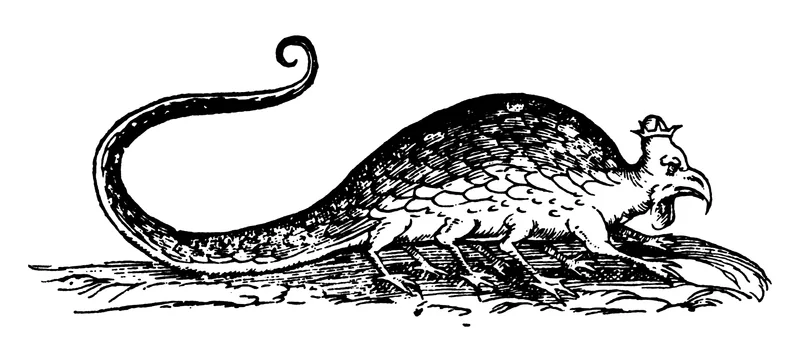
Other discussions became classics of their kind. He questions whether the pelican feeds its young with its own blood, a familiar Christian emblem, and whether the swan sings before it dies; he examines the legend of the phoenix and concludes there is no good evidence for a single, self-renewing bird. On the mandrake he rejects the shriek that kills whoever uproots it.
Browne's scepticism is selective, and he occasionally accepts what later naturalists rejected. But his habit of separating a symbol's moral meaning from its claim to fact was influential: the pelican could remain a valid emblem of charity in a church window while ceasing to be a fact of zoology.
Popular Customs and Omens in Pseudodoxia Epidemica§
Several chapters deal directly with what we would now call superstition. Browne discusses the custom of blessing a person who sneezes and traces it, as earlier writers had, to classical antiquity rather than to a plague in the time of Pope Gregory; this question and others are still debated in Luck, Omens and Portents. A late chapter of Book V gathers a series of popular customs and omens, among them the ill luck of spilt salt, the meaning of a hare crossing the road, the practice of breaking eggshells after eating, and similar household beliefs of the kind collected in Household Superstitions.
His treatment of such customs is characteristic. He looks for their sources in classical texts, notes where pagan augury or Christian symbolism may have shaped them, and asks whether any natural cause supports them. Often he concludes that they are survivals of heathen divination, kept by habit; sometimes he concedes a moral or practical point. This approach, of tracing an omen to an older religious context, was later taken up by antiquaries and folklorists.
Limits of the Enquiry: Witchcraft and the Bury St Edmunds Trial§
Browne's reputation as a debunker should not be overstated. In Religio Medici he declared that those who doubt the existence of witches are a sort not of infidels but of atheists, and Pseudodoxia Epidemica does not challenge the reality of witchcraft. In 1662 Browne was called as an expert at the trial of Amy Denny and Rose Cullender at Bury St Edmunds, before Sir Matthew Hale. According to the published report of the trial (1682), he gave his opinion that the fits suffered by the supposed victims were natural in origin but could be heightened by the Devil working with witches. Both women were convicted and hanged. Gilbert Geis and Ivan Bunn's study A Trial of Witches (1997) reconstructs the case.
The contrast with Reginald Scot, who had denied the power of witches in 1584, is instructive; see Reginald Scot's Discoverie of Witchcraft and the full text in the reading room. Browne attacked errors about nature, not the spiritual order he believed in, and the wider debate on witches continued in works such as Joseph Glanvill's Saducismus Triumphatus and John Webster's Displaying of Supposed Witchcraft.
Legacy: From Vulgar Errors to the Study of Folklore§
Pseudodoxia Epidemica belonged to a European genre. The French physician Laurent Joubert had published Erreurs populaires on medical folk beliefs in 1578, and James Primrose's De vulgi in medicina erroribus (1638) appeared in English as Popular Errours in 1651. Browne's book was wider in scope and more widely read, and it provoked replies, notably from the conservative Scottish writer Alexander Ross, who defended the ancients.
Its influence on the English language is also notable: the Oxford English Dictionary records many words first in Browne, among them "electricity", which appears in Pseudodoxia Epidemica. Later antiquaries, beginning with Henry Bourne's Antiquitates Vulgares (1725) and John Brand's Observations on Popular Antiquities (1777), turned the catalogue of errors into a catalogue of customs to be recorded, and the nineteenth-century folklorists completed the shift from refutation to collection, as traced in Origins of Superstition. Readers from Samuel Taylor Coleridge to Jorge Luis Borges admired Browne's style, and historians of science now read him as a key witness to the slow change from book learning to observation.
Frequently asked questions§
What does Pseudodoxia Epidemica mean?§
The Greek-derived title means roughly "widespread false opinions". Browne's subtitle explains that the book enquires into "very many received tenents and commonly presumed truths", and English readers soon called it simply Vulgar Errors.
Was Thomas Browne a sceptic?§
Only in part. He tested many claims about nature against reason and experience, but he remained a devout Anglican who believed in witches, angels and the Devil, and his evidence contributed to the conviction of two women for witchcraft in 1662.
What errors did Browne refute?§
Among many others he denied that the basilisk kills by sight, that the salamander lives in fire, that elephants have no joints, that the pelican feeds its young with its blood and that the phoenix exists, and he examined omens such as spilt salt and a hare crossing the road.
Sources and further reading§
- Pseudodoxia Epidemica — Thomas Browne, 1646
- Religio Medici — Thomas Browne, 1643
- The Advancement of Learning — Francis Bacon, 1605
- Sir Thomas Browne: A Life — Reid Barbour, 2013
- Thomas Browne and the Writing of Early Modern Science — Claire Preston, 2005
- A Trial of Witches: A Seventeenth-Century Witchcraft Prosecution — Gilbert Geis and Ivan Bunn, 1997
- Popular Errors — Laurent Joubert, 1578