What Is Superstition? Meaning, History and Origins
What is superstition? The meaning and history of the word, the main kinds of folk belief, and which supposedly ancient superstitions are really modern.

A superstition is a belief or practice that links an action, object, sign or moment to good or bad fortune by a connection that ordinary causal reasoning cannot explain: touching wood after a boast, avoiding the number thirteen, saluting a magpie, not opening an umbrella indoors. The word has always been a judgement as much as a description, applied by one group to the beliefs of another, and historians now treat superstitions as a rich body of folk belief with real and often surprising histories, many of them far younger than popular accounts claim.
Defining Superstition: Belief, Habit and Half-Belief§
No definition of superstition satisfies everyone, because the word is evaluative. To call a practice superstitious is to say that it is mistaken, irrational or improperly religious, and the judgement depends on who is speaking. A Roman senator, a medieval bishop, a Protestant reformer, an Enlightenment philosopher and a modern psychologist would each draw the line in a different place.
Folklorists have therefore adopted working definitions. Iona Opie and Moira Tatem, whose Dictionary of Superstitions (1989) collects dated records of British beliefs, treat a superstition as a belief that a given action or event will bring good or bad luck, or that it foretells the future, without any rational connection between the two. Steve Roud adds an important observation: most people who keep superstitions do not hold them as firm doctrine. They "half-believe", acting as if the rule were true while doubting it, and they often say so with a laugh. Touching wood is less a statement about trees than a reflex, a joke and a precaution at once.
This half-belief distinguishes superstition from organised religion and from deliberate magic, although all three overlap. Religion has a theology, institutions and clergy; magic, as described in What Is Magic?, usually involves intention and technique. Superstition is mostly small, unsystematic and shared by people who would not call themselves practitioners of anything.
Superstitio and Deisidaimonia: Where the Word Comes From§
The Greeks had a word, deisidaimonia, literally "fear of the divine powers", which could once mean simple piety but came to mean anxious and excessive religiosity. Around 319 BC the philosopher Theophrastus included the deisidaimōn, the superstitious man, among his comic Characters: he washes his hands at three springs, carries a laurel leaf in his mouth, and if a weasel runs across his path he will not go on until someone else has passed or he has thrown three stones across the road. Some four centuries later Plutarch wrote an essay arguing that superstition was worse than atheism, because the atheist merely denies the gods while the superstitious person lives in terror of them.

The Latin superstitio had a similar sense. Cicero, in On the Nature of the Gods, offered an etymology still repeated today: people who prayed and sacrificed all day so that their children would survive them (superstites) were called superstitiosi. Modern linguists doubt this derivation, and the word's real origin is debated, but Cicero's contrast between religio, proper worship, and superstitio, its excess, shaped the European idea for two thousand years. Roman authors also used superstitio for foreign cults; Tacitus and Pliny the Younger both called early Christianity a superstitio.
Christianity reversed the charge. For Augustine and the bishops who followed him, superstition meant the remnants of paganism and the use of unapproved signs and rites. The story of how the word moved from Roman religion to medieval penance, Protestant polemic and Enlightenment satire is told in The Origins of Superstition.
The Main Kinds of Superstition§
Despite their variety, superstitions fall into a handful of recurring types, found in the folk beliefs of Europe, Asia, Africa and the Caribbean and the Americas alike.
Omens and portents§
An omen is a sign that announces what is coming: a bird tapping at the window, an itching palm, a shooting star, a comet. The interpretation of omens was once a learned science in Mesopotamia and Rome; in folk tradition it survives as scattered signs of death, visitors, money and weather. These are surveyed in Luck, Omens and Portents.
Lucky and unlucky acts§
Many superstitions prescribe or forbid ordinary actions: do not walk under a ladder, throw spilled salt over your shoulder, get out of bed on the right side, never put new shoes on the table. Here the action itself is thought to cause luck, not merely to signal it.
Charms and mascots§
Objects such as the horseshoe, the four-leaf clover, the rabbit's foot or a lucky coin are kept to attract good fortune or deflect harm. They shade into the protective objects discussed in Amulets and Talismans.
Calendar and number beliefs§
Some days, dates and numbers carry luck: Friday the thirteenth in the English-speaking world, the number four in East Asia, the lucky seven and eight. See Lucky and Unlucky Numbers and Days.
Life-cycle and household beliefs§
The greatest concentration of superstitions surrounds vulnerable moments and places: the house and its threshold, birth, weddings and death. These are covered in Household Superstitions and Superstitions of Birth, Marriage and Death, while beliefs about cats, magpies, ravens and other creatures have their own article on animals and birds.
Documented History Versus Invented Antiquity§
Nearly every popular book of superstitions explains each belief with a confident origin story. Walking under a ladder is said to break the Holy Trinity formed by ladder, wall and ground; knocking on wood is said to wake tree spirits worshipped by druids; the broken mirror's seven years of bad luck is traced to Roman beliefs about the soul. These explanations are almost never supported by evidence. Folklorists who have searched the written record, chiefly Opie and Tatem and Roud for Britain, find that many familiar superstitions are first recorded in the eighteenth or nineteenth century, and some only in the twentieth.
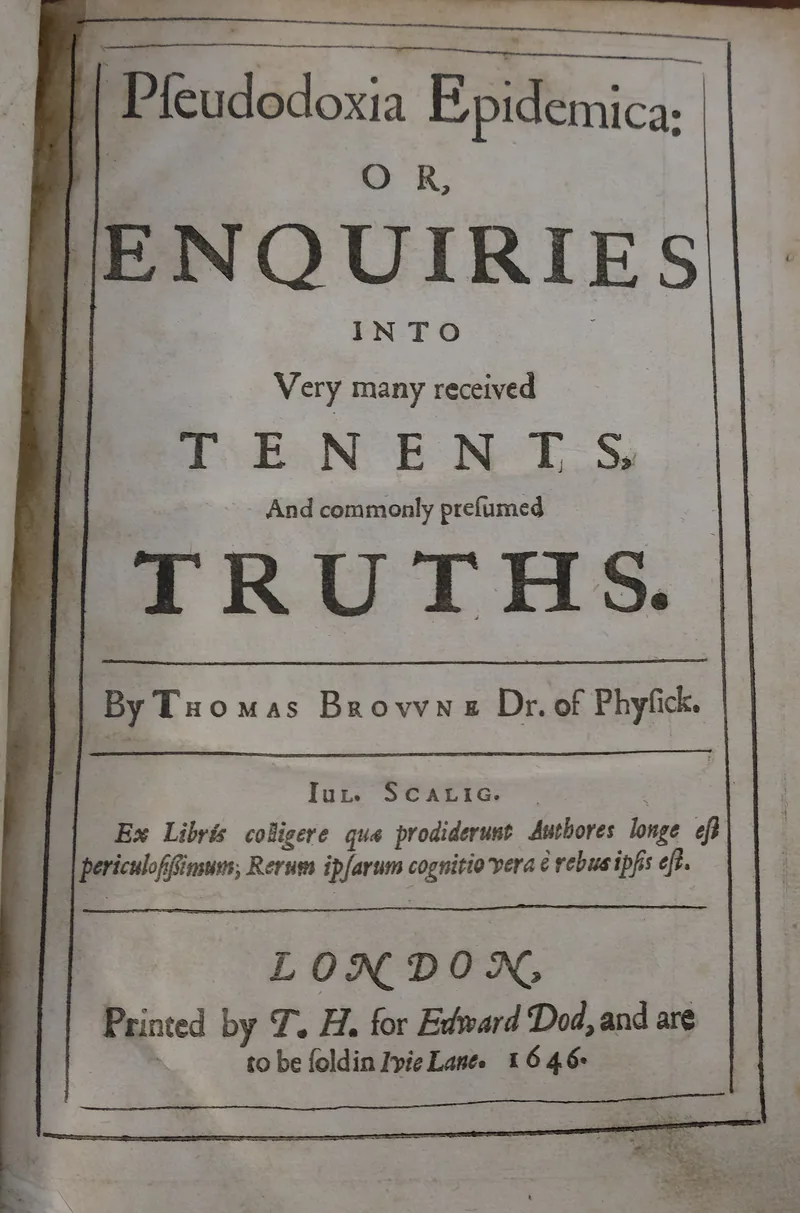
Knocking or touching wood, for example, has no reliable record before the nineteenth century. The unlucky combination of Friday and thirteen is not clearly attested before the late nineteenth century and was popularised in the early twentieth. The legend that Britain will fall if the ravens leave the Tower of London appears to be Victorian or later. The supposed ancient origins were often added by writers who assumed that any folk custom must be a fossil of paganism, an assumption that came from nineteenth-century anthropology rather than from the sources.
A responsible account therefore separates three things: the earliest dated record of a belief; genuinely ancient parallels, such as Roman concerns about sneezing or marrying in May, which may or may not be connected; and modern rationalisations invented to make a belief seem venerable. Ancient roots are sometimes real. They are simply not to be assumed. The site's general article on Myths and Misconceptions discusses the same problem across esoteric history.
Superstition, Religion and Magic§
The boundary between superstition and religion has always been contested. Medieval theologians condemned the use of charms but encouraged holy water, blessed candles and saints' relics; Protestant reformers then called many of those Catholic practices superstitious in turn. Much of what is now called superstition was once ordinary devotion: crossing oneself after a near miss, blessing a sneeze, avoiding work on certain holy days. The world of Folk Christianity shows how lay people combined official religion with their own protective customs.
Superstition also borders on magic and divination. Throwing salt over the shoulder is, structurally, a small protective rite; reading a dropped spoon as a sign of visitors is a tiny act of divination. The difference lies mostly in scale and intention. The specialist practices of cunning-folk and charmers are described in Folk Magic and Protective Magic, and the learned arts of reading signs in What Is Divination?
Why Superstitions Persist§
Superstitions survive in highly educated, technological societies. Hotels and office buildings omit the thirteenth floor, aircraft seat maps skip row thirteen, and in parts of East Asia buildings avoid floors numbered four. Athletes, students, performers and soldiers keep personal rituals before a test of skill or nerve.
Several explanations, which can work together, have been offered. Superstitions cost little and promise much, so keeping them is cheap insurance against uncertainty. They are learned socially, from parents, schoolfriends and colleagues, and observing them signals belonging. They offer a sense of control in situations, such as illness, exams, travel and competition, where outcomes are uncertain and important. Psychologists since B. F. Skinner's 1948 experiments with pigeons have studied how chance coincidences reinforce such behaviour, and how the mind's tendency to notice patterns and remember hits rather than misses keeps them alive; that research is surveyed in The Psychology of Superstition.
Above all, superstitions are part of culture. They encode attitudes to death, marriage, the household, animals and the unknown, and they record history in miniature: the spread of umbrellas and street lighting, Victorian mourning, the coming of printed newspapers. Studied carefully, they reveal how ordinary people thought about fortune long after the learned had stopped writing about it.
Frequently asked questions§
What is the simplest definition of superstition?§
A superstition is a belief that an action, object, sign or time brings good or bad luck, or predicts the future, by a connection that cannot be explained by ordinary cause and effect. The word also carries a judgement that the belief is mistaken.
Are superstitions really ancient?§
Some are, many are not. Romans worried about sneezes, owls and marrying in May, but many familiar Western superstitions, such as touching wood or fearing Friday the thirteenth, are first recorded in the eighteenth to early twentieth centuries. Dramatic pagan origin stories are usually modern inventions.
What is the difference between superstition and religion?§
Religion has organised beliefs, rites and authorities; superstition consists of scattered, usually half-believed practices about luck. Historically, though, the line has been drawn by religious authorities themselves, and practices called superstitious by one church were often devout to another.
Why do people still believe in superstitions?§
Most people keep superstitions as a cheap precaution, a habit learned from others or a way to feel in control of uncertain events, without fully believing them. Psychological research shows how coincidences and selective memory reinforce them.
Sources and further reading§
- A Dictionary of Superstitions — Iona Opie and Moira Tatem, 1989
- The Penguin Guide to the Superstitions of Britain and Ireland — Steve Roud, 2003
- A Dictionary of English Folklore — Jacqueline Simpson and Steve Roud, 2000
- Religion and the Decline of Magic — Keith Thomas, 1971
- Enchanted Europe: Superstition, Reason, and Religion, 1250–1750 — Euan Cameron, 2010
- Inventing Superstition: From the Hippocratics to the Christians — Dale B. Martin, 2004
- Believing in Magic: The Psychology of Superstition — Stuart A. Vyse, 1997
- On the Nature of the Gods — Cicero, 45 BCE