Old Wives' Tales: History of the Phrase and the Beliefs
Old wives' tales: the phrase from Plato and 1 Timothy, the Distaff Gospels, midwives and maternal impressions, and why women became the face of superstition.

An old wives' tale is a piece of traditional advice or belief, usually about health, pregnancy, children, the weather or luck, that is passed on by word of mouth and dismissed as unscientific. The phrase is very old: Greek philosophers, Roman poets and the New Testament all used versions of it to label ideas as foolish, and in each case the fool was imagined as an elderly woman. The history of the phrase is therefore also a history of how learned men drew the line between their own knowledge and the knowledge of women, midwives and the household.
An Ancient Insult: Old Women's Tales in Greece and Rome§
The idea that old women tell foolish stories was already proverbial in classical Athens. Near the end of Plato's Gorgias, after Socrates has told a myth about the judgement of souls, he anticipates that his opponent will dismiss it as a tale told by an old woman, mythos hōsper graos. The remark is ironic: Socrates thinks the story true, but he knows how such stories were usually received. The Greek adjective graōdēs, "old-womanish", became a standard term of contempt for credulous belief.
Latin writers inherited the stereotype. Horace, in the sixth satire of his second book, has a country neighbour "chatter old wives' tales" (aniles fabellas) to make a point, and the tale he tells is the fable of the town mouse and the country mouse, a reminder that the phrase could cover moral stories as well as nonsense. Cicero, in On the Nature of the Gods, has his Stoic speaker dismiss the crude mythology of the poets as "almost old-womanish superstitions" (superstitiones paene aniles). Here the phrase is joined directly to superstitio, the word whose history is traced in The Origins of Superstition. For a Roman gentleman, superstition was the vice of the uneducated, the fearful and the female, and the old woman stood for all three.
"Old Wives' Fables" in the Bible and the Christian Tradition§
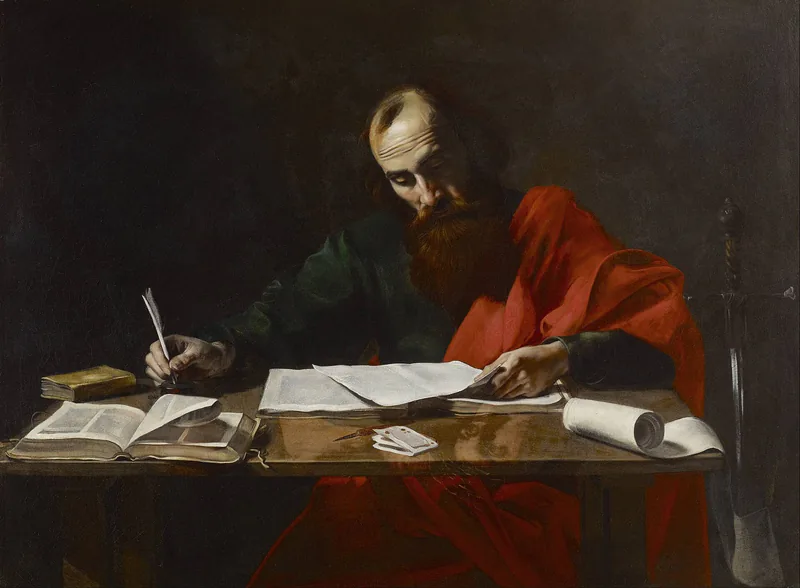
The phrase reached English mainly through scripture. In the First Epistle to Timothy, the writer urges his reader to avoid empty speculation, and the King James Version renders the verse: "But refuse profane and old wives' fables, and exercise thyself rather unto godliness" (1 Timothy 4). The Greek again uses graōdeis mythous. In context the target was probably a rival group of Christian teachers rather than grandmothers, but the vivid image ensured that the phrase passed into every European vernacular.
Medieval preachers and penitential handbooks condemned the observances of "foolish women" who watched for omens, used charms at childbirth or performed rites at New Year. Women were not the only people accused, but they were the most convenient symbol, because they ran the household, attended births and deaths, and cared for the sick, the places where much popular ritual was concentrated. After the Reformation, Protestant writers turned the same language against Catholic devotion. Reginald Scot, in his Discoverie of Witchcraft (1584), blamed "our mothers' maids" for frightening children with tales of bogeys, witches, elves and fairies, so that grown men still started at shadows; the book is discussed in Reginald Scot's Discoverie of Witchcraft.
The Distaff Gospels and the Spinning-Room§
The most remarkable document of the "old wives" tradition is a French text known as Les Évangiles des quenouilles, the Distaff Gospels, written in the Burgundian Netherlands in the second half of the fifteenth century. Its frame story describes a group of women who meet on six winter evenings to spin together. Each evening one of them presides and recites a series of "gospels", which the others gloss and approve, while a male secretary writes them down.
The "gospels" are hundreds of short beliefs and rules: how to tell whether an unborn child is a boy or a girl, what it means when a dog howls at night, how to protect a baby from fairies and the evil eye, which days are unlucky for beginning work, how a wife may keep her husband's love. Many correspond to beliefs recorded independently in later centuries, which makes the book a valuable early witness to popular lore, but it is also a satire. Its title parodies the Gospels, its women are comic, and the manuscripts associate the compilation with male authors. It was printed at Bruges around 1480 and translated into English in the early sixteenth century as The Gospelles of Dystaues. The modern editors Madeleine Jeay and Kathleen Garay have shown how the text both records and mocks a culture of female knowledge centred on the distaff, the hearth and the childbed.
Learned Men, Midwives and the Policing of Women's Knowledge§
From the sixteenth century onward, physicians increasingly defined their profession against "old women and empirics". Midwives, wise women and village healers were accused of ignorance, and occasionally of witchcraft, although historians of the European witch trials have found that midwives were not, as once claimed, especially likely to be prosecuted. Clerical writers such as the French priest Jean-Baptiste Thiers, whose Traité des superstitions appeared in 1679, compiled long catalogues of popular practices around baptism, marriage and sickness, many of them attributed to women.
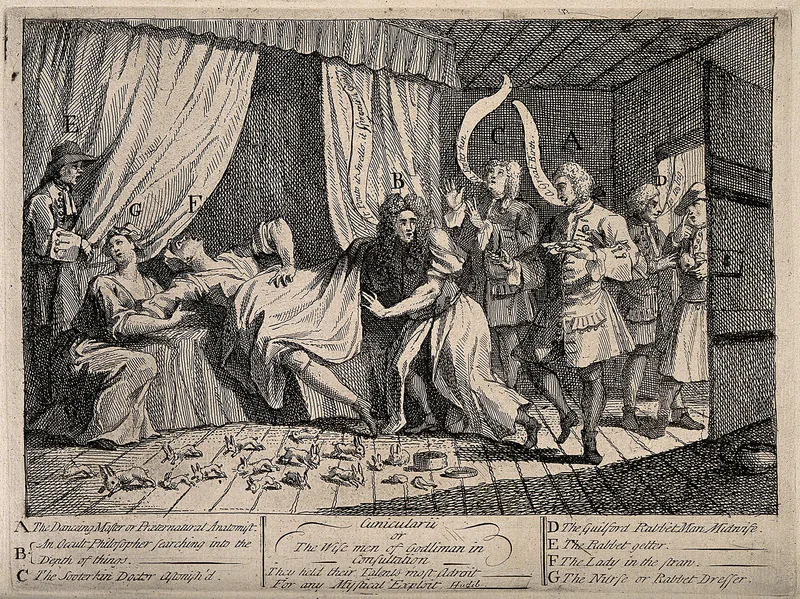
The boundary between learned and popular belief was far less clear than these authors claimed. A telling example is the theory of maternal impressions, the idea that what a pregnant woman saw, feared or craved could mark the body of her child. It sounds like a typical old wives' tale, yet it was taught by respected physicians from antiquity into the eighteenth century. In 1726 Mary Toft of Godalming in Surrey persuaded several medical men, including a surgeon to the royal household, that she had given birth to rabbits after being startled by one in a field. The hoax collapsed within weeks and was mocked by William Hogarth, but the episode showed that the "old wife" and the doctor could share the same assumptions. Similar beliefs about pregnancy and infancy are discussed in Superstitions of Birth, Marriage and Death.
When Old Wives Were Right, and When the Story Grew§
Popular writing often claims that old wives' tales "contain a grain of truth", and sometimes they do. Practical weather lore based on cloud and wind can be roughly reliable over short periods; herbal remedies occasionally contained active compounds; and advice to keep invalids warm, fed and rested was sensible in any age. The case most often cited is the foxglove. In 1785 the English physician William Withering published An Account of the Foxglove, in which he wrote that he had been asked his opinion of a family recipe for dropsy kept by an old woman in Shropshire, and that he identified foxglove as its active ingredient. His careful trials helped introduce digitalis into medicine.
Withering's anonymous informant was later given a name, "Mother Hutton", and a romantic biography, but this detail appears to come from twentieth-century advertising rather than from Withering himself. The story is a useful warning: the modern wish to vindicate the old wife can generate legends of its own. For most traditional predictions, such as guessing a baby's sex from the shape of the mother's bump or swinging a ring on a thread over her hand, systematic testing has found no better than chance results. The psychological reasons such beliefs feel convincing are explored in The Psychology of Superstition, and the wider history of herbal healing in Healing Charms and Folk Charmers.
The Old Wife as Storyteller: Mother Goose and the Folklorists§
The same figure who was mocked as a source of error was also celebrated as a source of stories. George Peele's comedy The Old Wives' Tale, printed in 1595, frames its action as a story told by an old woman to lost travellers by her fireside. In 1697 Charles Perrault published his fairy tales with a frontispiece showing an old woman spinning beside the hearth while children listen, captioned Contes de ma mère l'Oye, "Tales of My Mother Goose". The scholar Marina Warner has traced how this image of the female narrator shaped the European fairy tale, even as the published collections were edited by men.
Nineteenth-century folklorists depended on the same voices. Many of the informants behind collections of popular belief in Britain, Ireland, Germany and Scandinavia were older women, and their testimony now forms much of the documentary record surveyed by Iona Opie and Moira Tatem and by Steve Roud. Scholars today generally avoid "old wives' tale" as an analytical term, preferring "folk belief" or "vernacular knowledge", and they treat the women who carried these traditions as practitioners with their own logic rather than as the embodiment of superstition. The broader definitions are set out in What Is Superstition?, and the comparable figure of the hearth-side spirit in Household Spirits.
Frequently asked questions§
Where does the phrase "old wives' tale" come from?§
The idea goes back to classical Greek, where Plato and others spoke of tales told by an old woman. English usage owes most to the King James Bible, whose First Epistle to Timothy warns against "old wives' fables". By the sixteenth century "old wives' tale" was a common English expression.
What were the Distaff Gospels?§
The Distaff Gospels (Les Évangiles des quenouilles) is a fifteenth-century French text in which women gathered to spin recite hundreds of folk beliefs as mock "gospels". It records genuine popular lore about pregnancy, children, omens and marriage, but it was written as a satire and is usually attributed to male compilers.
Are old wives' tales ever true?§
Some traditional advice reflects real observation, such as certain weather signs or sensible care for the sick, and a few herbal remedies contained active substances. Most predictive beliefs, such as forecasting a baby's sex, perform no better than chance when tested. Stories of old wives being vindicated by science are sometimes embellished.
Why were superstitions blamed on women?§
Classical and Christian writers associated women with credulity, and women managed the domestic events, births, illnesses and deaths, around which much popular ritual gathered. Calling a belief an "old wives' tale" let learned men separate their own knowledge from household tradition, even when the two overlapped.
Sources and further reading§
- The Distaff Gospels: A First Modern English Edition of Les Évangiles des Quenouilles — Madeleine Jeay and Kathleen Garay (eds.), 2006
- From the Beast to the Blonde: On Fairy Tales and Their Tellers — Marina Warner, 1994
- A Dictionary of Superstitions — Iona Opie and Moira Tatem, 1989
- Religion and the Decline of Magic — Keith Thomas, 1971
- The Discoverie of Witchcraft — Reginald Scot, 1584
- An Account of the Foxglove and Some of Its Medical Uses — William Withering, 1785
- The Penguin Guide to the Superstitions of Britain and Ireland — Steve Roud, 2003