Liber XXIX · Superstitions · Chapter VI: Home & Hearth
Household Spirits: Brownies, Domovoi, Tomte and the Lares
Household spirits in folklore: the Roman Lares, Scottish brownies, English boggarts, German kobolds, Scandinavian tomte, the domovoi and the Kitchen God.

Household spirits are beings believed to live in a house or farm, protecting its people, animals and luck in return for respect and small offerings of food. They are found across Europe and Asia under many names: the Roman Lares, the Scottish brownie, the English hob and boggart, the German kobold, the Scandinavian tomte or nisse, the Slavic domovoi, the Japanese zashiki-warashi and the Chinese Kitchen God. Their legends share rules that tell much about traditional household life: feed the spirit, keep the house in order, do not insult or reward it wrongly, and above all do not drive it away, for when it leaves, the luck of the house goes with it.
The Spirit of the House: A Widespread Belief§
Belief in a protective spirit of the house appears wherever the household was an economic unit as well as a family: a farm with its fields, animals, stores and servants. The spirit was usually small, old, hairy or grey, and invisible most of the time. It lived in a particular place, the hearth, the stove, the barn or the cellar, and it took an interest in how the household was run. A tidy, generous house was rewarded with good harvests and healthy animals; a careless or mean one was plagued with mischief.
These spirits are close relatives of the fairies, but folklorists such as Katharine Briggs distinguished the "domestic" or "tutelary" type, attached to a family or place, from the trooping fairies who lived apart. Some scholars have linked household spirits to ancestor cults, since in several traditions the spirit is a "grandfather" or the founder of the house, while others see in them a personification of the order and luck of the home. The more practical charms that protected the same home from witches and misfortune are described in Household Superstitions.
Roman Lares, Penates and the Household Shrine§
The best-documented ancient household cult is Roman. Each family honoured its Lar familiaris, the guardian of the house, together with the Penates, gods of the store-cupboard (penus), and the Genius of the head of the household. In Plautus's comedy Aulularia, written around 200 BCE, the prologue is spoken by the Lar of the house, who explains that he has guarded a hidden pot of gold for generations and rewards the family according to their piety. Cato's farming manual instructs the farm manager's wife to garland the hearth and pray to the Lar familiaris on the Kalends, Ides and Nones of each month.
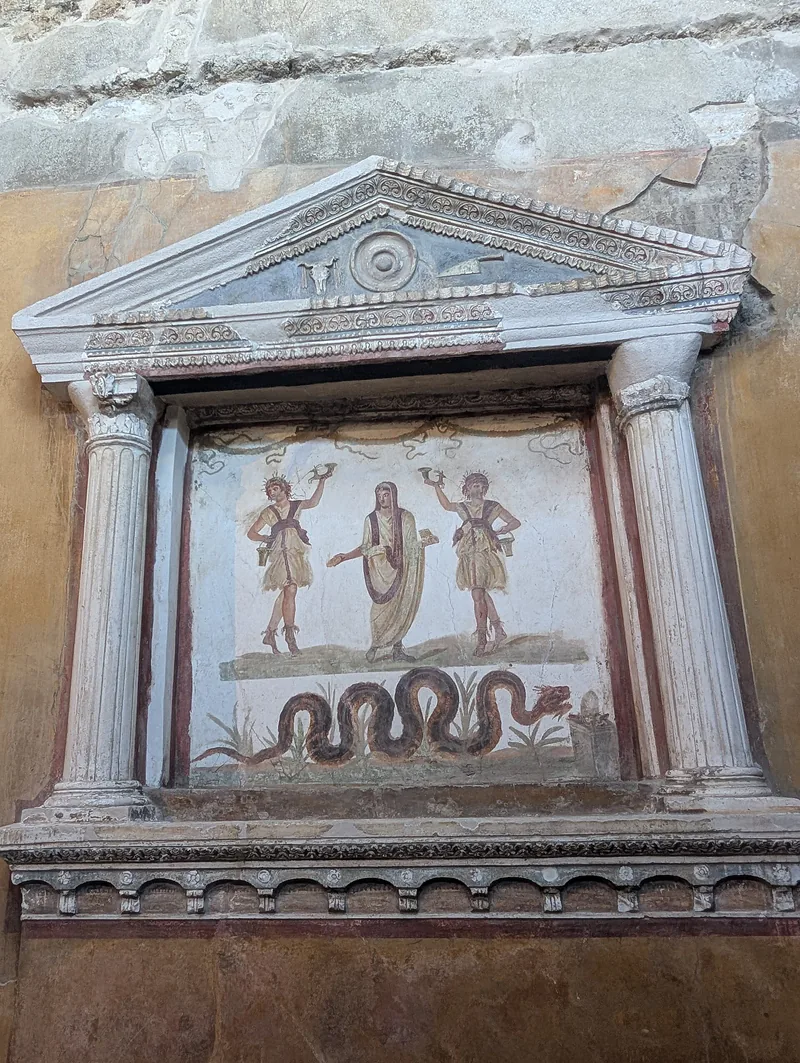
Many houses at Pompeii and Herculaneum preserve their lararia, small painted or built shrines in the kitchen or atrium. The typical painting shows two dancing Lares pouring wine, the Genius making an offering, and serpents beneath, symbols of the fertility of the place. Offerings of food, wine, incense and garlands were made at meals and family occasions. The Roman background is surveyed in Roman Religion; comparable household protectors in Egypt are described in the entry on Bes and Taweret.
Brownies, Hobs and Boggarts in Britain§
The brownie of Scotland and northern England is the classic British house spirit. James VI, in his Daemonologie (1597), describes a spirit "called Brownie" that appeared like a rough man and haunted houses doing useful tasks, and notes that some people thought it brought luck; the king regarded it as a devil. Martin Martin's Description of the Western Islands of Scotland (1703) reports that in Shetland families poured milk or wort into a hollow "Browny's stone" as an offering. The full text of King James's treatise is available in the reading room.
In later folklore the brownie threshed corn, churned butter, herded animals and tidied the house at night, asking only a bowl of cream or porridge. Gifts of clothing, however, drove him away, often with a rhyme of farewell, and so did criticism of his work. John Milton describes the same figure in L'Allegro as the "drudging Goblin" who earns his "Cream-bowle" by threshing a whole night's corn.
In England the hob or hobthrush played a similar role, and Robin Goodfellow combined household help with mischief. The boggart of Lancashire and Yorkshire was a brownie turned bad, who plagued the family he lived with. A widely told tale has a farmer move house to escape his boggart, only to hear a voice from the milk churn on the cart saying, "Aye, we're flitting". The household spirit belonged to the place and the family, not merely to the building.
Kobolds, Tomte and Nisse in Germany and Scandinavia§
In the German-speaking lands the kobold was a house spirit that could help with chores or cause trouble, and a mine spirit that misled miners; the metal cobalt takes its name from the kobolds whom miners blamed for ores that yielded no silver. The Heinzelmännchen of Cologne, little men who secretly did the townspeople's work at night until a curious tailor's wife scattered peas to trip them and see them, were made famous by August Kopisch's poem of 1836.
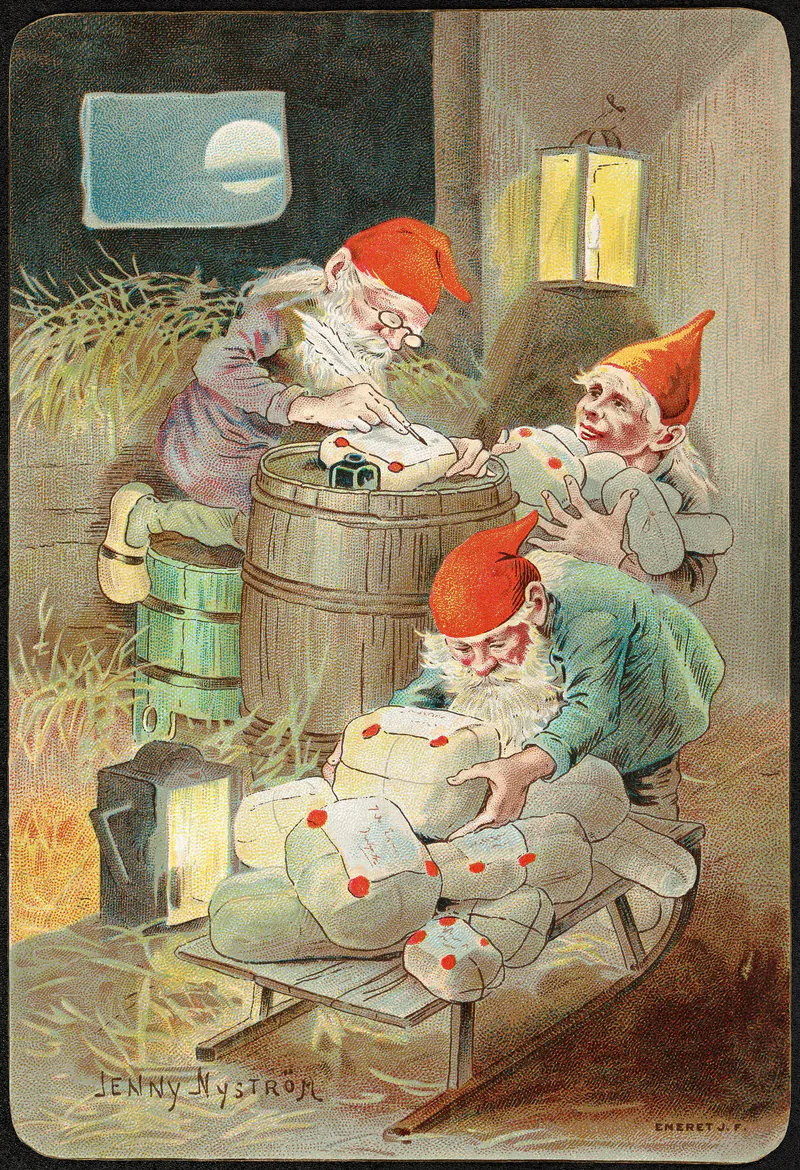
The Scandinavian tomte (Swedish) or nisse (Danish and Norwegian) was the guardian of the farmstead, often imagined as an old man of small size with a grey beard and red cap. He cared for the animals, especially horses, and expected to be treated with respect and given porridge with butter at Christmas. A well-known story tells of a nisse who, finding no butter on his Christmas porridge, killed the farm's best cow, only to discover the butter hidden at the bottom of the bowl, whereupon he went to the neighbour's barn and replaced the cow. The anthology Scandinavian Folk Belief and Legend collects many such accounts.
From the 1880s the farm spirit became a Christmas figure. Viktor Rydberg's poem Tomten (1881), illustrated by Jenny Nyström, and Nyström's popular Christmas cards turned him into the jultomte or julenisse, who brings gifts at Christmas and merges with Saint Nicholas and Father Christmas. Seasonal customs are discussed further in Wheel of the Year.
The Domovoi and the Slavic House Spirits§
In Russian and other East Slavic belief the domovoi, "the one of the house", was often called simply "grandfather" or "master". He lived behind or under the stove, the centre of the peasant house, and was rarely seen, though he might appear as a little old man covered in hair, as the head of the household, or as a cat. Peasants reported feeling his touch at night: a warm, shaggy hand foretold good fortune, a cold or bare one misfortune. The domovoi was fed with bread, salt and porridge, and households were careful not to anger him by quarrelling, swearing or neglecting the animals.
When a family moved, the domovoi had to be invited to come too, often by carrying embers from the old stove to the new one in a pot or an old bast shoe and speaking a formal invitation. Other spirits governed the outbuildings: the dvorovoi of the yard, the ovinnik of the threshing barn and the bannik of the bathhouse, the last regarded as the most dangerous. Linda Ivanits's Russian Folk Belief and W. F. Ryan's The Bathhouse at Midnight are the standard guides, and Slavic threshold customs are noted in European Superstitions.
Household Spirits in East Asia: The Kitchen God and Zashiki-warashi§
In Chinese popular religion the Kitchen God, Zao Jun, watches over the family from a paper image above the stove. At the end of the lunar year he ascends to heaven to report the household's conduct to the Jade Emperor, and families offer sweet foods such as malt sugar so that he will speak well of them, or so that his lips are sealed. His old image is burned to send him on his way, and a new one is put up for the New Year; see Chinese Ancestor Veneration and Popular Religion and New Year Superstitions.
In northeastern Japan the zashiki-warashi is a child spirit that lives in the inner rooms of old houses. Kunio Yanagita's The Legends of Tōno (1910) records local accounts: a house where the spirit lives prospers, and when it is seen leaving, the family's decline follows. The figure is related to the wider world of yōkai.
Across these traditions the household spirit expresses a moral economy of the home. Its rules of respect, order and generosity are the rules of a successful farm household, and its departure dramatises the sudden loss of luck that every family feared.
Frequently asked questions§
What is a brownie in folklore?§
A brownie is a household spirit of Scotland and northern England who secretly helps with farm and house work at night in return for cream or porridge. He leaves for good if offered clothes or if his work is criticised.
What is a domovoi?§
The domovoi is the house spirit of East Slavic folklore, believed to live by the stove and protect the family and its animals. Families fed him and, when they moved house, invited him to follow them by carrying embers from the old hearth.
Is the tomte the same as Santa Claus?§
Not originally. The tomte or nisse was a farm guardian spirit, but from the 1880s Scandinavian poetry, illustration and Christmas cards turned him into the jultomte or julenisse, a Christmas gift-bringer who later merged with Santa Claus.
Sources and further reading§
- A Dictionary of Fairies — Katharine Briggs, 1976
- Daemonologie — King James VI and I, 1597
- A Description of the Western Islands of Scotland — Martin Martin, 1703
- Scandinavian Folk Belief and Legend — Reimund Kvideland and Henning K. Sehmsdorf (eds), 1988
- Russian Folk Belief — Linda J. Ivanits, 1989
- The Bathhouse at Midnight: An Historical Survey of Magic and Divination in Russia — W. F. Ryan, 1999
- The Legends of Tono — Yanagita Kunio, 1975