Liber XXVI · Shinto · Chapter IX: Yokai & Folklore
Yōkai: Spirits, Demons and Monsters of Japanese Folklore
Yokai explained: the spirits and monsters of Japanese folklore, from kitsune, tengu, kappa and oni to the Night Parade of 100 Demons, Toriyama Sekien and Mizuki.

Yōkai (妖怪) are the strange beings of Japanese folklore: shape-shifting foxes and raccoon dogs, long-nosed mountain goblins (tengu), water imps (kappa), horned demons (oni), household objects come to life, and countless local apparitions blamed for unexplained events. Described in medieval tales and picture scrolls, catalogued by Edo-period artists such as Toriyama Sekien, and studied by modern folklorists, they occupy the ambiguous borderland between gods, ghosts and natural phenomena, and remain central to Japanese popular culture today.
What Are Yōkai? Words and Definitions§
The word yōkai combines characters meaning "bewitching" or "calamitous" and "strange" or "mysterious". It was used occasionally in earlier texts but became the common scholarly and popular term only through the Meiji-period philosopher Inoue Enryō (1858–1919), who founded a "yōkai studies" (yōkaigaku) aimed at explaining away superstitions. Before that, people spoke of bakemono or obake ("things that change form"), mononoke (malevolent spirits, especially of the living or dead that cause illness), and ayakashi (sea apparitions).
The historian of folklore Michael Dylan Foster describes yōkai as a category that is defined by mystery and ambiguity. They include creatures, spirits and phenomena, from a giant skeleton to the unexplained sound of beans being washed in a river at night. Many scholars distinguish yōkai from yūrei, the ghosts of particular dead people, usually depicted as pale women with long black hair and no feet, though the boundary is porous. Yōkai also overlap with the kami, since some were worshipped and some kami were feared.
Fallen Gods and Strange Phenomena: The Origins of Yōkai§
Yōkai have diverse origins. Some derive from Chinese lore, such as the fox spirits and nine-tailed foxes of Chinese literature, or the Chinese tiangou ("heavenly dog", a meteor) whose name became the Japanese tengu. Others are local spirits of mountains, rivers and the sea, or personifications of dangers such as drowning, avalanches and fog. In the Heian period, angry spirits of the dead and mononoke were thought to cause disease and were driven out by Buddhist monks and the yin-yang masters of Onmyōdō.
The pioneering folklorist Yanagita Kunio (1875–1962) argued that many yōkai were degraded kami: deities whose cult had lapsed and who survived in folk memory as frightening apparitions. This theory has been influential, though later scholars such as Komatsu Kazuhiko caution that it cannot explain all yōkai. Another category is the tsukumogami, utensils that come to life after a hundred years of service; a late medieval picture scroll tells how discarded household tools, angry at being thrown away, turn into monsters before being converted to Buddhism.
Foxes, Tengu, Kappa and Oni: Famous Yōkai§
Kitsune and tanuki§
The fox (kitsune) is both the sacred messenger of the rice deity Inari and a trickster able to take human form, often as a beautiful woman. Foxes with many tails were thought to be old and powerful; the legend of Tamamo-no-Mae, a nine-tailed fox who bewitched an emperor, was famous from the medieval period. Fox possession (kitsunetsuki) was a recognised affliction in rural Japan, treated by religious specialists. The tanuki, or raccoon dog, is a comic shape-shifter, often depicted with a sake flask and an enormous belly.
Tengu§
Tengu were first imagined in medieval Japan as bird-like creatures, often associated with arrogant or misguided Buddhist monks, who interfered with practice and led people astray. Later they came to be depicted as red-faced, long-nosed figures in the dress of mountain ascetics, linked with the yamabushi of Shugendō. Legend says that the tengu king Sōjōbō of Mount Kurama taught swordsmanship to the young warrior Minamoto no Yoshitsune.
Kappa§
The kappa, known by many regional names, is a child-sized water creature with a beak, a shell and a dish-like hollow on its head filled with water, which gives it strength. Stories say it drags people and horses into rivers, but it is also polite, keeps promises and loves cucumbers. Historians see the kappa as a personification of the dangers of water.
Oni§
Oni are horned demons or ogres, often red or blue, armed with iron clubs and wearing tiger-skin loincloths, an appearance sometimes explained by the "ox-tiger" (north-east) direction of the demon gate in yin-yang lore. They range from the torturers of Buddhist hells to bandit-like monsters such as Shuten-dōji, whom the warrior Minamoto no Raikō was said to have slain on Mount Ōe. Noriko Reider has traced how oni evolved from fearsome outsiders into the friendly figures of children's stories. At Setsubun, families still drive out oni by throwing beans.
Night Parades and Picture Scrolls: Yōkai in Art§
Medieval Japan imagined a Night Parade of One Hundred Demons (hyakki yagyō), a procession of monsters that roamed the capital on certain nights, death or illness befalling anyone who saw it. Picture scrolls on this theme, the most famous of which is preserved at the Shinjuan subtemple of Daitokuji in Kyoto and is usually dated to the sixteenth century, show a riotous procession of animated utensils, animals and grotesque creatures.
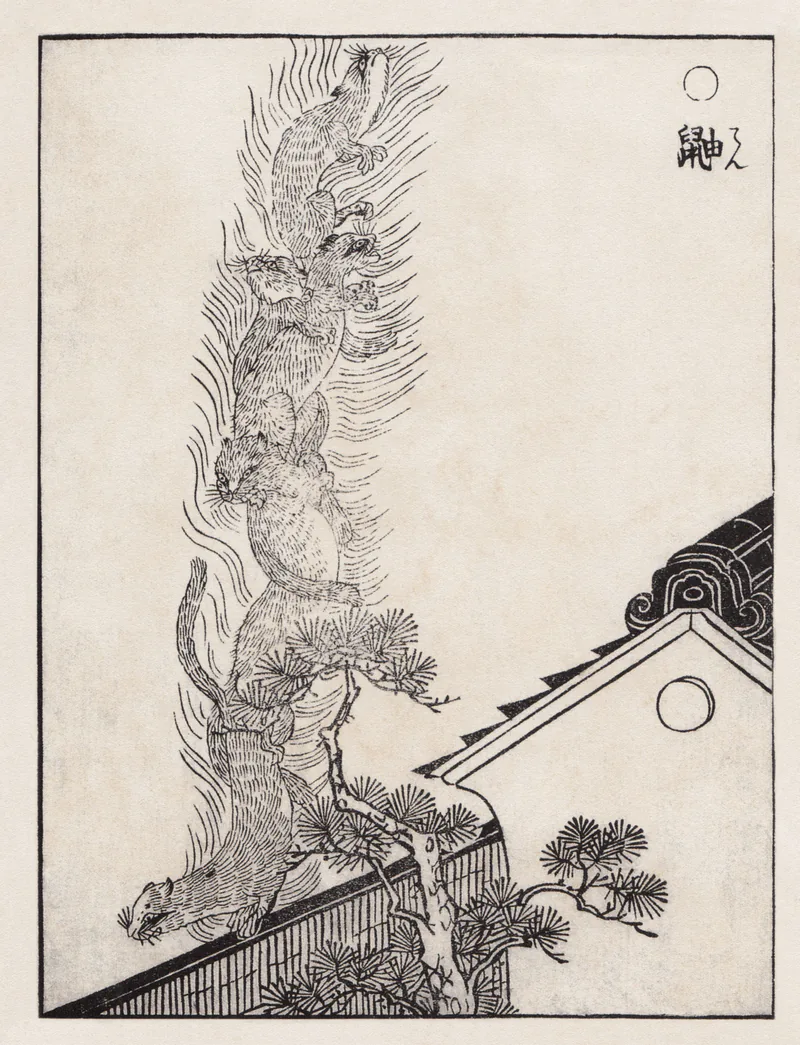
In 1776 the artist Toriyama Sekien (1712–1788) published The Illustrated Night Parade of a Hundred Demons, the first of four books that presented yōkai one by one, each with a name and often a short witty caption, like entries in an encyclopedia. Sekien drew on folklore, Chinese encyclopedias and his own invention, and his images became the standard reference for later artists. His work is available in English as Japandemonium Illustrated. Ukiyo-e masters such as Katsushika Hokusai, Utagawa Kuniyoshi and Tsukioka Yoshitoshi also produced celebrated yōkai and ghost prints.
Ghost Stories and the Edo Yōkai Craze§
Yōkai flourished as entertainment in the Edo period (1603–1868). Urban audiences enjoyed collections of strange tales (kaidan), kabuki plays of vengeful ghosts, such as Yotsuya Kaidan (1825), and a parlour game called hyakumonogatari kaidankai, "a gathering of a hundred strange tales", in which participants told stories by the light of a hundred lamps, extinguishing one after each tale, in the belief that something uncanny would appear when the last went out. Foster has argued that in this period yōkai shifted from objects of fear toward objects of play, collection and classification.
Many familiar yōkai were popularised in this way, including the rokurokubi, a woman whose neck stretches at night; the faceless nopperabō; the yuki-onna, a snow woman whose breath freezes travellers; and the zashiki-warashi, a child spirit that brings luck to a house. Lafcadio Hearn's retellings in Kwaidan (1904) introduced several of these stories to Western readers; comparable traditions elsewhere are surveyed in ghosts and hauntings.
From Superstition to Folklore Studies: Inoue Enryō and Yanagita Kunio§
The Meiji government's drive to modernise Japan cast yōkai as superstition. Inoue Enryō lectured and wrote voluminously to distinguish "false mysteries", explainable by psychology and natural science, from the "true mystery" he associated with philosophy and Buddhism. Gerald Figal has shown how this debate was bound up with the creation of a modern Japanese nation.
Yanagita Kunio, by contrast, sought in yōkai the traces of an older, authentic folk religion. His Legends of Tōno (Tōno monogatari, 1910), a collection of tales from a mountain district of Iwate told to him by a local storyteller, describes kappa, zashiki-warashi, mountain men and supernatural encounters as part of ordinary rural life. Yanagita's work founded Japanese folklore studies and remains a classic.
Yōkai in Modern Japan and Popular Culture§
From the 1960s Mizuki Shigeru's manga GeGeGe no Kitarō, about a yōkai boy who protects humans from malevolent spirits, created a national yōkai boom; Mizuki also produced illustrated encyclopedias that blended traditional lore with his own creations, and his hometown of Sakaiminato now has a street lined with yōkai statues. Yōkai appear in films such as Studio Ghibli's Pom Poko and Spirited Away, in video games and in anime, and new "urban legend" yōkai, such as the slit-mouthed woman (kuchisake-onna) of a 1979 rumour panic, continue to emerge. Scholars treat this living tradition as evidence of how Japanese culture continually reimagines the uncanny, from the shrine to the screen.
Frequently asked questions§
What is the difference between yōkai and yūrei?§
Yūrei are the ghosts of specific dead people, often returning because of a grudge or unfinished business. Yōkai is a broader term for strange creatures, spirits and phenomena, many of which were never human. In practice the categories overlap.
Are yōkai evil?§
Not necessarily. Some yōkai are dangerous, some mischievous, some helpful or bring good luck, and many are simply strange. Their ambiguity is one of their defining features.
Who was Toriyama Sekien?§
Toriyama Sekien (1712–1788) was an Edo-period artist whose illustrated catalogues of yōkai, beginning in 1776, depicted hundreds of creatures with names and captions. His images defined the appearance of many yōkai for later artists, including Mizuki Shigeru.
Sources and further reading§
- Pandemonium and Parade: Japanese Monsters and the Culture of Yōkai — Michael Dylan Foster, 2009
- The Book of Yōkai: Mysterious Creatures of Japanese Folklore — Michael Dylan Foster, 2015
- Japandemonium Illustrated: The Yokai Encyclopedias of Toriyama Sekien — Hiroko Yoda and Matt Alt (trans.), 2017
- Kwaidan: Stories and Studies of Strange Things — Lafcadio Hearn, 1904
- The Legends of Tono — Yanagita Kunio, trans. Ronald A. Morse, 1975
- Japanese Demon Lore: Oni from Ancient Times to the Present — Noriko T. Reider, 2010
- Civilization and Monsters: Spirits of Modernity in Meiji Japan — Gerald Figal, 1999
- An Introduction to Yōkai Culture: Monsters, Ghosts, and Outsiders in Japanese History — Komatsu Kazuhiko, 2017