Liber XXVI · Shinto · Chapter IX: Yokai & Folklore
Kitsune: Fox Spirits in Japanese Folklore and Inari Belief
Kitsune, the fox spirits of Japan: Inari's messengers, shape-shifting fox wives, nine-tailed foxes, Tamamo-no-mae and fox possession explained.

Kitsune, the Japanese word for "fox", names both the animal and one of the most important supernatural beings of Japanese religion and folklore. Foxes are honoured as the messengers of the rice deity Inari, whose shrines are guarded by pairs of stone foxes, and they are also feared and loved as shape-shifters who take human form, bewitch travellers, marry humans and possess the minds of the people they choose.
Kitsune in Japanese Religion and Folklore§
The fox occupies a distinctive place among the strange beings described in yōkai and Japanese folklore. Unlike most yōkai, it is a real animal, common in the countryside and often seen at the edges of fields and villages. Its intelligence, its nocturnal habits and its liminal position between the cultivated and the wild made it a natural figure for stories of trickery and transformation. At the same time, because foxes prey on the rodents that eat stored grain, they were associated with the protection of the rice harvest.
The result is a creature of deep ambiguity, as Michael Bathgate's study of the fox in Japanese religion emphasises: it can be a divine messenger or a seducer, a loyal wife or a malicious spirit, a bringer of wealth or of madness. Japanese folklore expresses this by distinguishing zenko, "good foxes", often associated with Inari and sometimes depicted as white, from yako, "field foxes", the mischievous or dangerous kind.
From China to Japan: Fox Spirits in Early Literature§
Stories of fox spirits were well established in China long before they appear in Japan. Chinese texts describe foxes that live for centuries, take the form of beautiful women or scholars, and in their highest form become heavenly foxes with nine tails. The nine-tailed fox appears in the ancient geographical work Shanhaijing, and medieval Chinese tales of fox women who drain the life of their lovers were widely read in Japan.
The earliest Japanese fox story is found in the Nihon ryōiki, a collection of Buddhist miracle tales compiled by the monk Kyōkai in the early ninth century. A man of Mino Province marries a beautiful woman he meets on a moor, and they have a son. The family dog constantly barks at her, and one day, frightened, she reveals herself as a fox. The husband tells her that he will never forget her and asks her to "come and sleep" with him always; the tale derives the word kitsune from this phrase, a folk etymology not accepted by linguists. Their son, it says, founded a lineage named after the fox.
Heian literature developed the theme. The scholar-official Ōe no Masafusa wrote a short Record of Fox Enchantments (Kobiki) in 1101, describing a series of fox apparitions in Kyoto, and the twelfth-century Konjaku monogatari shū contains numerous tales of foxes who lead men astray, take the form of women, or are tricked themselves.
Inari's Messengers: Foxes at the Shrine§
Inari is the kami of rice and, by extension, of agriculture, prosperity and commerce. The principal shrine, Fushimi Inari Taisha in Kyoto, traces its foundation to 711 and to the immigrant Hata lineage, and is famous for its thousands of vermilion torii donated by worshippers. Inari shrines, often estimated at around thirty thousand, are found in villages, city streets, office rooftops and private gardens, making Inari one of the most widely worshipped kami.
Foxes are Inari's messengers (tsukai). Pairs of stone or bronze foxes, often wearing red bibs, flank Inari shrines, holding in their mouths a jewel, a key to the rice granary, a scroll or a sheaf of rice. Worshippers offer fried tofu (aburaage), believed to be a favourite food of foxes, which explains the names of dishes such as inari-zushi and kitsune udon. Although theologians insist that the fox is the servant and not the deity, popular belief has often blurred the two.
The anthropologist Karen Smyers, in The Fox and the Jewel, showed how Inari worship combines Shinto and Buddhist strands. In esoteric Buddhism Inari was identified with Dakiniten, a deity derived from the Indian ḍākinī and depicted riding a white fox; the Sōtō Zen temple of Toyokawa Inari is the best-known Buddhist centre of this cult. Smyers also documented the variety of private meanings that worshippers attach to Inari, from family protector to personal guardian.
Shape-Shifters, Fox Wives and Fox Fires§
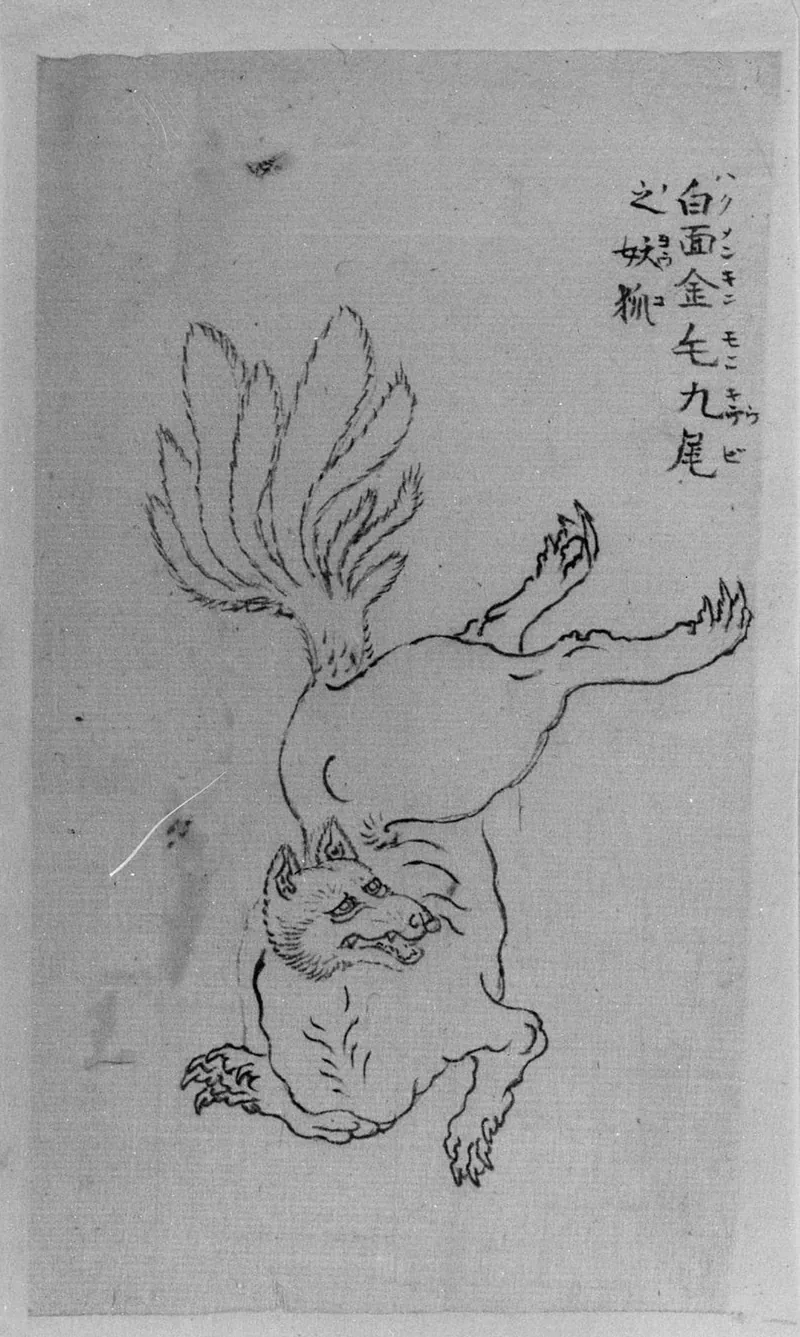
Folklore attributes to foxes the power of transformation (bakeru), which they share with the raccoon dog (tanuki). A fox was said to gain power with age: at fifty or a hundred years it could take human form, and it gained additional tails with its increasing age and power, up to nine. A fox of a thousand years might become a tenko, a heavenly fox, golden or white and close to the divine. Foxes were thought to create illusions, leading travellers in circles, turning leaves into money or dung into a feast, and the phrase "bewitched by a fox" (kitsune ni tsumamareru) is still used of baffling experiences.

Many tales concern fox wives. The most famous is the story of Kuzunoha, the white fox who married a man named Abe no Yasuna and became the mother of the great diviner Abe no Seimei. Such stories are often tender: the fox wife is a good mother and partner, and her departure, once her nature is revealed, is a source of grief rather than horror.
Other lore concerns natural phenomena. Kitsunebi, "fox fires", were mysterious lights seen in fields at night, and lines of such lights were called "the fox's wedding procession" (kitsune no yomeiri); the same phrase is used for rain falling while the sun shines. A famous print by Hiroshige, from his One Hundred Famous Views of Edo (1857), shows foxes gathering beneath a great tree near the Ōji Inari Shrine on New Year's Eve, their breath glowing as fox fire; according to local tradition, the foxes of the region assembled there each year before visiting the shrine.
Tamamo-no-mae and the Killing Stone§
The darkest fox legend is that of Tamamo-no-mae, a beautiful and learned woman at the court of the retired emperor Toba in the twelfth century. In the story, which developed in the late medieval period, the emperor falls mysteriously ill, and a court diviner of the Abe family discovers that Tamamo-no-mae is a nine-tailed fox. Exposed, she flees to the plain of Nasu in the east, where warriors hunt and kill her. Her spirit enters a rock, the Sesshōseki or "killing stone", which poisons any living creature that touches it, until a Zen monk, Gennō, pacifies it.
Later versions extended the story, identifying the same fox with notorious consorts of ancient Chinese and Indian rulers, so that she becomes a pan-Asian destroyer of kingdoms. The tale was dramatised in the Noh play Sesshōseki, in puppet theatre and in woodblock prints. The stone itself, at Nasu in Tochigi Prefecture, became a tourist attraction, and when it was found split in two in March 2022 the news was widely reported in Japan and abroad.
Fox Possession and Fox-Owning Families§
The belief that foxes could possess people (kitsune-tsuki) was widespread from the Heian period to the twentieth century. A possessed person might crave fried tofu or red beans, speak in a strange voice, behave wildly or fall ill; exorcism was performed by Buddhist priests, the mountain ascetics of Shugendō and other specialists, sometimes harshly. In the Meiji period doctors, including the German physician Erwin Bälz, studied fox possession as a psychiatric phenomenon, and reformers such as Inoue Enryō campaigned against it as superstition.
In some regions, especially Izumo and parts of central and eastern Japan, certain families were said to keep small fox-like spirits, known by local names such as osaki or kuda-gitsune, which brought them wealth by stealing from neighbours and could be sent to possess enemies. These fox-owning families (kitsune-mochi) were avoided in marriage, sometimes for generations, a form of social discrimination studied by folklorists and anthropologists into the late twentieth century. The idea of an animal spirit serving a household or sorcerer invites comparison with European beliefs about the witch's familiar.
Kitsune in Literature, Theatre and Modern Culture§
Foxes are favourite characters on the stage. In the kyōgen comedy Tsurigitsune an old fox disguises itself as a priest to warn a hunter against trapping foxes. In the puppet and kabuki play Yoshitsune senbon zakura (1747), a fox takes the form of a loyal retainer in order to follow a drum made from the skins of his fox parents, one of the most touching scenes of the repertoire. Lafcadio Hearn devoted a chapter to fox beliefs in Glimpses of Unfamiliar Japan (1894), introducing them to Western readers.
Today kitsune are everywhere in Japanese popular culture, from anime and video games to fox masks sold at festivals, and since the 1990s a costumed fox procession has been held in Ōji on New Year's Eve, inspired by Hiroshige's print. Behind the playful images, Inari shrines continue to receive the prayers of farmers, merchants and office workers, and the fox remains, as it has been for more than a thousand years, a messenger between the human world and the kami.
Frequently asked questions§
Are kitsune good or evil?§
Kitsune can be either. Japanese folklore distinguishes benevolent foxes, often associated with Inari, from mischievous or malicious ones, and many stories show foxes as loyal wives or grateful helpers as well as tricksters and possessing spirits.
Is Inari a fox?§
No. Inari is the kami of rice and prosperity, and foxes are Inari's messengers. Popular belief has sometimes treated the foxes as the deity itself, but shrine teaching distinguishes them.
What is a nine-tailed fox?§
In Chinese and Japanese lore a fox gains tails and power as it ages, and a fox with nine tails is extremely old and powerful. The most famous Japanese nine-tailed fox is Tamamo-no-mae, whose spirit was said to inhabit the killing stone at Nasu.
Sources and further reading§
- The Fox and the Jewel: Shared and Private Meanings in Contemporary Japanese Inari Worship — Karen A. Smyers, 1999
- Kitsune: Japan's Fox of Mystery, Romance, and Humor — Kiyoshi Nozaki, 1961
- The Fox's Craft in Japanese Religion and Folklore: Shapeshifters, Transformations, and Duplicities — Michael Bathgate, 2004
- Miraculous Stories from the Japanese Buddhist Tradition: The Nihon Ryōiki of the Monk Kyōkai — Kyoko Motomochi Nakamura, 1973
- The Book of Yōkai: Mysterious Creatures of Japanese Folklore — Michael Dylan Foster, 2015
- Glimpses of Unfamiliar Japan — Lafcadio Hearn, 1894
- The Catalpa Bow: A Study of Shamanistic Practices in Japan — Carmen Blacker, 1975