Liber XXVI · Shinto · Chapter VIII: Shugendo
Shugendō: Yamabushi and Japan's Mountain Asceticism
Shugendo explained: En no Gyoja, the yamabushi mountain ascetics, sacred peaks of Yoshino, Kumano and Haguro, the ten realms practice, and the Meiji ban.
Shugendō (修験道, "the way of acquiring power through austerities") is a Japanese religious tradition of mountain asceticism whose practitioners, the yamabushi ("those who lie down in the mountains"), enter sacred peaks to undergo hardships, rituals and symbolic death and rebirth, gaining spiritual power to heal, exorcise and pray for their communities. Combining the worship of mountain kami with esoteric Buddhism, Taoist and folk practice, it claims as its founder the seventh-century wonder-worker En no Gyōja and flourished from the medieval period until it was banned by the Meiji government in 1872.
Shugendō: The Way of Ascetic Power§
The word shugen combines shu, "to practise" or "to cultivate", and gen, "efficacy" or "proof", and refers to the extraordinary powers (genriki) that come from ascetic training. Long before Shugendō took organised form, Japanese mountains were regarded as the homes of kami and of the dead, and wandering ascetics, both Buddhist and unaffiliated, practised in them. From the Heian period these strands were drawn together under the influence of esoteric Buddhism, which provided a doctrinal framework of mandalas, mantras and initiations.
Shugendō is therefore a classic example of the Japanese combination of kami and buddhas described in Shinto and Buddhism. Its deities are mostly gongen, buddhas manifested as kami, and its practitioners have served both shrines and temples. Scholars such as Miyake Hitoshi have described it as a religion of the folk, synthesising elements that elsewhere belong to separate traditions.
En no Gyōja: Legend of the Founder§
Shugendō traces itself to En no Gyōja, "En the Ascetic", also called En no Ozunu. The official chronicle Shoku Nihongi records that in 699 En no Kimi Ozunu, who lived on Mount Katsuragi, was banished to the Izu peninsula after a disciple accused him of misleading people with sorcery, and that he was said to command spirits to draw water and gather firewood for him. The early ninth-century Buddhist tale collection Nihon ryōiki adds that he flew through the air and recited the spell of the Peacock King.
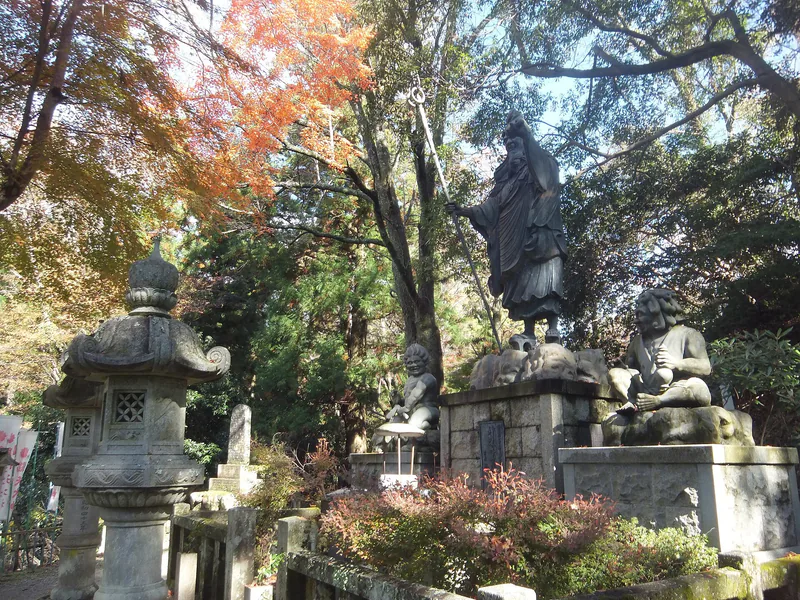
Later legend made him the opener of the great sacred mountains and the one who, through intense prayer on Mount Kinpu above Yoshino, called forth Zaō Gongen, a wrathful protector with one leg raised and a vajra in his hand, who remains Shugendō's principal deity at the temple Kinpusenji. En no Gyōja is often depicted as an old man with a staff, attended by two demons, Zenki and Gōki, whom he had subdued. In 1799 the imperial court granted him the posthumous title Jinben Daibosatsu. Historians regard the founder legend as largely a product of later centuries, built around a real but obscure figure.
Sacred Mountains: Yoshino, Ōmine, Kumano and Haguro§
Shugendō has many sacred mountains, each with its own traditions.
- Yoshino and Ōmine, in the Kii peninsula south of Nara, form the heartland. The ridge route between Yoshino and Kumano, the Ōmine okugake, is the most celebrated ascetic pilgrimage. Mount Sanjōgatake (Ōminesan) still maintains a ban on women entering its summit area, a long-standing practice that has become controversial.
- Kumano, with its three great shrines, was a goal of medieval pilgrimage by retired emperors and commoners alike. Its deities were identified with the buddhas Amida, Yakushi and Kannon, and Kumano was regarded as a Pure Land on earth. The Kii mountain sites and pilgrimage routes were listed as a UNESCO World Heritage Site in 2004.
- Dewa Sanzan, the Three Mountains of Dewa in Yamagata (Haguro, Gassan and Yudono), are associated with the present, the past and the future, or with birth, death and rebirth. The autumn retreat at Haguro was studied in detail by H. Byron Earhart.
- Other centres include Mount Hiko in Kyushu, Ishizuchi in Shikoku, Hakusan, Tateyama and Ontake, where lay confraternities later climbed under the guidance of ascetics.
In the medieval and early modern periods, practitioners were organised into two main branches: the Honzan-ha, affiliated with Tendai and led from the Shōgoin temple in Kyoto, and the Tōzan-ha, affiliated with Shingon and centred on the Sanbōin of Daigoji.
Entering the Mountain: Death, Rebirth and the Ten Realms§
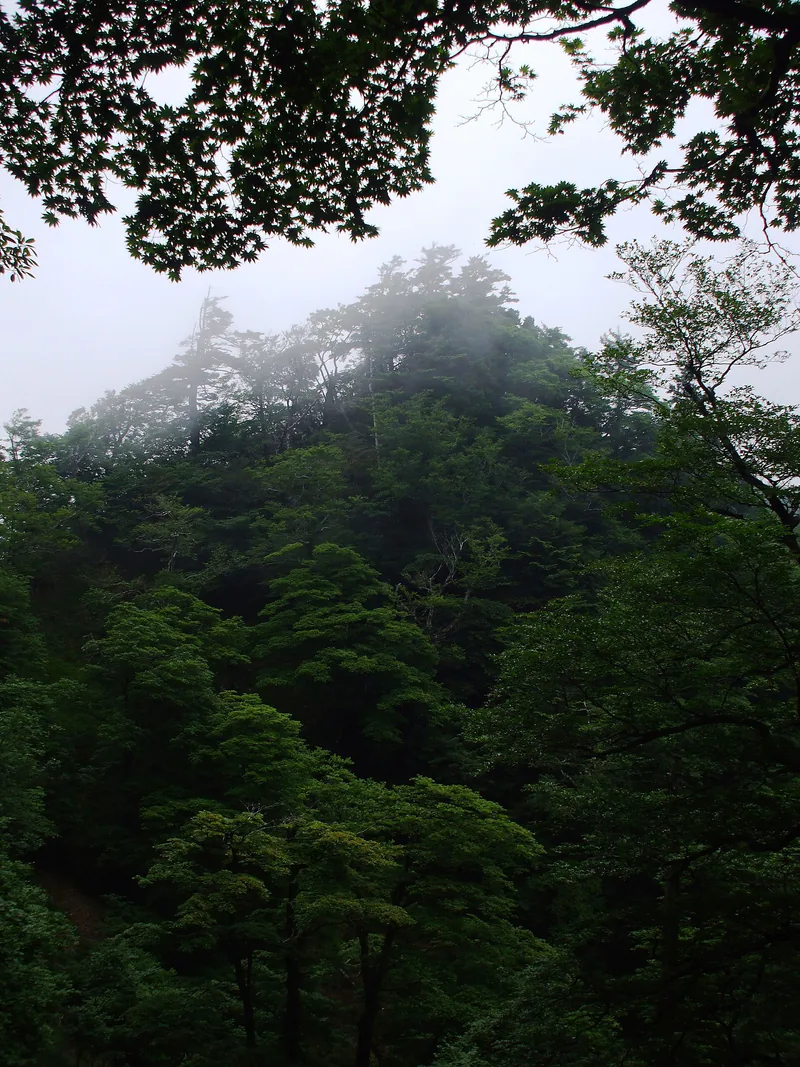
The central act of Shugendō is mine-iri, "entering the peak". The mountain is understood as the womb of the cosmic buddha, as a mandala in which each peak and rock is a deity, and as the realm of the dead. Entering it, the yamabushi symbolically dies, passes through the womb and is reborn with new power.
In many traditions this passage is structured as the ten realms practice (jikkai shugyō), in which practitioners pass through the ten realms of existence in Buddhist cosmology, from the hells, hungry ghosts and animals up through humans and gods to the realm of buddhas. Each realm is enacted through an ordeal: fasting and abstention from water, sitting before smoky fires, confession of sins, sumo wrestling, and the famous nozoki, in which a practitioner is held by the shoulders and leaned out over a precipice to confess and make vows. These are traditional ritual austerities undertaken only with experienced guides; accounts by Carmen Blacker and Earhart describe them as they were practised in the twentieth century.
The Yamabushi's Dress, Tools and Rituals§
Yamabushi wear a distinctive costume, each element given symbolic meaning: a small black cap (tokin) on the forehead, representing the crown of Dainichi; a checked robe (suzukake); a stole with coloured pompoms; a rosary; and a ringed staff (shakujō). They blow a large conch shell (horagai), whose sound is said to represent the Buddha's preaching and which signals movement on the mountain.
Their rituals draw on esoteric Buddhism: mudrā and mantra, the nine-syllable protective spell with its gestures cutting a grid in the air, and especially the saitō goma, an outdoor fire ritual in which a great pyre of cedar branches is lit to burn away defilements and carry prayers. Some groups also perform fire-walking and sword-ladder climbing as public demonstrations of ascetic power.
Healers, Exorcists and Village Religion§
For most of history the yamabushi's significance lay less in mountain retreats than in the village. Many settled in communities, where they performed prayers for health, rain and harvest, exorcised spirits believed to cause illness, made amulets, practised divination and guided pilgrims to the sacred mountains. Some worked with female mediums (miko), who were possessed by a deity or spirit while the ascetic questioned it, a combination analysed in Blacker's study of Japanese shamanism, The Catalpa Bow.
Folklore attributes to yamabushi magical powers and often associates them with the long-nosed mountain goblins known as tengu, who wear yamabushi dress; see yōkai and Japanese folklore. Shugendō practitioners also shared methods with the yin-yang specialists of Onmyōdō, such as directional taboos and protective talismans.
Suppression and Revival: Shugendō in Modern Japan§
The Meiji government's separation of kami and buddhas struck Shugendō with particular force, because it was by nature a combination of the two. In 1872 Shugendō was abolished by decree: practitioners had to join a Tendai or Shingon temple or become Shinto priests, and many mountain sites were converted into purely Shinto shrines. Haguro, for example, became a Shinto shrine, though a Buddhist branch persisted. Tens of thousands of yamabushi lost their status.
After the Second World War and the new freedom of religion, Shugendō groups re-formed as independent religious corporations, among them Kinpusenji's Kinpusen Shugen Honshū and the Honzan Shugenshū of Shōgoin. Today ascetic retreats on Ōmine, Haguro and other mountains attract priests, lay devotees and, increasingly, curious visitors from Japan and abroad, and Shugendō is studied as an important part of Japan's religious heritage.
Frequently asked questions§
What is a yamabushi?§
A yamabushi, literally "one who lies down in the mountains", is a practitioner of Shugendō who undergoes ascetic training in sacred mountains. Yamabushi are recognisable by their small black cap, checked robe, staff and conch-shell trumpet.
Is Shugendō Shinto or Buddhist?§
It is both. Shugendō combines the worship of mountain kami with esoteric Buddhist doctrine and ritual, and its main deities are buddhas manifested as kami. It is one of the clearest examples of the Japanese combination of Shinto and Buddhism.
Can women practise Shugendō?§
Many Shugendō groups now accept women, and women ascetics have a long, if often overlooked, history. Some sacred areas, notably the summit of Mount Ōmine (Sanjōgatake), still exclude women by tradition, a ban that is the subject of public debate.
Sources and further reading§
- The Catalpa Bow: A Study of Shamanistic Practices in Japan — Carmen Blacker, 1975
- A Religious Study of the Mount Haguro Sect of Shugendō — H. Byron Earhart, 1970
- Shugendō: Essays on the Structure of Japanese Folk Religion — Miyake Hitoshi, 2001
- The Mandala of the Mountain: Shugendō and Folk Religion — Miyake Hitoshi, 2005
- Buddhas and Kami in Japan: Honji Suijaku as a Combinatory Paradigm — Mark Teeuwen and Fabio Rambelli (eds.), 2003
- Shinto: A History — Helen Hardacre, 2017