Liber XXVI · Shinto · Chapter VI: Shinto & Buddhism
Shinto and Buddhism: Shinbutsu Shūgō and Honji Suijaku
Shinto and Buddhism explained: the fusion of kami and buddhas (shinbutsu shugo), honji suijaku, Ryobu and Sanno Shinto, and the Meiji separation of 1868.

For more than a thousand years, from the arrival of Buddhism in the sixth century until the Meiji government's separation edicts of 1868, Shinto and Buddhism in Japan were not two separate religions but parts of a single combined system known as shinbutsu shūgō, "the amalgamation of kami and buddhas". Under the theory of honji suijaku, the kami were understood as local manifestations, or "traces", of buddhas and bodhisattvas, shrines and temples shared precincts and clergy, and esoteric Buddhist schools built elaborate theologies of the kami.
The Arrival of Buddhism and the Response of the Kami§
According to the Nihon shoki, King Seong of Paekche sent a gilt-bronze image of the Buddha and scriptures to the Japanese court in 552; another early source gives 538. The chronicle reports a dispute among the leading clans: the Soga argued for accepting the foreign deity, while the Mononobe and Nakatomi warned that the native kami would be angered. When epidemics broke out, the image was thrown into a canal. The Soga eventually prevailed in 587, and under Prince Shōtoku (574–622) and later rulers Buddhism became a pillar of the state.
The early sources describe the Buddha as a "foreign kami" (adashikuni no kami), showing that the Japanese first understood him in the categories they already had. Buddhism brought writing, architecture, art and ritual technologies that transformed kami worship itself; permanent shrine buildings and images of kami developed partly under Buddhist influence. For the background, see What Is Shinto?.
Kami in Need of Salvation: Shrine-Temples and Protector Gods§
From the late seventh and eighth centuries, Buddhist monks began to found shrine-temples (jingūji) within or beside shrine precincts. Foundation stories record oracles in which a kami declared that it suffered from its karmic existence as a god and wished to hear the Buddhist teaching in order to be liberated. The kami were thus incorporated into the Buddhist cosmos as beings within the cycle of rebirth, in need of salvation like humans.
At the same time, kami were seen as protectors of the Dharma. The most famous case is Hachiman, the deity of Usa in Kyushu, who in 749 was brought to Nara to protect the casting of the Great Buddha of Tōdaiji, and in 781 received the title Great Bodhisattva. Temples installed protective kami (chinju) in their precincts, such as the Hie deities who guarded the Tendai monastery on Mount Hiei. Monks recited sutras before the kami, and Buddhist rites were performed for the benefit of shrines.
Honji Suijaku: Buddhas as Origin, Kami as Traces§
From the Heian period (794–1185) a more ambitious theory developed. Drawing on Chinese Buddhist philosophy, which distinguished an "original ground" (honji) from its "manifest traces" (suijaku), Japanese thinkers proposed that buddhas and bodhisattvas, out of compassion, had appeared in Japan in the form of kami, "softening their light and mingling with the dust" so as to reach people who could not grasp the Dharma directly. Kami came to be called gongen, "provisional manifestations", or myōjin, "bright deities".
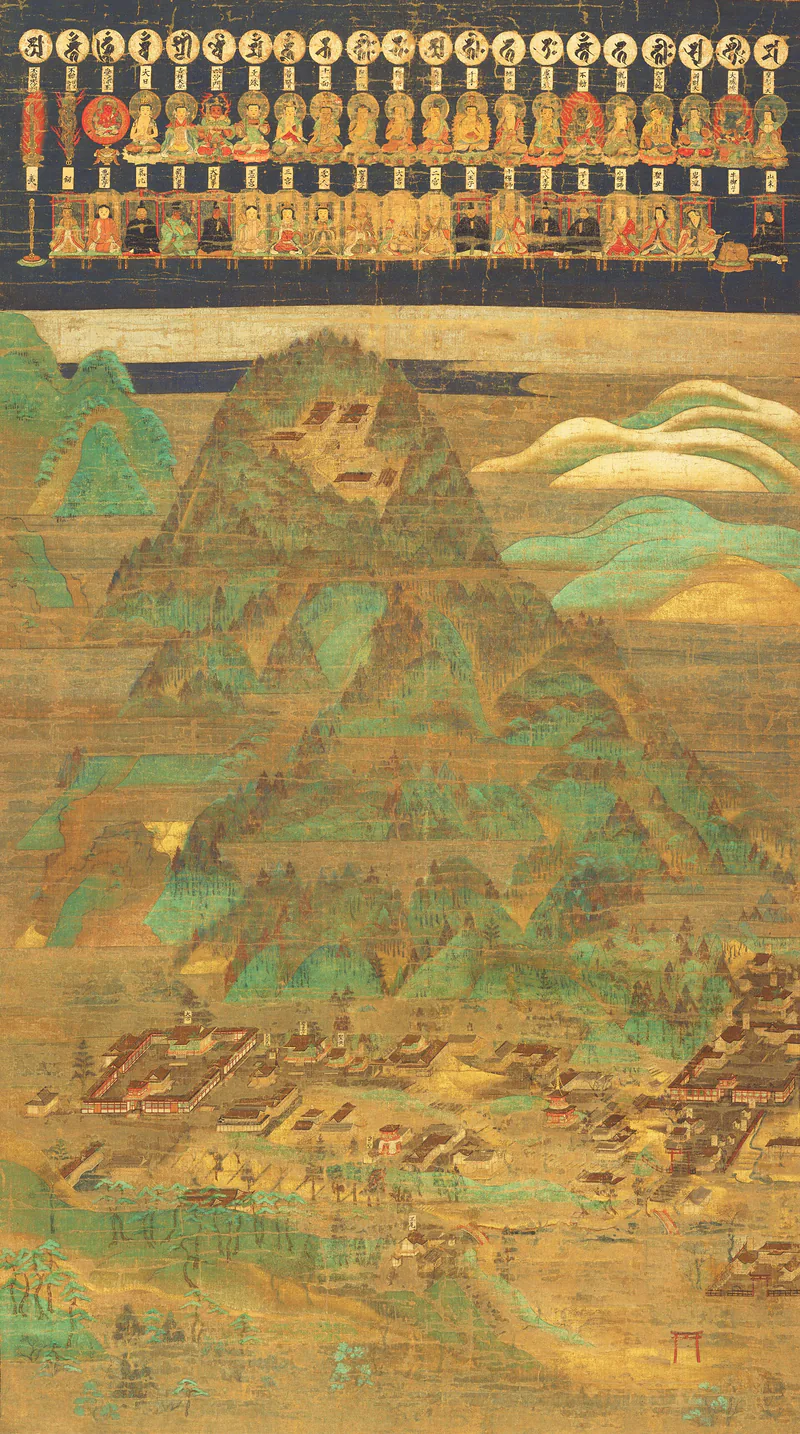
Specific pairings were established for each major shrine. Amaterasu was identified with Dainichi (Mahāvairocana), the cosmic buddha of esoteric Buddhism, whose name means "Great Sun"; Hachiman with Amida; the three Kumano deities with Amida, Yakushi and Kannon; and the gods of the Kasuga shrine in Nara with the buddhas and bodhisattvas worshipped at the neighbouring Kōfukuji temple. Paintings called shrine mandalas depicted a shrine's landscape with the buddhas floating above as its true identities. Mark Teeuwen and Fabio Rambelli describe honji suijaku as a flexible "combinatory paradigm" rather than a single doctrine.
Ryōbu and Sannō Shinto: Esoteric Theologies of the Kami§
The esoteric schools of Shingon and Tendai, described in esoteric Buddhism in Japan, developed the most elaborate kami theologies.
- Ryōbu Shinto ("Shinto of the two realms"), associated with Shingon, identified the Inner and Outer shrines of Ise with the two great mandalas of esoteric Buddhism, the Womb Realm and the Diamond Realm, so that the whole Ise complex became a map of the cosmic Buddha's body and mind.
- Sannō Shinto, associated with Tendai and the Hie shrines at the foot of Mount Hiei, interpreted the "Mountain King" (Sannō) deities as manifestations of the Buddha Śākyamuni and of the Lotus Sutra's teaching of the One Vehicle.
These theologies produced initiations, secret transmissions and ritual texts about the kami, many attributed to famous founders such as Kūkai. The mountain ascetics of Shugendō lived out the same combination in practice, worshipping kami-buddhas on sacred peaks.
Reversing the Order: Ise Shinto and Yoshida Shinto§
From the thirteenth century some shrine priests reversed the hierarchy. The Watarai priests of the Outer Shrine at Ise produced texts, later called the "Five Books of Shinto", that presented the kami as primordial and stressed purity and honesty as the core of their worship. Writers of the fourteenth century, among them Kitabatake Chikafusa, whose Chronicle of the Direct Descent of Gods and Sovereigns (1339) celebrated Japan as the land of the gods, drew on these ideas.
In the fifteenth century Yoshida Kanetomo (1435–1511) proclaimed "Unique Shinto" (Yuiitsu Shintō), claiming that Shinto was the root, Confucianism the branches and leaves, and Buddhism the flowers and fruit. Ironically, his rituals borrowed heavily from esoteric Buddhism and Taoism. Such reversed versions of honji suijaku prepared the way for the anti-Buddhist arguments of Edo-period Confucians and the scholars of National Learning, who sought a Shinto purified of foreign influence.
The Meiji Separation of Kami and Buddhas§
After the Meiji Restoration, the new government in 1868 issued a series of orders known collectively as the separation of kami and buddhas (shinbutsu bunri). Buddhist titles such as gongen and bosatsu were banned for kami; Buddhist images, bells and sutras were to be removed from shrines; and monks serving shrines were told to become Shinto priests or leave. In many places the orders unleashed a wave of destruction called haibutsu kishaku, "abolish the Buddha, destroy Śākyamuni". Temples were closed, statues burned or sold, and in the Satsuma domain virtually all temples were abolished. James Ketelaar's study describes how Buddhism was cast as a corrupt foreign religion in these years.
The separation was not total, and the destruction varied greatly by region, but it permanently reshaped Japanese religion. Combined cults such as the Kumano Gongen and the mountain sects of Shugendō, which was banned in 1872, were forcibly divided. The modern image of Shinto and Buddhism as two distinct religions owes much to these policies.
Combination in Contemporary Japan§
Despite the separation, combination survives. Many Buddhist temples still house protector kami, some shrines kept Buddhist elements, and the Seven Gods of Good Fortune mix Shinto, Buddhist, Taoist and Hindu figures. Toyokawa Inari, a famous site of the fox deity, is in fact a Zen temple. In everyday life, most Japanese visit shrines for births and festivals and temples for funerals and ancestral rites, a division of labour that continues the older pattern. Since the 2000s, some shrines and temples have revived joint rites, and pilgrimages such as the Kumano routes again celebrate kami and buddhas together.
Frequently asked questions§
What is shinbutsu shūgō?§
Shinbutsu shūgō means "the amalgamation of kami and buddhas". It refers to the combined religious system in which Shinto and Buddhism were integrated in Japan from roughly the eighth century until 1868, with shared precincts, clergy and theology.
What does honji suijaku mean?§
Honji suijaku means "original ground and manifest traces". It is the theory that buddhas and bodhisattvas are the original forms and that the Japanese kami are their local manifestations, adapted to the people of Japan.
Why were Shinto and Buddhism separated?§
The Meiji government separated them in 1868 to create a Shinto centred on the emperor and free of what it regarded as foreign Buddhist influence. The policy drew on earlier nativist and Confucian criticisms of Buddhism and led to widespread destruction of Buddhist property.
Sources and further reading§
- Buddhas and Kami in Japan: Honji Suijaku as a Combinatory Paradigm — Mark Teeuwen and Fabio Rambelli (eds.), 2003
- The Protocol of the Gods: A Study of the Kasuga Cult in Japanese History — Allan G. Grapard, 1992
- Of Heretics and Martyrs in Meiji Japan: Buddhism and Its Persecution — James Edward Ketelaar, 1990
- A New History of Shinto — John Breen and Mark Teeuwen, 2010
- Shinto: A History — Helen Hardacre, 2017
- Religion in Japanese History — Joseph M. Kitagawa, 1966