Liber XXVI · Shinto · Chapter III: The Kami
Amaterasu Ōmikami: The Sun Goddess of Shinto and Ise
Amaterasu Ōmikami, the Shinto sun goddess: her myths, the Rock Cave of Heaven, the imperial regalia, the Ise Grand Shrine and her worship through history.

Amaterasu Ōmikami, "the great kami who shines in heaven", is the sun goddess of Japanese mythology and the most honoured of the Shinto kami. The eighth-century chronicles describe her as ruler of the High Plain of Heaven and ancestor of the imperial family, and since at least the late seventh century she has been worshipped at the Inner Shrine of Ise, where a sacred mirror is kept as her symbol and vessel.
Amaterasu in the Kojiki and Nihon Shoki§
The two court histories compiled in the early eighth century, the Kojiki and the Nihon shoki, are the oldest written sources for Amaterasu; their compilation and purpose are described in Myths of the Kojiki and Nihon Shoki. In the Kojiki, the god Izanagi returns from the underworld Yomi polluted by death and washes in a river. From his left eye is born Amaterasu, from his right eye the moon god Tsukuyomi, and from his nose the storm god Susanoo. Delighted with these "three noble children", Izanagi gives Amaterasu his necklace of jewels and entrusts her with the High Plain of Heaven (Takamagahara). The story of her parents is told in Izanagi and Izanami.
The Nihon shoki gives several versions. In its main text the sun goddess is born to Izanagi and Izanami together, and she is also called Ōhirume no muchi, a name usually understood as "great sun woman" or "great woman of the sun".
Amaterasu's relationship with Susanoo drives much of the narrative. Before leaving heaven, Susanoo comes to visit her, and she meets him armed, suspecting an invasion. The two hold a contest of oaths (ukei): she breaks his sword and produces three goddesses, later worshipped at Munakata in Kyushu; he chews her jewels and produces five male deities. Because the males came from her jewels, they are reckoned her children, and the eldest, Ame no Oshihomimi, becomes the ancestor of the imperial line.
The Rock Cave of Heaven: Amaterasu Hides from the World§
After his victory Susanoo runs riot. He breaks down the dikes of Amaterasu's rice fields, defiles the hall where she tastes the first fruits, and throws a flayed horse through the roof of the sacred weaving hall, killing one of the weaving maidens. In fear and anger Amaterasu enters the Rock Cave of Heaven (Ame no Iwato) and closes the door. Heaven and earth fall into darkness, and all kinds of misfortune arise.
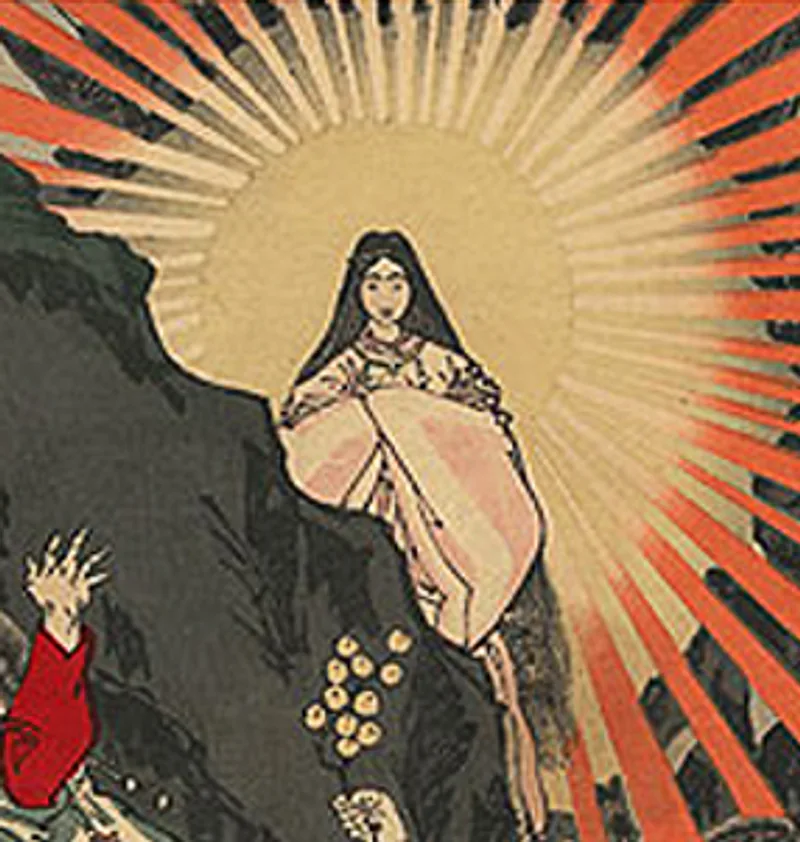
The eight hundred myriad kami gather in council by a riverbed in heaven. On the advice of the wise god Omoikane they assemble long-crowing birds, have a mirror and strings of curved jewels made, hang them with cloth offerings on a sacred sakaki tree, and recite solemn words. The goddess Ame no Uzume then dances on an upturned tub before the cave, half-exposing herself in an ecstatic performance, and the assembled gods roar with laughter. Curious, Amaterasu opens the door a little to ask why they rejoice in the dark. She is told that a deity greater than she has appeared, and as she leans out to look, the mirror is held up to her. The strong god Tajikarao pulls her out, and a straw rope (shimenawa) is stretched behind her so she cannot return. Light comes back to the world, and Susanoo is fined and expelled from heaven.
Scholars have read this episode as a myth of the winter solstice, an eclipse or royal renewal, and it clearly mirrors ritual: the mirror, the jewels, the sakaki branch, the rope and the dance all appear in later shrine worship. Ame no Uzume was regarded as the ancestress of the Sarume, a lineage of female court dancers, and the story is the traditional origin of kagura sacred dance, described in Shinto festivals.
The Heavenly Grandson and the Imperial Regalia§
Once the land below has been pacified, Amaterasu, often acting together with the creator deity Takamimusubi, sends her grandson Ninigi down to rule it. He descends to the peak of Takachiho in Kyushu carrying three treasures: the mirror (Yata no kagami) used to lure her from the cave, the jewel (Yasakani no magatama), and the sword (Kusanagi) that Susanoo had taken from the tail of the eight-headed serpent. In the Kojiki she instructs that the mirror be revered as if it were her own spirit. Ninigi's great-grandson is Jimmu, the legendary first emperor, whose accession the Nihon shoki places in a year corresponding to 660 BCE, a date historians regard as a later construction.
These three objects became the imperial regalia (sanshu no jingi), the tokens of legitimate rule handed on at every accession. According to tradition the mirror is kept at Ise, the sword at the Atsuta Shrine in Nagoya, and the jewel in the imperial palace, with replicas of the mirror and sword also kept at court. None has ever been publicly displayed.
Some historians have pointed out that Takamimusubi, not Amaterasu, appears as the commanding deity in several early passages, and have suggested that he was an older ancestral god of the Yamato rulers and that Amaterasu was raised to supreme position during the state-building of the late seventh century. Others connect a female solar ancestor with the female rulers of early Japan. Such theories remain debated.
The Ise Grand Shrine and the Imperial Priestess§
The Nihon shoki tells that the mirror was first kept in the palace, then moved out under Emperor Sujin, and finally brought to Ise by the princess Yamatohime, who wandered through several provinces until the goddess declared that she wished to dwell beside the Isuzu River. Historians generally date the establishment of Ise as the royal cult centre to the reigns of Tenmu and Jitō in the late seventh century, when the first recorded periodic rebuilding of the shrine took place, traditionally in 690.
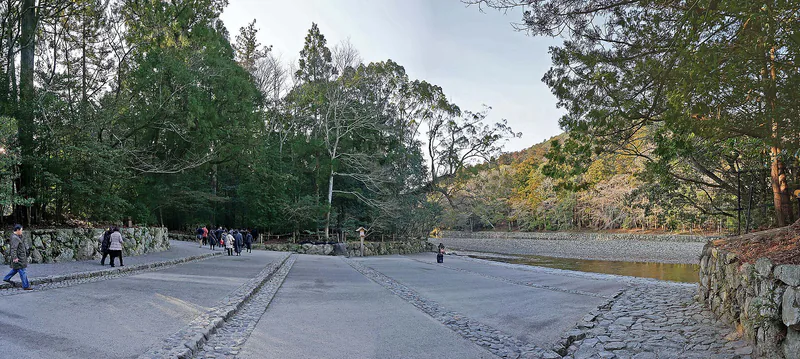
The Ise Grand Shrine (Ise Jingū) consists of the Inner Shrine (Naikū), dedicated to Amaterasu, and the Outer Shrine (Gekū), dedicated to Toyouke, the goddess of food who serves her meals, together with more than a hundred subsidiary shrines. Both main sanctuaries are rebuilt on adjacent plots every twenty years in the ceremony of shikinen sengū, most recently in 2013; the architecture and the cycle are discussed in Shinto shrines and purification.
For centuries an unmarried imperial princess, the saiō, served as Amaterasu's priestess at Ise, living in a separate palace under strict rules of purity. The institution is attested from the late seventh century and lapsed in the fourteenth. Twice a day priests of the Outer Shrine still offer food to Amaterasu, and the rice harvest rites of the court, the Niinamesai and Daijōsai, are offered to her above all.
Pilgrims, Amulets and Medieval Transformations§
In early centuries Ise was reserved for the emperor's offerings; private offerings were forbidden. As imperial support declined in the medieval period, the shrines turned to wider patrons. Priestly agents called oshi (or onshi) travelled the country, organised confraternities (Ise-kō) that pooled savings to send members on pilgrimage, distributed paper amulets of the shrine, and lodged visitors at Ise. By the Edo period (1603–1868) a journey to Ise was a once-in-a-lifetime aspiration for ordinary people, and waves of mass pilgrimage called okage mairi swept the country in 1705, 1771 and 1830, involving by contemporary estimates millions of people.
Medieval religion also transformed the goddess. Under the theory of honji suijaku, explained in Shinto and Buddhism, Amaterasu was identified with Dainichi, the cosmic "Great Sun" buddha of esoteric Buddhism, and the two Ise shrines with the two great mandalas. Medieval texts and images sometimes portrayed the deity in Buddhist forms, as a dragon or serpent, or even as male.
In the eighteenth century the National Learning scholar Motoori Norinaga insisted that Amaterasu was literally the sun that shines over every country, a claim his contemporary Ueda Akinari disputed in a famous exchange. Motoori's reading fed the later ideology of Japan as the land of the sun goddess's descendants.
Amaterasu in Modern Japan§
After 1868 the Meiji state placed Ise at the summit of a national hierarchy of shrines and promoted reverence for Amaterasu as the imperial ancestor. Ise amulets (Jingū taima) were distributed to households across the country to be kept on the domestic altar, the kamidana, a practice that continues today on a voluntary basis. The ideology of the emperor's divine descent, central to State Shinto, was officially disowned after 1945, but the imperial family still reports major events to Amaterasu at Ise and at the palace sanctuary of the Kashikodokoro.
For many Japanese today Amaterasu is less a figure of political theology than the kami of a beloved pilgrimage site and a symbol of light and renewal. She is honoured at shrines throughout Japan, often under the name Shinmei. Comparative mythologists, as surveyed in gods and goddesses, note that a female sun deity is unusual among the world's mythologies, and Amaterasu has become an important figure for feminist readings of Japanese religion.
Frequently asked questions§
Who is Amaterasu?§
Amaterasu Ōmikami is the sun goddess of Japanese mythology and the principal kami of Shinto. The eighth-century chronicles make her the ruler of heaven and the ancestor of the imperial family, and she is worshipped above all at the Inner Shrine of Ise.
Why did Amaterasu hide in a cave?§
In the myth she withdraws into the Rock Cave of Heaven after her brother Susanoo ruins her rice fields and kills one of her weaving maidens. The world falls dark until the gods lure her out with a mirror, jewels and the dance of Ame no Uzume.
What is the sacred mirror of Amaterasu?§
The mirror, Yata no kagami, is one of the three imperial regalia. According to the myths it was made to draw Amaterasu from the cave and given to her grandson Ninigi as her spirit; tradition holds that it is enshrined at Ise, though it has never been shown publicly.
Is Amaterasu still worshipped today?§
Yes. Millions of people visit the Ise Grand Shrine each year, shrines to Amaterasu exist throughout Japan, and many households keep an Ise amulet on their domestic altar. The imperial family also continues to perform rites addressed to her.
Sources and further reading§
- Kojiki — trans. Donald L. Philippi, 1968
- Nihongi: Chronicles of Japan from the Earliest Times to A.D. 697 — W. G. Aston, 1896
- A Social History of the Ise Shrines: Divine Capital — John Breen and Mark Teeuwen, 2017
- Shinto in History: Ways of the Kami — John Breen and Mark Teeuwen (eds.), 2000
- Buddhas and Kami in Japan: Honji Suijaku as a Combinatory Paradigm — Mark Teeuwen and Fabio Rambelli (eds.), 2003
- Shinto: A History — Helen Hardacre, 2017