Liber XXVI · Shinto · Chapter III: The Kami
Tenjin: Sugawara no Michizane and Japan's Vengeful Spirits
How the exiled scholar Sugawara no Michizane became Tenjin, kami of learning: the goryō cult of vengeful spirits, Kitano Tenmangū, Dazaifu and plum blossom.

Tenjin (天神, "heavenly deity") is the kami of learning, scholarship and calligraphy worshipped at some ten thousand shrines in Japan, and he is the deified spirit of Sugawara no Michizane (845–903), a Heian court scholar and minister who died in exile. Michizane was first worshipped as a goryō, an angry spirit blamed for lightning, plague and the deaths of his enemies, and only gradually became the benevolent patron to whom students now pray before examinations.
Sugawara no Michizane: Scholar and Statesman§
Michizane was born in 845 into the Sugawara family, a line of hereditary scholars who taught at the court academy. A gifted poet in classical Chinese (kanshi) and a historian, he passed the highest state examination, served as governor of Sanuki province on Shikoku, and returned to the capital to become a trusted adviser of Emperor Uda. In 894 he was appointed ambassador to Tang China but recommended that the embassy be suspended, and no further official missions were sent.
Under Uda's patronage Michizane rose far above the usual rank of scholars. In 899, under the young Emperor Daigo, he became Minister of the Right, second only to Fujiwara no Tokihira, the Minister of the Left and head of the powerful Fujiwara clan. His rise was resented. In 901 Tokihira's faction accused him of scheming to place a son-in-law, a prince, on the throne, and Michizane was demoted to the post of provisional governor-general of Dazaifu, the government headquarters in Kyushu, in effect a sentence of exile. He lived there in poverty and ill health and died in 903. The historian Robert Borgen's biography shows a dedicated official whose fall had more to do with court politics than with any crime.
The Plum Tree and the Exile's Poems§
Michizane's poetry made his exile memorable. Before leaving the capital he addressed a famous verse to the plum tree in his garden, asking it to send its fragrance on the east wind and not to forget the spring though its master was gone. A later legend tells that the tree, longing for him, flew through the night to Dazaifu, where a "flying plum" (tobiume) still grows before the shrine. Plum blossoms became his emblem, and the plum-blossom crest appears on Tenjin shrines throughout Japan.

His Chinese poems from Dazaifu, collected after his death, describe hunger, sickness and the injustice of his fate, and they helped create the image of a loyal minister wrongly punished. That image was essential to what followed: in Heian belief the spirits of those who died with unresolved grievances were especially dangerous.
The Goryō Cult: Angry Spirits of the Wrongfully Dead§
Belief in goryō (御霊, "honourable spirits") and the related onryō (vengeful ghosts) was already well established. The court attributed epidemics and disasters to the spirits of nobles who had died in political disgrace, especially Prince Sawara, brother of Emperor Kanmu, who starved himself in 785 after being accused in an assassination plot; he was posthumously given the title of emperor in an attempt to calm him. In 863 the court held a goryōe, a festival to console the spirits of six such figures, in the Shinsen'en garden of the capital, with music, dance and sutra readings. The Gion festival of Kyoto, traditionally dated to 869, began as a similar rite to drive away pestilence.
Pacification combined Buddhist ritual, posthumous honours and entertainment. The underlying idea was that a dangerous spirit could be transformed: properly honoured, it would turn its power from destruction to protection. Specialists in onmyōdō and esoteric Buddhism were called upon to identify such spirits and perform rites against them. This logic, rather than any ancient theology, explains how many human beings became kami.
Lightning over the Palace: Michizane Becomes a God§
In the decades after Michizane's death misfortune struck his enemies. Tokihira died in 909, still in his thirties. In 923 the crown prince, Tokihira's nephew, died, and the court restored Michizane posthumously to his office and burned the order of exile; two years later the prince's young son and heir also died. In 930 lightning struck the Seiryōden, a hall of the imperial palace where officials were meeting, killing several of them, and Emperor Daigo, who fell ill after witnessing the disaster, died a few months later. Michizane's spirit was widely blamed and identified with the god of thunder.
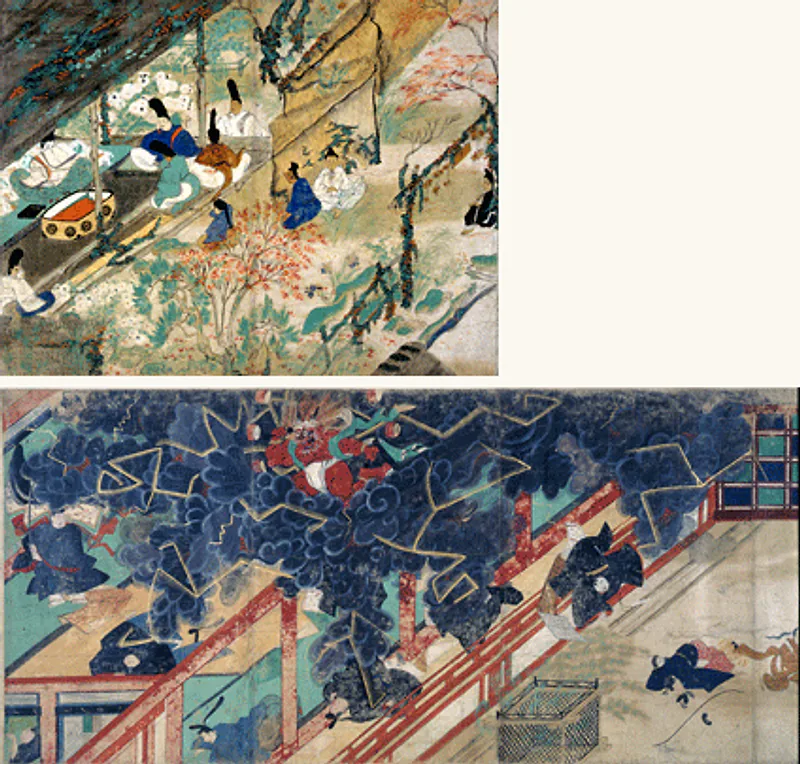
Visions confirmed the identification. A text attributed to the monk Nichizō describes how, during a near-death experience in 941, he met Michizane in the other world as a powerful deity commanding thunder spirits, and saw Emperor Daigo suffering in hell for his treatment of the minister. In 942 a woman of the capital named Tajihi no Ayako received an oracle in which Michizane asked to be worshipped at Kitano, north-west of the palace, and in 947 a shrine was built there. In 987 the court began to send official offerings, and in 993 Michizane was posthumously promoted to Chancellor (daijō daijin), the highest office of state. He was now Tenman Daijizai Tenjin, "the Heavenly Deity of Great Freedom who Fills the Heavens".
Kitano Tenmangū, Dazaifu and the Spread of the Tenjin Cult§
Two great shrines stand at the heart of the cult. Kitano Tenmangū in Kyoto grew into a major shrine-temple complex; its illustrated history, the Kitano Tenjin engi emaki, painted in the early thirteenth century, depicts Michizane's career, the thunder god attacking the palace and Nichizō's journey through the hells, and is one of the masterpieces of Japanese narrative painting. Dazaifu Tenmangū in Kyushu stands over his grave; tradition holds that the ox drawing his coffin stopped and refused to move at this spot. Oxen, as a result, are sacred to Tenjin, and statues of reclining oxen, their heads polished by worshippers' hands, stand in many Tenjin shrines.
In the era of Shinto and Buddhist fusion Tenjin was identified with the Eleven-headed Kannon, and in the Muromachi period Zen monks told how he had travelled in a dream to China to study with a Chan master, an image known as Totō Tenjin. As his anger faded from memory, his learning came to the fore: he became the patron of poetry, especially linked verse (renga), of calligraphy, and of the temple schools (terakoya) of the Edo period, where an image of Tenjin was often hung. He was also invoked by those falsely accused.
Tenjin Today: The God of Examinations§
In modern Japan Tenjin is above all the god of examinations. Each winter students and their families visit Tenjin shrines to pray for success in school and university entrance tests, writing their wishes on wooden ema plaques that hang by the thousand. Kitano and Dazaifu hold plum-blossom festivals on 25 February, the anniversary of Michizane's death, and Osaka's Tenjin Matsuri in July, with its river procession of illuminated boats, is counted among the three great festivals of Japan.
Michizane is the most famous of the human beings who became kami, but not the only one. The tenth-century rebel Taira no Masakado, whose head is said to have flown back to the east after his execution, is honoured at the Kanda Myōjin shrine in Tokyo, and the retired Emperor Sutoku, who died in exile in 1164 cursing the court, was feared for centuries; in 1868 his spirit was ceremonially returned to Kyoto at the start of the Meiji era. These cults show a distinctive feature of Japanese religion described in The Kami: the dead, and especially the unhappy dead, can become gods, and worship is a means of turning their wrath into blessing.
Frequently asked questions§
Who is Tenjin in Shinto?§
Tenjin is the deified spirit of Sugawara no Michizane (845–903), a Heian scholar and minister who died in exile. He is worshipped as the kami of learning, scholarship and calligraphy at Kitano Tenmangū, Dazaifu Tenmangū and thousands of other shrines.
Why was Michizane feared after his death?§
After his exile and death, a series of deaths among his political enemies and a deadly lightning strike on the imperial palace in 930 were blamed on his angry spirit. The court honoured him with a shrine and posthumous titles to pacify him.
What is a goryō?§
A goryō is the spirit of a person who died with a grievance, often in political disgrace, and was believed to cause disasters and epidemics. Through rites, festivals and enshrinement such spirits could be calmed and transformed into protective kami.
Why do students pray to Tenjin?§
Because Michizane was one of the greatest scholars of his age, Tenjin became the patron of learning. Students visit his shrines, especially before entrance examinations, and write their hopes on votive plaques.
Sources and further reading§
- Sugawara no Michizane and the Early Heian Court — Robert Borgen, 1986
- Ōkagami, the Great Mirror: Fujiwara Michinaga (966–1027) and His Times — Helen Craig McCullough (trans.), 1980
- Japanese Tales — Royall Tyler, 1987
- The Fluid Pantheon: Gods of Medieval Japan — Bernard Faure, 2016
- A New History of Shinto — John Breen and Mark Teeuwen, 2010
- Shinto: A History — Helen Hardacre, 2017