Liber XXVI · Shinto · Chapter II: Festivals & Rites
Shinto Festivals and Rites: Matsuri, Kagura and the Ritual Year
Shinto festivals and rites explained: the structure of matsuri, mikoshi and floats, the rice-year rites, Gion Matsuri, kagura and Shinto rites of passage.

Shinto festivals, or matsuri, are community rites in which the kami of a shrine is purified, welcomed, offered food and drink, entertained with music, dance and processions, and then sent back to its dwelling, renewing the bond between the kami and its people. They follow an agricultural calendar centred on rice, from the spring prayer for the harvest to the autumn thanksgiving, and are complemented by shrine rites of passage for births, children, weddings and new buildings.
The Meaning and Structure of Matsuri§
The word matsuri refers both to a shrine's formal rites and to the public festivities around them. Scholars and priests often describe a common underlying pattern. First, priests and participants undergo purification; then the kami is invited to descend or to manifest; offerings (shinsen) of rice, sake, fish, vegetables, fruit and salt are presented, and the priest reads a norito, a ritual prayer in classical Japanese; branches of the sacred sakaki tree are offered by representatives of the community. Finally the offerings are shared in a feast, the naorai, in which humans eat with the kami, before the kami is sent back.
Public festivals add celebration. The kami's spirit is transferred to a mikoshi, a portable shrine carried on the shoulders of young men and, increasingly, women, through the shrine's parish, sometimes shaken vigorously to energise the kami. Towns build floats (dashi, yama or hoko), decorated with tapestries, puppets or lanterns, and pulled through the streets with music. Fairs, food stalls, sumo, horse races, archery and theatre may follow. The festival thus reaffirms the identity of a neighbourhood as well as its relationship to its kami. For the precinct and purification rites, see shrines and purification.
Rites of the Rice Year: Toshigoi and Niiname§
Shinto's ritual calendar grew out of rice agriculture, and the imperial court has long performed rites to secure the harvest. The Toshigoi-sai, the prayer for the year's crops, is held in February. In October the Kanname-sai at Ise offers the first rice of the new harvest to Amaterasu.

The Niiname-sai, celebrated on 23 November, is the most important rite of the court calendar: the emperor offers newly harvested rice to the kami and partakes of it himself. Since 1948 the date has been a national holiday, Labour Thanksgiving Day. After a new emperor's accession, the first Niiname-sai is performed on a grand scale as the Daijōsai, an enthronement rite whose most recent celebration took place in November 2019 for Emperor Naruhito, and whose public funding again prompted debate about the separation of religion and state. At village shrines, spring festivals pray for a good crop and autumn festivals give thanks, while rice-planting rites (otaue) with music and dance are performed in some regions.
Great Festivals of Japan§
Every shrine has its annual festival, but some have become famous throughout Japan.
- The Gion Matsuri of Yasaka Shrine in Kyoto, held through July, began, according to tradition, in 869 as a rite to placate the spirits believed to cause an epidemic. Its procession of towering wheeled floats (yamaboko), sponsored by the city's neighbourhoods, is one of the best-known festival spectacles in Japan.
- The Aoi Matsuri of the Kamo shrines in Kyoto, held on 15 May, preserves a procession in Heian-period court costume.
- The Tenjin Matsuri in Osaka, in late July, honours the deified scholar Sugawara no Michizane with a river procession of boats.
- The Kanda Matsuri and Sannō Matsuri were the great festivals of Edo (Tokyo).
- The Onbashira festival of the Suwa shrines in Nagano, held every six years, involves felling giant fir trunks and riding them down a mountain slope before raising them at the shrine corners.
In 2016 thirty-three float festivals were inscribed together on UNESCO's list of intangible cultural heritage as "Yama, Hoko, Yatai, float festivals in Japan".
Kagura: Sacred Music and Dance§
Kagura is the music and dance offered to the kami. Its mythical model is the dance of the goddess Ame-no-Uzume before the Rock Cave of Heaven, which drew the sun goddess Amaterasu out of hiding, as told in the Kojiki. Scholars distinguish mikagura, the court kagura performed at the imperial palace with ancient instruments and songs; miko kagura, graceful dances by shrine maidens holding bells, fans or branches; and the varied sato kagura ("village kagura"), which include masked dramas of myths such as Susanoo's slaying of the eight-headed serpent, performed in regions such as Iwami in Shimane and Takachiho in Kyushu.
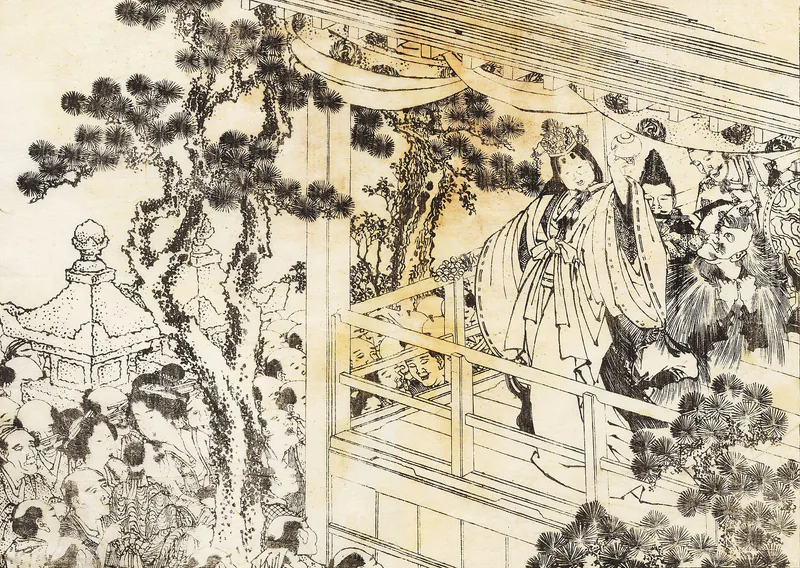
Some forms of kagura, like the "hot-water kagura" (yudate) in which boiling water is sprinkled on participants with bamboo leaves, have purificatory functions. Kagura also influenced later Japanese performing arts, including Noh.
The Calendar of the Year: New Year, Setsubun and Seasonal Rites§
The year begins with hatsumōde, the first shrine or temple visit of the New Year, which draws millions of people to major shrines such as Meiji Jingū in Tokyo. Households display pine and bamboo decorations and sacred ropes to welcome the year's deity, and old amulets are returned to shrines to be burned.
Setsubun, around 3 February, marks the eve of spring in the old calendar. People throw roasted soybeans while calling "demons out, fortune in", a custom descended from the court exorcism of demons (tsuina), influenced by Chinese practice and by the yin-yang masters of Onmyōdō. Seasonal festivals of Chinese origin, such as the Girls' Festival in March, the Boys' Festival in May and Tanabata in July, are observed at home and at some shrines, while the summer festival for the dead, Obon, is Buddhist. The Great Purifications of June and December mark the two halves of the year.
Rites of Passage: From Birth to Marriage§
Shrines mark many stages of life:
- Hatsumiyamairi: a baby's first shrine visit, about a month after birth, presenting the child to the local kami.
- Shichi-go-san ("seven-five-three"): on or around 15 November, girls of three and seven and boys of three and five (customs vary) are dressed in their best clothes and taken to the shrine to pray for healthy growth.
- Weddings: the Shinto wedding ceremony (shinzen kekkon), with the exchange of sake cups before the kami, became popular in the twentieth century after the wedding of the crown prince in 1900 set a model; many couples now choose Christian-style or secular ceremonies.
- Yakubarai: purification for people in their "unlucky years" (yakudoshi), traditionally 25 and 42 for men and 19 and 33 for women, counted in the traditional way.
- Jichinsai: a ground-breaking ceremony to pacify the kami of the land before construction, still widely performed even for modern office towers.
Funerals are usually Buddhist, though Shinto funerals (shinsōsai) exist and were promoted in the nineteenth century. See What Is Shinto? for the historical division between shrine and temple roles.
Matsuri in Modern Japan§
Festivals have survived industrialisation, war and urbanisation, but they have changed. In cities, neighbourhood associations and businesses sponsor festivals; in depopulating rural areas, communities struggle to find young people to carry mikoshi, and some festivals have been suspended or adapted. Tourism and heritage policy have given festivals new audiences and funding, while anthropologists such as Michael Ashkenazi and John Nelson have documented how participants combine devotion, civic pride and sheer enjoyment. Many festivals were cancelled or scaled down during the COVID-19 pandemic of 2020–2021 and have since been revived.
Frequently asked questions§
What is a matsuri?§
A matsuri is a Shinto festival in which the kami of a shrine is honoured with purification, offerings, prayers, music and processions, often including a portable shrine carried through the community. The word also refers more broadly to the act of worshipping the kami.
What is a mikoshi?§
A mikoshi is a portable shrine into which the kami's spirit is ritually transferred during a festival. It is carried on poles through the shrine's parish so that the kami can visit and bless its territory.
What happens at shichi-go-san?§
At shichi-go-san, held around 15 November, children aged three, five and seven are dressed in formal clothes and taken to a shrine, where prayers are offered for their health and growth. Children traditionally receive long, thin "thousand-year candy" as a wish for long life.
Sources and further reading§
- A Year in the Life of a Shinto Shrine — John K. Nelson, 1996
- Matsuri: Festivals of a Japanese Town — Michael Ashkenazi, 1993
- Engi-shiki: Procedures of the Engi Era — trans. Felicia G. Bock, 1970
- Shinto: A History — Helen Hardacre, 2017
- Practically Religious: Worldly Benefits and the Common Religion of Japan — Ian Reader and George J. Tanabe Jr., 1998
- Shinto: The Kami Way — Sokyo Ono, 1962