Liber XXVI · Shinto · Chapter III: The Kami
The Kami: Gods, Spirits and Sacred Powers of Shinto
The kami of Shinto explained: what kami are, Motoori Norinaga's definition, Amaterasu, Hachiman and Inari, deified humans like Tenjin, and the mitama spirit.

Kami are the gods, spirits and sacred powers worshipped in Shinto: celestial deities such as the sun goddess Amaterasu, gods of mountains, rivers, rice and the sea, clan and village protectors, and human beings honoured after death, all of whom are believed to reside in or visit shrines and natural sites. The Edo-period scholar Motoori Norinaga defined a kami as anything extraordinary that inspires awe, and Japanese tradition speaks of "eight hundred myriad kami", an expression meaning a countless number.
What Are Kami? Motoori Norinaga's Definition§
The Japanese word kami is singular and plural at once and has no exact English equivalent. "God" suggests a single almighty being, "spirit" something insubstantial; kami can be personal deities with names and genealogies, or impersonal sacred presences felt in a waterfall, an ancient tree or a mountain. A popular etymology links kami with kami, "above", but historical linguists doubt the connection, because the two words appear to have been pronounced differently in Old Japanese.
The best-known definition comes from Motoori Norinaga (1730–1801), the leading scholar of the National Learning movement. In his commentary on the Kojiki he explained that kami include the deities of heaven and earth in the classics, the spirits enshrined in shrines, human beings, birds, beasts, trees, grasses, seas and mountains, indeed anything out of the ordinary that possesses superior power and inspires awe. He stressed that kami need not be noble or good: evil and strange things that are deeply awe-inspiring are also kami. This broad view remains influential, though scholars note that it reflects Norinaga's own theological project.
The Eight Hundred Myriad Kami: Kinds of Kami§
The classical myths divide the gods into heavenly kami (amatsukami), who dwell in or descend from the High Plain of Heaven (Takamagahara), and earthly kami (kunitsukami), who belonged to the land before the descent of Amaterasu's grandson. Beyond this mythological scheme, kami can be grouped in several overlapping ways:
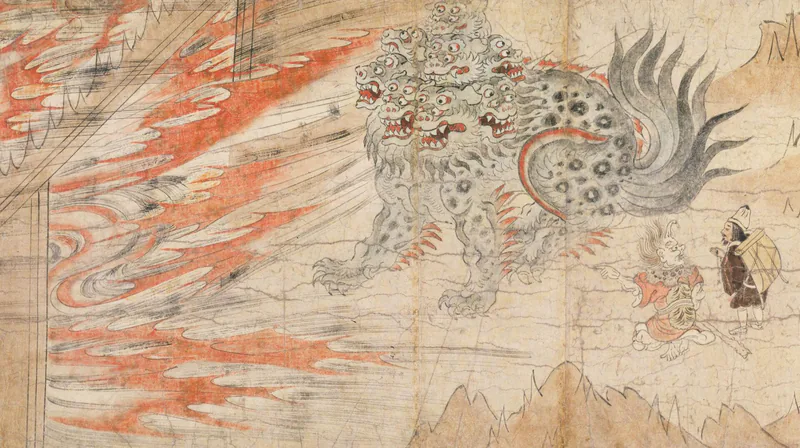
- Nature kami: gods of mountains, such as the deity of Mount Fuji; of the sea, wind, thunder, fire and rice; and of particular rocks, trees and springs.
- Clan and community kami: ujigami, originally the tutelary deities of noble clans and later of villages and neighbourhoods, whose parishioners are called ujiko.
- Deified human beings: emperors, heroes and scholars honoured as kami after death. The scholar-statesman Sugawara no Michizane (845–903), who died in exile, was believed to have returned as an angry spirit causing lightning and plague; he was appeased and enshrined as Tenjin, and became the patron of learning, visited today by students before examinations. The shogun Tokugawa Ieyasu was enshrined at Nikkō in the seventeenth century, and the Yasukuni Shrine in Tokyo enshrines Japan's war dead.
- Vengeful spirits (goryō): the restless dead of those who died unjustly, whose anger was believed to cause disaster until they were pacified by rites, as at Kyoto's Gion festival in its origins.
Major Kami: Amaterasu, Hachiman, Inari and Others§
Amaterasu Ōmikami, "Great Kami Shining in Heaven", is the sun goddess, ruler of the High Plain of Heaven and, according to the myths, ancestor of the imperial line. She is enshrined at the Inner Shrine of Ise, where a sacred mirror represents her. Her unruly brother Susanoo, storm god and slayer of the eight-headed serpent, is worshipped at Izumo and at Yasaka Shrine in Kyoto. Ōkuninushi, "Great Lord of the Land", Susanoo's descendant who ceded the land to Amaterasu's line, is the deity of the great shrine of Izumo and a patron of marriage and good relationships.
Hachiman, enshrined at Usa in Kyushu and at thousands of shrines, was identified with the legendary emperor Ōjin. He became a protector of the state and of the warrior class, especially the Minamoto clan, and was given the Buddhist title of bodhisattva in the late eighth century, an early sign of the fusion described in Shinto and Buddhism. Inari, god of rice and later of commerce and prosperity, is honoured at more shrines than any other kami; foxes are Inari's messengers, and the head shrine of Fushimi Inari in Kyoto, traditionally founded in 711, is famed for its tunnels of vermilion torii donated by worshippers.
Other popular kami include Ebisu, the smiling god of fishermen and business, one of the Seven Gods of Good Fortune; Sarutahiko, the guardian of crossroads who guided the heavenly descent; and the gods of Kumano, Kotohira and Mount Fuji, centres of pilgrimage.
Mitama: The Spirit and Its Aspects§
Kami are believed to possess a mitama, a spirit or soul. Some sources distinguish its gentle aspect (nigimitama), which brings peace and blessing, from its rough aspect (aramitama), which can be violent and must be calmed, and some shrines enshrine the two separately. This duality expresses a widespread conviction that the same power can bless or harm depending on how it is treated.
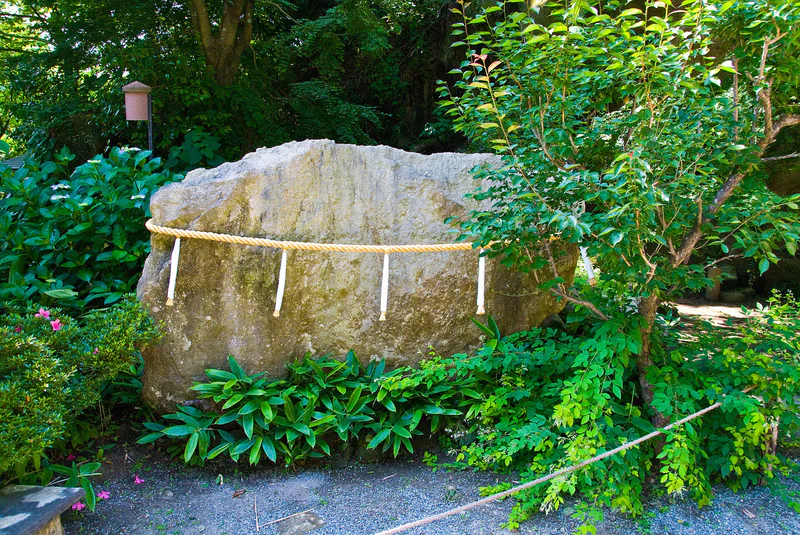
Because a kami's spirit can be divided without being diminished, a portion (bunrei) can be ritually transferred to a new shrine, a process called kanjō. This is how the kami of a few great shrines, Inari, Hachiman, Tenjin, Kumano and Ise, came to be worshipped in tens of thousands of branch shrines. Kami are thought to reside in a sacred object called the shintai or mitamashiro, such as a mirror, sword, jewel or stone, kept hidden in the shrine's main hall. More ancient forms of worship called them down temporarily into a yorishiro, a tree, rock or pole marked with a sacred rope (shimenawa), during rites. See shrines and purification.
Kami and Humans: Ancestors, Communities and Emperors§
The boundary between humans and kami is permeable. In Shinto funerary practice, which developed mainly in the early modern and modern periods, the spirit of the deceased becomes, after a period of rites, an ancestral kami protecting the household, though most Japanese families have traditionally entrusted funerals to Buddhist temples. Village kami bind communities together through annual festivals, in which the kami is carried through its territory in a portable shrine.
The relationship between kami and the emperor was politically decisive. The myths present the imperial house as descended from Amaterasu, and the emperor as the chief priest of the nation. Between 1868 and 1945 the state promoted the emperor as a "manifest kami" (akitsumikami), an idea renounced in the emperor's New Year rescript of 1946; see What Is Shinto?.
How Kami Are Approached: Offerings, Prayer and Divination§
Kami are approached through purity, offerings and respectful words. Priests present rice, sake, salt, water, fish, vegetables and branches of the sacred sakaki tree, and recite norito, formal prayers in classical Japanese. Lay worshippers offer coins, bow twice, clap twice and bow once. Kami are believed to respond to sincerity, to protect those under their care, and to be offended by pollution and neglect. Communities have also sought the will of the kami through divination and spirit possession, practices discussed in Onmyōdō and in studies of Japanese shamanism. The world of kami shades into that of yōkai, the strange beings of folklore, some of which were said to be fallen or neglected gods.
Frequently asked questions§
Are kami gods?§
Some kami resemble gods, with names, myths and personalities, such as Amaterasu or Hachiman. Others are impersonal sacred powers in nature or places. The English word "god" covers only part of what kami means, so many writers leave the word untranslated.
How many kami are there?§
Tradition speaks of "eight hundred myriad" (yaoyorozu) kami, a poetic way of saying countless. New kami can also be enshrined, such as deified historical figures, so the number has never been fixed.
Who is the most important kami?§
Amaterasu, the sun goddess and mythical ancestor of the imperial family, is generally regarded as the highest kami, and her Ise shrine is the most sacred. In terms of the number of shrines, Inari and Hachiman are the most widely worshipped.
Sources and further reading§
- Shinto: A History — Helen Hardacre, 2017
- A New History of Shinto — John Breen and Mark Teeuwen, 2010
- Shinto: The Kami Way — Sokyo Ono, 1962
- Kojiki — trans. Donald L. Philippi, 1968
- The Protocol of the Gods: A Study of the Kasuga Cult in Japanese History — Allan G. Grapard, 1992
- Essentials of Shinto: An Analytical Guide to Principal Teachings — Stuart D. B. Picken, 1994
- The Catalpa Bow: A Study of Shamanistic Practices in Japan — Carmen Blacker, 1975