Kokugaku: Motoori Norinaga and Japan's National Learning
Kokugaku, or National Learning: how Keichū, Kamo no Mabuchi, Motoori Norinaga and Hirata Atsutane read Japan's classics and reshaped Shinto thought.

Kokugaku (国学, "National Learning" or "nativism") was an intellectual movement of Edo-period Japan (1603–1868) that sought the original Japanese mind in the country's oldest texts, above all the Kojiki and the poetry anthology Man'yōshū, and set it against Chinese Confucian and Buddhist learning. Its greatest scholar, Motoori Norinaga (1730–1801), transformed the study of the Kojiki, and his self-proclaimed successor Hirata Atsutane (1776–1843) turned the movement into a theology of the kami and the afterlife that helped shape modern Shinto.
What Was Kokugaku? Philology and the Search for Antiquity§
In the seventeenth century the dominant learning in Japan was Neo-Confucianism, studied through Chinese texts, while Buddhism framed most religious life. Kokugaku began as a reaction within scholarship itself. Confucian scholars such as Ogyū Sorai (1666–1728) had taught that the meaning of the Chinese classics could be recovered only by studying the ancient language in which they were written. Japanese scholars applied the same method to their own antiquity, asking what the oldest Japanese words had meant before Chinese concepts were read into them.
The pioneer was the Shingon monk Keichū (1640–1701), whose commentary on the Man'yōshū, completed around 1690, rejected medieval secret traditions of interpretation in favour of evidence drawn from the texts themselves. His work was not yet a programme of national renewal, but it established the philological method that defines the movement. Kokugaku remained, at its core, a discipline of reading: of poetry, ancient prayers (norito) and the chronicles described in Myths of the Kojiki and Nihon Shoki.
Kada no Azumamaro and Kamo no Mabuchi§
Kada no Azumamaro (1669–1736), from a family of priests at the Fushimi Inari shrine in Kyoto, lectured on the Nihon shoki and on poetry and is traditionally said to have petitioned the shogunate to found a school of national learning; scholars doubt whether the petition attributed to him is authentic, but later nativists honoured him as a founder.
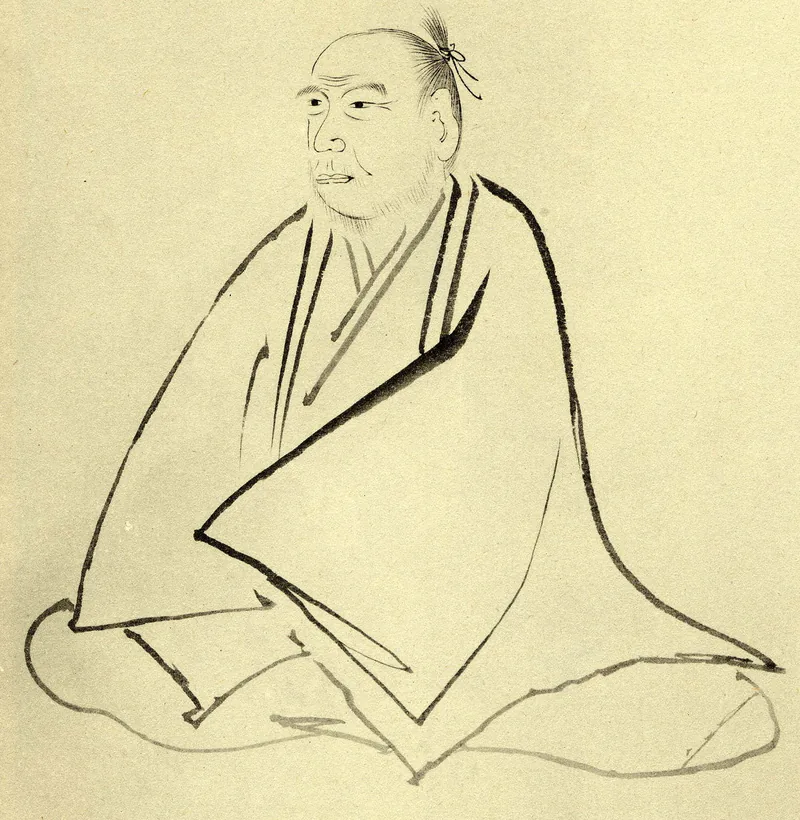
His pupil Kamo no Mabuchi (1697–1769), the son of a shrine family near Hamamatsu, made the Man'yōshū the key to antiquity. In its direct and vigorous poems he found a "manly" spirit (masuraoburi) and a natural, spontaneous way of life that he believed had been corrupted by Chinese moralism and Buddhist otherworldliness. In his essay Kokuikō ("Reflections on the Idea of the Country", around 1765) he argued that Confucian rule had produced only disorder in China, whereas ancient Japan had been governed peacefully by following nature and the sovereign. Mabuchi taught that one must first master the ancient language and poetry before one could understand the way of the gods.
Motoori Norinaga: Life and the Kojiki-den§
Motoori Norinaga was born in 1730 into a merchant family of Matsusaka in Ise province. Unsuited to trade, he studied medicine and Confucian learning in Kyoto and returned home to practise as a physician, which he continued to do throughout his life. In 1763 he met Mabuchi for a single evening at an inn in Matsusaka, an encounter later celebrated as the "night at Matsusaka", and became his correspondence student.
Norinaga's early work was literary. In essays of 1763 he developed the idea of mono no aware, the capacity to be moved by things, as the essence of poetry and of The Tale of Genji: the novel's purpose, he argued, was not moral instruction but to let readers feel the pathos of human life. This defence of feeling against moralism ran through all his later thought.
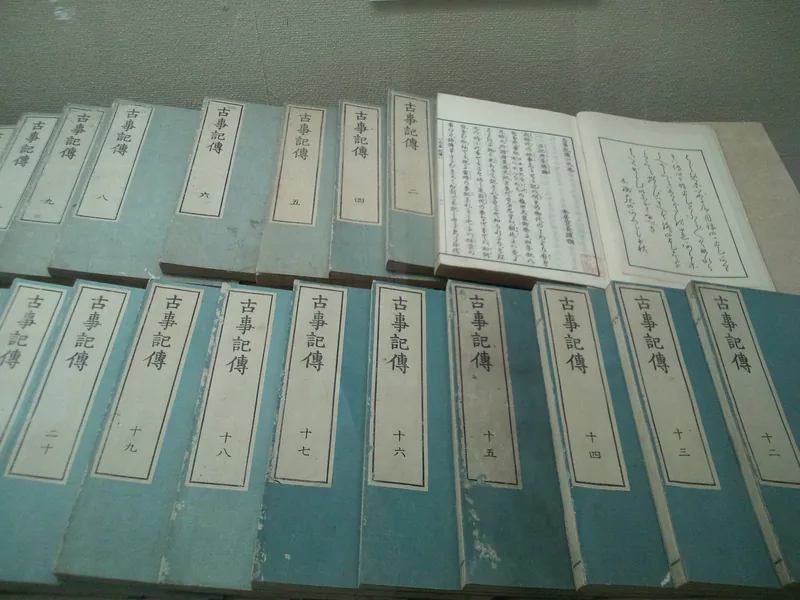
His great work was the Kojiki-den, a commentary on the Kojiki in forty-four books, begun in the mid-1760s, completed in 1798 and published in instalments between 1790 and 1822. Earlier scholars had preferred the Nihon shoki, written in Chinese style; Norinaga argued that the Kojiki, though recorded in Chinese characters, preserved the ancient Japanese language and therefore the true traditions of the age of the gods. He reconstructed its readings word by word, and his edition remains the basis of modern study. He attracted hundreds of students from across Japan to his study in Matsusaka, known as the Suzunoya, the "House of Bells", after the bells he liked to ring while working.
Norinaga's Way of the Gods: Kami, Karagokoro and Death§
For Norinaga the Kojiki was literally true. In Naobi no mitama ("The Rectifying Spirit", 1771) he argued that the ancient way had been established by the creator deities and handed down by Amaterasu to the imperial line, and that it needed no doctrine because the Japanese had once simply followed it. What obscured it was karagokoro, the "Chinese heart": the habit of rationalising, moralising and explaining the world through abstract principles. Human beings cannot fathom the deeds of the gods and should accept them with sincerity.
His definition of the kami as anything extraordinary and awe-inspiring, good or evil, high or low, is still the most quoted account of the word. It explained why evil occurs in the world: misfortune comes from the malicious deity Magatsuhi, born from the pollution Izanagi washed off after visiting the land of the dead. Norinaga also refused to soften the ancient picture of death. All people, he taught, go after death to Yomi, a dark and unclean land; there is no consolation to be found in philosophy, and the proper response is simply to grieve. This bleak honesty set him apart from both Buddhist and Confucian teaching, and it troubled many of his followers. His literal reading of myth drew sharp criticism from the writer Ueda Akinari, with whom he exchanged polemics in the 1780s over the sun goddess and the age of the gods.
Hirata Atsutane: The Unseen World and a Theology of the Kami§
Hirata Atsutane (1776–1843), from a samurai family of Akita, came to Edo as a young man and discovered Norinaga's works only after the master's death; he claimed that Norinaga had accepted him as a disciple in a dream. Where Norinaga had been above all a philologist, Hirata was a theologian, eager to give the kami a cosmology and the dead a destiny.
In Tama no mihashira ("The True Pillar of the Soul", 1813) he argued that the souls of the dead do not go to Yomi but remain in this world, in an unseen realm (kakuriyo) governed by the deity Ōkuninushi of Izumo, from where they watch over their descendants. He reordered the creator deities into a supreme god who rules the universe, and modern scholars have noted that some of these ideas show the influence of Christian works in Chinese written by Jesuit missionaries. Hirata also studied Chinese medicine, divination and the lore of immortals, and recorded the testimony of a boy who claimed to have been carried off by tengu in Senkyō ibun (1822). He was expelled from Edo by the shogunate in 1841 and died in Akita two years later.
Kokugaku, the Restoration and Modern Shinto§
Hirata's school spread through networks of village headmen, rural doctors, merchants and shrine priests, who studied his books and enrolled posthumously as his disciples; by the 1860s it had thousands of members. Its emphasis on the emperor, the kami and the purity of Japan fed the movement to "revere the emperor" that brought down the shogunate. After 1868 Hirata disciples staffed the revived Department of Divinities, drafted the edicts that separated kami and buddhas and pressed for funerals according to Shinto rites. They were soon pushed aside by pragmatic officials, but their ideas left a lasting mark on State Shinto and on Shinto theology.
In the twentieth century the folklorist Yanagita Kunio described his own study of village customs as a "new national learning". Historians have since examined kokugaku as a mirror of its time. H. D. Harootunian read it as a discourse that gave commoners a new sense of agency; Susan Burns showed that Norinaga's readers produced competing images of a national community long before the modern nation-state; and Peter Nosco interpreted it as a nostalgia for a lost paradise. Many scholars also trace to kokugaku the idea, central to modern nationalism, of a unique and unchanging Japanese essence.
Frequently asked questions§
What does kokugaku mean?§
Kokugaku means "study of the country", usually translated as National Learning or nativism. It designated the study of Japan's own ancient language, poetry and chronicles, in contrast to kangaku, the study of Chinese texts, and later rangaku, Dutch or Western learning.
Who was Motoori Norinaga?§
Motoori Norinaga (1730–1801) was a physician and scholar from Matsusaka in Ise province, the most important figure of kokugaku. He is best known for his commentary on the Kojiki, the Kojiki-den, and for his theory of mono no aware in poetry and The Tale of Genji.
How did kokugaku influence Shinto?§
Kokugaku made the Kojiki the central text of Shinto, defined the kami in terms still used today and promoted the idea of a pure Japanese way free of Buddhist and Chinese elements. Through Hirata Atsutane's followers it shaped the Meiji separation of kami and buddhas and the early policies of State Shinto.
Sources and further reading§
- Motoori Norinaga, 1730–1801 — Shigeru Matsumoto, 1970
- Things Seen and Unseen: Discourse and Ideology in Tokugawa Nativism — H. D. Harootunian, 1988
- Remembering Paradise: Nativism and Nostalgia in Eighteenth-Century Japan — Peter Nosco, 1990
- Before the Nation: Kokugaku and the Imagining of Community in Early Modern Japan — Susan L. Burns, 2003
- The Poetics of Motoori Norinaga: A Hermeneutical Journey — Michael F. Marra, 2007
- When Tengu Talk: Hirata Atsutane's Ethnography of the Other World — Wilburn Hansen, 2008
- Kojiki — Donald L. Philippi (trans.), 1968
- Shinto: A History — Helen Hardacre, 2017