Liber XXVI · Shinto · Chapter VII: Shrines & Purification
Izumo Taisha: Ōkuninushi and the Grand Shrine of Izumo
Izumo Taisha, one of Japan's oldest shrines: the myths of Ōkuninushi, the giant ancient hall, the Senge priestly line, Kamiarizuki and matchmaking.

Izumo Taisha (出雲大社), officially Izumo Ōyashiro, is one of the oldest and most important Shinto shrines in Japan, standing on the coast of Shimane Prefecture and dedicated to Ōkuninushi, the "Great Master of the Land" of the Kojiki myths. Its main hall, built in the archaic taisha-zukuri style, was once said to be the tallest building in Japan, and the shrine is famous today as the place where, according to popular belief, all the kami of Japan gather each autumn and as a centre of prayers for good relationships.
Ōkuninushi in the Myths of the Kojiki§
Ōkuninushi, also called Ōnamuchi, is the central figure of the Izumo cycle of the Kojiki (712) and Nihon shoki (720), described in Myths of the Kojiki and Nihon Shoki. A descendant of the storm god Susanoo, he first appears as the despised youngest of many brothers. On the way to court a princess of Inaba he heals a hare that had been skinned by crocodiles (or sharks), and the grateful animal predicts his success; the "White Hare of Inaba" is one of the best-loved Japanese folk tales. His jealous brothers kill him twice, and twice he is revived by his mother's prayers. He flees to Susanoo's netherworld, passes Susanoo's ordeals with the help of his daughter Suseribime, and returns to subdue his brothers and rule the land.
With the tiny god Sukunabikona, who arrives across the sea in a seed-pod boat, Ōkuninushi then builds and settles the country, teaching medicine and the control of pests. In this role he is a culture hero, a god of agriculture, healing and the ordering of the land.
The Ceding of the Land and the Origin of the Shrine§
The myths then turn to the claims of heaven. Amaterasu declares that the land below should be ruled by her descendants and sends messengers to Ōkuninushi; the first ones go over to his side, but eventually the warrior gods Takemikazuchi and, in the Nihon shoki, Futsunushi descend to the beach of Inasa in Izumo and demand the land. Ōkuninushi's son Kotoshironushi agrees; another son, Takeminakata, resists, is defeated and flees to Suwa in Shinano. Ōkuninushi then yields.
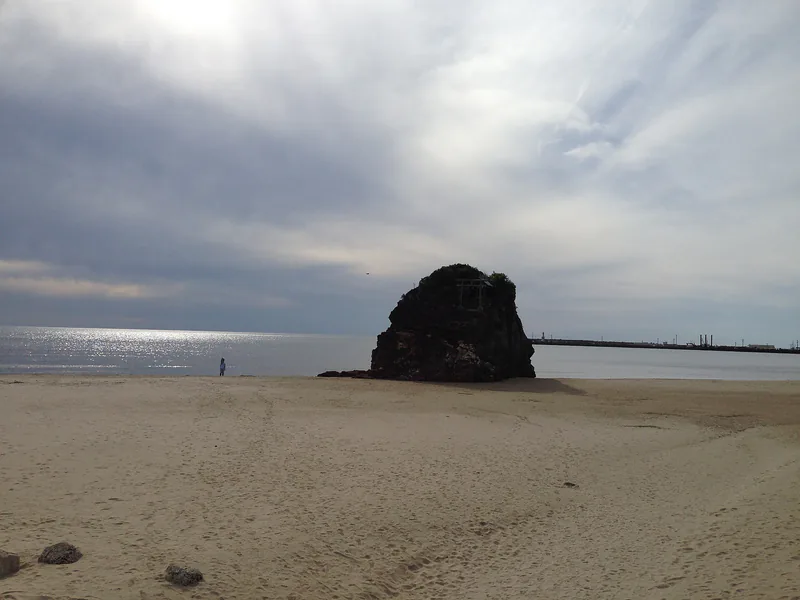
In return he asks for a dwelling built like the palace of the heavenly gods, with pillars rooted firmly in the bedrock and crossbeams rising to the High Plain of Heaven. In one version in the Nihon shoki the heavenly gods agree that the descendants of Amaterasu will govern visible affairs, while Ōkuninushi will govern the hidden, divine matters (kamigoto). Izumo Taisha is traditionally understood as this palace. The myth of the ceding of the land (kuni yuzuri) has been read by historians as a reflection of the subordination of a powerful Izumo polity to the Yamato court, though the archaeological picture is more complex. The province's own gazetteer, the Izumo fudoki (733), preserves different local traditions, including a myth in which a giant god pulls pieces of land from across the sea with ropes to enlarge Izumo.
The Great Hall: Taisha-zukuri and the Giant Pillars§
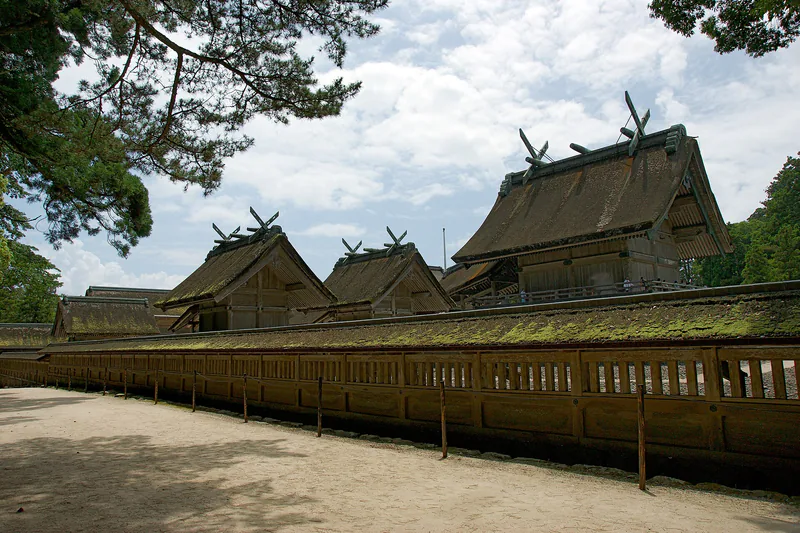
The main hall (honden) of Izumo is the classic example of the taisha-zukuri style, regarded with Ise's shinmei-zukuri as among the most ancient forms of Japanese shrine architecture. It is a raised, nearly square building with a gabled roof and an entrance on the gable end, set off-centre, supported by nine pillars including a thick central pillar (shin no mihashira). Inside, the sacred seat of the deity faces west rather than toward the entrance, a feature that has prompted much speculation. The present hall, completed in 1744, stands about twenty-four metres high, making it the tallest shrine sanctuary in Japan.
Medieval traditions claimed that the hall had once been twice or even four times that height. A mnemonic text for children compiled in 970, the Kuchizusami, lists the largest buildings of the land as "Unta, Wani, Kyōsan": Izumo first, the Great Buddha Hall of Tōdaiji in Nara second, and the Kyoto palace's Great Hall of State third. Such claims were long dismissed as legend until 2000, when excavations in front of the present hall uncovered the bases of colossal pillars, each made of three cedar trunks bound together to a combined diameter of about three metres. They have been dated to the thirteenth century, and their arrangement matches an old plan preserved by the Senge family. Whether the hall really reached the legendary height of forty-eight metres remains disputed, but the finds confirm that it was once far larger than today. The hall was rebuilt periodically, and the most recent major renovation of the roof, the Heisei-era sengū, was completed in 2013.
The Izumo Kokusō: Priests of the Grand Shrine§
Izumo Taisha has been served since antiquity by the Izumo no kuni no miyatsuko (kokusō), hereditary chiefs who claimed descent from Amaterasu's son Ame no Hohi, the first heavenly messenger sent to Ōkuninushi, who according to the myth went over to his side. In the Nara and Heian periods each new kokusō travelled to the capital to recite a congratulatory address to the emperor, the Izumo no kuni no miyatsuko no kamuyogoto, whose text is preserved among the ritual prayers of the Engishiki (927). In the fourteenth century the line divided into two houses, the Senge and the Kitajima, which for centuries shared the shrine's rites. The succession of a new kokusō still involves a fire ritual in which sacred fire is kindled by friction, symbolising the continuity of the line. On priestly lineages generally, see Kannushi and Miko.
In the early Meiji era the head of the Senge house, Senge Takatomi (1845–1918), became one of the leading figures of the national Shinto establishment. In the "pantheon dispute" of 1875–1881 he argued that Ōkuninushi, as ruler of the unseen world and of the dead, should be worshipped alongside the creator gods and Amaterasu in the hall of the national Shinto office; Ise's priests opposed him, and the matter was settled against Izumo by imperial decision. The quarrel helped persuade the government to separate shrine rites from religious teaching, a key step toward State Shinto. Senge then founded Izumo Ōyashirokyō, a teaching organisation recognised as one of the Sect Shinto bodies, which still promotes devotion to the shrine across Japan.
Kamiarizuki: The Month When the Gods Gather§
Across most of Japan the tenth month of the old lunar calendar is called Kannazuki, popularly explained as "the month without gods", because the kami are said to leave their shrines to assemble at Izumo; in Izumo itself the month is called Kamiarizuki, "the month with gods". Linguists generally think the original meaning of kannazuki was simply "month of the gods", and the explanation from Izumo appears in sources from the medieval period onward, but the belief became widely popular, spread in part by Izumo's travelling preachers (oshi) in the Edo period.
The shrine still celebrates the gathering. At night on the tenth day of the tenth lunar month, now usually in November, priests welcome the gods at Inasa beach, the site of the ceding of the land, with bonfires and lead them in procession to the shrine. The visiting kami lodge in two long buildings, the jūkusha, on either side of the main hall, and during the following days they are believed to hold council on the affairs of the coming year, including human destinies and marriages. A final rite sends them home.
En-musubi: Ties of Fate and Modern Pilgrimage§
Because Ōkuninushi governs hidden matters and the gods are thought to decide human ties at their annual assembly, Izumo became known as a shrine of en-musubi, the "tying of bonds", above all marriage. Many couples, and many people hoping to find a partner, visit the shrine, and weddings are held there. Worshippers at Izumo observe a distinctive form of prayer, bowing twice, clapping four times and bowing once, rather than the two claps usual at most shrines. Ōkuninushi was also identified, partly through a play on the characters of his name, with the Buddhist god Daikokuten, and as Daikoku he became one of the popular Seven Gods of Fortune, often paired with his son Kotoshironushi as Ebisu.
The shrine's massive sacred rope (shimenawa), hung over the entrance of the ritual hall (kaguraden), is among the largest in Japan and a favourite image of the shrine. Western readers first encountered Izumo through Lafcadio Hearn, who visited in 1890 and described it under its old name of Kitzuki in Glimpses of Unfamiliar Japan (1894), calling it the most ancient shrine of the land. Izumo remains, with Ise, one of the two poles of Japan's sacred geography: Ise the shrine of the heavenly gods and the imperial line, Izumo the shrine of the earthly gods and the hidden world. For shrine customs and purification more generally, see Shinto shrines and purification.
Frequently asked questions§
Who is enshrined at Izumo Taisha?§
Izumo Taisha enshrines Ōkuninushi no Ōkami, the "Great Master of the Land", a descendant of Susanoo who in the myths built and ruled the land before ceding it to the descendants of the sun goddess Amaterasu.
Why is Izumo Taisha associated with marriage?§
Ōkuninushi is believed to govern hidden affairs, including the bonds between people, and the kami who gather at Izumo in the tenth lunar month are said to decide marriages and other ties. The shrine is therefore visited by those praying for a good partner or for harmony in relationships.
Why do people clap four times at Izumo Taisha?§
Izumo preserves a distinctive form of worship of two bows, four claps and one bow, instead of the usual two claps. The custom is old and its origin is not documented; some explain it as an expression of especially deep reverence.
How old is Izumo Taisha?§
The shrine is mentioned in the eighth-century Kojiki, Nihon shoki and Izumo fudoki, and its origins are probably older. The present main hall was built in 1744.
Sources and further reading§
- Kojiki — Donald L. Philippi (trans.), 1968
- Engi-shiki: Procedures of the Engi Era, Books I–V — Felicia Gressitt Bock (trans.), 1970
- Records of Wind and Earth: A Translation of Fudoki with Introduction and Commentaries — Michiko Y. Aoki, 1997
- Glimpses of Unfamiliar Japan — Lafcadio Hearn, 1894
- Shinto and the State, 1868–1988 — Helen Hardacre, 1989
- A New History of Shinto — John Breen and Mark Teeuwen, 2010
- Shinto: A History — Helen Hardacre, 2017