Liber XXVI · Shinto · Chapter IV: Myths of the Kojiki
Myths of the Kojiki and Nihon Shoki: Japan's Sacred Histories
The myths of the Kojiki and Nihon shoki explained: Izanagi and Izanami, Yomi, Amaterasu and the cave, Susanoo and the serpent, and the first emperor Jimmu.

The Kojiki ("Record of Ancient Matters", 712) and the Nihon shoki ("Chronicles of Japan", 720) are Japan's oldest surviving histories, compiled at the imperial court to tell the story of the world from the creation of the islands by the gods Izanagi and Izanami to the reigns of the historical emperors. Their myths of the sun goddess Amaterasu, her storm-god brother Susanoo and the descent of her grandson to rule the land became the classical mythology of Shinto and the foundation of the claim that the imperial line descends from the gods.
The Kojiki and Nihon Shoki: Compilation and Purpose§
According to its preface, the Kojiki was commissioned by Emperor Tenmu (r. 673–686), who wished to correct errors in the genealogies and traditions held by the noble houses. A court attendant named Hieda no Are, noted for a remarkable memory, learned the traditions, and in 711–712 the official Ō no Yasumaro wrote them down for Empress Genmei. The work is in three books: the age of the gods, the legendary early emperors, and the later emperors to Empress Suiko (d. 628). It uses Chinese characters in a mixed way, some for meaning and some for sound, to record names and songs in Japanese.
The Nihon shoki, completed in 720 under the supervision of Prince Toneri, is a much longer chronicle in thirty books, written in classical Chinese on the model of the Chinese dynastic histories, and continuing to 697. A distinctive feature of its mythological chapters is that it records many variant versions, introduced with "one writing says", showing that several traditions were in circulation. The two works are often referred to together as the Kiki. Provincial gazetteers (fudoki), ordered in 713, preserve further local myths, especially for Izumo.
Creation: Izanagi and Izanami§
In the Kojiki, the world begins when heaven and earth separate and a series of kami come into being on the High Plain of Heaven. After seven generations of deities, a male and female pair, Izanagi ("he who invites") and Izanami ("she who invites"), are commanded to solidify the drifting land. Standing on the Floating Bridge of Heaven, they stir the brine below with a jewelled spear; drops falling from its tip form the first island, Onogoro.
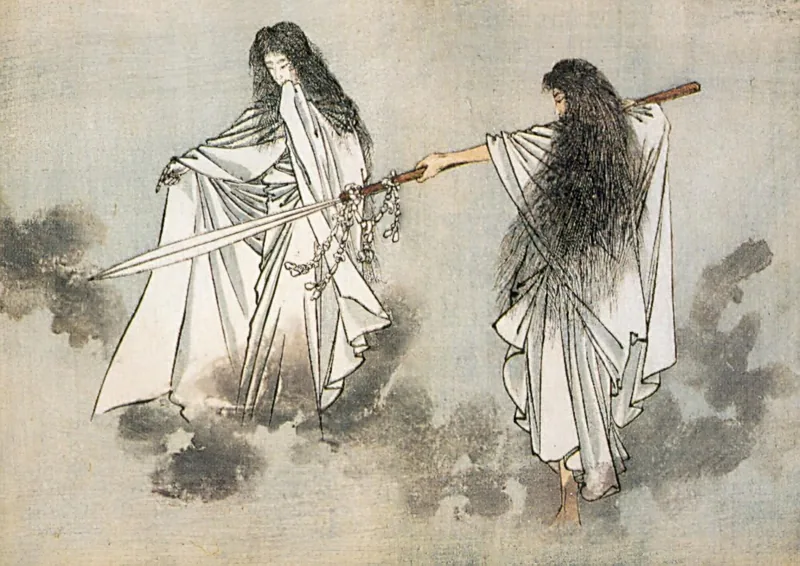
They descend, erect a pillar and a hall, and marry by walking around the pillar in opposite directions. Because Izanami speaks first when they meet, their first child is malformed and set adrift; the heavenly gods, consulted by divination, tell them the man should speak first. Repeating the ritual correctly, they give birth to the islands of Japan and to many kami of sea, wind, trees, mountains and plains. The opening of the Nihon shoki, by contrast, begins with a cosmology of yin and yang adapted from Chinese sources such as the Huainanzi, illustrating its more Sinicised character; compare yin and yang.
Journey to Yomi and the Birth of the Sun Goddess§
Izanami is fatally burned giving birth to the fire god and departs to Yomi, the land of the dead. Izanagi follows her, longing to bring her back. She tells him she has already eaten the food of Yomi but will ask its gods for permission to leave, if he does not look at her. Impatient, he lights a tooth of his comb and sees her body rotting and swarming with maggots and thunder deities. He flees, pursued by the hags of Yomi, by the thunder gods and finally by Izanami herself, and blocks the pass between the worlds with a great boulder. Across it Izanami vows to kill a thousand people a day; Izanagi replies that he will cause fifteen hundred to be born. Thus death and birth enter the world. Comparisons with the Greek story of Orpheus have often been made.
Polluted by contact with death, Izanagi purifies himself in a river. As he washes, kami are born from his clothes and body; finally, from his left eye comes Amaterasu, the sun goddess, from his right eye Tsukuyomi, the moon god, and from his nose Susanoo, the storm god. This episode is the mythical model of Shinto purification (misogi and harae), described in shrines and purification.
Amaterasu, Susanoo and the Rock Cave of Heaven§
Izanagi gives Amaterasu rule over the High Plain of Heaven. Susanoo, who weeps for his dead mother and neglects his realm, is banished, but first visits his sister. After a contest in which they produce children from each other's possessions, Susanoo, claiming victory, runs riot: he breaks down the divisions of her rice fields, defiles her hall of first-fruits, and throws a flayed horse into her weaving hall.
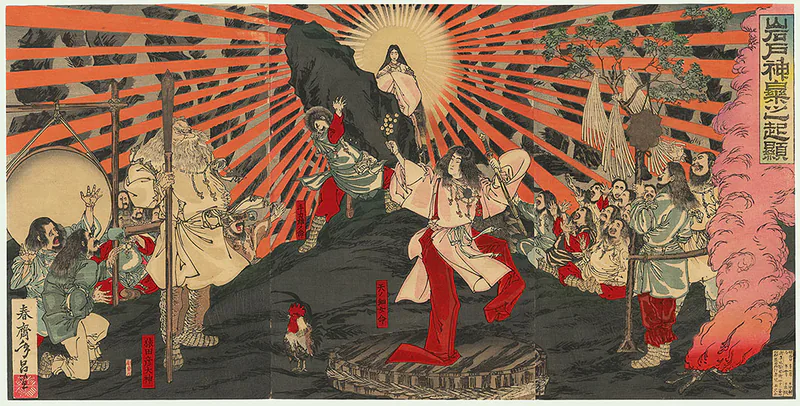
Terrified or offended, Amaterasu hides in the Rock Cave of Heaven (Ama-no-Iwato), plunging the world into darkness. The eight hundred myriad kami gather and devise a plan: they hang a mirror and curved jewels on a sacred tree, set roosters crowing, and the goddess Ame-no-Uzume performs an ecstatic dance on an upturned tub, exposing herself, so that the gods roar with laughter. Curious, Amaterasu opens the door; seeing her reflection in the mirror, she leans out, a strong god pulls her forth, and a sacred rope is stretched across the entrance so she cannot return. Light returns to the world. The myth has been read as a solar eclipse or winter-solstice story, as an origin of ritual dance (kagura), and as a charter for the rites of the imperial court.
Izumo, Ōkuninushi and the Ceding of the Land§
Expelled from heaven, Susanoo descends to Izumo, on the Japan Sea coast, where he meets an old couple weeping because the eight-headed, eight-tailed serpent Yamata no Orochi has devoured seven of their eight daughters. He has them prepare eight vats of strong sake; the serpent drinks and falls asleep, and Susanoo cuts it to pieces. In one tail he finds a sword, later called Kusanagi, which he presents to Amaterasu. He marries the rescued daughter, Kushinada-hime.
His descendant Ōkuninushi, after adventures that include healing the White Hare of Inaba and surviving ordeals in the underworld, builds up the land of Izumo. Heaven then sends envoys to demand that the land be handed over to Amaterasu's descendants. After resistance, Ōkuninushi agrees, on condition that a great palace be built for him: the origin story of the Izumo Grand Shrine. Historians often interpret this cycle as reflecting the incorporation of a powerful Izumo region into the Yamato state.
The Heavenly Descent, the Regalia and the First Emperor§
Amaterasu's grandson Ninigi descends from heaven to Mount Takachiho in Kyushu, bearing the three regalia: the mirror, the sword Kusanagi and the curved jewel, which remain the imperial regalia of Japan. Ninigi marries Konohana-sakuya-hime, the princess of blossoming trees, but rejects her rock-like elder sister, which is why human lives are as brief as blossoms. After further generations, including the tale of the brothers Luck-of-the-Sea and Luck-of-the-Mountain and a visit to the palace of the sea god, Ninigi's great-grandson sets out eastward, conquers the land of Yamato, and becomes Jimmu, the first emperor.
The Nihon shoki dates Jimmu's enthronement to a year corresponding to 660 BCE, a date historians regard as calculated rather than historical. The early emperors in both works are considered legendary, and reliable history is usually thought to begin with the rulers of the fifth and sixth centuries.
Reading the Myths: Politics, Comparison and Modern Interpretation§
Modern scholars emphasise that the Kojiki and Nihon shoki were produced by a centralising court to establish the divine authority of the imperial house and the ranks of the noble clans, each of which is given a divine ancestor in the narrative. At the same time they preserve older myths with parallels in Korea, China, Southeast Asia and the Pacific.
The Kojiki was relatively neglected until the Edo-period scholar Motoori Norinaga devoted decades to his commentary, the Kojiki-den (completed 1798), presenting it as the purest record of the ancient Japanese spirit. Under State Shinto the myths were taught as national history, and the historian Tsuda Sōkichi, who argued that the early chapters were political constructions, was prosecuted in the early 1940s. Since 1945 critical scholarship has flourished, and English translations range from Basil Hall Chamberlain's (1882) and W. G. Aston's Nihongi (1896) to Donald Philippi's (1968) and Gustav Heldt's (2014). The myths' kami are discussed further in the kami.
Frequently asked questions§
What is the difference between the Kojiki and the Nihon shoki?§
The Kojiki (712) is shorter, written in a hybrid style that records Japanese names and songs, and presents a single continuous narrative. The Nihon shoki (720) is a longer official chronicle in classical Chinese that records many variant versions of the myths and continues further into historical times.
Who created Japan in Shinto mythology?§
The divine couple Izanagi and Izanami, commanded by the heavenly gods, created the islands of Japan by stirring the ocean with a jewelled spear and then giving birth to the islands and many kami.
Is Emperor Jimmu historical?§
Most historians consider Jimmu legendary. His traditional enthronement date of 660 BCE was calculated by the compilers of the Nihon shoki, and the first emperors whose existence is supported by other evidence lived many centuries later.
Sources and further reading§
- The Kojiki: Records of Ancient Matters — Basil Hall Chamberlain, 1882
- Nihongi: Chronicles of Japan from the Earliest Times to A.D. 697 — W. G. Aston, 1896
- Kojiki — trans. Donald L. Philippi, 1968
- The Kojiki: An Account of Ancient Matters — trans. Gustav Heldt, 2014
- A New History of Shinto — John Breen and Mark Teeuwen, 2010
- Shinto: A History — Helen Hardacre, 2017