State Shinto: Emperor, Shrines and Nation in Japan, 1868–1945
State Shinto explained: how Meiji Japan made shrines into state institutions, linked them to the emperor and schools, and how the system ended in 1945.

State Shinto (kokka Shintō) is the name historians give to the system by which the Japanese government, between the Meiji Restoration of 1868 and the defeat of 1945, administered shrines as public institutions, tied their rites to the cult of the emperor and taught reverence for both as a civic duty. It was never a single law or church but a set of policies built up over seventy years, and how far it reached into ordinary religious life is still debated.
Restoration and the Return of the Department of Divinities§
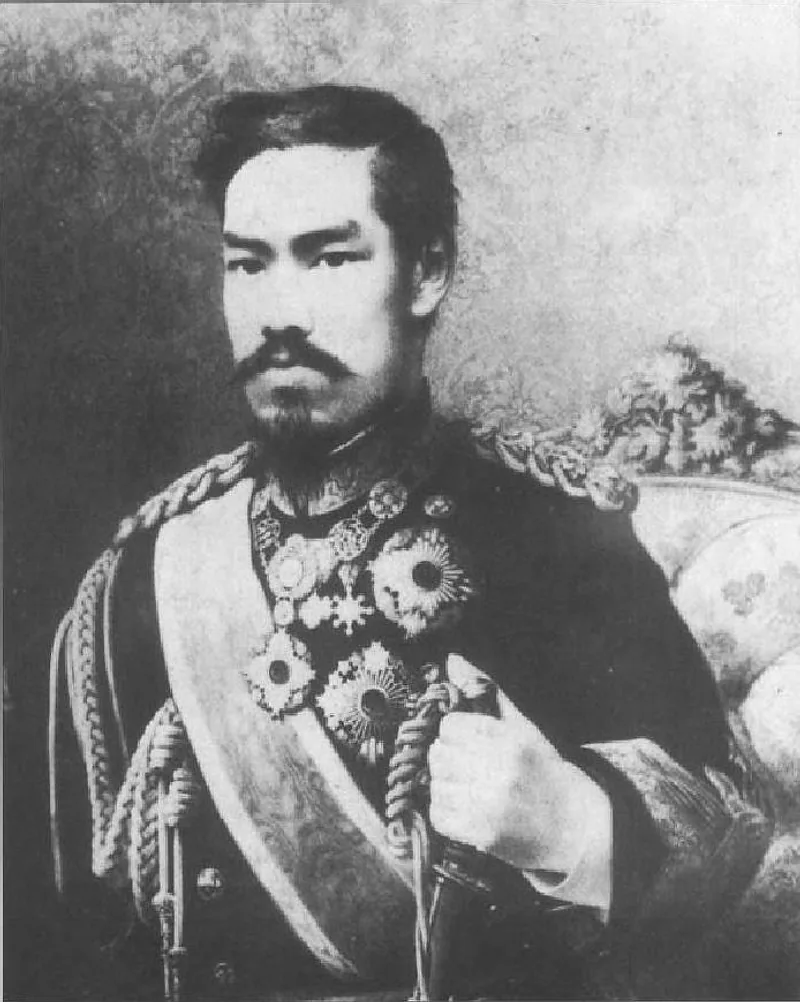
The men who overthrew the Tokugawa shogunate in 1868 justified their revolution as a return to direct rule by the emperor, modelled on an idealised antiquity. Many of their advisers were followers of the Hirata school of National Learning, who held that the emperor descended from the sun goddess Amaterasu and that government and worship had once been one (saisei itchi). In the first months of the new regime the government revived the ancient Jingikan, the Department of Divinities of the eighth-century codes, and placed it formally above the other ministries.
In the same year a series of edicts ordered the separation of kami and buddhas. Buddhist statues, priests and titles were removed from shrines, and in some regions the policy turned into the destruction of temples. In 1871 the state declared shrines to be sites for "the rites of the state" (kokka no sōshi), abolished hereditary shrine priesthoods and created a ranked hierarchy of national, imperial, prefectural and village shrines, with the Ise shrines at the summit. Priests became, in principle, state appointees.
The Great Promulgation Campaign and the Ministry of Doctrine§
The early Meiji leaders also tried to create a national creed. An imperial rescript of 1870 announced a "Great Teaching" (taikyō), and in 1872 a new Ministry of Doctrine (Kyōbushō) replaced the Department of Divinities. It enlisted Shinto priests, Buddhist clergy, popular preachers and even storytellers as "national evangelists" (kyōdōshoku), who were to preach three principles: revere the kami and love the country; make clear the principles of heaven and the way of humanity; and revere the emperor and obey the court.
The campaign was not a success. Buddhist sects, led by the Jōdo Shin (True Pure Land) cleric Shimaji Mokurai, objected to preaching kami doctrines and called for religious freedom; the Great Teaching Institute set up in a Tokyo temple in 1873 was dissolved in 1875, and the Ministry of Doctrine itself was abolished in 1877. Western diplomats, meanwhile, pressed Japan to end the ban on Christianity, whose public notice boards were taken down in 1873. Within ten years the attempt to impose a single state religion had been abandoned.
Shrines as Non-Religion: The Legal Formula§
What replaced it was a subtler formula. After a bitter quarrel in the early 1880s between Ise and Izumo priests over which deities should be worshipped in the national Shinto office (see Izumo Taisha), the government decided in 1882 that priests of the official shrines should no longer preach or conduct funerals. Shrine rites were redefined as public ceremonies of the nation rather than "religion" (shūkyō, itself a new word coined to translate the Western concept). Groups that did preach and gather believers were classed as Sect Shinto (kyōha Shintō); thirteen such bodies, including Kurozumikyō, Tenrikyō and Izumo Ōyashirokyō, were eventually recognised.
The Meiji Constitution of 1889 declared the emperor "sacred and inviolable" and granted freedom of religious belief only "within limits not prejudicial to peace and order, and not antagonistic to their duties as subjects." Because shrine reverence counted as a civic duty, it could be demanded of Buddhists and Christians without, in official eyes, violating their freedom. Jason Ānanda Josephson has shown how this distinction between "religion", "superstition" and the "secular" was itself a product of Meiji diplomacy and law.
Administratively, a Shrine Bureau separate from the bureau dealing with religions was created in the Home Ministry in 1900, and in 1940 it was upgraded into an Institute of Divinities (Jingiin). From 1906 the government also pushed a programme of shrine mergers (jinja gōshi), consolidating village shrines so that each community would have one properly funded shrine. By most estimates tens of thousands of small shrines disappeared; the naturalist Minakata Kumagusu protested that the policy destroyed sacred groves and local custom.
Schools, the Imperial Rescript and Yasukuni§
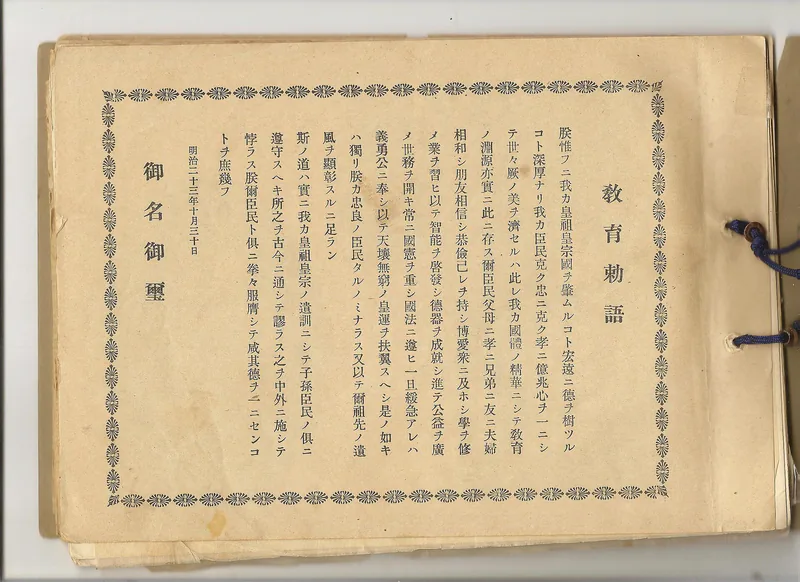
For most Japanese, State Shinto was experienced less in the shrine than in the classroom. The Imperial Rescript on Education, issued in 1890, told subjects to practise filial piety and loyalty and, in an emergency, to offer themselves to the state to support the imperial throne. Copies were kept in schools together with portraits of the emperor and empress and read aloud with great ceremony on national holidays; in 1891 the Christian teacher Uchimura Kanzō was forced from his post after he was judged to have bowed insufficiently before the rescript. Textbooks taught the myths of the Kojiki and Nihon shoki as national history.
The war dead received a cult of their own. A shrine founded in Tokyo in 1869 to console the spirits of those who had died fighting for the imperial side was renamed Yasukuni Jinja in 1879 and placed under the Army and Navy ministries rather than the Home Ministry. Soldiers killed in Japan's wars were enshrined there as kami in ceremonies attended by the emperor, and local "nation-protecting shrines" (gokoku jinja) extended the cult throughout the country. As the empire expanded, shrines were also founded abroad, among them the Taiwan Shrine (1901) and the Korea Shrine in Seoul (1925); attendance at shrine ceremonies became a point of serious conflict with Korean Christians in the 1930s.
Ultranationalism and the Policing of Religion, 1920s–1945§
In the 1930s the system hardened. The Ministry of Education's Kokutai no hongi (Cardinal Principles of the National Entity, 1937) presented Japan as a family-state headed by a divine emperor and rejected individualism as a Western error. Religious groups whose teachings seemed to compete with the imperial myth were suppressed. The new religion Ōmoto was raided in 1921 and again, far more harshly, in 1935, when its buildings were dynamited; leaders of Hitonomichi and of the lay Buddhist Sōka Kyōiku Gakkai were arrested, and the latter's founder, Makiguchi Tsunesaburō, died in prison in 1944 (see Japanese new religions and Sōka Gakkai).
Christian churches generally accommodated the requirement of shrine reverence. After students of the Catholic Sophia University declined to bow at Yasukuni in 1932, the Japanese bishops sought assurances that such acts were civic rather than religious, and in 1936 the Vatican's missionary congregation instructed Catholics that they could take part. The Religious Organisations Law of 1939 placed all recognised religions under close state supervision for the duration of the war.
The Shinto Directive and the End of State Shinto§
After Japan's surrender, the Allied Occupation treated State Shinto as a root of militarism. The Shinto Directive of 15 December 1945 ordered the end of government sponsorship, funding and supervision of shrines and banned Shinto teaching in public schools; it was in this document that the term "State Shinto" first gained wide currency in English. On 1 January 1946 the emperor issued a rescript, widely called the "Declaration of Humanity", denying that the bond between ruler and people rested on myth or on the idea of the emperor as a manifest deity.
Shrines became private religious corporations. In February 1946 most of them joined the newly founded Association of Shinto Shrines (Jinja Honchō), which regards Ise as its spiritual centre. The 1947 constitution guarantees religious freedom, forbids the state to grant privileges to any religion and bars public money from religious bodies. Yasukuni chose to remain independent, and the enshrinement there in 1978 of fourteen men convicted as Class A war criminals has made visits by prime ministers a recurring diplomatic controversy.
How Historians Define State Shinto§
Scholars disagree about the scope of the term. The religious historian Murakami Shigeyoshi, in an influential book of 1970, used it broadly for an imperial state religion that dominated Japanese spiritual life. Shinto scholars such as Sakamoto Koremaru and Nitta Hitoshi have argued for a narrower definition: the administrative system of state shrines, which was often underfunded and politically weak. Shimazono Susumu has in turn argued that the emperor cult carried by schools, rescripts and national ritual was the core of State Shinto, whatever the formal status of shrines.
Helen Hardacre's studies show a system that developed unevenly, with real tensions between priests, bureaucrats and military authorities. Most historians now agree that it was a modern construction rather than the survival of an ancient religion, and that it drew on genuinely old rites, myths and sites to make the new nation-state appear timeless. Debates about the place of imperial ritual, such as the Daijōsai, in a secular constitution continue in Japan today.
Frequently asked questions§
What was State Shinto?§
State Shinto was the system, from 1868 to 1945, in which the Japanese government ranked and funded shrines, appointed their priests and promoted reverence for the emperor and the kami through shrines, schools and national ceremonies. The state defined these rites as civic duties rather than religion.
Was State Shinto a religion?§
Officially it was not: the government insisted that shrine rites were patriotic ceremonies, which allowed it to require participation while claiming to respect religious freedom. Most modern historians regard this as a legal and political distinction rather than a description of how people experienced the shrines.
When did State Shinto end?§
It was dismantled by the Allied Occupation's Shinto Directive of 15 December 1945, followed by the emperor's New Year rescript of 1946 and the separation of religion and state in the 1947 constitution.
What is the difference between State Shinto and Shrine Shinto today?§
Today's Shrine Shinto consists of privately run shrines, most affiliated with the Association of Shinto Shrines, that receive no government money. They continue many of the same rites, but participation is voluntary and the state has no role in appointing priests.
Sources and further reading§
- Shinto and the State, 1868–1988 — Helen Hardacre, 1989
- Shinto: A History — Helen Hardacre, 2017
- The Invention of Religion in Japan — Jason Ānanda Josephson, 2012
- Japan's Modern Myths: Ideology in the Late Meiji Period — Carol Gluck, 1985
- The "Greatest Problem": Religion and State Formation in Meiji Japan — Trent E. Maxey, 2014
- Kokutai no Hongi: Cardinal Principles of the National Entity of Japan — John Owen Gauntlett (trans.) and Robert King Hall (ed.), 1949
- Yasukuni, the War Dead and the Struggle for Japan's Past — John Breen (ed.), 2008
- A New History of Shinto — John Breen and Mark Teeuwen, 2010