Liber XXVI · Shinto · Chapter I: Esoteric Buddhism in Japan
Esoteric Buddhism in Japan: Kūkai, Shingon and Tendai Mikkyō
Japanese esoteric Buddhism (mikkyo) explained: Kukai and Shingon, Saicho and Tendai, the two mandalas, mantra and mudra, goma fire rites and marathon monks.

Esoteric Buddhism in Japan, called mikkyō ("secret teaching"), is the Japanese form of tantric or Vajrayāna Buddhism, transmitted from Tang China in the early ninth century by the monks Kūkai, founder of the Shingon school, and Saichō, founder of Tendai. It teaches that buddhahood can be realised "in this very body" through the "three mysteries" of ritual gesture (mudrā), sacred sound (mantra) and meditative visualisation, centred on the cosmic buddha Dainichi (Mahāvairocana) and the two great mandalas of the Womb and Diamond realms.
What Is Mikkyō? Esoteric Buddhism Defined§
Japanese Buddhists traditionally distinguish exoteric teachings (kengyō), the doctrines the historical Buddha preached openly, adapted to his hearers, from esoteric teachings (mikkyō), which Kūkai described as the direct self-expression of the cosmic Buddha Dainichi, "Great Sun", whose body is the universe itself. Esoteric teachings are "secret" not because they are hidden for their own sake but because they can be understood only through initiation and practice under a qualified teacher.
The name Shingon, "true word", is the Japanese reading of the Chinese translation of the Sanskrit mantra. Like the tantric traditions of India and Tibetan Buddhism, mikkyō uses consecration rites, mandalas, mantras and ritual implements such as the vajra to transform the practitioner's ordinary body, speech and mind into those of a buddha. Unlike Tibetan Vajrayāna, Japanese esotericism developed from an earlier phase of Indian tantra and does not include the later "highest yoga" tantras that became central in Tibet.
From India to China: The Tantric Lineage of the Tang§
Esoteric Buddhism took systematic form in India in the seventh century, with scriptures such as the Mahāvairocana Sūtra and the Sarvatathāgata-tattvasaṃgraha, known in Japan as the Dainichikyō and Kongōchōkyō. These were brought to China by Indian and Central Asian masters: Śubhakarasiṃha (637–735), who translated the Mahāvairocana Sūtra; Vajrabodhi (671–741); and his disciple Amoghavajra (705–774), who became a powerful figure at the Tang court, performing rites for the protection of the state. Charles Orzech and other scholars have shown how this "esoteric" Buddhism became part of the religion of the Chinese empire.
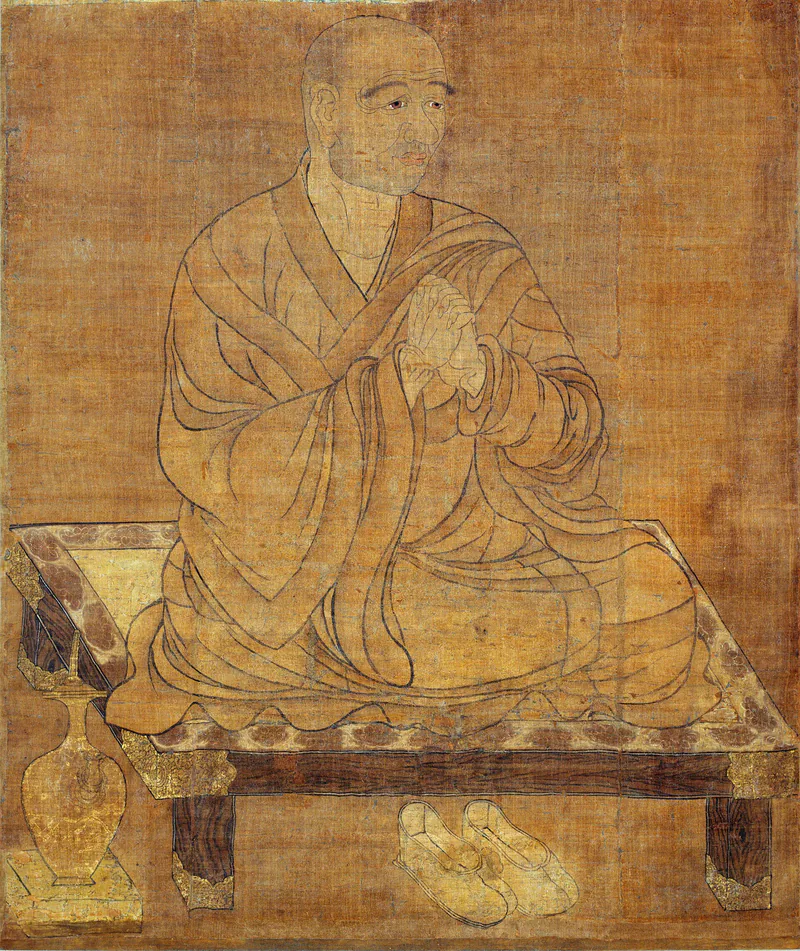
Amoghavajra's disciple Huiguo (746–805), at the Qinglong temple in the capital Chang'an, was the first to transmit both great mandala systems together. It was from him that Kūkai received his initiations.
Kūkai and the Founding of Shingon§
Kūkai, posthumously known as Kōbō Daishi, was born in 774 on the island of Shikoku. He abandoned a career at the state academy for Buddhist practice, reportedly including a mantra recitation for memory performed in mountains and caves. In 804 he sailed to China with an official embassy, and in Chang'an Huiguo, who was near death, gave him full initiation into the Womb and Diamond mandalas and named him his successor. Kūkai returned to Japan in 806 with scriptures, mandalas, ritual implements and portraits of the patriarchs.
He won the patronage of Emperor Saga, received permission in 816 to found a monastic centre on Mount Kōya and in 823 was entrusted with the temple Tōji in Kyoto. His writings, several of which Yoshito Hakeda translated, set out a complete system: Attaining Enlightenment in This Very Existence, which argues that the six elements of the universe are the Buddha's body; works on the meaning of sound and letters; and the Ten Stages of Mind, which ranks all religions and Buddhist schools as steps toward the esoteric. Kūkai was also a renowned calligrapher, poet and founder of a school open to commoners. Shingon tradition holds that he did not die in 835 but entered eternal meditation at Okunoin on Mount Kōya, where he is still offered meals daily. The eighty-eight-temple pilgrimage of Shikoku is dedicated to him.
Saichō, Mount Hiei and Tendai Esotericism§
Saichō (767–822), posthumously Dengyō Daishi, travelled on the same embassy of 804 and studied the Tiantai (Tendai) teaching centred on the Lotus Sutra. He also received some esoteric initiation, and on his return the court was at first more interested in his esoteric rites than in his Lotus teaching. His monastery, Enryakuji on Mount Hiei above Kyoto, became the largest religious institution in Japan and the training ground of later founders such as Hōnen, Shinran, Dōgen and Nichiren. For a time Saichō sought esoteric instruction from Kūkai, but their relationship broke down.

Saichō's successors Ennin (794–864) and Enchin (814–891) travelled to China and brought back fuller esoteric transmissions, so that Tendai esotericism (Taimitsu) came to rival that of Shingon (Tōmitsu, "esotericism of Tōji"). Tendai thus combined Lotus Sutra doctrine, meditation, precepts and esoteric ritual, and from the Heian period almost every school of Japanese Buddhism was penetrated by esoteric practice. The historian Kuroda Toshio described the medieval religious establishment as an "exoteric-esoteric system".
The Two Mandalas and the Three Mysteries§
At the heart of Shingon practice are the two mandalas (ryōkai mandara), hung facing each other in the ritual hall.
- The Womb Realm (Taizōkai) mandala, based on the Mahāvairocana Sūtra, shows Dainichi at the centre of an eight-petalled lotus surrounded by hundreds of buddhas, bodhisattvas and deities, expressing the compassion that nurtures all beings like a womb.
- The Diamond Realm (Kongōkai) mandala, based on the Tattvasaṃgraha, is divided into nine assemblies and expresses the indestructible wisdom of enlightenment.
The two represent principle and wisdom, matter and mind, and in Shingon thought they are ultimately one. Practice works through the three mysteries (sanmitsu): the practitioner forms mudrā with the hands, recites mantra and dhāraṇī, and visualises the deity and its seed-syllable, so that body, speech and mind enter into union with the Buddha's. A characteristic Shingon meditation, ajikan, contemplates the Sanskrit letter A, symbol of the unborn origin of all things, on a moon disc. The wrathful protector Fudō Myōō (Acala), wreathed in flames, is among the most widely venerated esoteric deities.
Rituals and Austerities: Goma, Initiation and the Marathon Monks§
Esoteric ritual served individuals and the state alike. The goma fire ritual, derived ultimately from the Vedic homa, burns wooden sticks inscribed with prayers in a sacred hearth before an image of Fudō, symbolically consuming defilements in the fire of wisdom; it is performed daily in many temples. Initiation (kanjō, from the Sanskrit abhiṣeka) admits practitioners to the mandala; in a public form, kechien kanjō, blindfolded participants throw a flower onto the mandala to establish a karmic link with whichever buddha it lands on. Court rituals invoked esoteric deities to protect the emperor, bring rain or subdue enemies.
Tendai's most famous austerity is the kaihōgyō, the "circling the mountain" practice of Mount Hiei, in which monks walk long circuits of the mountain's holy sites, worshipping at each, over a total of a thousand days spread across seven years, followed by a period of fasting and sleepless recitation; very few have completed it. A later medieval Shingon lineage, the Tachikawa school, was condemned by rivals as a sexual heresy, but recent scholarship suggests that much of its notoriety was created by polemic.
Esoteric Buddhism in Japanese Religion and Culture§
Mikkyō supplied the theology of the kami-buddha combination, including the identification of Amaterasu with Dainichi described in Shinto and Buddhism. It shaped the mountain asceticism of Shugendō, whose practitioners use mudrā, mantra and the goma, and it overlapped with the yin-yang specialists of Onmyōdō in rites of protection and astrology. Its painted mandalas, sculptures of wrathful kings and Siddham script are among the treasures of Japanese art. Shingon and Tendai remain major schools today, with Mount Kōya and Mount Hiei visited by pilgrims and travellers from around the world.
Frequently asked questions§
What is the difference between Shingon and Tendai?§
Shingon, founded by Kūkai, is a fully esoteric school centred on Dainichi and the two mandalas. Tendai, founded by Saichō, is based on the Lotus Sutra and combines esoteric ritual with meditation, doctrine and later Pure Land and other practices.
What does "attaining buddhahood in this very body" mean?§
It is Kūkai's teaching (sokushin jōbutsu) that a person need not pass through countless lifetimes to become a buddha. Through esoteric practice uniting body, speech and mind with the Buddha's, enlightenment can be realised in the present life.
Is Shingon the same as Tibetan Buddhism?§
Both are forms of Vajrayāna Buddhism using mandalas, mantras and initiations, but they derive from different phases of Indian tantra and developed separately. Shingon is based mainly on the earlier Mahāvairocana and Tattvasaṃgraha systems transmitted through Tang China.
Sources and further reading§
- Kūkai: Major Works — Yoshito S. Hakeda, 1972
- The Weaving of Mantra: Kūkai and the Construction of Esoteric Buddhist Discourse — Ryūichi Abé, 1999
- Shingon: Japanese Esoteric Buddhism — Taikō Yamasaki, 1988
- Shingon Buddhism: Theory and Practice — Minoru Kiyota, 1978
- Saichō: The Establishment of the Japanese Tendai School — Paul Groner, 1984
- Esoteric Buddhism and the Tantras in East Asia — Charles D. Orzech, Henrik H. Sørensen and Richard K. Payne (eds.), 2011
- The Marathon Monks of Mount Hiei — John Stevens, 1988