Liber XXVI · Shinto · Chapter I: Esoteric Buddhism in Japan
The Shikoku Henro: Kōbō Daishi and the 88-Temple Pilgrimage
The Shikoku henro, Japan's 88-temple pilgrimage: its links to Kūkai (Kōbō Daishi), its history, pilgrim dress and customs, legends and modern revival.

The Shikoku henro (四国遍路) is a Buddhist pilgrimage of eighty-eight temples around the island of Shikoku in western Japan, a circuit of roughly 1,200 kilometres associated with Kūkai, the ninth-century founder of Shingon Buddhism, who is venerated as Kōbō Daishi. Pilgrims, called henro or o-henro-san, travel it on foot, by bus or by car, believing that the Daishi accompanies them on the way, and the island's residents have long supported them with gifts known as settai.
Kūkai and the Island of Shikoku§
Kūkai (774–835) was born in Sanuki province in northern Shikoku, by tradition at the site of the temple Zentsūji, now the seventy-fifth on the route. In his youthful work Sangō shiiki ("Indications of the Goals of the Three Teachings", 797) he records that he left the state academy to practise a mantra recitation in the mountains, climbing Mount Tairyū in Awa and meditating at Cape Muroto in Tosa, where, he writes, the morning star appeared. Later legend expanded this into the story that the star flew into his mouth. The temples Tairyūji (21) and Hotsumisakiji (24) mark these places.
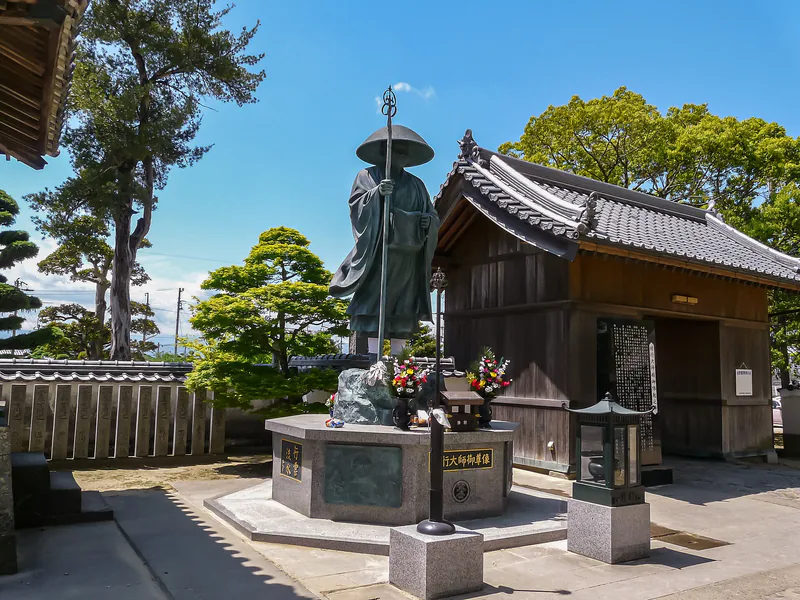
After his death on Mount Kōya in 835, Kūkai became the object of an enormous popular cult. Shingon tradition holds that he did not die but entered eternal meditation (nyūjō) in his mausoleum at Okunoin, and that he still travels the land helping those in need. In 921 the court awarded him the title Kōbō Daishi, "Great Teacher who Spread the Dharma", and over the following centuries countless springs, wells, rocks and temples across Japan were said to have been created by the wandering Daishi. Shikoku, his birthplace, became the centre of this devotion.
Origins of the Pilgrimage Route§
The pilgrimage did not begin as a fixed circuit of eighty-eight temples. Late Heian sources, including a song in the twelfth-century collection Ryōjin hishō and a tale in the Konjaku monogatari, describe ascetics who walked the rugged coasts of Shikoku, a practice called Shikoku no hechi, "the margins of Shikoku". These wanderers belonged to the world of mountain asceticism described in Shugendō, and many temples on the route were originally centres of such practice or of local kami worship.
During the medieval period itinerant holy men known as hijiri, many affiliated with Mount Kōya, spread the cult of the Daishi and probably linked these sites into a route associated with him. Graffiti left by pilgrims in the fifteenth and sixteenth centuries show that a circuit of Shikoku was being walked by then. The decisive step came in the seventeenth century. In 1687 the priest Shinnen published Shikoku henro michishirube, the first popular guidebook, and erected stone signposts along the way; two years later the scholar-monk Jakuhon compiled a history of the temples. By this time the canonical list of eighty-eight temples, with their numbers and principal images, had become standard.
Why eighty-eight? No early explanation survives. Popular theories link the number to the eighty-eight delusions of Buddhist doctrine, or to the "unlucky ages" of men, women and children added together, but these are later interpretations.
The Four Dōjō: The Route as a Path to Enlightenment§
Pilgrims traditionally walk clockwise from Ryōzenji (temple 1) in Tokushima to Ōkuboji (temple 88) in Kagawa, though they may begin anywhere. Each of the four provinces is described as a training hall (dōjō) corresponding to a stage of the Buddhist path:
- Awa (temples 1–23): the arousal of the aspiration to enlightenment (hosshin);
- Tosa (24–39): ascetic practice (shugyō), fitting for the long, remote stretches of the Pacific coast;
- Iyo (40–65): enlightenment (bodai);
- Sanuki (66–88): nirvana (nehan).
The temples belong mostly to the Shingon school but also to Tendai, Zen and Pure Land lineages, and their principal images range from Yakushi, the healing buddha, to Kannon, Amida and Fudō Myōō. At each temple pilgrims typically wash at the basin, ring the bell, light candles and incense, leave a name slip (osamefuda), recite the Heart Sutra and the Daishi's mantra at both the main hall and the Daishi hall, and have their book (nōkyōchō) stamped and inscribed. Besides the eighty-eight, there are twenty "extra" (bangai) temples that many pilgrims also visit.
Dōgyō Ninin: Walking with the Daishi§
The central idea of the pilgrimage is expressed in the phrase dōgyō ninin, "two people travelling together", written on the pilgrim's hat. The pilgrim is never alone: the Daishi walks alongside, embodied in the wooden staff (kongōzue) that is treated with great respect, washed at the end of each day and never allowed to strike the ground on bridges, lest it disturb the Daishi, who according to legend once spent a night sleeping under a bridge.
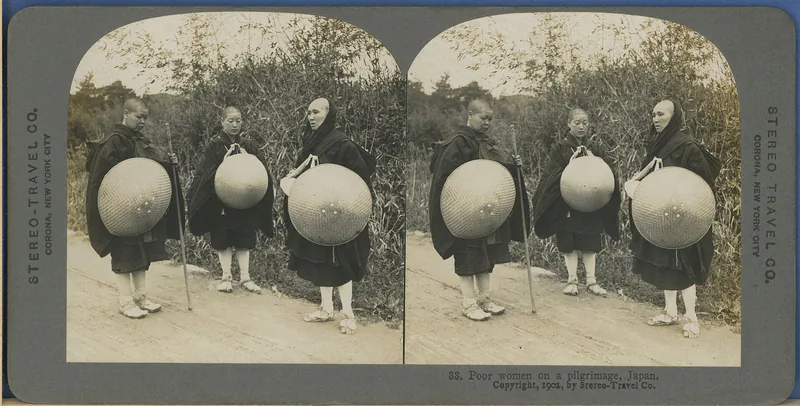
Traditional pilgrim dress reinforces the sense of a journey between life and death. The white robe (hakui) resembles a burial garment, and the conical sedge hat bears a verse on impermanence. In earlier centuries a pilgrim who died on the road was buried where he or she fell, and the many small graves along the route recall these deaths.
The most famous legend of the pilgrimage concerns Emon Saburō, a rich and greedy man of Iyo who drove away a begging monk and broke his bowl. After his eight sons died one by one, he realised that the monk had been Kōbō Daishi and set out around Shikoku to beg forgiveness. Circling the island again and again, he finally walked in reverse in the hope of meeting the Daishi head-on, and collapsed near the twelfth temple, Shōsanji, where the Daishi appeared and forgave him. The story is often cited as the origin of the pilgrimage and of the custom of walking in reverse (gyaku-uchi) in leap years.
Settai: The Island's Hospitality§
Pilgrims have long depended on settai, the giving of food, money, lodging or small gifts by local people. Because the pilgrim may be the Daishi in disguise, or at least walks in his company, giving to a henro is itself a meritorious act, and refusing it is considered impolite. Groups from other regions, known as settai-kō, travelled to Shikoku to distribute alms. Free lodgings (zenkonyado) offered by households along the route remain part of the experience.
Not all pilgrims were welcome. In the Edo period the pilgrimage drew the poor, the sick and outcasts as well as devout farmers and townspeople; people with leprosy, rejected by their communities, sometimes walked the route for years as a form of permanent exile. Domain authorities, particularly in Tosa, restricted pilgrims' movements, and in the Meiji period some officials condemned the henro as beggars. The separation of kami and buddhas after 1868 also disrupted the route, since several temples had been closely tied to shrines.
The Pilgrimage in Modern Japan§
The twentieth century transformed the henro. Bus pilgrimages began in the 1950s, and today most pilgrims travel by coach or car, completing the circuit in a week or two rather than the forty days or more needed on foot. Since the 1990s walking has enjoyed a revival, encouraged by guidebooks, television series and the growth of international interest; temple estimates put the annual number of pilgrims at around a hundred thousand or more at the peak in the early 2000s, of whom walkers formed only a small minority of a few thousand. The anthropologist Ian Reader, whose fieldwork on the route is the most detailed study in English, cautions that all such figures are approximate. Many people complete it in sections over several years.
Reader shows that pilgrims' motives are diverse: mourning a death, praying for health, fulfilling a vow, seeking time for reflection, or simply enjoying the walk and the landscape. Some become "professional" pilgrims who circle the island repeatedly. Miniature versions of the route, with sand from each of the eighty-eight temples placed beneath statues, were created throughout Japan from the Edo period, allowing those unable to travel to perform the pilgrimage in a single afternoon. After completing the circuit, many pilgrims visit Mount Kōya to report to the Daishi at Okunoin, a custom that links the Shikoku route with other great Japanese pilgrimages such as the Kumano Kodō.
Frequently asked questions§
How long is the Shikoku pilgrimage?§
The circuit of eighty-eight temples is roughly 1,100 to 1,400 kilometres long depending on the route taken. Walkers usually need between forty and sixty days; by bus or car it can be completed in about ten days.
Who was Kōbō Daishi?§
Kōbō Daishi is the posthumous title of Kūkai (774–835), the founder of Shingon Buddhism, who was born on Shikoku. Devotees believe that he remains in eternal meditation on Mount Kōya and accompanies every pilgrim on the Shikoku route.
Do you have to be Buddhist to walk the Shikoku pilgrimage?§
No. The temples welcome pilgrims of any background, and many modern walkers are not religious. Most, however, follow at least some of the customs of worship at each temple as a sign of respect.
Sources and further reading§
- Kukai: Major Works — Yoshito S. Hakeda, 1972
- Japanese Pilgrimage — Oliver Statler, 1983
- Pilgrimage in Popular Culture — Ian Reader and Tony Walter (eds.), 1993
- The Weaving of Mantra: Kūkai and the Construction of Esoteric Buddhist Discourse — Ryūichi Abé, 1999
- Making Pilgrimages: Meaning and Practice in Shikoku — Ian Reader, 2005