Liber XXXI · Taoism & Chinese Religion
The Three Teachings: Confucianism, Taoism and Buddhism in China
The Three Teachings of China explained: how Confucianism, Taoism and Buddhism competed, debated and merged, from Han rivalry to Lin Zhao'en and temple life.

The Three Teachings (sanjiao) is the traditional Chinese name for Confucianism, Taoism and Buddhism considered together, as the three great bodies of doctrine and practice in imperial China. For nearly two thousand years they competed for patronage and argued about which was superior, yet most Chinese people drew on all three, and from the Song dynasty onward a widespread conviction held that "the three teachings are one".
What the Three Teachings Are§
The Chinese word jiao means "teaching" or "instruction", and it did not carry the modern sense of an exclusive religion to which one belongs. A teaching was a body of texts, masters and practices that one might study and use. In this sense the three were:
- Ru jiao, the teaching of the scholars, which Westerners call Confucianism: the classics, ritual propriety, family virtue and the ethics of government.
- Dao jiao, the teaching of the Way, or Taoism: the classics of Laozi and Zhuangzi, the priesthood founded by the Celestial Masters, and methods of self-cultivation and longevity.
- Fo jiao or Shi jiao, the teaching of the Buddha (Shi is short for Shijiamouni, Shakyamuni), which arrived from India and Central Asia and became one of the great Chinese traditions in its own right.
The sociologist C. K. Yang described Chinese religion as largely "diffused": woven into family, community and state rather than organised into separate churches. The three teachings each had specialists, such as scholar-officials, Taoist priests and Buddhist monks, but ordinary households turned to all of them, alongside the gods and ancestors of popular religion, without any sense of contradiction.
Buddhism Arrives: Rivalry and Translation§
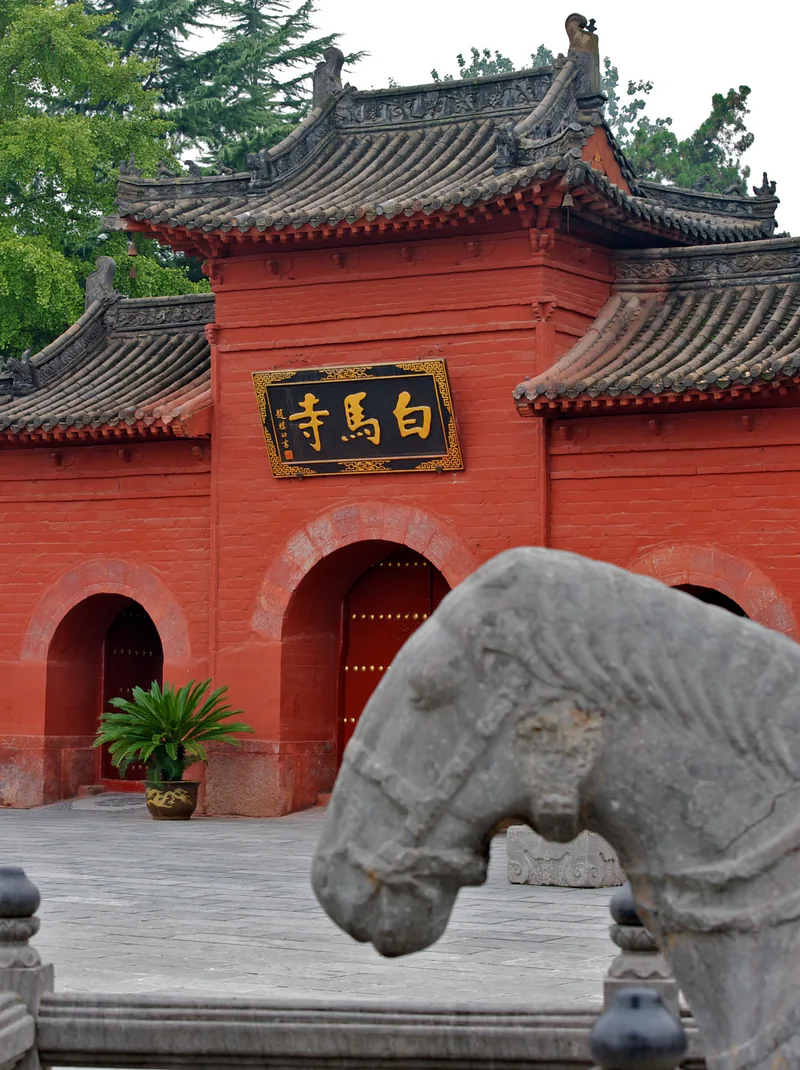
Buddhism reached China along the trade routes during the Han dynasty. A later legend tells of Emperor Ming (r. 57–75 CE) dreaming of a golden man and sending envoys west, who returned with scriptures carried by a white horse; the White Horse Temple at Luoyang commemorates the story. Historians treat the legend cautiously, but a Buddhist community is attested at the Han court by the 160s, when translators such as An Shigao began rendering Indian texts into Chinese.
Early translators borrowed Taoist and Confucian vocabulary to make foreign ideas intelligible. Nirvana was sometimes rendered with the Taoist term wuwei, and emptiness with the "non-being" (wu) of the Tao Te Ching. This method, later called geyi or "matching concepts", made Buddhism seem familiar but also blurred its distinctiveness, and later translators such as Kumarajiva (344–413) worked to replace it with more precise terminology.
Rivalry came quickly. Confucian critics objected that monks abandoned their parents, shaved the body inherited from them and left no descendants, all offences against filial piety; they also called Buddhism a foreign creed. A defence called Mouzi's Disposing of Errors (Mouzi lihuo lun), whose date is disputed, answered such objections in dialogue form. Taoists, for their part, circulated the claim that Laozi had gone west and converted the barbarians, so that Buddhism was merely a garbled version of his teaching. This "conversion of the barbarians" story, discussed in the article on the deified Laozi, fuelled centuries of polemic.
Court Debates, Rankings and Persecutions§
Between the fourth and ninth centuries the relative standing of the teachings was a matter of state. Emperors hosted formal debates, often on their birthdays, at which Buddhist monks, Taoist priests and Confucian scholars argued points of doctrine before the throne. Rulers then issued rankings that fixed the order of precedence at court ceremonies.
The Tang dynasty (618–907) is the classic example. The ruling Li family claimed descent from Laozi, whose surname was also said to be Li, and Taoism was usually ranked first. Empress Wu Zetian (r. 690–705) reversed the order in favour of Buddhism, which she used to legitimise her rule, and later emperors changed it again. The examination system, meanwhile, kept Confucian learning at the heart of government.
Rivalry sometimes became persecution. Emperor Wu of the Northern Zhou proscribed both Buddhism and Taoism in 574. The most famous suppression came in 842–845 under the Tang emperor Wuzong, a devotee of Taoist elixirs: according to the official figures some 4,600 monasteries were closed and about 260,000 monks and nuns returned to lay life. Economic motives, especially the tax-exempt wealth of the monasteries, were as important as doctrine. Earlier, in 819, the Confucian writer Han Yu had protested against the veneration of a relic of the Buddha, calling Buddhism a barbarian cult; his essay became a touchstone for later Confucian critics.
"The Three Teachings Are One": Harmonising Formulas§
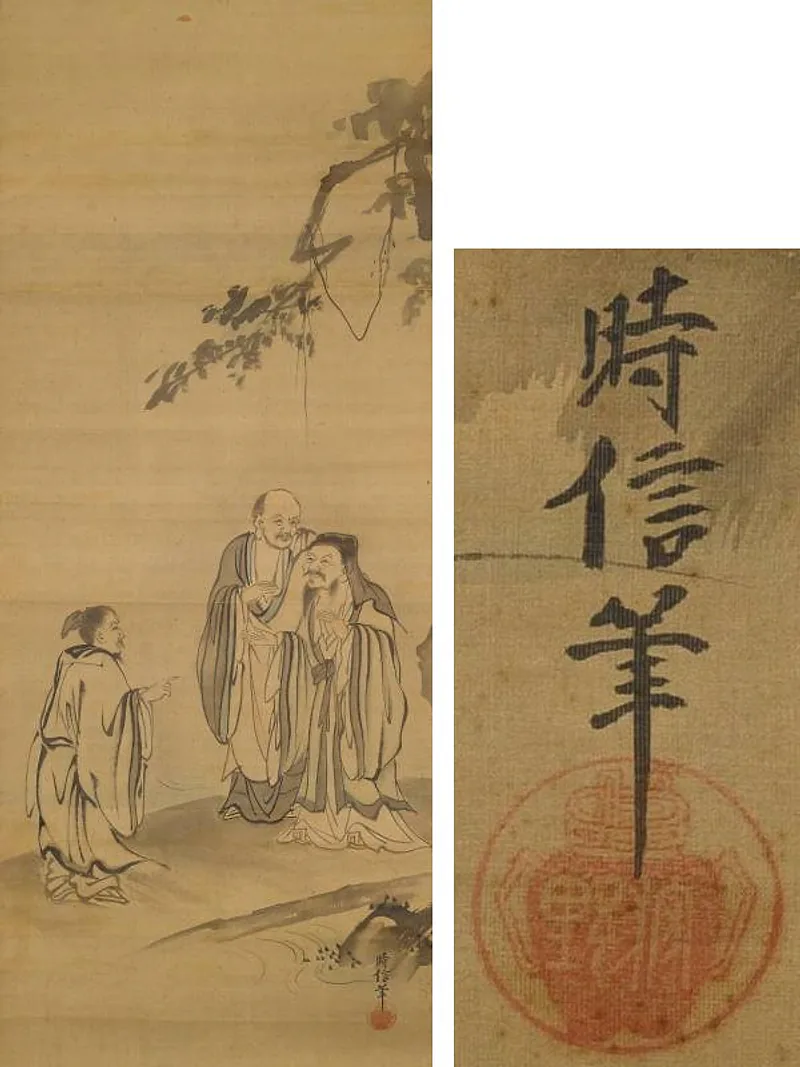
Alongside rivalry, a habit of reconciliation grew steadily. A favourite image is the legend of the "Three Laughs at Tiger Creek": the Buddhist master Huiyuan, who had vowed never to cross the creek below his monastery on Mount Lu, walked his guests, the poet Tao Yuanming and the Taoist Lu Xiujing, past it while deep in conversation, and the three laughed when they realised. The meeting could not have happened as told, since the three men's dates do not fit, but painters returned to it for centuries as a picture of friendship between the teachings.
From the Song dynasty (960–1279) the idea of unity became a commonplace. A saying attributed to Emperor Xiaozong (r. 1162–1189) assigned each teaching its sphere: Buddhism to govern the mind, Taoism to nourish the body and Confucianism to order the world. Phrases such as sanjiao heyi ("the three teachings unite as one") and sanjiao guiyi ("the three teachings return to one") were used by monks, priests and scholars alike.
Each tradition absorbed the others in practice:
- Chan (Zen) Buddhism owed much of its style of spontaneity and paradox to Taoist sensibility, as many scholars have argued.
- The Quanzhen order, founded by Wang Chongyang in the twelfth century, told its followers to read the Tao Te Ching, the Buddhist Heart Sutra and the Confucian Classic of Filial Piety, and adopted Buddhist-style monasticism.
- Neo-Confucianism, though it formally rejected Buddhism, built a metaphysics and a practice of quiet sitting that responded to Buddhist and Taoist challenges.
Harmony was not always equality. Each camp tended to argue that the three were one because its own teaching contained the essence of the others. Zhu Xi and many later Confucians remained sharply critical of Buddhist "emptiness", and Buddhist and Taoist apologists ranked their own paths highest.
Lin Zhao'en and the Three-in-One Teaching§
The most systematic attempt to fuse the teachings came from Lin Zhao'en (1517–1598), a scholar from Putian in Fujian who abandoned an official career after a personal crisis. He taught that Confucius, Laozi and the Buddha had all expressed the same truth of the mind, and that their followers had later obscured it. His practice combined Confucian ethics and study, Taoist-style inner cultivation, and Buddhist-inspired meditation, organised in a graded path he called the "heart method".
After his death his disciples deified him as the "Lord of the Three Teachings" (Sanjiao xiansheng and related titles), and the movement became a religion with temples, scriptures and rituals. The Three-in-One Teaching (Sanyi jiao) survived Qing suppression and twentieth-century campaigns, and still has temples in the Putian region and among Fujianese communities in Southeast Asia. Judith Berling's study of Lin remains the standard account in English.
Later popular sects went further, sometimes speaking of five teachings by adding Christianity and Islam. Several modern Chinese salvationist movements, described in the article on syncretic new religions, continue this pattern.
The Three Teachings in Everyday Religion§
For most people the three teachings met not in debate halls but in daily life. A family might consult a Taoist priest to exorcise a sickness, invite Buddhist monks to chant sutras at a funeral, honour the ancestors in a Confucian manner at the household altar, and buy a Tong Shu almanac to choose the date of a wedding. The great festival of the seventh month, the Hungry Ghost Festival, has both a Buddhist name, Yulanpen, and a Taoist one, Zhongyuan.
Temples reflected this mixture. Halls dedicated to the three founders together, with the Buddha, Laozi and Confucius seated side by side, are found across China and Taiwan, and popular morality books borrowed freely from all three, teaching that deeds are recorded by heavenly officials and rewarded or punished. The Jade Emperor presided over a pantheon that included Buddhist bodhisattvas and deified Confucian worthies.
In the twentieth century the modern category of "religion" (zongjiao) changed the picture. Reformers treated much temple practice as superstition, and the People's Republic officially recognises Buddhism and Taoism (alongside Islam, Catholicism and Protestantism) but not Confucianism, which is classed as philosophy or heritage. Scholars such as Vincent Goossaert and David Palmer have traced how this reclassification reshaped Chinese religious life, even as many people continue to draw on all three teachings.
Frequently asked questions§
What are the Three Teachings of China?§
They are Confucianism, Taoism and Buddhism, known together as sanjiao. Confucianism and Taoism are native to China, while Buddhism came from India from around the first century CE and became fully Chinese over the following centuries.
What does "the three teachings are one" mean?§
It is a harmonising slogan, common from the Song dynasty, holding that the three traditions share one underlying truth and differ mainly in emphasis. In practice each tradition often claimed that its own teaching contained the essence of the other two.
Can a person follow all three teachings?§
Historically, most Chinese people did, turning to each for different needs: Confucian ethics and ancestral rites, Taoist ritual and longevity practices, Buddhist funerals and merit-making. Exclusive membership in one tradition was usual only for clergy and committed lay followers.
Was there ever conflict between them?§
Yes. There were court debates, polemical writings and several state persecutions, notably the suppression of Buddhism in 842–845. Rivalry and synthesis coexisted throughout Chinese history.
Sources and further reading§
- The Syncretic Religion of Lin Chao-en — Judith A. Berling, 1980
- The Buddhist Conquest of China — Erik Zürcher, 1959
- Religion in Chinese Society — C. K. Yang, 1961
- Chinese Religion: An Introduction — Laurence G. Thompson, 1969
- Religions of China in Practice — Donald S. Lopez Jr. (ed.), 1996
- The Religious Question in Modern China — Vincent Goossaert and David A. Palmer, 2011