Liber XXI · New Religions · Chapter VII: Syncretic Religions
Syncretic New Religions: Cao Đài, Santo Daime and Others
Syncretic new religions explained: Cao Đài and Hòa Hảo in Vietnam, Chinese salvationist sects, Santo Daime in Brazil and African prophetic churches.

Syncretic new religions are modern religious movements that deliberately or gradually combine elements from several traditions into a new whole. Examples include Cao Đài in Vietnam, which unites Buddhism, Taoism, Confucianism, Christianity and Spiritism under the symbol of the Divine Eye; the Chinese salvationist movement Yiguandao; Brazil's Santo Daime and Valley of the Dawn; and African prophetic churches such as Kimbanguism. Such movements often arise in colonial or rapidly changing societies, where founders claim new revelations that reconcile the religions of the world. Scholars treat "syncretism" carefully, since every religion borrows, but the term remains useful for movements that make the unity of religions their message.
What Is Syncretism?§
The word synkretismos appears in Plutarch for the Cretans' habit of uniting against a common enemy; in the seventeenth century it was used, often critically, for attempts to reconcile Christian confessions. Nineteenth-century scholars applied it to the mixing of Greek, Egyptian and Eastern cults in the Hellenistic world. In the twentieth century missionaries and theologians used "syncretism" to criticise churches in Africa, Asia and the Americas that had absorbed indigenous elements.
Anthropologists Charles Stewart and Rosalind Shaw, in Syncretism/Anti-Syncretism (1994), argued that the term should describe a process of combination and the politics of approving or rejecting it, not a judgement on purity. All religions borrow; Christianity absorbed Jewish, Greek and Roman forms, and Buddhism adapted to every culture it entered. The movements in this article are distinctive because they consciously present themselves as syntheses, or because outsiders have classified them so. Older Afro-Atlantic traditions such as Santería and Candomblé, often called syncretic for their identification of African deities with Catholic saints, are covered in Candomblé and Umbanda and African Diasporic Religions.
Cao Đài: The Divine Eye§
Cao Đài, officially the Great Way of the Third Universal Redemption (Đại Đạo Tam Kỳ Phổ Độ), emerged in southern Vietnam under French colonial rule. In 1921 Ngô Văn Chiêu, a colonial civil servant who practised spirit communication, reported a vision of the Supreme Being, Cao Đài ("High Palace"), in the form of a left eye within a triangle, which became the religion's emblem. A circle of officials and intellectuals in Saigon received further messages in séances using a beaked basket (corbeille à bec) and planchette, combining Chinese spirit-writing traditions with the French Spiritism of Allan Kardec, discussed in Spiritualism. The religion was formally declared in 1926.
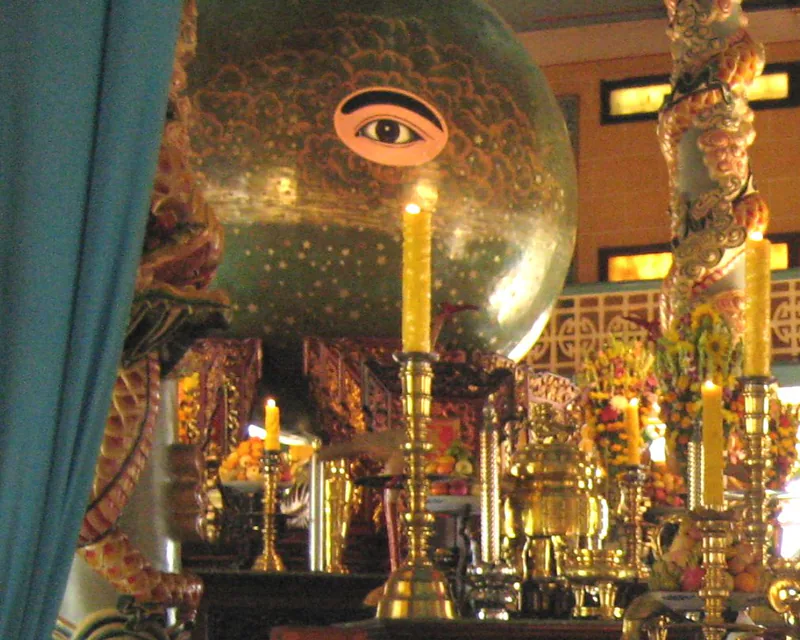
Cao Đài teaches that God revealed himself in two earlier periods through founders such as Moses, the Buddha, Laozi, Confucius and Jesus, and that because those teachings were distorted, God now speaks directly in a third and final amnesty. It unites the "three teachings" of East Asia with Christianity and venerates a wide range of saints and spirits, including the Chinese poet Li Bai, the Vietnamese sage Nguyễn Bỉnh Khiêm, Sun Yat-sen and the French writer Victor Hugo, who is regarded as a spirit guide of its overseas mission. Its organisation is modelled partly on the Catholic Church, with a pope (Giáo Tông), cardinals and bishops, and women may hold high clerical rank. The Holy See at Tây Ninh, completed in the 1950s, is a colourful temple of dragons, columns and the great Divine Eye. Adherents pray four times a day, follow a largely vegetarian diet and observe the ethics of the five precepts.
Cao Đài became a political and military force during the wars of decolonisation, and under its leader Phạm Công Tắc it maintained an army in the 1940s and 1950s. After 1975 the communist government seized its properties and banned séances; it was officially recognised again in 1997 under state supervision. Estimates of adherents range from two to several million, with diaspora communities in the United States, France and Australia studied by the anthropologist Janet Hoskins.
Hòa Hảo and Other Vietnamese Movements§
In 1939 Huỳnh Phú Sổ, a young man from the Mekong Delta village of Hòa Hảo, recovered from illness and began to heal and preach a reformed lay Buddhism. Hòa Hảo rejects elaborate temples and clergy, emphasising prayer at home, simple offerings of water, flowers and incense, and moral living. It drew on the earlier millenarian tradition of Bửu Sơn Kỳ Hương, founded in the nineteenth century. Like Cao Đài it built an armed force; Huỳnh Phú Sổ was killed by the Việt Minh in 1947. The historian Hue-Tam Ho Tai has studied these movements as forms of peasant millenarianism.
Chinese Salvationist Movements§
From the sixteenth century China saw popular sectarian movements centred on the Eternal Venerable Mother (Wusheng Laomu), who calls her lost children home before a coming cosmic catastrophe. The most successful modern heir is Yiguandao, the "Way of Pervading Unity", which grew rapidly in the 1930s and 1940s under Zhang Tianran. It teaches that the "five teachings" of Confucianism, Buddhism, Taoism, Christianity and Islam share one truth, and it initiates members by revealing secret mantras and a "mystic portal" between the eyes. Banned in the People's Republic in 1951 and long persecuted in Taiwan, it was legalised there in 1987 and is now one of Taiwan's largest religions.

Other movements include the Red Swastika Society (Daoyuan), known for spirit-writing and charity, and, in the qigong boom of the 1980s and 1990s, Falun Gong, founded by Li Hongzhi in 1992, which combines Buddhist and Taoist ideas with meditative exercises and was banned in China in 1999. The scholar David Ownby has placed these within China's long sectarian tradition. The practices from which they draw are discussed in Qigong and the Internal Arts.
Brazil: Santo Daime and the Valley of the Dawn§
Brazil's religious landscape is famously mixed. Santo Daime, founded in the state of Acre in the 1930s by Raimundo Irineu Serra (Mestre Irineu), a descendant of enslaved Africans, combines folk Catholicism, Amazonian traditions, Afro-Brazilian and Spiritist elements. Its rituals, with hymns sung in unison and formal dances, centre on a sacrament made from Amazonian plants, the brew known elsewhere as ayahuasca; the library describes this historically and gives no preparation or use details. A related group, the União do Vegetal, won a 2006 United States Supreme Court case protecting its sacramental use.
The Vale do Amanhecer (Valley of the Dawn), founded by the medium Neiva Chaves Zelaya (Tia Neiva) and established near Brasília in 1969, blends Spiritism, Afro-Brazilian religion, Catholicism, ancient Egyptian and Inca imagery, and expectations of a new age, with spectacular costumed rituals of healing by mediums. These movements draw on the same Spiritist and Afro-Brazilian currents as Umbanda.
Africa: Prophets and Independent Churches§
In central and southern Africa, colonial missions gave rise to independent churches led by prophets. In 1921 Simon Kimbangu, a Baptist catechist in the Belgian Congo, began a healing ministry that drew thousands; Belgian authorities arrested him the same year, and he died in prison in 1951. His followers founded the Church of Jesus Christ on Earth by His Messenger Simon Kimbangu, one of the largest African independent churches. In South Africa the Zion Christian Church, founded by Engenas Lekganyane in the 1920s, and the Nazareth Baptist Church of Isaiah Shembe combine Christian scripture with healing, ancestral concerns and African forms of leadership; Bengt Sundkler's Bantu Prophets in South Africa (1948) remains a classic study. In West Africa the Aladura ("praying people") churches of the Yoruba emphasise prayer, prophecy and healing. These churches connect with the religions described in African Traditional Religions.
Frequently asked questions§
What is an example of a syncretic religion?§
Cao Đài is one of the clearest examples: it combines Buddhism, Taoism, Confucianism, Christianity and Spiritism and venerates figures from all of them. Others include Yiguandao, Santo Daime and the Valley of the Dawn.
Why does Cao Đài honour Victor Hugo?§
Early Cao Đài mediums reported messages from the spirit of Victor Hugo, who in his lifetime had practised table-turning séances in exile on Jersey. He is honoured as a saint and spiritual guide of the religion's foreign mission.
Is all religion syncretic?§
In one sense, yes: every tradition has absorbed ideas and practices from others. Scholars use "syncretic" more narrowly for movements that consciously combine traditions or whose mixing is especially visible, while avoiding the older idea that syncretism means corruption.
Sources and further reading§
- Syncretism/Anti-Syncretism: The Politics of Religious Synthesis — Charles Stewart and Rosalind Shaw (eds), 1994
- The Divine Eye and the Diaspora: Vietnamese Syncretism Becomes Transpacific Caodaism — Janet Alison Hoskins, 2015
- Peasant Politics and Religious Sectarianism: Peasant and Priest in the Cao Dai in Viet Nam — Jayne Susan Werner, 1981
- Millenarianism and Peasant Politics in Vietnam — Hue-Tam Ho Tai, 1983
- Falun Gong and the Future of China — David Ownby, 2008
- Bantu Prophets in South Africa — Bengt G. M. Sundkler, 1948
- New Era – New Religions: Religious Transformation in Contemporary Brazil — Andrew Dawson, 2007