Liber XXI · New Religions · Chapter VII: Syncretic Religions
Kimbanguism: Simon Kimbangu and the Prophetic Church of Congo
Kimbanguism explained: the Congolese prophet Simon Kimbangu, his 1921 healing ministry and imprisonment, the Kimbanguist Church, Nkamba, beliefs and history.

Kimbanguism is the religious movement inspired by Simon Kimbangu (c. 1887–1951), a Baptist catechist in the Belgian Congo whose brief healing ministry in 1921 drew tens of thousands of followers before the colonial authorities condemned him to death, a sentence commuted to life imprisonment. His followers kept the movement alive underground for almost four decades, and in 1959 the Church of Jesus Christ on Earth through the Prophet Simon Kimbangu (EJCSK) was legally recognised. It is now one of the largest African-initiated churches, with millions of adherents in the Democratic Republic of the Congo, neighbouring countries and the diaspora, and it is a classic case in the study of African prophetic Christianity.
Kongo Prophets before Kimbangu§
The Kongo peoples of the lower Congo River had encountered Christianity since the late fifteenth century, when the kingdom of Kongo adopted Catholicism. Prophetic renewal had a long history there. Around 1704 a young noblewoman, Dona Beatriz Kimpa Vita, claimed to be possessed by Saint Anthony and preached the restoration of the divided kingdom and an Africanised Christianity in which Christ and the saints had been Kongo; she was burned as a heretic in 1706. The historian John Thornton has reconstructed her Antonian movement in detail.
Kongo religion also had its own specialists: the nganga, a healer and ritual expert, and the minkisi, power objects used for healing, protection and the detection of witchcraft, forms of the protective practices discussed in African Traditional Religions. By the early twentieth century Protestant missions, among them the British Baptist Missionary Society, had built schools and congregations across the region, while Belgian colonial rule imposed forced labour, taxes and the disruptions of the Matadi–Léopoldville railway and the 1918 influenza epidemic. In this setting many Kongo Christians hoped for a healer who would combine the power of the Bible with the authority of the old prophets.
Simon Kimbangu's Call and the Healing Ministry of 1921§
Simon Kimbangu was born in Nkamba, probably in 1887 (some sources give 1889), and was raised partly by an aunt after his mother's death. Educated at the Baptist mission at Ngombe Lutete, he was baptised around 1915 and served as a catechist. According to Kimbanguist tradition, he heard a voice calling him to heal and preach during the influenza epidemic of 1918, resisted it and went to work in Léopoldville (Kinshasa), but eventually returned home.
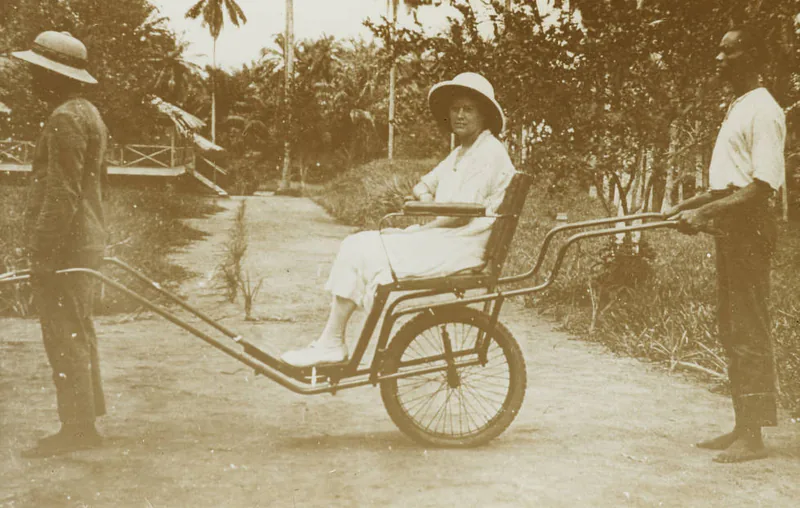
On 6 April 1921, a date the church still celebrates, he reportedly laid hands on a sick woman in a neighbouring village, who was healed. News spread rapidly. Crowds came to Nkamba, which followers began to call the New Jerusalem, bringing the sick and seeking blessing; people abandoned their minkisi, which Kimbangu urged them to destroy, along with polygamy and dancing associated with the old rites. He preached faith in God, obedience to the commandments and love of enemies, and he read and taught from the Bible. Mission hospitals emptied, Protestant congregations swelled with new converts, and workers left plantations and the railway to see the prophet. Some of the younger ngunza (prophets) who appeared alongside him used more radical, anti-European language.
Trial, Imprisonment and the Underground Church§
Belgian officials, Catholic missionaries and commercial interests saw the movement as a threat to colonial order. An attempt to arrest Kimbangu in June 1921 failed when he slipped away; in September he gave himself up. On 3 October 1921 a military court sentenced him to death for sedition and hostility to the state. Following appeals, including from Baptist missionaries, King Albert I commuted the sentence to life imprisonment. Kimbangu was transported to the prison at Élisabethville in the far south-east of the colony, where he remained, apparently a model prisoner, for thirty years until his death on 12 October 1951.
The colonial government banned the movement and deported thousands of suspected followers to labour colonies in distant provinces, which spread knowledge of Kimbangu across the Congo. Within the Lower Congo the movement went underground, meeting secretly in the forest and keeping the memory of the prophet alive in hymns. His wife, Marie Muilu Kiawanga, played a central role in sustaining the faithful. Related prophetic movements appeared, including the "Khaki" movement of Simon Mpadi from the 1930s, and on the French side of the river the political-religious Amicalism associated with André Matswa.
Recognition, Nkamba and the Kimbanguist Church§
In the 1950s Kimbangu's youngest son, Joseph Diangienda Kuntima (1918–1992), an educated clerk, organised the scattered believers into a disciplined church, insisting on non-violence and loyalty to civil authority. As independence approached, the colonial government recognised the Église de Jésus-Christ sur la terre par le prophète Simon Kimbangu on 24 December 1959. In 1960 Kimbangu's remains were brought from Lubumbashi to Nkamba and placed in a mausoleum, and Nkamba became the church's holy city, with a large temple and a constant stream of pilgrims who carry home water from its sacred spring for blessing and healing.
The church grew rapidly after independence. Under the regime of Mobutu Sese Seko, a law of 1971 granted official recognition to only a handful of religious bodies, among them the Catholic Church, the united Protestant church and the Kimbanguist Church, which gave it unusual prominence. In 1969 it had joined the World Council of Churches, an important step in the acceptance of African-initiated churches by world Christianity. After Diangienda's death in 1992, leadership passed to his brother Salomon Dialungana Kiangani and from 2001 to Kimbangu's grandson Simon Kimbangu Kiangani; a contested succession in the early 2000s divided some communities. The church runs schools, health centres and a university, and its brass bands and choirs are renowned; the Kimbanguist Symphony Orchestra in Kinshasa, founded in 1994 by a grandson of the prophet, became known internationally through a documentary film.
Beliefs, Worship and Moral Discipline§
Kimbanguists affirm the Bible, faith in God the Father, Jesus Christ and the Holy Spirit, and the sacraments of baptism and the Lord's Supper, which the church first celebrated in 1971 using bread and drink made from local produce rather than imported wheat and wine. Simon Kimbangu is honoured as the envoy of Christ, a prophet through whom God acted in Africa; many believers associate him with the Comforter promised in John 14:16–26. In recent decades the church's leadership has taught increasingly elevated doctrines about Kimbangu and his sons, which other churches and observers have described as a departure from mainstream Christian theology and which have strained ecumenical relations.
Moral discipline is strict. Members abstain from alcohol, tobacco, pork and certain other meats, from violence and from traditional charms and witchcraft accusations; polygamy is forbidden, and modesty in dress is expected, with shoes removed at holy places. Worship includes hymns, many composed in Kikongo and Lingala and said to be received through inspiration, prayers, readings and sermons, with special celebrations on 6 April (the beginning of the healing ministry) and other anniversaries in the prophet's family. Pilgrimage to Nkamba, understood in the light of the New Jerusalem of Revelation 21, is a high point of religious life.
Syncretism, Nationalism and Scholarship§
Colonial officials described Kimbanguism as a dangerous "sect" mixing Christianity with fetishism and anti-white politics. Early scholars, notably the Swedish missiologist Efraim Andersson in Messianic Popular Movements in the Lower Congo (1958), placed it within a series of Kongo prophetic movements. Bengt Sundkler's work on southern African prophets, discussed in Syncretic New Religions, provided a broader framework of "Zionist" and "Ethiopian" churches. The Swiss theologian Marie-Louise Martin, who worked with the church, presented it in 1975 as an authentically Christian African church, while the anthropologist Wyatt MacGaffey showed how Kimbanguist ideas of healing, death and the ancestors resonated with Kongo cosmology.
Kimbanguists themselves reject the label of syncretism, emphasising that Kimbangu burned charms and preached the Bible. Scholars today often describe the movement as an example of the "translation" of Christianity into African forms rather than a mixture of two religions. Its history has also been read politically: the Bakongo nationalist movement that led toward independence in 1960 drew on Kimbangu's memory, and he is widely regarded in the Congo as a forerunner of national liberation, though the church itself stressed non-violence and political loyalty. For the broader questions this raises, see What Is a New Religious Movement? and Studying New Religious Movements.
Frequently asked questions§
Who was Simon Kimbangu?§
Simon Kimbangu was a Congolese Baptist catechist who began a healing and preaching ministry in April 1921. He was arrested by the Belgian colonial authorities, condemned to death, and, after the sentence was commuted, spent thirty years in prison until his death in 1951. His followers founded the Kimbanguist Church.
Are Kimbanguists Christians?§
Kimbanguists regard themselves as Christians who believe in the Trinity and the Bible and honour Kimbangu as a prophet and envoy of Christ. The church was a member of the World Council of Churches from 1969, although later doctrinal developments about Kimbangu's spiritual status have led other Christians to question its orthodoxy.
What is Nkamba?§
Nkamba is Simon Kimbangu's birthplace in the Kongo Central province of the Democratic Republic of the Congo. Followers call it the New Jerusalem; it holds his mausoleum and a large temple and is the principal place of Kimbanguist pilgrimage.
Sources and further reading§
- Messianic Popular Movements in the Lower Congo — Efraim Andersson, 1958
- Kimbangu: An African Prophet and His Church — Marie-Louise Martin, 1975
- Modern Kongo Prophets: Religion in a Plural Society — Wyatt MacGaffey, 1983
- L'Église du prophète Kimbangu: De ses origines à son rôle actuel au Zaïre — Susan Asch, 1983
- The Kongo Saint Anthony: Dona Beatriz Kimpa Vita and the Antonian Movement, 1684–1706 — John K. Thornton, 1998
- The Church in Africa, 1450–1950 — Adrian Hastings, 1994
- Bantu Prophets in South Africa — Bengt G. M. Sundkler, 1948