Liber XXI · New Religions · Chapter VII: Syncretic Religions
Cao Đài: Vietnam's Great Way, the Divine Eye and Tây Ninh
Cao Đài explained: its founding by séance in 1920s Vietnam, the Divine Eye, the Five Branches, Victor Hugo and the saints, and the Holy See at Tây Ninh.

Cao Đài, or Caodaism, is a Vietnamese religion founded in the 1920s in French-ruled Cochinchina, whose followers believe that God, under the name Cao Đài ("High Tower" or "High Palace"), revealed a new and final teaching through spirit séances in order to unite the religions of East and West. Its full name, Đại Đạo Tam Kỳ Phổ Độ, means "the Great Way of the Third Period of Universal Salvation". Recognisable by its emblem of a single left eye, its colourful Holy See at Tây Ninh and its pantheon that includes the Buddha, Laozi, Confucius, Jesus and Victor Hugo, it is one of the largest religions of southern Vietnam.
Spirit Séances and the Founding of Cao Đài§
Cao Đài arose from a widespread practice in colonial Vietnam: the consultation of spirits through séances. Vietnamese literati had long practised Chinese-style spirit writing, in which a medium holding a beaked basket or stylus writes out messages from deities and immortals, the tradition described in Automatic Writing and Spirit Writing. In the early twentieth century French-educated Vietnamese also encountered the table-turning of European Spiritism, associated with Allan Kardec, which was fashionable among colonial officials.
Ngô Văn Chiêu (1878–1932), a district official serving on the island of Phú Quốc, practised spirit communication and around 1920 began to receive messages from a spirit who identified himself as Cao Đài. According to Caodaist tradition, the spirit instructed him to worship it in the form of an eye, which he saw in a vision around 1921. Ngô Văn Chiêu later chose a path of private meditation and esoteric practice rather than public leadership, and his followers formed the Chiếu Minh branch of the religion.
In 1925 a group of young civil servants in Saigon, including Phạm Công Tắc, Cao Quỳnh Cư and Cao Hoài Sang, began holding séances for literary amusement and received messages from a spirit at first known only by the letters "A, Ă, Â", who on Christmas Eve 1925 revealed himself as Cao Đài, the Supreme Being. Joined by Ngô Văn Chiêu and by Lê Văn Trung, a former member of the colonial council, they submitted a declaration of the new religion to the French governor in October 1926. On 18–19 November 1926 a great inaugural ceremony was held at a pagoda in Tây Ninh province, north-west of Saigon, attended by thousands. Lê Văn Trung became acting pope, the spirit of the Tang dynasty poet Li Bai being regarded as the religion's spiritual pope.
Teachings: Three Periods and Five Branches§
Caodaists believe that God revealed the truth to humanity in two earlier periods of salvation. In the first, according to Caodaist teaching, revelation came through figures such as Dipankara Buddha and the legendary Chinese sage Fu Xi; in the second, through Shakyamuni Buddha, Laozi, Confucius and Jesus. Because these teachings were confined to particular peoples and distorted by human transmission, God now speaks directly, through spirit messages rather than through a human prophet, in a Third Period of universal salvation, sometimes described as a third amnesty.
The religion organises human religious life into five branches, which it treats as successive steps of spiritual development: the way of humans, associated with Confucianism; the way of the genies, or spirits; the way of the saints, associated with Christianity; the way of the immortals, associated with Taoism; and the way of the Buddhas, associated with Buddhism. In practice Caodaist ethics draws strongly on Confucian family morality, Taoist self-cultivation and Buddhist teachings on karma, rebirth and compassion as found in Mahayana Buddhism. The ultimate aim is liberation from the cycle of rebirth and reunion with God.
God is understood as a father, and alongside him Caodaists venerate the Mother Goddess (Đức Phật Mẫu), who presides over the creation of beings; her worship is especially associated with women and has its own temples. Caodaists observe five precepts: not to kill, steal, commit sexual misconduct, become intoxicated, or sin in speech. Adherents keep a vegetarian diet on at least several days each month, and the clergy are wholly vegetarian.
The Divine Eye and the Pantheon of Saints§
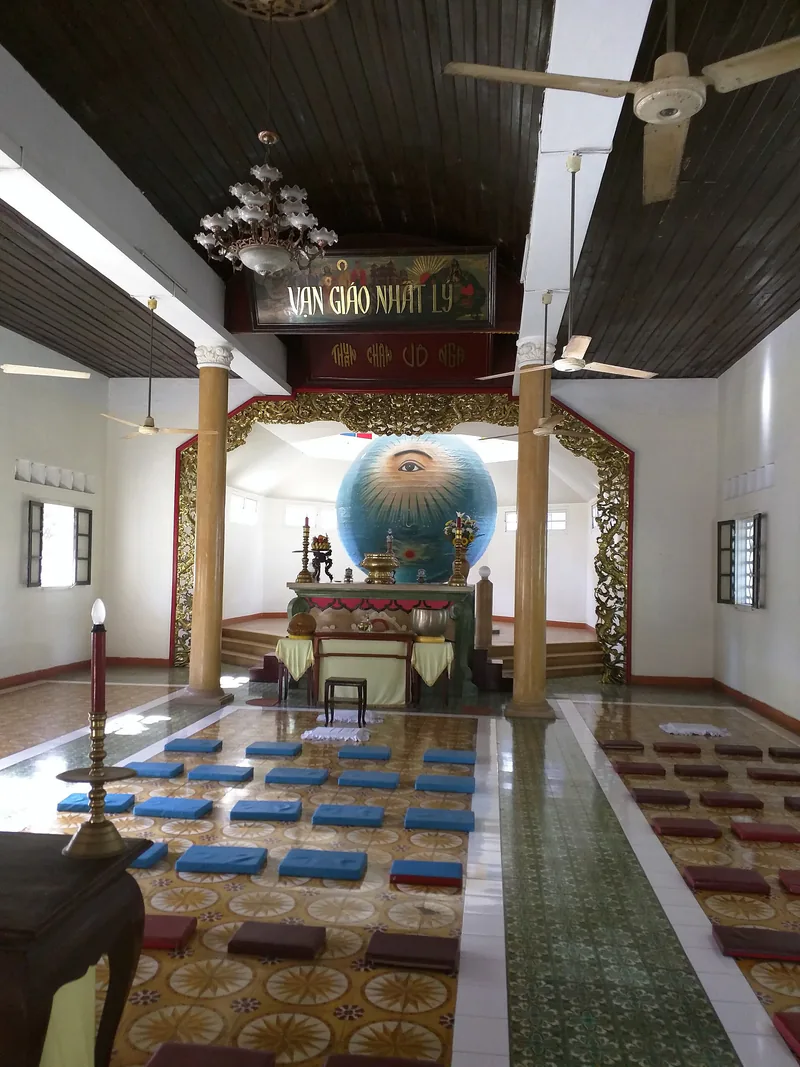
The supreme symbol of Cao Đài is the Divine Eye (Thiên Nhãn), a left eye, often within a triangle or a globe surrounded by rays, which appears on every altar. The left side is associated in Chinese thought with the yang principle and with the spirit, and Caodaists read the eye as God's all-seeing presence and as a reminder of the divine spark in the human heart; it invites comparison with other images discussed in The Third Eye.
Beneath God the altar presents a hierarchy of figures: the Buddha, Laozi and Confucius at the highest level; the bodhisattva Guanyin, the poet Li Bai and the warrior-god Guan Yu below them; then Jesus and the Chinese strategist Jiang Ziya. Many other spirits have communicated through Caodaist séances, including figures from Vietnamese, Chinese and European history. The best known is Victor Hugo, who is honoured as the spiritual head of the religion's overseas mission. A famous mural in the Holy See's entrance hall depicts three saints signing a "Third Alliance" between God and humanity: Hugo, the Chinese revolutionary Sun Yat-sen and the sixteenth-century Vietnamese poet and prophet Nguyễn Bỉnh Khiêm. The French writer's own interest in table-turning during his exile on Jersey made him a natural figure for a religion born from séances.
Organisation, Worship and the Holy See at Tây Ninh§
Caodaism's organisation, as set out in its Religious Constitution, is modelled in part on the Catholic Church, which its founders knew well from colonial society. The Cửu Trùng Đài, the executive body, is a hierarchy of nine ranks headed by the pope (Giáo Tông), with cardinals, archbishops, bishops, priests and lower grades. Clergy of the three main branches wear robes of yellow for Buddhism, blue for Taoism and red for Confucianism. Women may be ordained up to the rank of cardinal. The Hiệp Thiên Đài, headed by the Hộ Pháp, the "Defender of the Dharma", is responsible for law and for communication with the spirits through séances, while the Bát Quái Đài is the invisible council of divine beings.

Ritual services are held four times daily, at about six in the morning, noon, six in the evening and midnight, with offerings of flowers, fruit, tea, wine and incense, chanting and music. Lay worshippers dress in white.
The Holy See (Tòa Thánh) at Tây Ninh, built from 1933 and inaugurated in 1955, is the centre of the main branch. Its long nave, painted columns entwined with dragons, sky-blue vaulting and great globe bearing the Divine Eye fuse elements of Buddhist pagoda, Catholic cathedral and Chinese palace. Graham Greene, who visited during the French war, described its ceremonies in The Quiet American (1955), and it remains a major destination for pilgrims and visitors.
Politics, War and the Religion After 1975§
Cao Đài spread with remarkable speed among the peasants of the Mekong Delta and southern provinces, with estimates of several hundred thousand followers within a decade. Historians such as Jayne Werner and Hue-Tam Ho Tai have explained its appeal by the dislocation of rural society under colonialism and by its capacity to offer both religious renewal and a framework for Vietnamese identity. The French authorities grew suspicious, and in 1941 the Hộ Pháp Phạm Công Tắc was arrested and exiled to Madagascar.
During the Japanese occupation and the wars that followed, the Tây Ninh branch built an armed militia. It shifted alliances between the Japanese, the French, the Việt Minh and the nationalists, and in the early 1950s controlled much of Tây Ninh province. In 1955 the government of Ngô Đình Diệm moved against the religious armies; Phạm Công Tắc fled to Cambodia in 1956 and died in Phnom Penh in 1959. The religion was by then divided into numerous branches, some of which never accepted Tây Ninh's leadership.
After the communist victory in 1975 the new authorities confiscated Caodaist properties, dissolved much of the hierarchy and prohibited séances. In 1997 a reorganised leadership at Tây Ninh received official recognition under state supervision, and other branches have since been registered. Some adherents, in Vietnam and abroad, regard the state-approved bodies as illegitimate, and international human-rights reports have described restrictions on independent Caodaists. Estimates of adherents range from about a million in official Vietnamese figures to several million in the religion's own accounts. The diaspora, especially in California and Australia, has built new temples, a story told in Janet Hoskins's ethnography and set within the broader patterns described in Syncretic New Religions.
Frequently asked questions§
What does Cao Đài mean?§
Cao Đài means "High Tower" or "High Palace" and is used as a name for God, the Supreme Being. The full name of the religion, Đại Đạo Tam Kỳ Phổ Độ, means "Great Way of the Third Period of Universal Salvation".
Why is Victor Hugo a saint in Cao Đài?§
Caodaists believe that the spirit of Victor Hugo communicated through their séances and was given responsibility for spreading the religion abroad. Hugo's own experiments with table-turning in the 1850s, and his reputation as a humanitarian writer, made him a fitting figure in a religion built on spirit communication.
What is the symbol of Cao Đài?§
The symbol is the Divine Eye, a single left eye often shown within a triangle or on a globe radiating light. It represents God's presence and all-seeing knowledge and stands on the altar of every Caodaist temple.
Sources and further reading§
- Caodai Spiritism: A Study of Religion in Vietnamese Society — Victor L. Oliver, 1976
- Peasant Politics and Religious Sectarianism: Peasant and Priest in the Cao Dai in Viet Nam — Jayne Susan Werner, 1981
- Millenarianism and Peasant Politics in Vietnam — Hue-Tam Ho Tai, 1983
- Modernity and Re-enchantment: Religion in Post-revolutionary Vietnam — Philip Taylor (ed.), 2007
- The Divine Eye and the Diaspora: Vietnamese Syncretism Becomes Transpacific Caodaism — Janet Alison Hoskins, 2015