Liber XXI · New Religions · Chapter VI: Studying New Religions
When Prophecy Fails: Festinger, Failed Prophecy and Dissonance
When Prophecy Fails explained: Festinger's study of a 1954 flying-saucer group, cognitive dissonance theory and later research on failed prophecy.

When Prophecy Fails (1956) is a study by the social psychologists Leon Festinger, Henry W. Riecken and Stanley Schachter of a small group in the American Midwest that expected the world to be flooded on 21 December 1954 and its members to be rescued by a flying saucer. When the prophecy failed, the authors reported, the most committed believers did not abandon their faith but began to seek converts more energetically, a response they explained with the theory of cognitive dissonance. The book became a classic of social psychology and the starting point for decades of research on how religious groups respond to disconfirmed predictions.
Dorothy Martin and the Prophecy of December 1954§
Dorothy Martin was a housewife in Oak Park, Illinois, with a long interest in occult and metaphysical teachings, including Theosophical ideas about spiritual masters and, according to the book, the then-new movement of Dianetics described in Scientology. In 1954 she began to practise automatic writing, the technique discussed in Automatic Writing and Spirit Writing, and to receive messages from beings she called the Guardians, among them a figure named Sananda, whom the group identified with Jesus, speaking from a planet called Clarion.
The messages warned that a great flood would destroy much of North America before dawn on 21 December 1954, and that the faithful would be collected by spacecraft shortly beforehand. A small circle formed around her, including a physician at Michigan State College, Charles Laughead, and his wife Lillian, who led a group of students in East Lansing. Some members gave up jobs, studies, possessions and relationships. Laughead lost his college post after the prophecy became public. In the book the setting was disguised as "Lake City", Laughead appeared as "Dr Thomas Armstrong", and the student circle as the "Seekers" of "Collegeville".
On the night of 20 December the believers gathered in Martin's house, having removed metal from their clothing at the Guardians' instruction, and waited for midnight. No spacecraft came. After hours of distress, shortly before five in the morning, Martin received a new message: the group's faith had spread so much light that God had spared the world. Within hours the group, which had previously avoided reporters, began telephoning newspapers and actively seeking publicity for its message.
Festinger's Covert Study and Its Method§
Festinger, then at the University of Minnesota, read a newspaper report of the prophecy in the autumn of 1954 and saw an opportunity to test a hypothesis. He, Riecken, Schachter and several paid observers joined the group without disclosing their purpose, recording conversations and events as fully as they could.

The authors were candid about the difficulties. In a group of about a dozen core members, the arrival of several new and apparently sincere enquirers was itself significant, and the believers sometimes interpreted the observers as messengers or as signs that their message was spreading. The observers could not avoid influencing what they studied. The covert method also raises ethical questions that later research ethics would treat seriously, since the members never consented to being studied.
Cognitive Dissonance and the Five Conditions§
The theoretical heart of the book is the claim that people experience discomfort when they hold two cognitions that do not fit together, such as "I have given up everything for this prophecy" and "the prophecy did not come true". Festinger called this discomfort dissonance and argued that people act to reduce it. Abandoning a belief is one way; another is to add new cognitions that support it, and one of the most effective is to persuade others, since the agreement of a growing number of people makes a belief seem more surely true.
Festinger and his colleagues specified five conditions under which they expected disconfirmation to produce more fervent belief and proselytising:
- the belief must be held with deep conviction and have consequences for action;
- the believer must have committed to it by an act difficult to undo;
- the belief must be specific enough to be clearly refuted by events;
- the disconfirmation must occur and be recognised by the believer;
- the believer must have the social support of other believers.
The last condition was illustrated within the study itself. Members who spent the critical night together in Martin's house tended to remain committed and to proselytise, while several of the students who passed it alone, scattered away from their group, drifted away from the belief. Festinger developed the wider theory in A Theory of Cognitive Dissonance (1957), which became one of the most influential ideas in twentieth-century social psychology, applied to topics far beyond religion.
Historical Cases: Millerites, Sabbatai Zevi and Later Movements§
The book opened by setting its contemporary case against historical examples, and these remain central to the discussion.
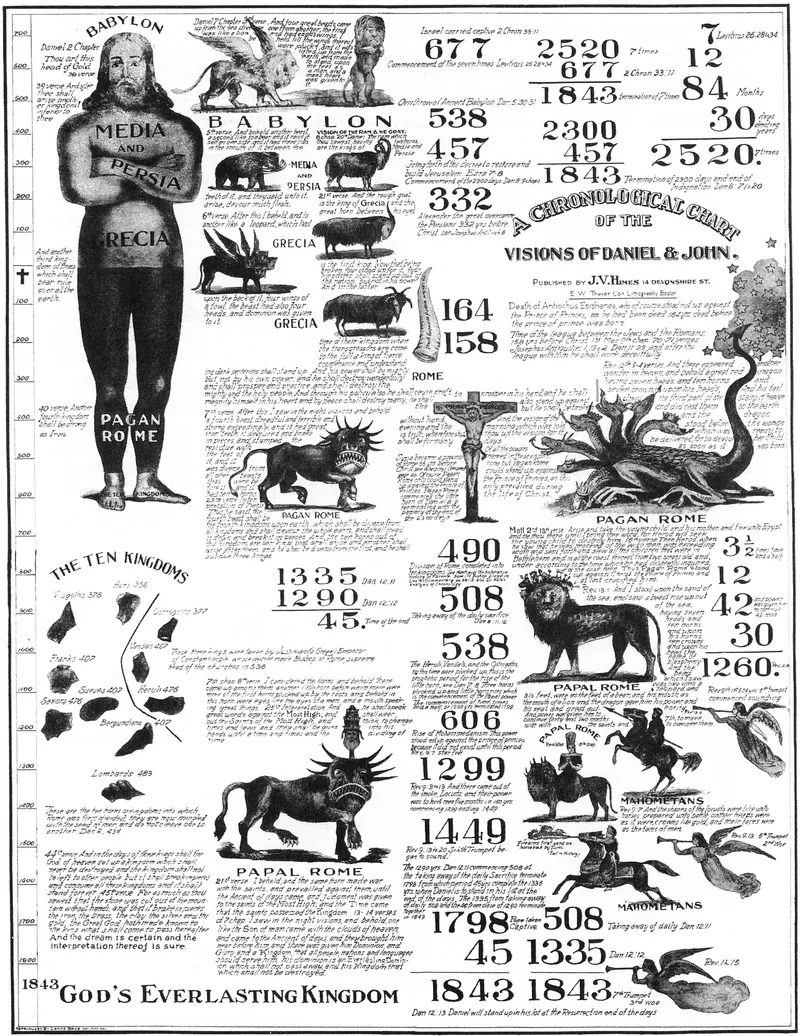
The Millerites, followers of the Baptist preacher William Miller, expected the return of Christ in 1843 and then on 22 October 1844. The "Great Disappointment" that followed scattered the movement, but some of its members reinterpreted the date as the beginning of a heavenly event rather than an earthly one, a reading from which Seventh-day Adventism grew, as described in Adventist and Restorationist Movements. In the seventeenth century the Jewish messianic claimant Sabbatai Zevi converted to Islam in 1666 under Ottoman pressure; many followers abandoned him, but a committed minority explained the apostasy as a hidden stage of redemption, the theology traced in Sabbateanism.
Later cases studied by sociologists include the expectations surrounding 1914, 1925 and 1975 among the Bible Students and Jehovah's Witnesses; the Taiwanese group Chen Tao, which expected God to appear in Garland, Texas, in March 1998; the Unarius Academy of Science, a Californian UFO religion whose expected landing of space brothers did not take place; and the radio preacher Harold Camping, who predicted the Rapture for 21 May 2011. Scholars have also applied dissonance theory to the Chabad-Lubavitch movement after the death of its Rebbe, Menachem Mendel Schneerson, in 1994, whom some followers had expected to reveal himself as the Messiah.
Critiques and Later Research on Failed Prophecy§
Subsequent research has qualified Festinger's conclusions considerably. In an influential article of 1985 the historian of religion J. Gordon Melton argued that believers in such groups rarely experience a prophecy as having simply failed. Instead they spiritualise it, reinterpreting the event as having happened on an invisible plane, or say that it was conditional, postponed, or misunderstood by the believers themselves. The group then reaffirms its basic commitments. In this view prophecy is only one element of a religious world, embedded in relationships, practices and leadership, and its failure is seldom fatal.
Lorne Dawson, reviewing a dozen or more studies in 1999, found that the increase in proselytising that Festinger predicted is unusual. Groups more commonly respond with rationalisation, with reassertion of leadership, or with a period of withdrawal, and almost all lose some members. Diana Tumminia's ethnography of Unarius, When Prophecy Never Fails (2005), described how members constantly reworked expectations so that no single date carried the whole weight of belief. The essays collected by Jon R. Stone in Expecting Armageddon (2000) show the wide range of outcomes, from collapse to growth. Critics have also noted that the original sample was small, that the observers altered the group's behaviour, and that Martin's group did not in fact win many converts after December 1954.
Martin herself left Chicago soon afterwards and, according to later accounts, continued a spiritual career for decades under the name Sister Thedra, teaching in Peru and later in the United States; she was never persuaded that she had been wrong.
Legacy in the Study of Religion§
Despite its limits, When Prophecy Fails shaped how scholars think about apocalyptic movements and about belief generally. Biblical scholars have used dissonance theory to examine how ancient communities coped with unfulfilled hopes. Robert Carroll's When Prophecy Failed (1979) applied it to the prophetic books of the Hebrew Bible, and John Gager's Kingdom and Community (1975) to the earliest Christians, who expected the imminent return of Christ, a hope expressed in texts such as 1 Thessalonians 4. The theme connects with the long history of apocalyptic expectation surveyed in Studying New Religious Movements.
The study also became a cautionary example in research ethics and a recurring reference in public discussion of conspiracy theories and political movements whose predictions fail. Most scholars now treat its central finding as one possible response among several, rather than a law, while continuing to regard the book as a pioneering attempt to observe a religious movement from the inside at the very moment of crisis.
Frequently asked questions§
What was the main finding of When Prophecy Fails?§
The authors reported that when a specific prophecy failed, the most committed believers, especially those who faced the failure together, did not give up their belief but began to proselytise more actively. They explained this as a way of reducing cognitive dissonance.
Who was "Marian Keech"?§
"Marian Keech" was the pseudonym used in the book for Dorothy Martin, an Oak Park, Illinois, woman who received messages by automatic writing from beings she believed lived on other planets. She later taught under the name Sister Thedra.
Do groups usually grow after a failed prophecy?§
Usually not. Later studies found that groups more often reinterpret the prophecy, treat it as fulfilled spiritually or as postponed, and lose some members, while only a few show the surge of proselytising Festinger described.
Sources and further reading§
- When Prophecy Fails — Leon Festinger, Henry W. Riecken and Stanley Schachter, 1956
- A Theory of Cognitive Dissonance — Leon Festinger, 1957
- Kingdom and Community: The Social World of Early Christianity — John G. Gager, 1975
- When Prophecy Failed: Cognitive Dissonance in the Prophetic Traditions of the Old Testament — Robert P. Carroll, 1979
- The Disappointed: Millerism and Millenarianism in the Nineteenth Century — Ronald L. Numbers and Jonathan M. Butler (eds.), 1987
- Expecting Armageddon: Essential Readings in Failed Prophecy — Jon R. Stone (ed.), 2000
- When Prophecy Never Fails: Myth and Reality in a Flying-Saucer Group — Diana G. Tumminia, 2005