Liber XXI · New Religions · Chapter VI: Studying New Religions
Peoples Temple and Jonestown: Jim Jones and the 1978 Deaths
Peoples Temple and Jonestown: Jim Jones's integrated church, its move to Guyana, the deaths of 18 November 1978 and how scholars interpret them.

Peoples Temple was an American religious movement founded by Jim Jones in Indianapolis in the 1950s, which grew into a racially integrated, politically active church in California and ended at its agricultural settlement of Jonestown in Guyana, where on 18 November 1978 more than 900 people died, most of them by drinking poisoned fruit drink at Jones's direction. The deaths, together with the killing of Congressman Leo Ryan the same day, made Jonestown the defining case in public debate about "cults" and one of the most intensively studied events in the scholarship on new religions.
Jim Jones and the Indianapolis Church§
James Warren Jones was born in 1931 in Crete, Indiana, and grew up in the small town of Lynn. As a young man he was drawn to Pentecostal and Holiness worship, with its emotional preaching and healing services, and in the early 1950s he worked briefly as a student pastor in a Methodist church in Indianapolis. In the mid-1950s he founded his own congregation, which after an earlier name became known as Peoples Temple.
From the beginning the church was unusual for its commitment to racial integration in a segregated city. Jones and his wife Marceline adopted children of several races, whom they called their "rainbow family", and the congregation ran a soup kitchen, a care home and other services for the poor. In 1960 the Temple affiliated with the Disciples of Christ (Christian Church), a mainstream Protestant denomination, and Jones was later ordained. At the same time he modelled his ministry on the healer and preacher Father Divine of the Peace Mission movement, whose communal and interracial model he admired, and he performed healings that former members later described as staged.
Redwood Valley, San Francisco and Apostolic Socialism§
In 1965 Jones moved with about seventy families to Redwood Valley, near Ukiah in northern California, partly, he said, because he feared nuclear war. In the early 1970s the Temple expanded into San Francisco and Los Angeles, attracting a large, predominantly African American membership, much of it elderly and female, alongside young white idealists from the counter-culture and the professions. Many members pooled income and lived communally.
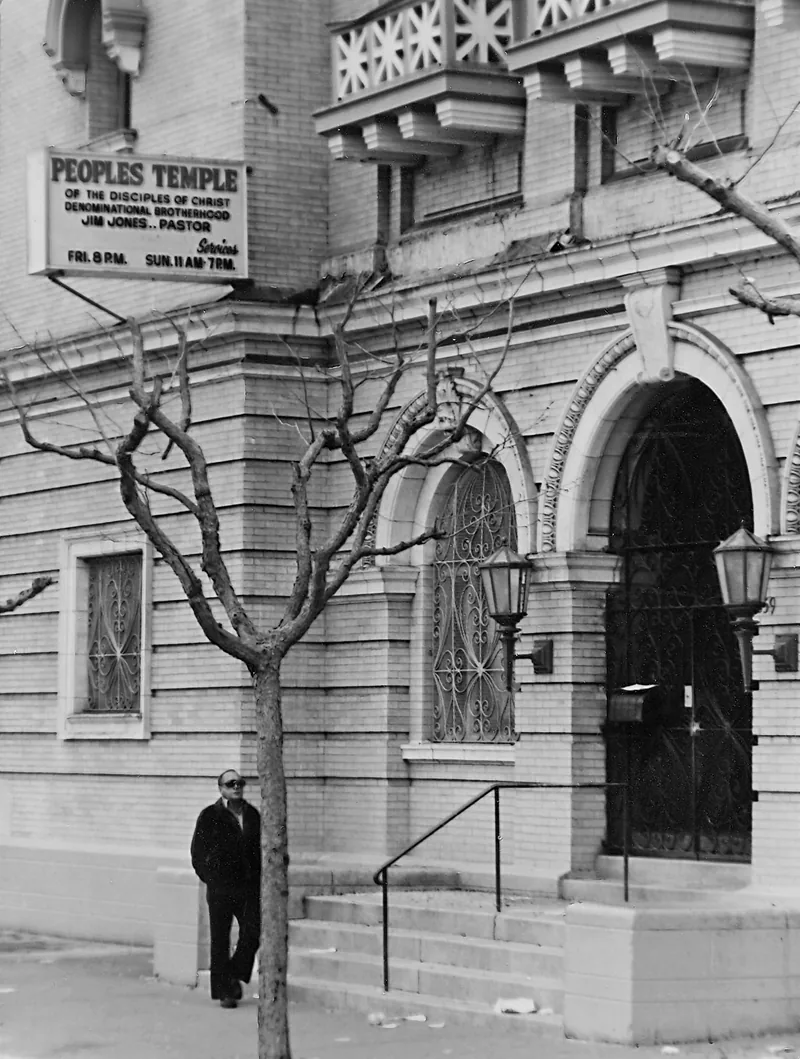
Jones's preaching moved steadily away from conventional Christianity. He mocked the "Sky God" of the Bible, read passages to show its contradictions, and presented himself as the embodiment of a divine principle of socialism; he called his message apostolic socialism, drawing on the communal life of the early church described in Acts 2:44–45. The Temple's ability to deliver disciplined crowds of volunteers and voters gave Jones access to California's liberal politicians, and in 1976 he was appointed to the San Francisco Housing Authority Commission.
Inside the community there were features that historians later emphasised: public "catharsis" meetings in which members confessed faults and were sometimes punished, strict control of money and information, sexual relationships between Jones and followers, and a growing language of siege. Defectors began to speak to journalists. In August 1977 the magazine New West published an exposé based on their accounts, and by then Jones had already left for South America.
The Move to Guyana and the Jonestown Settlement§
In 1974 the Temple leased land in the jungle of north-western Guyana, near the small port of Port Kaituma, for what it called the Peoples Temple Agricultural Project. Guyana's socialist government was sympathetic, and Jones presented the project as a refuge from American racism. Most of the roughly one thousand residents arrived in 1977, after the press exposure.
Life at Jonestown combined real achievement with severe hardship. Residents cleared land and built cottages, a school, a medical clinic and a central pavilion, but crops were poor and work hours long. Jones broadcast his voice over loudspeakers for hours each day, read news of a collapsing America, and warned of attacks by the CIA and by the "Concerned Relatives", an association of family members in the United States trying to bring their relatives home. Passports were held by the leadership and leaving was very difficult.
During 1978 Jones held repeated night-time emergency drills, later called "White Nights", in which residents rehearsed collective death in the face of an imagined assault. He framed this as "revolutionary suicide", a phrase taken from the title of the Black Panther leader Huey Newton's 1973 memoir, where it meant risking death in struggle rather than accepting oppression; Jones gave it a literal and fatal meaning.
Congressman Leo Ryan's Visit and 18 November 1978§
Pressed by the Concerned Relatives, Leo Ryan, a Democratic congressman from the San Francisco area, travelled to Guyana with journalists and relatives and visited Jonestown on 17 November 1978. The visit seemed at first to go smoothly, but that evening and the next morning several residents asked to leave with him. On the afternoon of 18 November, as the party boarded planes at the Port Kaituma airstrip, Temple gunmen opened fire, killing Ryan, three journalists and a defecting member; others were wounded.
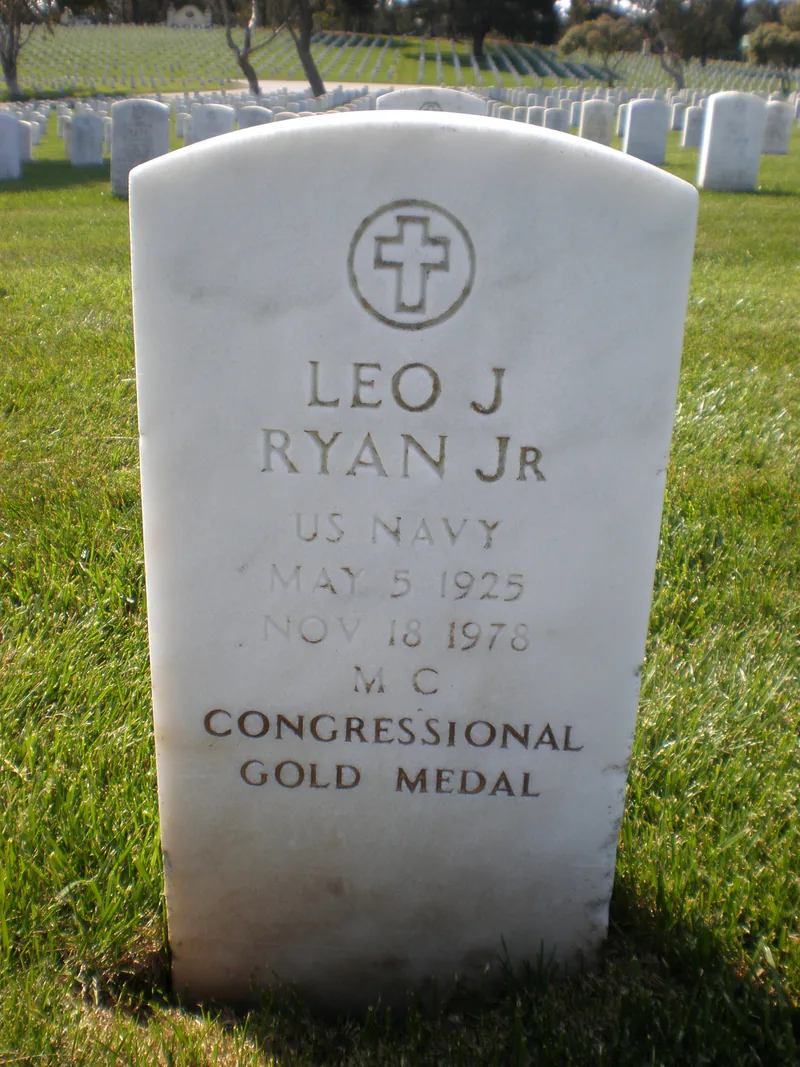
Back at Jonestown, Jones assembled the community in the pavilion. An audio recording of the gathering survives, in which Jones argued that the community would be destroyed and that death was the only dignified course, while at least one resident, Christine Miller, openly argued against him. A drink laced with cyanide and sedatives was given first to children and infants, often by syringe into the mouth, and then to adults; some people were injected. 909 people died at Jonestown, around a third of them children; Jones himself died of a gunshot wound to the head. In the Temple's house in Georgetown a member killed her three children and herself, bringing the total number of deaths that day, including those at the airstrip, to 918.
The phrase "drinking the Kool-Aid" comes from these events, though the drink was mainly Flavor Aid.
Suicide or Murder? How Scholars Interpret Jonestown§
Early press coverage described Jonestown as a mass suicide by brainwashed cultists, and the event gave great momentum to the anti-cult movement discussed in Studying New Religious Movements. Scholars have since complicated that picture in several ways.
First, many argue that "mass suicide" is misleading. Infants and children could not consent, armed guards surrounded the pavilion, and some adults were evidently coerced. The religious studies scholar Rebecca Moore, two of whose sisters died at Jonestown, has argued for describing the deaths as a mixture of murder and suicide, and for seeing the residents as people with their own reasons and voices rather than as automatons.
Second, scholars have read Peoples Temple as a religious movement rather than a political commune with a religious veneer. David Chidester's Salvation and Suicide (1988) reconstructed the Temple's worldview, in which death could be understood as a redemptive act of "translation" to another plane; John R. Hall's Gone from the Promised Land (1987) placed it within American traditions of communal and apocalyptic sects; and Mary Maaga (1998) stressed the role of women leaders around Jones.
Third, the case is central to theories of millennial violence. Catherine Wessinger described Peoples Temple as a "fragile" millennial group, one whose leader feels the community is failing and whose expectations of persecution become self-fulfilling under outside pressure. Scholars emphasise that external opposition did not cause the deaths, which were planned and rehearsed by Jones and his inner circle, but that the dynamics between the group, defectors, journalists and government helped bring the crisis to a head. The broader pattern of apocalyptic expectation is discussed in The Book of Revelation and in What Is a New Religious Movement?.
Finally, historians have stressed the Temple's place in African American religious history. Roughly two-thirds of those who died were Black, many of them older women from Southern Baptist and Pentecostal backgrounds who joined because the Temple offered dignity, community, social services and an apparently uncompromising stand against racism. Studies collected in Peoples Temple and Black Religion in America (2004) argue that their choices deserve to be understood on those terms.
Aftermath, Memory and the Anti-Cult Movement§
The shock of Jonestown shaped public responses to new religions for a generation. It strengthened calls for government action against "cults", lent credibility to deprogramming, and formed the background against which authorities approached later confrontations, above all the 1993 siege of the Branch Davidians at Waco, a group descended from the Adventist tradition described in Adventist and Restorationist Movements. Scholars of new religions, by contrast, stressed that such tragedies are rare and that understanding a group's beliefs helps avoid confrontation. The same tensions shaped later moral panics, including the Satanic Panic of the 1980s.
The bodies were flown to the United States, and several hundred, many of them unidentified or unclaimed, were buried in a mass grave at Evergreen Cemetery in Oakland, California, where a memorial listing the names of the dead was dedicated in 2011. An archive of documents and recordings maintained by Rebecca Moore and Fielding McGehee is now the main resource for research.
Frequently asked questions§
How many people died at Jonestown?§
909 people died at the Jonestown settlement in Guyana on 18 November 1978, about a third of them children. Including Congressman Leo Ryan and the four others killed at the Port Kaituma airstrip and the four deaths at the Temple's house in Georgetown, the total that day was 918.
Was Peoples Temple a Christian church?§
It began as an independent Pentecostal-influenced church and was affiliated with the Disciples of Christ from 1960. By the 1970s Jones openly rejected the God of the Bible and preached a religious socialism, though many members continued to understand their faith in Christian terms.
Why do some scholars avoid calling Jonestown a mass suicide?§
Because children could not consent, armed guards were present and some adults were coerced or injected. Many researchers prefer to speak of murders and suicides, while recognising that some adults did choose to die.
Where does "drinking the Kool-Aid" come from?§
The phrase refers to the poisoned drink at Jonestown, although the powdered drink used there was mostly Flavor Aid. Relatives of the dead have often found its casual use hurtful.
Sources and further reading§
- Raven: The Untold Story of the Rev. Jim Jones and His People — Tim Reiterman and John Jacobs, 1982
- Gone from the Promised Land: Jonestown in American Cultural History — John R. Hall, 1987
- Salvation and Suicide: An Interpretation of Jim Jones, the Peoples Temple, and Jonestown — David Chidester, 1988
- Hearing the Voices of Jonestown — Mary McCormick Maaga, 1998
- How the Millennium Comes Violently: From Jonestown to Heaven's Gate — Catherine Wessinger, 2000
- Peoples Temple and Black Religion in America — Rebecca Moore, Anthony B. Pinn and Mary R. Sawyer (eds.), 2004
- Understanding Jonestown and Peoples Temple — Rebecca Moore, 2009
- The Road to Jonestown: Jim Jones and Peoples Temple — Jeff Guinn, 2017