Liber IV · Buddhism · Chapter VI: Mahayana
Mahayana Buddhism: The Bodhisattva Path, Emptiness and Sutras
Mahayana Buddhism explained: its origins in India, the bodhisattva ideal, Nagarjuna and emptiness, Yogacara, buddha-nature and its schools in East Asia.

Mahayana, the "Great Vehicle", is the broad tradition of Buddhism that took shape in India from around the first century BCE and became the dominant form of Buddhism in China, Korea, Japan, Vietnam and, through Vajrayana, Tibet and Mongolia. It is defined by the ideal of the bodhisattva, who seeks full buddhahood in order to liberate all beings, by new scriptures such as the Perfection of Wisdom and Lotus Sutras, and by the philosophies of emptiness and of mind.
Origins of the Mahayana in India§
The origins of the Mahayana remain one of the most debated questions in Buddhist studies. Its earliest evidence is textual: sutras that began to circulate around the turn of the Common Era, known to us through Chinese translations from the late second century CE and from Gandhari manuscripts. These texts called their path the "Great Vehicle" and contrasted it with the "Lesser Vehicle" (Hinayana) of disciples who sought only their own nirvana — a polemical label, not the name of any real school.
Earlier scholars suggested that the Mahayana arose among lay devotees at stupas. More recent research, including Paul Harrison's and Jan Nattier's studies of early sutras, points instead to monks, some of them forest ascetics, who saw the bodhisattva path as a demanding vocation for a few. Gregory Schopen argued that devotion to the sutras themselves, as sacred books, was an early focus. What is clear is that Mahayana followers lived in the same monasteries and under the same monastic codes as other Buddhists. Chinese pilgrims such as Faxian in the early fifth century and Xuanzang in the seventh describe Mahayana and non-Mahayana monks living side by side, and Mahayana remained a minority in India for centuries.
The Bodhisattva Ideal and the Six Perfections§
In early Buddhism the term bodhisattva, "awakening-being", described the Buddha before his awakening. The Mahayana made it a path open to all and, in principle, the highest one. A bodhisattva begins by generating bodhicitta, the "mind of awakening", the aspiration to attain buddhahood for the sake of all beings, and takes vows to that effect. The path, described as lasting for countless aeons, passes through ten stages (bhumis) and requires the cultivation of six perfections (paramitas): generosity, ethical conduct, patience, vigour, meditation and wisdom.
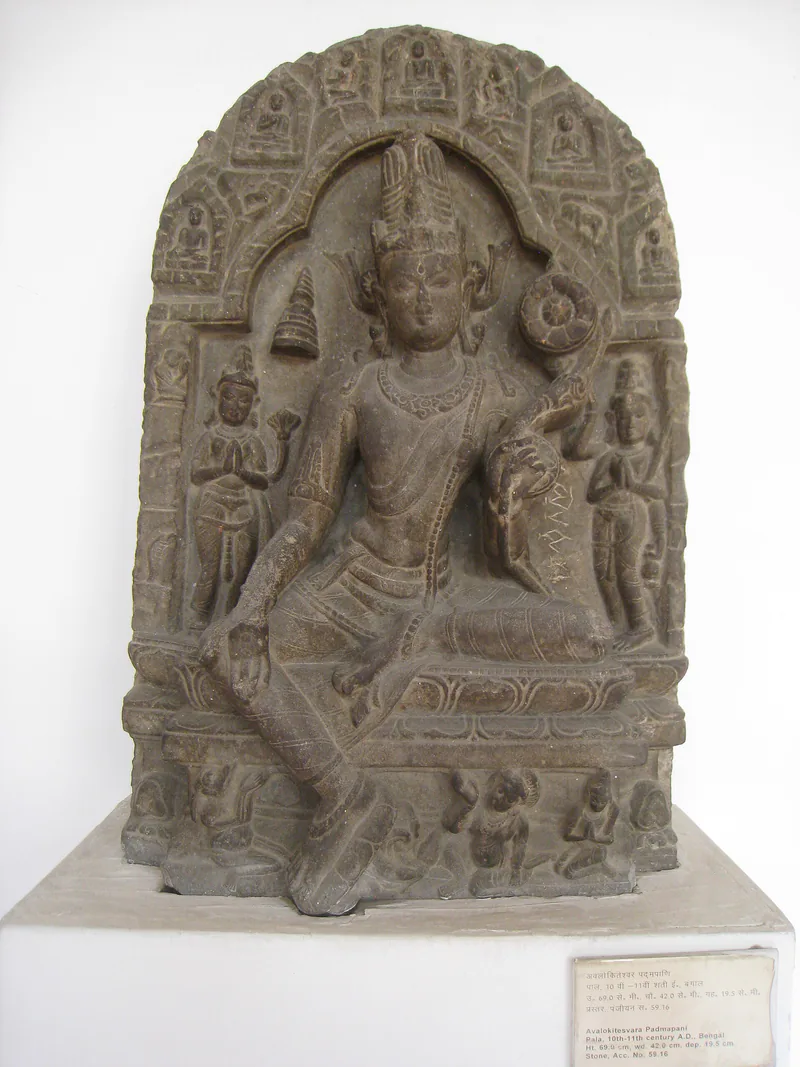
Compassion (karuna) and wisdom (prajna) are treated as the two wings of the path. The bodhisattva also uses "skilful means" (upaya), adapting the teaching to the capacities of those who hear it; the Lotus Sutra uses this idea to argue that all earlier teachings were provisional paths leading to a single vehicle of buddhahood. The eighth-century poet Shantideva's Bodhicaryavatara, "Entering the Path of Awakening", is the classic devotional and philosophical guide to the bodhisattva's life and is still widely studied, especially in Tibet.
The Mahayana also developed the teaching of the three bodies (trikaya) of a buddha: the Dharma body, identical with ultimate reality; the enjoyment body, in which buddhas appear in glory to bodhisattvas in their pure lands; and the emanation body, such as the historical Buddha Shakyamuni, who appears in the world to teach.
Emptiness and the Madhyamaka School§
The Perfection of Wisdom sutras teach that all phenomena, including the Buddha's own teachings, are empty (shunya). The Indian philosopher Nagarjuna, who probably lived in the second century CE, gave this teaching systematic form in his Mulamadhyamakakarika, "Root Verses on the Middle Way", founding the Madhyamaka or "Middle" school.
Nagarjuna argued that if things had an independent, fixed nature (svabhava), they could not arise, change or cease; because they do arise in dependence on conditions, they lack such a nature, and this lack is what emptiness means. Emptiness is thus another name for dependent origination, the central doctrine of the core teachings, and it is not nothingness: it is the middle way between eternalism and annihilationism. Nagarjuna distinguished two truths — the conventional truth of everyday language and the ultimate truth of emptiness — and insisted that emptiness is itself empty and must not be grasped as a view. Later Madhyamaka thinkers such as Chandrakirti (seventh century) shaped Tibetan philosophy profoundly.
Yogacara and Buddha-Nature§
A second great school, Yogacara ("practice of yoga"), associated with the brothers Asanga and Vasubandhu (perhaps fourth to fifth century), focused on the analysis of consciousness. It taught that the world as ordinarily experienced is a construction of the mind, often summarised as "mind only" or "consciousness only". Yogacara introduced the idea of a "storehouse consciousness" (alaya-vijnana) in which the seeds of past karma are stored and from which experience arises, and a doctrine of three natures describing how the constructed world relates to reality. Yogacara analysis was transmitted to China by Xuanzang.
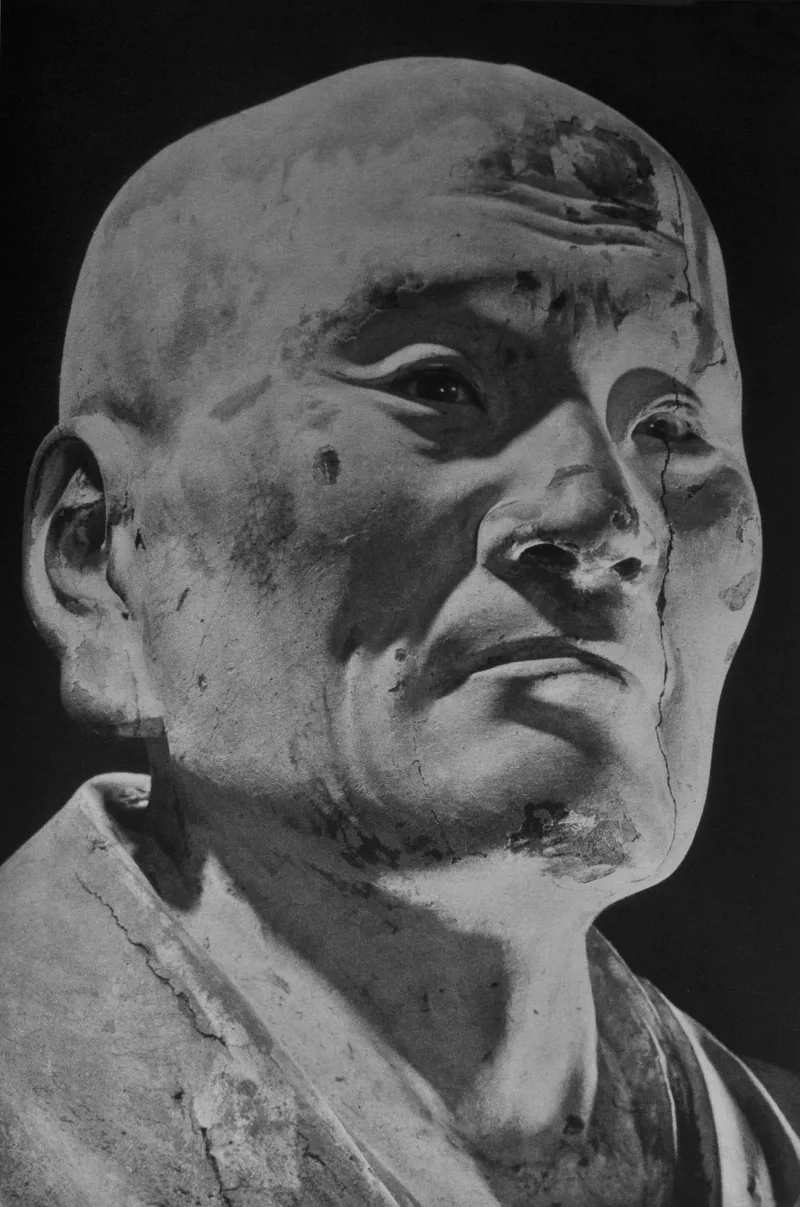
Alongside these philosophies, texts such as the Tathagatagarbha Sutra and the Ratnagotravibhaga taught that all beings possess the "embryo" or "womb" of a buddha (tathagatagarbha), a buddha-nature obscured by defilements but originally pure. This idea, sometimes criticised within Buddhism as too close to the notion of a self, became immensely influential in East Asia, where the conviction that awakening is already present underlies much of Zen and Chan.
Celestial Buddhas and Bodhisattvas§
Mahayana sutras describe a universe filled with countless buddhas, each presiding over a "buddha-field" in a different world system, and with great bodhisattvas of immense power. Devotion to these figures is a central part of Mahayana religious life. Among the most widely venerated are:
- Amitabha, the Buddha of Infinite Light, whose western Pure Land is the goal of Pure Land Buddhism.
- Avalokiteshvara, the bodhisattva of compassion, who in China became the often female Guanyin, in Japan Kannon, and in Tibet Chenrezig, of whom the Dalai Lamas are considered emanations.
- Manjushri, the bodhisattva of wisdom, shown with a sword that cuts through ignorance.
- Maitreya, the future buddha, now dwelling in the Tushita heaven.
- Kshitigarbha, known in China as Dizang and in Japan as Jizo, who vows to save beings in the hells and protects children and travellers.
- Bhaishajyaguru, the Medicine Buddha.
Mahayana in East Asia: China, Korea, Japan and Vietnam§
Buddhism reached China along the Silk Road by the first century CE, and over the following centuries Chinese Buddhists translated an enormous body of Mahayana texts. Faced with scriptures that seemed to contradict one another, Chinese thinkers created systematic schools that ranked the sutras. The Tiantai school, founded by Zhiyi (538–597), centred on the Lotus Sutra; the Huayan school, systematised by Fazang (643–712), on the Flower Garland Sutra's vision of mutual interpenetration. The Chan school stressed meditation and direct insight, and Pure Land devotion spread across all levels of society. Chinese monastics also adopted a vegetarian diet, under the influence of Mahayana texts and the sixth-century Emperor Wu of Liang.
Buddhism passed from China to Korea from the late fourth century and to Japan in the sixth. In Japan, Saicho (767–822) founded the Tendai school on Mount Hiei, and in the thirteenth century Nichiren (1222–1282) taught that chanting the title of the Lotus Sutra was the essential practice for the age, a teaching continued by several modern movements. Vietnamese Buddhism combines Chan, known there as Thien, with Pure Land devotion. In the twentieth century, reformers such as the Chinese monk Taixu promoted a "humanistic Buddhism" focused on this world, which inspired large organisations in Taiwan. Mahayana's esoteric development is treated under Vajrayana Buddhism.
Frequently asked questions§
What does Mahayana mean?§
Mahayana is Sanskrit for "Great Vehicle". Its followers chose the name to describe a path aimed at the liberation of all beings through the attainment of full buddhahood, which they contrasted with the pursuit of individual nirvana.
What is a bodhisattva?§
A bodhisattva is a being on the path to becoming a buddha. In Mahayana Buddhism the term refers both to ordinary practitioners who have taken the bodhisattva vow and to advanced, almost divine figures such as Avalokiteshvara and Manjushri, who are venerated and called upon for help.
Is Zen a form of Mahayana Buddhism?§
Yes. Zen, known in China as Chan, is a Mahayana school that developed in China from around the sixth century and later spread to Korea, Vietnam and Japan. It draws on Mahayana teachings of emptiness and buddha-nature while emphasising meditation and direct insight.
Sources and further reading§
- Mahayana Buddhism: The Doctrinal Foundations — Paul Williams, 1989
- The Fundamental Wisdom of the Middle Way: Nagarjuna's Mulamadhyamakakarika — Jay L. Garfield, 1995
- A Few Good Men: The Bodhisattva Path According to the Inquiry of Ugra — Jan Nattier, 2003
- The Bodhicaryavatara — Shantideva, 1995
- The Buddhist Conquest of China — Erik Zürcher, 1959
- Buddhism in China: A Historical Survey — Kenneth Ch'en, 1964