Liber IV · Buddhism · Chapter VI: Mahayana
Yogacara Buddhism: Asanga, Vasubandhu and the Mind-Only School
Yogacara Buddhism explained: Asanga and Vasubandhu, the storehouse consciousness, the three natures, mind only, and the school's legacy in China and Tibet.

Yogacara ("practice of yoga") is one of the two great philosophical schools of Indian Mahayana Buddhism, founded according to tradition by the brothers Asanga and Vasubandhu in Gandhara around the fourth or fifth century CE. It analyses how experience is produced by consciousness, teaching that the world as we ordinarily perceive it is a mental construction — hence its other names, Vijnanavada ("doctrine of consciousness") and Cittamatra ("mind only").
Origins of Yogacara in Indian Mahayana§
By the third century CE the Mahayana had produced the Perfection of Wisdom sutras, summarised in texts such as the Heart Sutra, and Nagarjuna's Madhyamaka philosophy, which taught that all things are empty of inherent existence. Yogacara accepted emptiness but asked a different question: if things are empty, how is it that we experience a seemingly solid world of self and objects, and how does that experience change on the path to awakening?
The school's name points to its roots in meditation. Its earliest texts are concerned with the experience of practitioners (yogacara means both "yoga practice" and "yoga practitioner"), who noticed that images seen in deep concentration were plainly produced by the mind and yet appeared as real as external objects. The Samdhinirmocana Sutra ("Sutra Unravelling the Intent"), probably compiled in the third or fourth century, introduced several of the school's key ideas: a subtle consciousness that holds karmic seeds, the three natures, and the claim that the Buddha had turned the wheel of the Dharma three times, with this third turning making explicit what earlier teachings left implicit. The Lankavatara Sutra, a later and more eclectic work, combined Yogacara ideas with teaching on buddha-nature and became important for Zen and Chan.
Asanga, Vasubandhu and the Founding Treatises§
Asanga and Vasubandhu are traditionally said to have been half-brothers from a Brahmin family of Purushapura, modern Peshawar. Their dates are uncertain; most scholars place them in the fourth or early fifth century.
A well-known legend tells that Asanga spent twelve years meditating in a cave in the hope of a vision of Maitreya, the future buddha, without success. Leaving in despair, he found a wounded dog covered in maggots and, moved by compassion, prepared to remove them with his tongue so as not to harm them; at that moment the dog became Maitreya, who explained that Asanga's own obscurations had prevented him from seeing him earlier. Maitreya then took him to the Tushita heaven and taught him. Tibetan tradition credits Maitreya with five treatises transmitted through Asanga, among them the Ornament of the Mahayana Sutras and the Distinguishing the Middle from the Extremes. Modern scholars debate whether "Maitreya" here was a human teacher, a visionary source or a later attribution.
Asanga's own works include the Compendium of the Mahayana (Mahayanasamgraha), a systematic presentation of the school, and a summary of Abhidharma; the immense Stages of Yogic Practice (Yogacarabhumi), attributed to Asanga in Tibet and to Maitreya in China, is now generally seen as a compilation built up over time.
Vasubandhu began as a scholar of the mainstream Abhidharma schools and wrote the Treasury of Abhidharma (Abhidharmakosha) with its auto-commentary, one of the most influential scholastic works in Buddhism. Tradition says that Asanga later converted him to the Mahayana. His short Yogacara works — the Twenty Verses, the Thirty Verses and the Treatise on the Three Natures — are the school's classic statements. Because the Abhidharma master and the Yogacara author seem so different, the scholar Erich Frauwallner proposed in 1951 that there were two Vasubandhus; the theory is no longer widely held, but the question is still discussed.
The Eight Consciousnesses and the Storehouse Consciousness§
Earlier Buddhist analysis recognised six kinds of consciousness: those of the five senses and the mind. Yogacara added two more. The afflicted mind (klishta-manas) constantly misidentifies a deeper layer of consciousness as a permanent self, producing the instinctive sense of "I". That deeper layer is the storehouse consciousness (alaya-vijnana).
The storehouse consciousness solved a problem that had troubled Buddhist thinkers. If there is no permanent soul, how does karma carry over from one moment, or one life, to the next, especially through states such as deep meditation in which ordinary consciousness ceases? Yogacara answered that every intentional act leaves an imprint (vasana) or "seed" (bija) in the storehouse, where it ripens over time and eventually produces new experience, including the experience of a body and a world. The storehouse is not a self: it is a constantly changing stream, compared in the texts to a flowing river. Its theory of hidden seeds and habitual tendencies has invited comparison with modern ideas of the unconscious, a comparison scholars such as William Waldron have explored with appropriate caution.
The Three Natures and the Meaning of "Mind Only"§
Yogacara describes reality in terms of three natures (trisvabhava). The imagined nature is the world as falsely constructed: separate, enduring objects set over against a subject who perceives them. The dependent nature is the actual flow of experience arising from causes and conditions, above all from the seeds in consciousness. The perfected nature is the dependent nature seen without the overlay of the imagined — the absence of the split between perceiver and perceived. Emptiness, in this account, is not mere nothingness but the absence of that false duality, and the school presents itself as a middle way between denying everything and affirming too much.
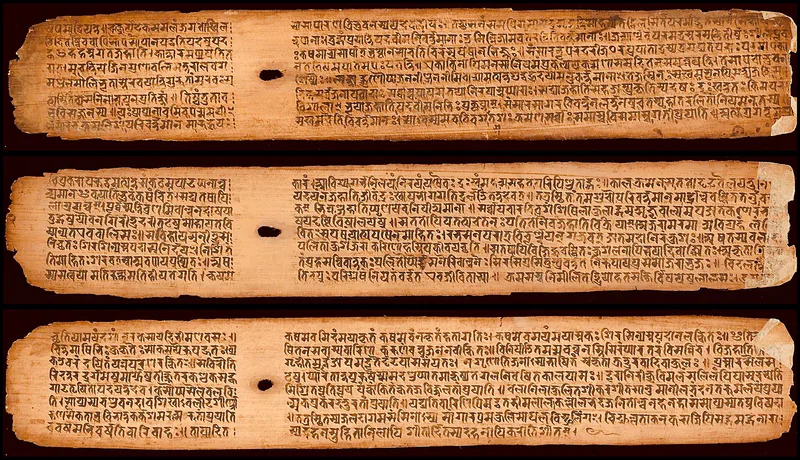
In the Twenty Verses, Vasubandhu defends the claim that there are only representations (vijnapti-matra) and no external objects. He answers objections — that experience has a fixed place and time, is shared by different perceivers and has real effects — with examples: dreams, in which places and effects seem real; hungry ghosts who, through shared karma, all see the same river as filled with pus; and the guardians of hell, who appear to torment beings without existing independently. He also argues that the idea of indivisible atoms is incoherent.
Whether Yogacara is idealism in the Western philosophical sense is one of the liveliest debates in Buddhist studies. Many interpreters, traditional and modern, have read it as holding that only mind exists. Others, such as Dan Lusthaus, argue that it is better understood as a phenomenology: an analysis of how experience is structured and of the way grasping distorts it, which brackets rather than denies questions about what lies outside experience.
Yogacara Practice and the Transformation of the Basis§
For Yogacara, analysis serves liberation. Its texts describe a long bodhisattva path in five stages and ten levels, in which the practitioner gradually realises that the dualistic appearance of subject and object is unfounded. The culmination is the "transformation of the basis" (ashraya-paravritti): the storehouse consciousness, purified of defiled seeds, ceases to function as the root of samsara. The eight consciousnesses are then transformed into four kinds of awakened wisdom, the first of which, the mirror-like wisdom, reflects everything without distortion.
Yogacara thinkers also helped systematise the Mahayana doctrine of the three bodies of a buddha — the Dharma body, the enjoyment body and the emanation body — which became standard throughout the Mahayana and Vajrayana.
Yogacara in India, China, Japan and Tibet§
In India, Yogacara flourished at monastic universities such as Nalanda, where scholars such as Sthiramati and Dharmapala wrote commentaries on Vasubandhu. The logicians Dignaga and Dharmakirti, whose theories of perception and inference shaped all later Indian philosophy, are often associated with the school. From the eighth century, Shantarakshita and others created a synthesis of Yogacara and Madhyamaka.
In China, the Indian translator Paramartha (499–569) introduced Asanga's Compendium. The pilgrim Xuanzang (602–664), who studied at Nalanda, brought back Yogacara texts and with his disciple Kuiji produced the Demonstration of Consciousness Only (Cheng weishi lun), a synthesis of commentaries on the Thirty Verses. Their Faxiang school declined after the Tang dynasty, but its ideas shaped Huayan and Chan. In Japan, the school continued as Hosso, based at the Nara temples of Kofukuji and Yakushiji; Kofukuji preserves celebrated thirteenth-century statues of Asanga and Vasubandhu carved by the workshop of the sculptor Unkei. A Yogacara revival in early twentieth-century China influenced reformers and philosophers such as Xiong Shili.
In Tibet, Yogacara was studied as the "Mind Only" (Cittamatra) system, ranked below Madhyamaka in the Gelug curriculum, while the Jonang teacher Dolpopa and his successors developed a related "other-emptiness" (shentong) view that remains debated in Tibetan Buddhism.
Frequently asked questions§
What does "mind only" mean in Yogacara?§
It translates cittamatra or vijnaptimatra, "only mind" or "only representation". It means that the world as we experience it, divided into a self and external objects, is constructed by consciousness. Interpreters disagree about whether this denies that anything exists outside the mind or describes the structure of experience.
What is the storehouse consciousness?§
The alaya-vijnana is a subtle, continuously changing layer of consciousness in which the seeds of past actions are stored until they ripen into new experience. It explains karmic continuity without a permanent self, and it is purified and transformed at awakening.
How is Yogacara different from Madhyamaka?§
Madhyamaka stresses that all things, including the mind, lack inherent existence and avoids building positive systems. Yogacara accepts emptiness but offers a detailed account of consciousness and of how illusion arises. Later Indian and Tibetan scholars often combined the two.
Sources and further reading§
- Seven Works of Vasubandhu: The Buddhist Psychological Doctor — Stefan Anacker, 1984
- Buddhist Phenomenology: A Philosophical Investigation of Yogacara Buddhism and the Ch'eng Wei-shih Lun — Dan Lusthaus, 2002
- The Buddhist Unconscious: The Alaya-vijnana in the Context of Indian Buddhist Thought — William S. Waldron, 2003
- Three Texts on Consciousness Only — Francis H. Cook, 1999
- Mahayana Buddhism: The Doctrinal Foundations — Paul Williams, 1989
- Buddhist Thought: A Complete Introduction to the Indian Tradition — Paul Williams and Anthony Tribe, 2000