Liber IV · Buddhism · Chapter III: Buddhist Scriptures
The Heart Sutra: Meaning, History and the Perfection of Wisdom
The Heart Sutra explained: its teaching that form is emptiness, the gate gate mantra, the debate over a Chinese origin, its commentaries and daily chanting.

The Heart Sutra (Sanskrit Prajñāpāramitā-hṛdaya, "Heart of the Perfection of Wisdom") is a very short Mahayana Buddhist scripture in which the bodhisattva Avalokiteshvara explains to the monk Shariputra that all phenomena are "empty" of independent existence. Only about 260 characters long in its most widely used Chinese version, it is probably the most frequently recited Buddhist text in East Asia and is chanted daily in Zen, Chinese, Korean, Vietnamese and Tibetan communities.
The Heart Sutra and the Perfection of Wisdom Literature§
The Heart Sutra belongs to the Perfection of Wisdom sutras, a large body of Mahayana scriptures that began to take shape in India around the first century BCE or first century CE. The oldest, the Perfection of Wisdom in Eight Thousand Lines, was expanded into versions of 25,000 and 100,000 lines and condensed into shorter works such as the Diamond Sutra. Their shared theme is that the bodhisattva must understand that no phenomenon — not even the Buddha or nirvana — has a fixed, independent nature.
The word hṛdaya in the title means "heart" or "essence", and the text presents itself as the core of this vast literature. It was in the wider context of these sutras that the philosopher Nagarjuna developed the Madhyamaka school, and later Indian commentators read the Heart Sutra through Madhyamaka and, to a lesser extent, Yogacara categories.
Two forms of the sutra exist. The short version, used throughout East Asia, begins abruptly with Avalokiteshvara's insight and has no setting. The long version, preserved in Sanskrit, Tibetan and some Chinese translations, adds a conventional frame: the Buddha sits in meditation on Vulture Peak, Shariputra asks Avalokiteshvara how a practitioner should train in the perfection of wisdom, and at the end the Buddha emerges from meditation and approves the answer. The long version is the one included in the Tibetan canon.
What the Heart Sutra Says: Form Is Emptiness§
The sutra opens with Avalokiteshvara, the bodhisattva of compassion, "practising the deep perfection of wisdom" and seeing that the five aggregates (skandha) — form, feeling, perception, mental formations and consciousness, the components into which early Buddhism analysed a person — are all empty. By this insight, the text says, he passed beyond all suffering.
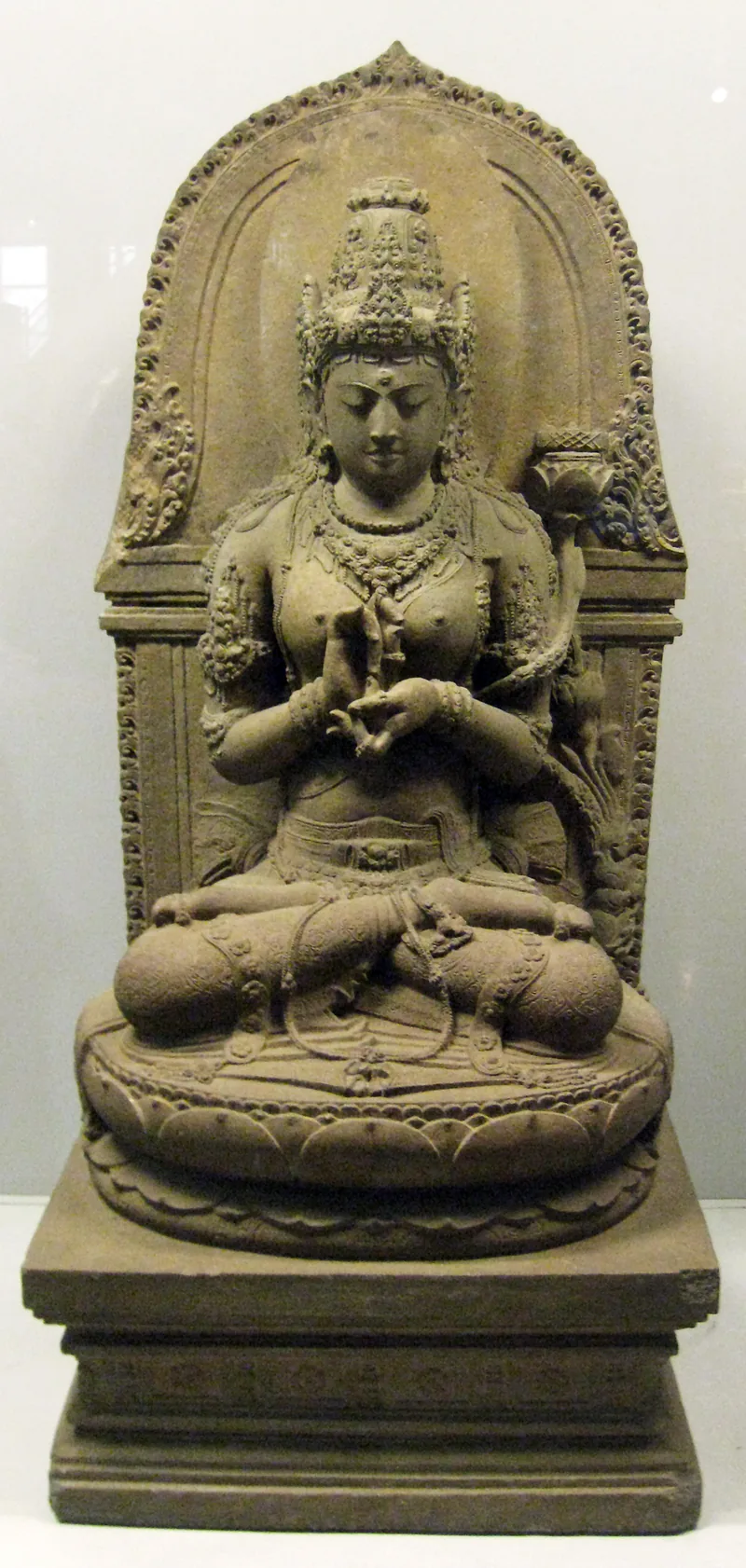
He then addresses Shariputra, who in tradition represents the analytical wisdom of the Abhidharma, with the sutra's most famous lines: form is emptiness and emptiness is form; emptiness is not other than form and form is not other than emptiness; and the same is true of the other four aggregates. "Emptiness" (śūnyatā) here does not mean that nothing exists. In Mahayana thought it means that things lack svabhāva, an inherent, self-sufficient essence, because they arise only in dependence on causes and conditions — the principle of dependent origination restated at its most radical.
The text continues with a series of negations. All phenomena are marked by emptiness: they neither arise nor cease, are neither defiled nor pure, neither increase nor decrease. In emptiness there are no aggregates, no sense organs or sense objects, no elements of perception. There is no ignorance and no end of ignorance, no old age and death and no end of old age and death — a reference to the twelve links of dependent origination. There are no Four Noble Truths, no wisdom and no attainment.
To readers schooled in the core teachings of Buddhism, this list is startling, because it appears to deny the very categories the Buddha taught. Commentators have generally explained it as a denial that these categories exist inherently, not that they are useless: the analytical lists of the Abhidharma are valid as conventional truth, but grasping them as ultimately real is itself a subtle attachment. Relying on the perfection of wisdom, the sutra goes on, the bodhisattva's mind is without obstruction and fear, and all the buddhas of past, present and future attain awakening through it.
The Mantra: Gate Gate Pāragate§
The sutra closes by praising the perfection of wisdom as a great mantra, unequalled and able to remove all suffering, and then gives it: gate gate pāragate pārasaṃgate bodhi svāhā. The words are usually rendered as "gone, gone, gone beyond, gone completely beyond, awakening, so be it". The grammar is irregular and its exact construction is debated; in Chinese and Japanese chanting it is transliterated rather than translated.
The presence of the mantra is important for the text's history. It linked the Heart Sutra to the world of dhāraṇī, protective formulas that were copied, recited and worn for their power, and helps explain why such a philosophically demanding text became one of the most popular Buddhist charms in East Asia. In Tibetan Buddhism it is recited to avert obstacles, and in Japan the esoteric master Kukai (774–835) wrote a commentary, the Secret Key to the Heart Sutra, that read the whole text as a mantra-centred teaching in the manner of Shingon.
Origins and the Question of a Chinese Composition§
The traditional view is that the Heart Sutra, like other Mahayana sutras, originated in India. Two Chinese translations of the short version are canonical: one attributed to Kumarajiva, the great translator active in Chang'an in the early fifth century, and one by the pilgrim Xuanzang, dated 649. Xuanzang's version became the standard text. A story in early accounts of his life relates that he recited it for protection while crossing the deserts of Central Asia on his way to India. Among the oldest surviving Sanskrit witnesses is a palm-leaf manuscript long kept at the Horyuji temple in Japan and now in the Tokyo National Museum; its traditional date in the early seventh century is doubted by palaeographers, who place it somewhat later.
In 1992 the American scholar Jan Nattier published an influential article arguing that the Heart Sutra was composed in China. She observed that the core passage of the short version corresponds almost word for word to a passage in Kumarajiva's Chinese translation of the Perfection of Wisdom in 25,000 Lines, while the Sanskrit Heart Sutra differs from the corresponding Sanskrit passage of that larger sutra in ways that look like a back-translation from Chinese. She proposed that a Chinese compiler extracted the passage, added an opening and the mantra, and that the text was later rendered into Sanskrit, perhaps by Xuanzang himself.
The thesis has been widely accepted, debated and contested. Some scholars have added philological support; others argue that a Sanskrit text could have circulated in India independently, or that the evidence cannot settle the matter. Whatever its origin, the sutra was received as authoritative across Asia.
Commentaries in India, China, Japan and Tibet§
The Heart Sutra attracted a remarkable body of commentary. Eight Indian commentaries survive in Tibetan translation, written by authors including Kamalashila, Vimalamitra and Atisha, mostly in the eighth to eleventh centuries; they interpret the sutra as a map of the bodhisattva's path, sometimes linking each line to a stage of practice.
In China, the Korean monk Woncheuk and Xuanzang's disciple Kuiji wrote commentaries in the seventh century, and the Huayan master Fazang composed an influential one in 702. In Japan, besides Kukai's esoteric reading, the Zen master Hakuin (1686–1769) wrote a sharp, often irreverent commentary in which he challenged the text line by line in the manner of a Zen teacher. Modern teachers have continued the tradition: the Vietnamese monk Thich Nhat Hanh's The Heart of Understanding (1988) presented emptiness as "interbeing", the mutual dependence of all things.
Chanting, Copying and the Heart Sutra in Daily Life§
The Heart Sutra's brevity made it ideal for liturgy. In Zen and Chan monasteries it is chanted at morning and evening services, at meals and at funerals, often to the steady beat of a wooden drum. In Japan it is known as the Hannya Shingyō and is recited across most schools except some Pure Land and Nichiren lineages, which prefer their own core texts; the Lotus Sutra plays the equivalent role for the latter.
Copying the sutra by hand, shakyō in Japanese, is a long-established devotional practice in East Asia. Copies were made for the merit of the dead, the recovery of the sick and the protection of the state, and temples still offer copying sessions. The text also appears on scrolls, fans and amulets. In this the Heart Sutra illustrates a characteristic Mahayana combination: a text that denies any fixed essence to phenomena is at the same time treated as a sacred object whose very letters are powerful.
Frequently asked questions§
What is the main message of the Heart Sutra?§
Its central message is that all phenomena, including the components of the person and even the Buddha's own teachings, are empty of inherent existence because they arise dependently. Understanding this, according to the sutra, frees the mind from fear and leads to awakening.
What does "gate gate paragate parasamgate bodhi svaha" mean?§
It is usually translated "gone, gone, gone beyond, gone completely beyond, awakening, so be it", describing passage to the "other shore" of awakening. The Sanskrit grammar is unusual, and many traditions recite it untranslated because it is treated as a mantra whose sound itself is significant.
Who wrote the Heart Sutra?§
Buddhist tradition regards it as the word of the Buddha, spoken through Avalokiteshvara and approved by the Buddha in the long version. Historians date it to the first millennium CE; its exact origin is debated, with an influential theory holding that it was compiled in China from a translated Perfection of Wisdom sutra and later rendered into Sanskrit.
Why is the Heart Sutra so popular?§
It is short enough to memorise, it summarises the central Mahayana teaching on wisdom, and it ends with a mantra regarded as protective. These qualities made it suitable for daily liturgy, funerals, devotional copying and popular religion across East Asia and Tibet.
Sources and further reading§
- The Heart Sutra Explained: Indian and Tibetan Commentaries — Donald S. Lopez Jr., 1988
- Elaborations on Emptiness: Uses of the Heart Sutra — Donald S. Lopez Jr., 1996
- Buddhist Wisdom Books: The Diamond Sutra and the Heart Sutra — Edward Conze, 1958
- The Heart Sutra: The Womb of Buddhas — Red Pine, 2004
- The Heart Sutra: A Comprehensive Guide to the Classic of Mahayana Buddhism — Kazuaki Tanahashi, 2014
- The Heart of Understanding: Commentaries on the Prajnaparamita Heart Sutra — Thich Nhat Hanh, 1988
- Mahayana Buddhism: The Doctrinal Foundations — Paul Williams, 1989