Liber IV · Buddhism · Chapter III: Buddhist Scriptures
The Lotus Sutra: History, Parables and Teachings of One Vehicle
The Lotus Sutra explained: its origins and translations, the one vehicle and skilful means, its famous parables, Tiantai in China and Nichiren in Japan.

The Lotus Sutra (Sanskrit Saddharmapundarika Sutra, "Sutra of the White Lotus of the True Dharma") is a Mahayana Buddhist scripture, composed in India around the turn of the Common Era, which teaches that all the Buddha's different paths are skilful means leading to a single vehicle of buddhahood open to every being. Through its Chinese translation it became the most influential sutra in East Asia, the foundation of the Tiantai and Tendai schools and of Nichiren Buddhism.
Origins and Translations of the Lotus Sutra§
Like other early Mahayana sutras, the Lotus presents itself as a discourse of the Buddha delivered on Vulture Peak near Rajagriha before a vast assembly of monks, nuns, bodhisattvas and gods. Historians instead see it as the work of Indian Mahayana communities over several generations. Differences between its prose and verse sections, and between groups of chapters, suggest that it grew in layers, and most scholars date its composition broadly between the first century BCE and the second century CE.
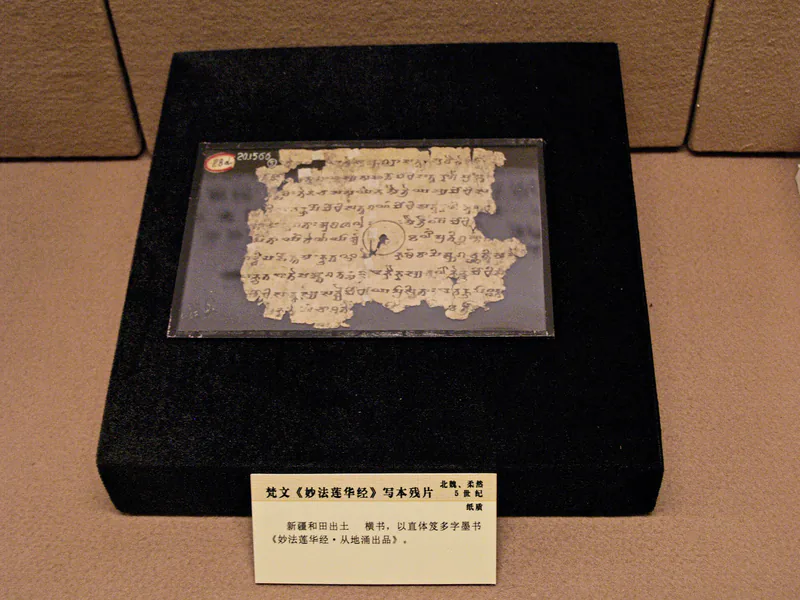
The sutra survives in Sanskrit manuscripts from Nepal, Gilgit in modern Pakistan and Central Asian sites such as Kashgar, and in Tibetan translation. Its history in China is better documented. Dharmaraksha translated it in 286 CE; Kumarajiva produced a new version, the Miaofa lianhua jing ("Sutra of the Lotus Flower of the Wonderful Dharma"), in 406; and a revised translation appeared in 601. Kumarajiva's elegant text, eventually arranged in twenty-eight chapters, became the version recited, commented on and copied across China, Korea, Japan and Vietnam. Its place among the wider canon is described in Buddhist scriptures.
Europe encountered the sutra in the nineteenth century. Eugène Burnouf, working from Sanskrit manuscripts sent from Nepal by Brian Hodgson, completed a French translation published posthumously in 1852, and Hendrik Kern's English version appeared in the Sacred Books of the East in 1884.
One Vehicle and Skilful Means§
The second chapter, "Skilful Means", announces the sutra's central claim. Earlier Buddhist teaching described three vehicles: that of the shravakas or disciples, who become arhats; that of the pratyekabuddhas, solitary awakened ones; and that of the bodhisattvas, who become buddhas. The Lotus declares that this division was provisional. There is in truth only one vehicle, the Buddha vehicle, and the Buddha taught three only because beings were not ready to hear more. The earlier teachings were not false, but expedient — skilful means (upaya) suited to their audience.
This gave the sutra a remarkable inclusiveness. Even the Buddha's senior disciples such as Shariputra, who had thought themselves content with arhatship, receive predictions that they will become buddhas. Later chapters extend the prediction to the Buddha's cousin and enemy Devadatta and to the nuns, including the Buddha's aunt Mahaprajapati and his former wife Yashodhara. The story of an eight-year-old naga princess who attains buddhahood in an instant — after transforming into a male body — has been read both as a radical affirmation that women and non-humans can awaken and as evidence of the limits of that affirmation; modern scholars and Buddhist women have debated it extensively.
Skilful means also offered a way to organise a vast, sometimes contradictory body of scriptures as stages of one teaching.
The Great Parables of the Lotus Sutra§
Much of the sutra's influence came from its parables, which were retold in sermons, paintings and literature for centuries.
- The burning house (chapter three): a rich man's children are playing in a house that has caught fire and will not come out. He promises them carts drawn by goats, deer and oxen; when they run out, he gives each of them a single magnificent cart drawn by a white ox. The three carts are the three vehicles; the great cart is the one vehicle; the burning house is the world of suffering.
- The lost son (chapter four): a son who left home as a child returns destitute and fails to recognise his wealthy father. The father hires him for menial work and slowly raises his position until he can reveal that the son is heir to everything — an image of how the Buddha gradually prepares disciples for the full teaching.
- The rain and the plants (chapter five): one rain falls on all plants, which absorb it according to their size, as all beings receive the one Dharma according to their capacities.
- The phantom city (chapter seven): a guide conjures a city to rest weary travellers before leading them on to the true treasure, as provisional nirvana prepares disciples for buddhahood.
- The jewel in the robe (chapter eight): a poor man does not know that a friend sewed a priceless jewel into his garment, as beings do not know their potential for awakening.
- The physician and his sons (chapter sixteen): a doctor whose children have taken poison pretends to die so that, in grief, they will take the medicine he has left; the Buddha's passing into nirvana is a similar compassionate device.
The Eternal Buddha, the Jewelled Stupa and the Bodhisattvas§
The second half of the sutra contains some of its most striking scenes. In chapter eleven a great jewelled stupa rises from the earth and hangs in the sky; inside sits Prabhutaratna, a buddha of the distant past, who has vowed to appear wherever the Lotus is preached. Shakyamuni opens the stupa and sits beside him. The image of the two buddhas side by side became a favourite subject in Chinese art, from the Yungang and Dunhuang cave temples onward. In chapter fifteen countless bodhisattvas well up from beneath the earth, disciples whom Shakyamuni says he has taught since time without beginning.
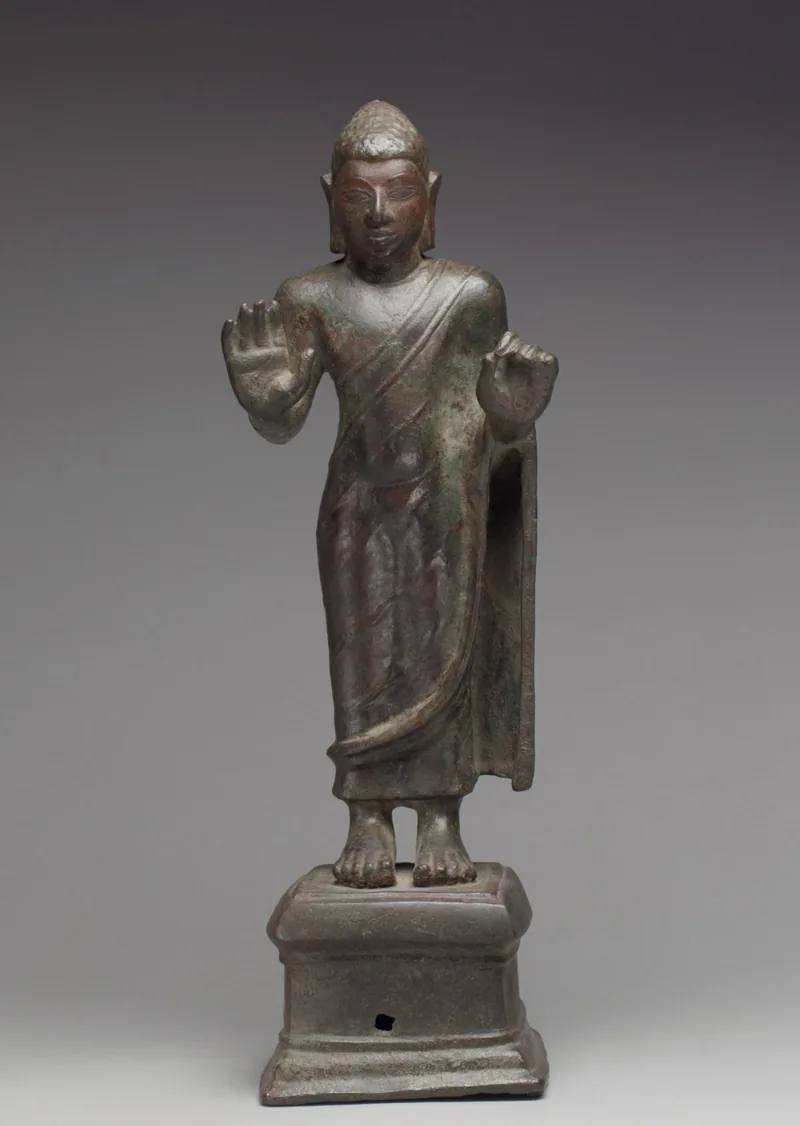
This prepares for chapter sixteen, "The Lifespan of the Tathagata", which many traditions regard as the heart of the sutra. The Buddha reveals that he did not first attain awakening under the bodhi tree at Bodh Gaya, as the life of the Buddha narrates, but incalculable aeons ago, and that his apparent death is a skilful means; he is always present, teaching. Other chapters praise the bodhisattva Never Disparaging, who bowed to everyone he met because all would become buddhas, and the bodhisattva Medicine King, who offered his own body as a lamp — a story that, as historians such as James Benn have shown, inspired rare acts of religious self-immolation in medieval China. Chapter twenty-five, on the bodhisattva Avalokiteshvara (Guanyin), circulated independently as a popular scripture of protection.
The sutra also praises itself repeatedly, promising great merit to those who preserve, recite, copy and teach it. These passages helped create a culture of devotion to the text as an object: sutra copying, lavishly decorated scrolls and recitation became central forms of practice.
The Lotus Sutra in China: Tiantai and Devotion§
In China the Lotus became the scriptural centre of the Tiantai school, named after Mount Tiantai where its systematiser Zhiyi (538–597) taught. Zhiyi ranked all the Buddha's teachings in a scheme of periods and methods culminating in the Lotus and the Nirvana Sutra, and drew on Nagarjuna's verse equating dependent origination, emptiness and the middle way — see Nagarjuna and Madhyamaka — to formulate his "threefold truth". His lectures, recorded by his disciple Guanding, were among the most sophisticated works of Chinese Buddhist philosophy.
Beyond the schools, miracle tales recorded the rewards of reciting the sutra, monks and laypeople memorised it whole, and lay societies formed to copy it.
Japan: Tendai, Nichiren and Modern Movements§
The Lotus reached Japan early: a commentary on it is traditionally attributed to Prince Shotoku (574–622), although his authorship is doubted. Saicho (767–822) founded the Japanese Tendai school on Mount Hiei on the basis of the Lotus, and Mount Hiei became the training ground for many later founders; its relations with esoteric Buddhism are described in Shingon and Tendai. Heian aristocrats commissioned splendid copies, such as the decorated sutra scrolls offered by the Taira clan at the Itsukushima shrine in 1164.
In the thirteenth century Nichiren (1222–1282) taught that in the degenerate final age the Lotus alone could save the nation and its people, and that chanting its title, Namu Myoho Renge Kyo, embodied the whole of its truth. His uncompromising criticism of other schools led to exile, but his followers formed several Nichiren denominations. In the twentieth century Nichiren-based lay movements such as Reiyukai, Rissho Kosei-kai and Soka Gakkai became some of the largest of Japan's new religions, carrying the sutra to the West. Literary admirers have included the poet Miyazawa Kenji (1896–1933). Few scriptures in any tradition have generated so many distinct ways of being religious.
Frequently asked questions§
What is the main teaching of the Lotus Sutra?§
Its main teaching is that there is only one vehicle, the path to full buddhahood, and that all earlier teachings were skilful means adapted to listeners' capacities. It also teaches that the Buddha's lifespan is immeasurable and that all beings can become buddhas.
Why is it called the Lotus Sutra?§
The title compares the true Dharma to a white lotus, a flower that grows from mud yet remains unstained — a common Buddhist image of purity arising within the world. In East Asian commentary the lotus, which bears flower and seed at once, was also read as a symbol of cause and effect occurring together.
Which schools of Buddhism are based on the Lotus Sutra?§
The Tiantai school in China, its Japanese counterpart Tendai, and the Nichiren schools and lay movements in Japan are based on the Lotus Sutra. It is also read and honoured in many other Mahayana traditions, including Zen.
What does Namu Myoho Renge Kyo mean?§
It is the Japanese pronunciation of the title of the Lotus Sutra preceded by an expression of devotion, roughly "Homage to the Sutra of the Lotus of the Wonderful Dharma". Nichiren taught that chanting this phrase, called the daimoku, is the essential practice for the present age.
Sources and further reading§
- The Lotus Sutra — Burton Watson, 1993
- Scripture of the Lotus Blossom of the Fine Dharma — Leon Hurvitz, 1976
- Readings of the Lotus Sutra — Stephen F. Teiser & Jacqueline I. Stone (eds.), 2009
- The Lotus Sutra: A Biography — Donald S. Lopez Jr., 2016
- Burning for the Buddha: Self-Immolation in Chinese Buddhism — James A. Benn, 2007
- Mahayana Buddhism: The Doctrinal Foundations — Paul Williams, 1989