Liber IV · Buddhism · Chapter X: Vajrayana
Vajrayana Buddhism: Tantra, Mantra and the Diamond Vehicle
Vajrayana Buddhism, the Diamond Vehicle: Indian tantric origins, mandala, mantra and deity yoga, initiation and the guru, tantra classes, Nepal and Shingon.

Vajrayana, the "Diamond" or "Thunderbolt Vehicle", is the esoteric form of Mahayana Buddhism that developed in India from about the sixth and seventh centuries, based on texts called tantras. It teaches that buddhahood can be reached swiftly, even in a single lifetime, through ritual and meditative methods transmitted by a qualified guru: initiation, mantra, mandala, and the visualisation of oneself as an awakened deity. Vajrayana is best known in its Tibetan form, but it also shaped the Buddhism of Nepal, Mongolia, Bhutan, and Japan's Shingon school.
What Vajrayana Means: The Diamond Vehicle§
The Sanskrit vajra originally denoted the thunderbolt weapon of the god Indra. In Buddhist tantra it came to mean the indestructible, adamantine nature of awakened mind, hard and clear as a diamond. The vajra, a short double-ended sceptre, is held in ritual alongside a bell; together they symbolise skilful means and wisdom, the masculine and feminine aspects of awakening. The tradition also calls itself Mantrayana, the "Mantra Vehicle", or the "Secret Mantra", and modern scholars often speak of "tantric" or "esoteric Buddhism".
Vajrayana does not regard itself as a separate religion or rejection of earlier Buddhism. Its practitioners take the refuge vows, keep monastic or lay precepts, and generate the bodhisattva's aspiration, adding tantric vows on top. In the Tibetan view, the Vajrayana is a branch of the Mahayana that shares its goal and philosophy of emptiness but uses "the result as the path": instead of slowly accumulating the causes of buddhahood, the practitioner rehearses the state of a buddha from the start.
Origins of Buddhist Tantra in India§
Elements later associated with tantra — protective spells (dharanis), mantras and rituals for worldly benefits — appear in Buddhist literature well before the tantras proper. Systematic tantric scriptures emerged from around the seventh century, beginning with texts such as the Mahavairocana Sutra and the Compendium of the Truth of All Tathagatas (Sarvatathagatatattvasamgraha), which set out mandalas of buddhas centred on the cosmic Buddha Vairocana.
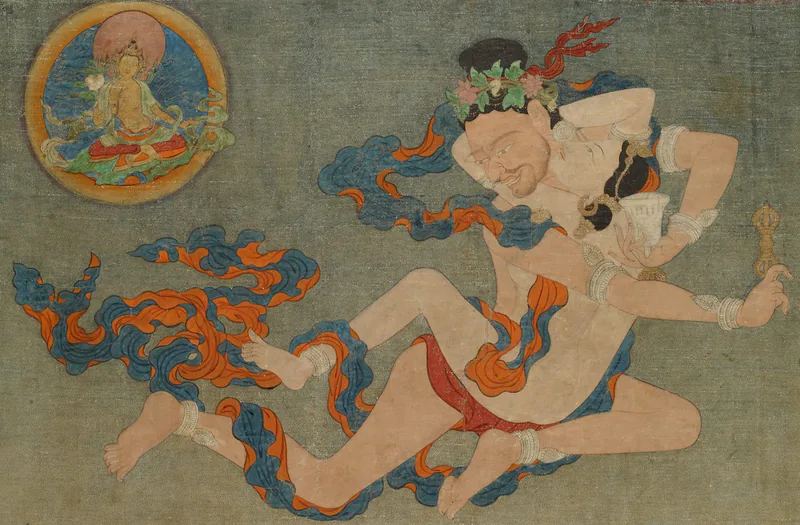
From the eighth century onward came the more radical "yogini" and "Highest Yoga" tantras, such as the Guhyasamaja, Hevajra and Chakrasamvara, which use fierce and erotic imagery, cremation-ground symbolism and practices of ritual transgression. Their exponents included the mahasiddhas, "great adepts" such as Saraha, whose songs and legends depict wandering yogins who defied social conventions; Tibetan tradition later counted eighty-four of them. The Kalachakra Tantra, usually dated to the early eleventh century, was among the last great Indian tantras.
Historians have debated the context of these developments. Ronald Davidson has linked tantric Buddhism to the fragmented, feudal political world of early medieval India, in which mandalas of deities mirrored circles of kings and vassals. Alexis Sanderson has shown that many Buddhist tantras borrowed extensively from Shaiva tantric texts, while transforming them into a Buddhist framework. Tantric Buddhism was also taught at the great monastic universities of Nalanda and Vikramashila, where scholar-monks integrated it with Mahayana philosophy. The wider history of Hindu and Buddhist tantra is surveyed in tantra: history and practice.
Mandalas, Mantras, Mudras and Deity Yoga§
Tantric ritual engages body, speech and mind together. The body forms mudras, ritual hand gestures; speech recites mantras, sacred syllables or phrases that embody a deity's presence, such as the six-syllable mantra of Avalokiteshvara, Om mani padme hum; and the mind visualises a mandala, a sacred diagram of a deity's palace and retinue arranged around a centre.
The central practice is deity yoga. Having received initiation, the practitioner dissolves ordinary appearances into emptiness and then visualises arising as the deity — a peaceful buddha such as Vairocana or a wrathful one such as Hevajra or Vajrabhairava — within the mandala, with "divine pride" in being that deity. Tibetan systems distinguish a "generation stage", in which the visualisation is built up in detail, and a "completion stage", in which the yogin works with the channels, winds and drops of the subtle body to produce experiences of bliss and emptiness. The completion-stage subtle body, with its channels and wheels (chakras), is one of the sources of later ideas discussed in the history of the chakras. Because some of these practices are physically and psychologically demanding, Vajrayana teachers have always insisted that they be undertaken only under close guidance.
Initiation, the Guru and Secrecy§
Entry into tantric practice requires initiation or "empowerment" (abhisheka, literally "consecration", modelled on the anointing of a king). The initiate is led into the mandala, introduced to the deity, given the mantra and bound by tantric vows. The guru who confers it is regarded as the embodiment of the Buddha, and devotion to the teacher is considered essential to the path; Tibetan tradition preserves texts such as the Fifty Verses on the Guru on the proper relationship.
The tantras are deliberately written in coded "twilight language", and their practices were traditionally kept secret from the uninitiated. One famous question is how to understand the sexual and transgressive elements of the Highest Yoga Tantras. Some Indian adepts appear to have practised them literally; monastic authorities such as Atisha in the eleventh century taught that celibate monks should not receive the initiations that involve sexual practice; and many commentators read these passages symbolically or as visualisations. These debates continue in modern scholarship and in the tradition itself.
Classes of Tantra and the Highest Yoga Tantras§
Tibetan scholars, especially in the New Translation schools, classify tantras into four classes according to their methods: action tantras (kriya), focused on external ritual and purity; performance tantras (charya), balancing ritual and meditation; yoga tantras, focused on internal meditation, such as the Compendium of Truth; and Highest Yoga Tantras (anuttarayoga), including the Guhyasamaja, Chakrasamvara, Hevajra and Kalachakra. The older Nyingma school uses a ninefold scheme culminating in Dzogchen. The scriptures themselves are surveyed in our guide to Buddhist scriptures, and the Tibetan schools, Dzogchen and Mahamudra in Tibetan Buddhism.
Vajrayana Beyond Tibet: Nepal, China and Japan's Shingon§
When Indian Buddhism declined, Vajrayana survived in several places. In the Kathmandu Valley of Nepal, the Newar community has maintained a Sanskrit-based tantric Buddhism for more than a thousand years, served by hereditary householder priests, the Vajracharyas, rather than by celibate monks.
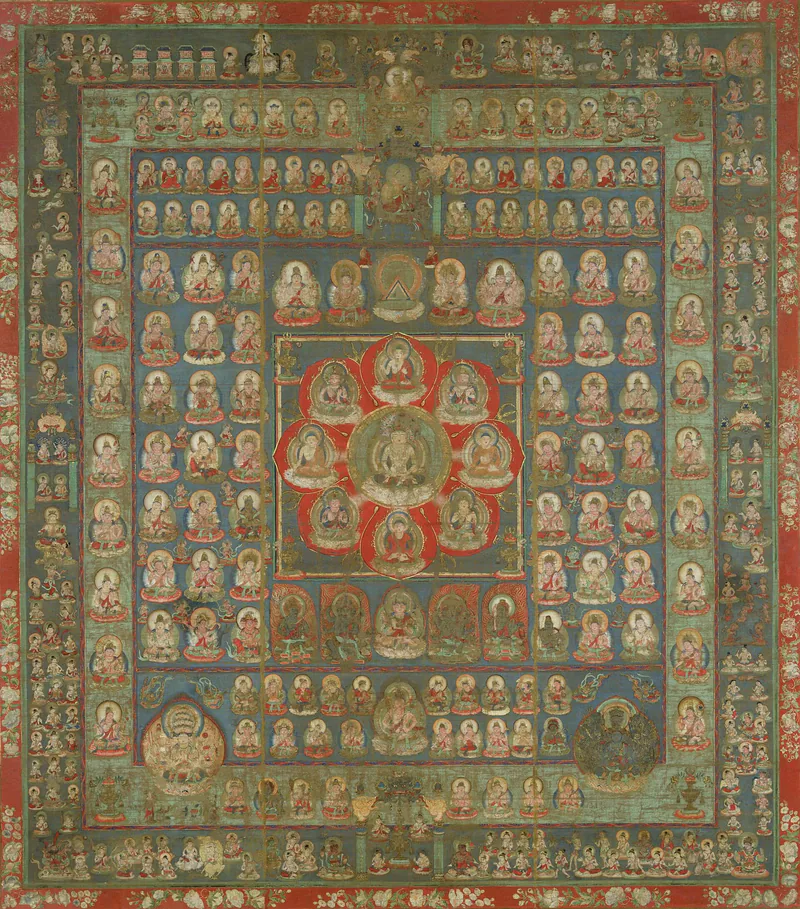
In China, three Indian and Central Asian masters — Shubhakarasimha, Vajrabodhi and Amoghavajra — introduced esoteric Buddhism at the Tang court in the eighth century, and Amoghavajra (705–774) became one of the most powerful monks of his day. The Japanese monk Kukai (774–835) studied this tradition in the Chinese capital Chang'an under the master Huiguo and on his return founded the Shingon ("True Word") school, building its monastic centre on Mount Koya. Shingon ritual is organised around two great mandalas, the Womb Realm and the Diamond Realm, and teaches that one may "become a buddha in this very body". Esoteric practices were also absorbed into the Tendai school and mixed with mountain asceticism and Shinto worship. Japanese esoteric Buddhism, however, did not adopt the later Highest Yoga Tantras that became central in Tibet.
Vajrayana also spread from Tibet to Mongolia, where it became the state religion of the Mongol khans in the thirteenth century and again from the sixteenth, and to Bhutan, Ladakh and the Buryat and Kalmyk peoples of Russia.
Frequently asked questions§
Is Vajrayana the same as Tibetan Buddhism?§
Not exactly. Tibetan Buddhism is the largest living Vajrayana tradition, but it also includes Mahayana philosophy and monastic discipline. Vajrayana, for its part, also exists outside Tibet, among the Newars of Nepal and in Japanese Shingon.
What is deity yoga?§
Deity yoga is the central meditation of Buddhist tantra, in which the practitioner, after initiation, visualises himself or herself as an awakened deity within a mandala. It is understood not as worship of an external god but as a way of transforming ordinary perception into the pure perception of a buddha, grounded in the understanding of emptiness.
Why is Vajrayana secret?§
Tantric teachings are traditionally given only to initiates because they are thought to be powerful, easily misunderstood and potentially harmful without proper preparation and guidance. Today many tantric texts are published, but traditional teachers still insist that practice requires initiation and a qualified teacher.
Sources and further reading§
- Indian Esoteric Buddhism: A Social History of the Tantric Movement — Ronald M. Davidson, 2002
- Buddhist Thought: A Complete Introduction to the Indian Tradition — Paul Williams & Anthony Tribe, 2000
- The Buddhist Tantras: Light on Indo-Tibetan Esotericism — Alex Wayman, 1973
- Kukai: Major Works — Yoshito S. Hakeda, 1972
- Esoteric Buddhism and the Tantras in East Asia — Charles D. Orzech, Henrik H. Sørensen & Richard K. Payne (eds.), 2011
- Introduction to Tibetan Buddhism — John Powers, 1995