Liber IV · Buddhism · Chapter X: Vajrayana
Tara in Tibetan Buddhism: Green Tara, White Tara and the 21 Taras
Tara in Tibetan Buddhism explained: the female buddha's Indian origins, the eight fears, Green and White Tara, the Twenty-One Taras and her tantric forms.

Tara is a female buddha and bodhisattva of compassion, the most widely venerated female figure in Tibetan and Himalayan Buddhism. Her name means "star" and also "she who carries across", and she is believed to rescue beings from danger and to guide them across the ocean of suffering to awakening. Arising in Indian Mahayana Buddhism around the sixth century, she is worshipped above all as Green Tara and White Tara and in a cycle of twenty-one forms praised daily in Tibetan monasteries and homes.
Who Is Tara? Names and Meaning§
The Sanskrit word tara means "star", and it is also connected with the verb tar, "to cross over", so that Tara can be understood as "she who ferries beings across" the river of samsara. Her Tibetan name, Drolma (sgrol ma), stresses the second meaning: "she who liberates" or "the saviouress".
In Mahayana thought Tara is both a bodhisattva, a being dedicated to the welfare of all, and a buddha, fully awakened. Indian sources associate her closely with Avalokiteshvara, the bodhisattva of compassion; a well-known Tibetan account says that she was born from his tears as he wept for the suffering of the world. Another story, recorded by the Tibetan historian Taranatha in the early seventeenth century, tells of a princess named Moon of Wisdom who, told by monks that she should pray to be reborn as a man in order to advance on the path, replied that from the standpoint of ultimate truth there is neither male nor female, and vowed always to attain awakening and to work for beings in a woman's body. That legend has made Tara an important figure in modern discussions of women in Buddhism.
Origins of Tara in Indian Buddhism§
Tara's history is clearer in images than in early texts. She does not appear in the oldest Mahayana sutras, but from roughly the sixth and seventh centuries she is depicted in the Buddhist caves of western India, at Ellora, Aurangabad and Kanheri, often accompanying Avalokiteshvara. Hymns in her honour were written by Indian poets; the Sragdhara Stotra of the Kashmiri monk Sarvajñamitra, usually dated to the eighth century, is one of the most celebrated.
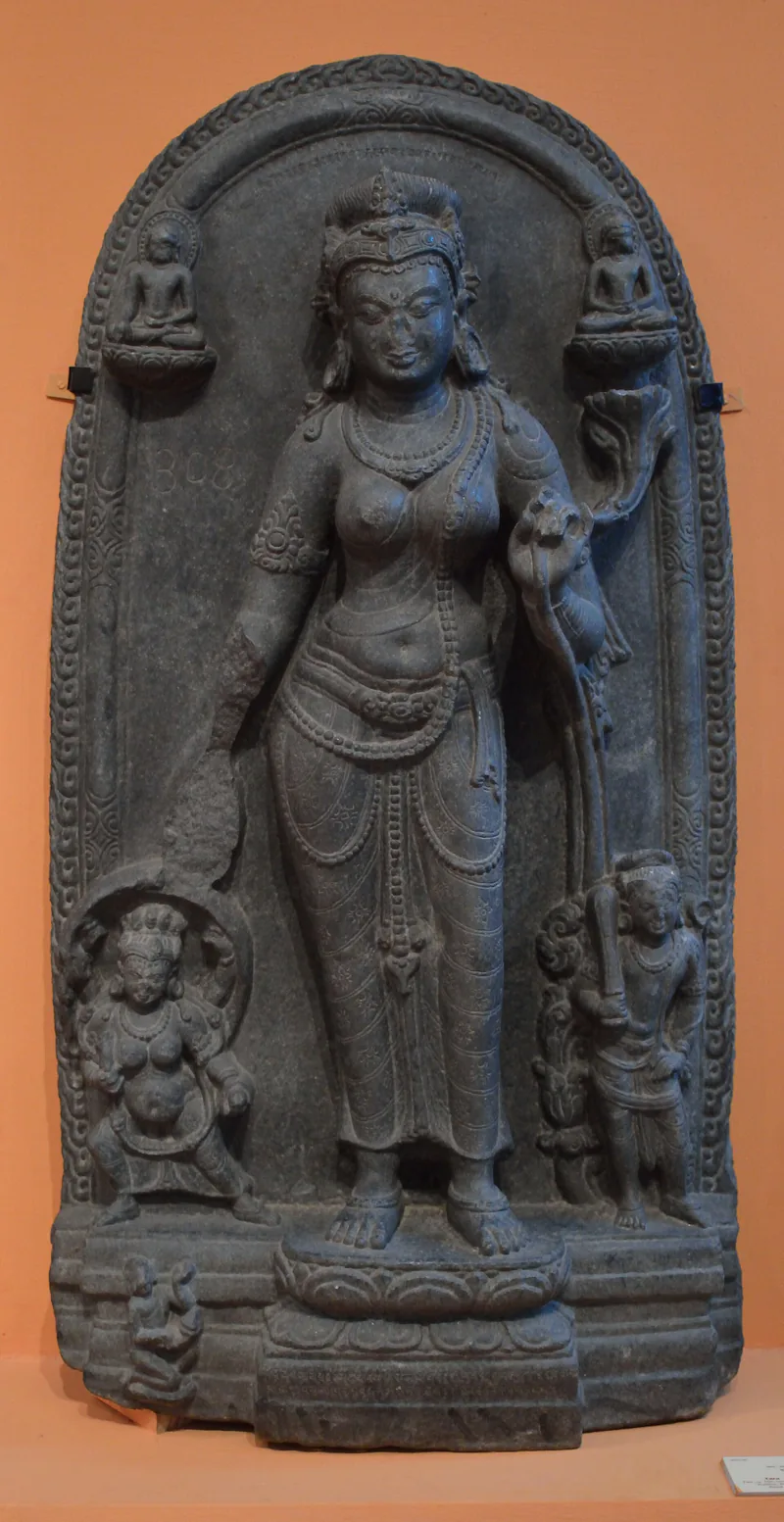
From the eighth century onward, with the growth of Vajrayana, Tara became the subject of tantric meditation manuals (sadhanas), in which practitioners visualise her form and recite her mantra. Collections such as the Sadhanamala contain numerous Tara practices, and images of her multiplied in the monasteries of eastern India under the Pala kings, including Nalanda. By the time Buddhism passed to Tibet she was firmly established as one of the principal deities of Indian Buddhism.
Tara Who Saves From the Eight Fears§
Tara's earliest and most enduring role is that of a protector who answers those who call on her in danger. Sculptural panels at Ellora and other western Indian sites show her surrounded by small scenes of people threatened by eight great perils — lions, elephants, fire, snakes, robbers, imprisonment, shipwreck or flood, and demons — each saved by Tara, who flies to their aid. The theme closely parallels the chapter on Avalokiteshvara in the Lotus Sutra, which similarly promises rescue from fire, water, bandits and chains to those who invoke him.
Later commentators, including Tibetan teachers, gave the eight dangers an inner meaning as well: the lion as pride, the elephant as ignorance, fire as anger, snakes as envy, robbers as wrong views, chains as avarice, floods as desire and attachment, and demons as doubt. Tara thus protects both from the perils of the road and from the mental afflictions that bind beings to samsara. Many Tibetans still turn to her prayers on journeys, in illness and in times of fear, a devotional practice that coexists with her role in advanced meditation.
Green Tara, White Tara and the Twenty-One Taras§
Tara appears in many forms distinguished by colour, posture and attributes. The two most popular are:
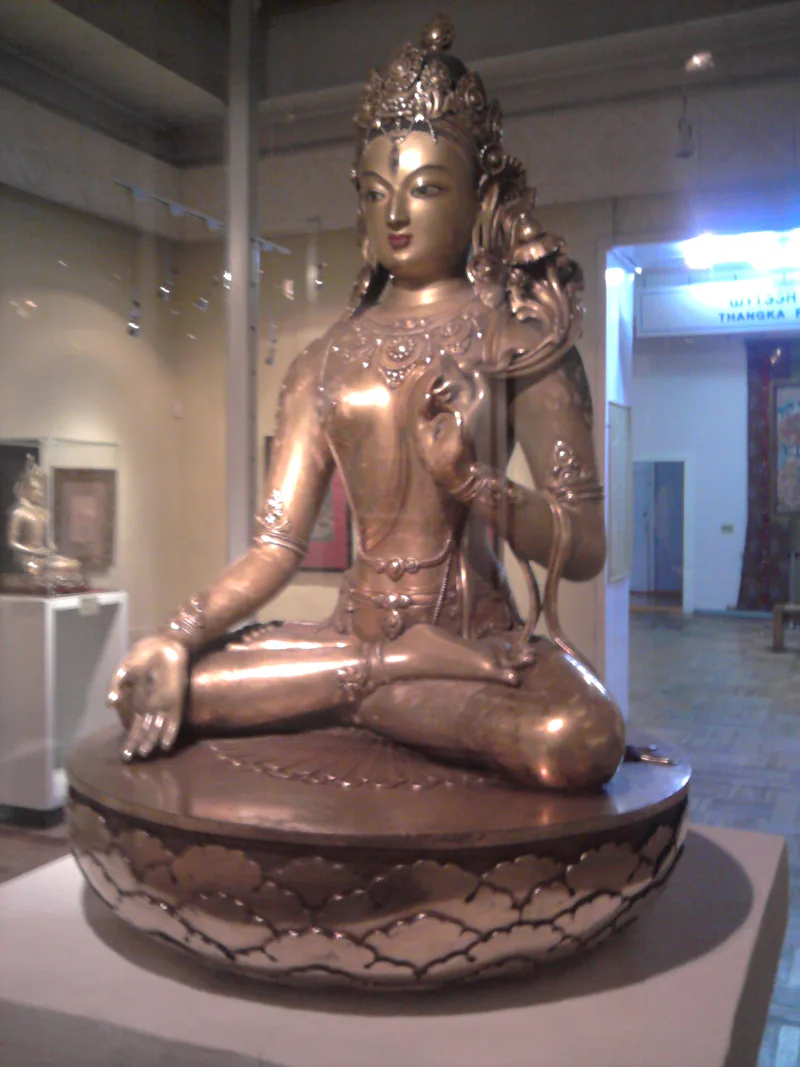
- Green Tara (Shyama Tara), the principal form. She sits on a lotus with her left leg folded in meditation and her right leg extended, as if ready to step down to help. Her right hand makes the gesture of giving, and her left holds the stem of a blue lotus at her heart. Green is associated with the swift, all-accomplishing activity of compassion.
- White Tara (Sita Tara), seated in full meditation posture, with seven eyes — one in her forehead and one in each palm and sole — signifying that she sees all suffering. She is invoked especially for long life and healing, and is grouped with Amitayus and Ushnishavijaya as one of the three deities of longevity.
The Praises to the Twenty-One Taras, a hymn preserved in the Tibetan canon as part of a Tara tantra, salutes twenty-one forms of the goddess, peaceful and wrathful, each with its own colour and function. Recited daily in many monasteries and households, often in its entirety several times, it is probably the best-known Tibetan prayer after the mantra of Avalokiteshvara. Different lineages, associated with the Indian masters Suryagupta and Atisha and with the Nyingma teacher Longchenpa, depict the twenty-one forms in different ways. Tara's short mantra, Om tare tuttare ture svaha, plays on her name and is widely recited by lay people.
Tara in Tibet: Atisha, Queens and Daily Devotion§
Tara's cult in Tibet is strongly associated with the Bengali master Atisha (982–1054), who came to Tibet in 1042 and was famous for his devotion to her; Tibetan biographies report that she guided him in visions, including in his decision to make the journey. His disciples founded the Kadam tradition, which carried Tara practice into all later schools of Tibetan Buddhism. The temple at Nyethang near Lhasa where Atisha spent his last years is dedicated to her.
Tibetan tradition also projected Tara back to the beginnings of Buddhism in Tibet. The two foreign wives of the seventh-century king Songtsen Gampo — the Nepalese princess Bhrikuti and the Chinese princess Wencheng, each said to have brought a sacred Buddha image to Lhasa — came to be regarded as emanations of Green and White Tara. Tibetans also speak of devout women, including great teachers such as Machig Labdron, as manifestations of Tara.
Her popularity spread wherever Tibetan Buddhism went. In Nepal she has a central place in Newar Buddhism; in Mongolia the sculptor and religious leader Zanabazar (1635–1723) produced gilt bronze images of Green and White Tara that are among the masterpieces of Buddhist art. In Tibetan homes, a Tara image on the household shrine and the recitation of her praises in the morning remain common practice.
Tara in Tantra, Hindu Parallels and Modern Readings§
As a tantric deity Tara is the focus of meditation practices in which the practitioner, after receiving the proper initiation, visualises himself or herself in Tara's form, recites her mantra and dissolves the visualisation into emptiness — a form of deity yoga described more generally in tantra's history and practice. Her ritual repertoire also includes the four classical tantric activities: pacifying, increasing, magnetising and subjugating. Wrathful or semi-wrathful forms such as the red Kurukulla, invoked in rites of attraction, and the fierce one-eyed Ekajati, a protector of the Nyingma teachings, are related to her or counted among her emanations.
Tara also has a Hindu counterpart. In Hindu Tantra a fierce goddess named Tara, dark blue and standing on a corpse, is one of the ten Mahavidyas, the "great wisdom" forms of the Goddess, and she shares iconography with the Buddhist Ugra Tara and Ekajati. Scholars continue to debate the direction of borrowing; the relationship illustrates the shared religious world of medieval Indian tantra discussed in Shaktism and the Hindu Goddess.
In the modern period Tara has attracted renewed interest. Stephan Beyer's study The Cult of Tara (1973) used her rituals to explore the whole of Tibetan religious practice, and scholars such as Miranda Shaw and Rita Gross have examined her as a resource for thinking about gender in Buddhism. For many Tibetans and practitioners elsewhere, however, she remains above all a present and responsive protector — the mother who comes quickly when called.
Frequently asked questions§
Is Tara a goddess or a buddha?§
In Tibetan Buddhism Tara is regarded as a fully awakened buddha who manifests in female form, as well as a bodhisattva who works for the welfare of beings. Western writers often call her a goddess, but for practitioners she is primarily an enlightened being rather than a deity of the world.
What is the difference between Green Tara and White Tara?§
Green Tara is the principal form, associated with swift compassionate action and protection from danger, and is shown with one leg extended ready to rise. White Tara, seated in meditation with seven eyes, is invoked especially for long life, health and healing.
What is the Tara mantra?§
The best-known Tara mantra is Om tare tuttare ture svaha, a play on her name expressing her role as liberator from dangers and suffering. It is recited by monastics and lay people alike, often on a rosary.
What are the Twenty-One Taras?§
They are twenty-one forms of Tara, each with a distinct colour, expression and function, praised in a short Sanskrit hymn translated into Tibetan. The Praises to the Twenty-One Taras is recited daily in many Tibetan monasteries and homes.
Sources and further reading§
- The Cult of Tara: Magic and Ritual in Tibet — Stephan Beyer, 1973
- In Praise of Tara: Songs to the Saviouress — Martin Willson, 1986
- Buddhist Goddesses of India — Miranda Shaw, 2006
- Buddhism After Patriarchy: A Feminist History, Analysis, and Reconstruction of Buddhism — Rita M. Gross, 1993
- Introduction to Tibetan Buddhism — John Powers, 1995
- Indian Esoteric Buddhism: A Social History of the Tantric Movement — Ronald M. Davidson, 2002