Liber IV · Buddhism · Chapter IX: Theravada
Theravada Buddhism: The Way of the Elders from Sri Lanka to Laos
Theravada Buddhism, the way of the elders: its origins, the Pali Canon, the arahant ideal, monks and merit, and its history in Sri Lanka, Burma and Thailand.

Theravada, "the teaching of the elders", is the oldest surviving school of Buddhism and the main religion of Sri Lanka, Myanmar (Burma), Thailand, Laos and Cambodia. It preserves its scriptures in the Pali language, emphasises the monastic community and the path of the arahant, the "worthy one" who attains nirvana, and is followed today by roughly 150 million people.
Origins: The Early Schools and the Elders§
In the century or two after the Buddha's death the community, which had no single head, divided over questions of monastic discipline and doctrine. Tradition places a Second Council at Vaishali about a century after the Buddha, and a first great schism between the Sthaviras ("elders") and the Mahasanghikas ("those of the great community"). The sources disagree about the cause: some say the elders were stricter about the rules, others that the dispute concerned the nature of the arahant. Further divisions produced the traditional "eighteen schools".
Theravada (Pali thera, "elder", and vada, "teaching") claims descent from a branch of the Sthaviras, and its chronicles describe a Third Council held under the emperor Ashoka at Pataliputra, which other schools do not record. Modern scholars treat these chronicles with caution, but agree that Theravada is the only one of the early schools to survive to the present, and that its Pali Canon is the only complete early canon in an Indian language. Theravadins regard their tradition as the faithful preservation of the original teaching; historians add that it has also changed and developed over two thousand years.
Theravada in Sri Lanka and the Great Monastery§
According to the Sri Lankan chronicles, the Dipavamsa and Mahavamsa, Buddhism was brought to the island in the third century BCE by Mahinda, a monk said to be Ashoka's son, who converted King Devanampiya Tissa. His sister Sanghamitta, a nun, is said to have brought a cutting of the bodhi tree, and a tree at Anuradhapura venerated as its descendant is still a major place of pilgrimage. Sri Lanka also became home to one of the most precious Buddhist relics, the Tooth Relic, now enshrined at Kandy.
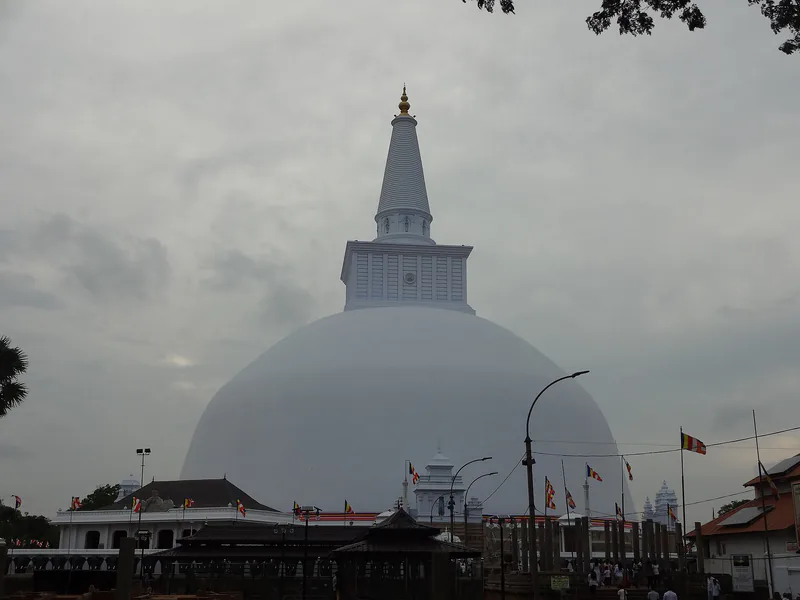
For much of the first millennium Sri Lankan Buddhism was divided between rival monastic centres at Anuradhapura: the conservative Mahavihara ("Great Monastery") and the Abhayagiri and Jetavana monasteries, which were more open to Mahayana ideas. In the fifth century the scholar Buddhaghosa, working at the Mahavihara, composed the commentaries on the canon and the Visuddhimagga, which defined Mahavihara orthodoxy. In the twelfth century King Parakramabahu I unified the monastic orders under the Mahavihara lineage, and "Theravada" in its modern sense descends from this reform.
Spread to Burma, Thailand, Laos and Cambodia§
Buddhism of several kinds, including Mahayana and tantric forms, reached mainland Southeast Asia early in the first millennium alongside Hindu traditions. Theravada became dominant through royal patronage in the second millennium. In Burma, King Anawrahta of Pagan (r. 1044–1077) adopted it, and Pagan's thousands of temples and stupas still stand. In the Thai lands the kingdom of Sukhothai embraced Sri Lankan-lineage Theravada in the thirteenth century, and Laos and Cambodia followed in the thirteenth and fourteenth centuries, when Angkor's Hindu and Mahayana state religion gave way to Theravada.
The connections ran both ways. When the Sri Lankan ordination lineage lapsed during colonial upheavals, it was restored by monks from Siam in 1753, founding the Siyam Nikaya, and later from Burma. In nineteenth-century Siam, the future King Mongkut, then a monk, founded the reformist Thammayut order, which stressed strict observance of the Vinaya and study of the Pali texts.
Teachings and the Arahant Ideal§
Theravada teaching is grounded in the core teachings of Buddhism as found in the Pali Canon: the Four Noble Truths, the Eightfold Path, the three marks of existence and dependent origination, interpreted through the Abhidhamma and the commentaries. Its ideal is the arahant, who has destroyed the defilements and will not be reborn. The path to that state is described in four stages: the stream-enterer, the once-returner, the non-returner and the arahant.

Theravada also recognises the bodhisattva path; the Buddha himself followed it through many lives, as told in the Jataka stories, and some Theravadins have aspired to become future buddhas. But the path is regarded as exceptional, and most practitioners aim for nirvana as disciples of the Buddha. The future Buddha Maitreya (Pali Metteyya) is widely honoured, and many lay people hope to be reborn in his time.
The tradition generally holds that we live in a declining age in which full awakening is rare. In some periods this belief led to an emphasis on preserving the texts and making merit rather than intensive meditation, a balance that modern reform movements challenged.
Monks, Laity and the Economy of Merit§
The heart of Theravada religious life is the relationship between the Sangha and the laity, described in detail in Buddhist monastic life. Monks, recognisable by their saffron, ochre or maroon robes, keep the 227 rules of the Pali Vinaya, study and teach, chant protective texts (paritta), and perform funerals and blessings. Lay people offer food on the daily alms round, robes at the kathina ceremony at the end of the rains retreat, and support for temples, and in return receive teaching and the opportunity to make merit (punna), which is believed to bring good fortune and better rebirth and can be shared with deceased relatives.
Many lay people observe the five precepts, and on the moon-day observances (uposatha) some take eight precepts and spend the day at the temple. In Thailand and Myanmar it has long been customary for young men to ordain temporarily, for a rains retreat or a shorter period; the Burmese shinbyu ceremony, in which a boy enters the monastery as a novice, re-enacts the Buddha's renunciation. Anthropologists such as Melford Spiro and Stanley Tambiah have also documented how Theravada coexists with the veneration of local spirits — the nats of Burma and the phi of Thailand and Laos — and with astrology and protective amulets.
Meditation Revival and Modern Theravada§
In the late nineteenth and twentieth centuries Burmese monks such as Ledi Sayadaw (1846–1923) taught meditation to lay people on an unprecedented scale, partly as a response to British colonial rule. Later teachers — Mahasi Sayadaw, the layman U Ba Khin and his student S. N. Goenka — developed systematic methods of insight meditation (vipassana) that spread across Asia and the West and became the background of the modern mindfulness movement, discussed in meditation in Eastern traditions. In Thailand, the forest tradition associated with Ajahn Mun and Ajahn Chah revived austere meditative monasticism, and Ajahn Chah's Western disciples founded monasteries in Britain and elsewhere.
In Sri Lanka, the revival led by Anagarika Dharmapala and supported by Theosophists such as Henry Steel Olcott produced what Richard Gombrich and Gananath Obeyesekere called "Protestant Buddhism", a reformed, lay-centred and scripturally focused religion. Twentieth-century Theravada has also been shaped by nationalism and politics, and by the debate over restoring the order of fully ordained nuns, lost in Sri Lanka around the eleventh century and revived there since the late 1990s.
Frequently asked questions§
What is the difference between Theravada and Mahayana?§
Theravada follows the Pali Canon and emphasises the path to nirvana as an arahant, while Mahayana accepts additional sutras and emphasises the bodhisattva's path to buddhahood for the sake of all beings. Mahayana also developed a larger pantheon of buddhas and bodhisattvas. Both share the core teachings and monastic discipline.
Where is Theravada Buddhism practised?§
Theravada is the majority religion of Sri Lanka, Myanmar, Thailand, Laos and Cambodia, and is found among minorities in Bangladesh, Vietnam, southern China and India. Through immigration and the insight-meditation movement it now also has monasteries and centres in Europe, North America and Australia.
Is "Hinayana" the same as Theravada?§
No. "Hinayana", the "lesser vehicle", is a polemical term used in Mahayana texts for the non-Mahayana schools of ancient India. Theravadins do not use it of themselves, and scholars now avoid applying it to Theravada.
Sources and further reading§
- Theravada Buddhism: A Social History from Ancient Benares to Modern Colombo — Richard Gombrich, 1988
- Theravada Buddhism: Continuity, Diversity, and Identity — Kate Crosby, 2014
- Buddhism and Society: A Great Tradition and Its Burmese Vicissitudes — Melford E. Spiro, 1970
- World Conqueror and World Renouncer — Stanley J. Tambiah, 1976
- Buddhism Transformed: Religious Change in Sri Lanka — Richard Gombrich & Gananath Obeyesekere, 1988
- The Birth of Insight: Meditation, Modern Buddhism, and the Burmese Monk Ledi Sayadaw — Erik Braun, 2013