What Is Buddhism? The Buddha, the Dharma and the Sangha
What is Buddhism? An introduction to the Buddha, the Four Noble Truths, karma, rebirth and nirvana, the Three Jewels, and the Theravada and Mahayana schools.

Buddhism is the religion and philosophy founded on the teaching of Siddhartha Gautama, the Buddha or "awakened one", who lived and taught in the Ganges plain of northern India in about the fifth century BCE. Buddhists take refuge in three "jewels" — the Buddha, his teaching (the Dharma) and the community of practitioners (the Sangha) — and follow a path of ethics, meditation and wisdom that aims at freedom from suffering and from the cycle of rebirth, a state called nirvana.
The Buddha and the Origins of Buddhism§
According to Buddhist tradition, Siddhartha was born a prince of the Shakya clan at Lumbini, in what is now southern Nepal. Troubled by the facts of old age, sickness and death, he left his home to become a wandering ascetic, practised severe austerities, abandoned them as fruitless, and finally attained awakening (bodhi) while meditating under a tree at Bodh Gaya. He spent the remaining decades of his life teaching across the kingdoms of Magadha and Kosala, and died at Kushinagar at the age of about eighty. The story, its sources and its historical problems are told in detail in the life of the Buddha.
The dates of the Buddha are among the most debated questions in the history of Indian religion. Theravada tradition places his death in 544 or 543 BCE; an older Western "long chronology" put it around 486 BCE; and since the late twentieth century many historians have favoured a "short chronology" placing it around 400 BCE. What is certain is that he belonged to a period of intense religious experiment, when shramanas — wandering renunciants such as the early Jains — challenged the authority of the Brahmin priests and their Vedic sacrifices, and new ideas about karma, rebirth and liberation were taking shape.
Buddhism should not be confused with Hinduism, though they grew from the same soil and share a vocabulary of karma, rebirth and yoga. The Buddha rejected the authority of the Vedas and the Brahmanical idea of an eternal self (atman), and he admitted members of every caste to his order. The relationship between the two traditions is explored further in our introduction to Hinduism.
The Three Jewels: Buddha, Dharma and Sangha§
The simplest definition of a Buddhist is a person who "takes refuge" in the Three Jewels (triratna). The formula, recited in Pali in Theravada countries and in Chinese, Tibetan, Japanese and many other languages elsewhere, has been the basic act of Buddhist commitment for more than two thousand years.

- The Buddha is the teacher who rediscovered the path to awakening. In early texts he is a human being who achieved a supreme understanding; in later Mahayana thought he becomes one of countless buddhas, with cosmic and transcendent dimensions.
- The Dharma (Pali dhamma) is the teaching, and also the truth or natural order that the teaching describes. It is preserved in scriptures that differ from school to school, surveyed in our guide to Buddhist scriptures.
- The Sangha is the community. In its narrowest sense it is the order of monks and nuns; in a broader sense it includes all who follow the path. The ordained community, its rules and its daily life are described in Buddhist monastic life.
Core Buddhist Teachings in Brief§
The Buddha's first sermon, delivered to five former companions in the Deer Park at Sarnath near Varanasi, set out the Four Noble Truths. The first is dukkha, usually translated "suffering" but meaning also unsatisfactoriness and the instability of every experience. The second is its origin in craving or thirst (tanha). The third is its cessation, nirvana (Pali nibbana), literally the "blowing out" of the fires of greed, hatred and delusion. The fourth is the Noble Eightfold Path, a training in right view, intention, speech, action, livelihood, effort, mindfulness and concentration.
Around this core stand several further teachings. All conditioned things are impermanent (anicca), unsatisfactory (dukkha) and without a fixed self (anatta). Beings are reborn according to their karma — intentional actions of body, speech and mind — in a beginningless round of existence called samsara. And all phenomena arise in dependence on conditions, a principle called dependent origination. These ideas are explained at greater length in the core teachings of Buddhism, and the many realms into which beings may be reborn in Buddhist cosmology.
It is often asked whether Buddhism is a religion or a philosophy. The question is largely a modern Western one. Buddhism has no creator god, and the Buddha is not worshipped as one, yet Buddhists across Asia venerate relics and images, make offerings, chant scriptures, believe in gods and spirits within samsara, and hope for good rebirth. It is fair to say that Buddhism includes rigorous philosophy and also the full range of activities that scholars call religion.
The Major Schools: Theravada, Mahayana and Vajrayana§
Within a century or two of the Buddha's death the community divided into several schools, traditionally eighteen, which disagreed over monastic discipline and points of doctrine. Only one of these early lineages survives as a living tradition: Theravada, "the teaching of the elders", which preserves its scriptures in the Pali language and is today the main religion of Sri Lanka, Myanmar, Thailand, Laos and Cambodia. Its ideal is the arahant, one who has fully realised nirvana.
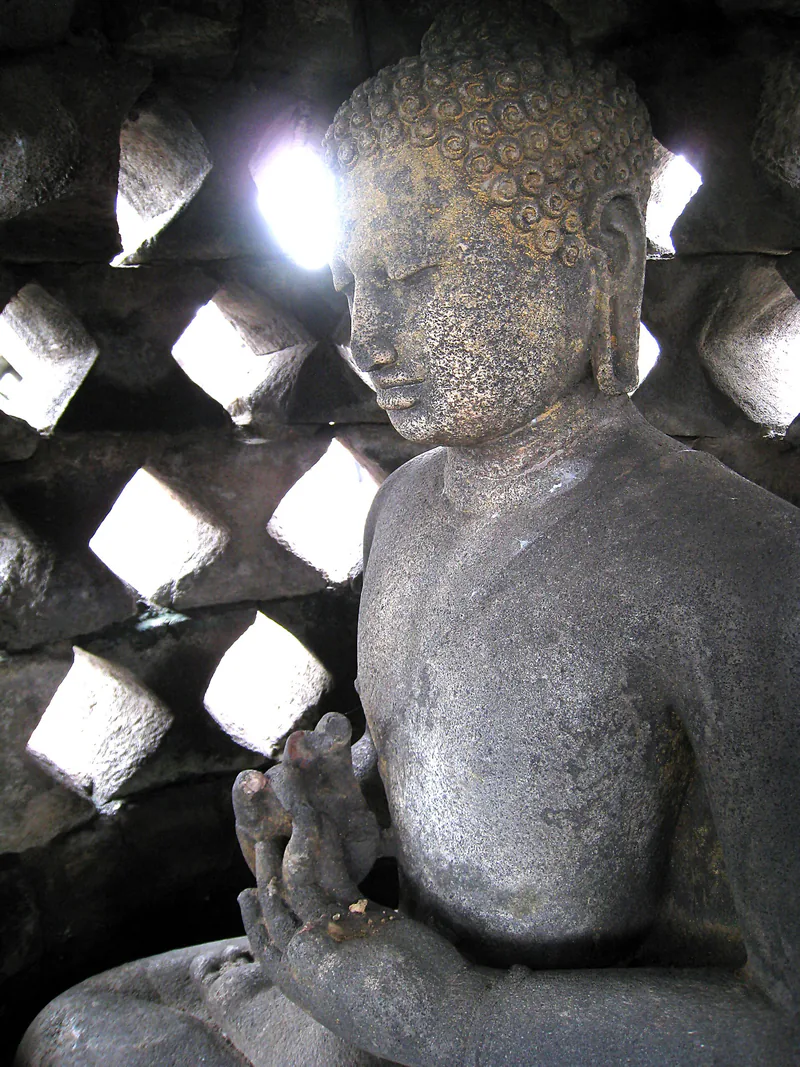
From around the first century BCE a movement calling itself the Mahayana, the "Great Vehicle", produced new scriptures that placed the bodhisattva — a being who vows to become a buddha in order to free all others — at the centre of the path. Mahayana teachers developed philosophies of emptiness (shunyata) and of mind, and a rich devotion to celestial buddhas and bodhisattvas. Mahayana became the Buddhism of China, Korea, Japan and Vietnam, where it gave rise to schools such as Tiantai, Huayan, Zen and Chan and Pure Land.
The third tradition, Vajrayana, the "Diamond Vehicle", is a form of Mahayana that adopted the ritual methods of the Indian tantras: initiation by a guru, mantra, mandala and visualisation of deities. It flourished in India from about the seventh century and passed to Tibet, Mongolia, Bhutan and Nepal, and in a different form to Japan as Shingon. Its Himalayan form is treated in our guide to Tibetan Buddhism.
Buddhist Practice: Ethics, Meditation and Devotion§
The path is traditionally summarised as three trainings: ethical conduct (shila), meditative concentration (samadhi) and wisdom (prajna). For lay Buddhists, ethics begins with the five precepts: to refrain from killing, stealing, sexual misconduct, false speech and intoxicants. Monks and nuns keep hundreds of further rules.
Meditation has a central place in the texts, in two broad forms: calm (shamatha), which stills and unifies the mind, and insight (vipashyana), which sees into impermanence and not-self. Historically, however, intensive meditation was the work of a minority of monastics. For most Buddhists the religious life has centred on generosity (dana) — above all giving food and support to monks and nuns — on keeping precepts, on visiting temples and stupas, on chanting, and on festivals such as Vesak, which in many countries celebrates the Buddha's birth, awakening and death on a single full-moon day. Such acts are understood to generate merit (punya), which leads to happier rebirths and can be dedicated to the welfare of others, including the dead.
The Spread of Buddhism Across Asia and the World§
Buddhism remained a regional Indian movement until the reign of the emperor Ashoka (c. 268–232 BCE), whose inscriptions promote the Dharma and whose patronage, according to tradition, sent missions abroad. His son Mahinda is said to have brought Buddhism to Sri Lanka in the third century BCE. Along the trade routes of Central Asia it reached China by the first century CE, Korea in the fourth century, Japan in the sixth century and Tibet in the seventh and eighth. Buddhism also spread by sea to Southeast Asia, where Theravada became dominant from the eleventh to the fourteenth centuries.
In India itself Buddhism declined from the seventh century onward and had largely disappeared by the thirteenth, after the loss of royal patronage, competition from Hindu devotional movements and the destruction of great monasteries such as Nalanda during the Turkic conquests. It revived in the twentieth century, most notably when B. R. Ambedkar and hundreds of thousands of his followers from formerly "untouchable" communities converted in 1956.
Since the nineteenth century Buddhism has travelled to Europe, the Americas and Australia through scholarship, immigration and the work of Asian teachers, a story told in Buddhism in the West. Today it is practised in forms ranging from traditional monasticism to secular mindfulness, and its estimated half a billion adherents live mostly in East and Southeast Asia.
Frequently asked questions§
Do Buddhists believe in God?§
Buddhism does not teach a creator god who made the world and judges souls, and the Buddha is revered as a teacher, not worshipped as a creator. Buddhist texts do describe many gods (devas) who live in heavenly realms, but they are themselves mortal beings within the cycle of rebirth. Many Buddhists also honour local deities and spirits alongside the Buddha.
What is the goal of Buddhism?§
The ultimate goal is nirvana, the end of craving, suffering and rebirth. Theravada emphasises becoming an arahant who attains nirvana, while Mahayana and Vajrayana emphasise the bodhisattva's path to full buddhahood for the sake of all beings. Many lay Buddhists also aim more immediately at a good rebirth through merit.
How many Buddhists are there in the world?§
Estimates vary because Buddhist identity often overlaps with other traditions, especially in China and Japan, but most surveys put the figure at around 500 million people, roughly seven percent of the world's population. The largest Buddhist populations are in China, Thailand, Japan, Myanmar, Sri Lanka and Vietnam.
Is Buddhism a religion or a philosophy?§
It is both, depending on which aspects one emphasises. Buddhism contains sophisticated philosophy of mind and knowledge, but it also has scriptures, rituals, monastic institutions, devotion to buddhas and bodhisattvas, and teachings about rebirth and other worlds. The idea of Buddhism as a purely rational philosophy owes much to nineteenth- and twentieth-century reformers in Asia and the West.
Sources and further reading§
- What the Buddha Taught — Walpola Rahula, 1959
- An Introduction to Buddhism: Teachings, History and Practices — Peter Harvey, 1990
- The Foundations of Buddhism — Rupert Gethin, 1998
- Buddhist Thought: A Complete Introduction to the Indian Tradition — Paul Williams & Anthony Tribe, 2000
- Theravada Buddhism: A Social History from Ancient Benares to Modern Colombo — Richard Gombrich, 1988
- Buddhism: A Very Short Introduction — Damien Keown, 1996