Liber XIV · Hinduism · Chapter X: Temples, Rituals & Festivals
Varanasi (Kashi): The Holy City of Shiva, the Ganga and Death
Varanasi (Kashi, Banaras), Hinduism's holiest city: its history, the Kashi Vishvanath temple, the ghats of the Ganga, cremation at Manikarnika and pilgrimage.

Varanasi, also called Kashi and Banaras, is the holiest city of Hinduism: a city on the west bank of the Ganga in Uttar Pradesh, sacred to Shiva, lined with stepped bathing places (ghats) and famous as the place where Hindus most wish to die and be cremated. Hindus believe that Shiva grants liberation to all who die within its sacred boundaries, and for well over two thousand years it has drawn pilgrims, ascetics, scholars and mourners from across India.
Kashi, Banaras, Varanasi: Names and Ancient History§
The city has many names. Kashi, perhaps meaning "shining," was originally the name of a kingdom and its people, mentioned in late Vedic literature and frequently in early Buddhist and Jain texts, where Kashi appears among the major states of north India. Varanasi, its official name, is traditionally explained as the land between the Varuna river to the north and the small Asi stream to the south; Banaras or Benares is a later popular form of the same name.
Archaeological excavations at Rajghat, on the northern edge of the city, show settlement going back to at least the early first millennium BCE, and Varanasi is often described as one of the oldest continuously inhabited cities in the world, although such claims are difficult to establish precisely. At Sarnath, a few miles to the north, the Buddha is said to have preached his first sermon in the Deer Park, an event described in The Life of the Buddha; the Mauryan emperor Ashoka later erected a pillar there whose lion capital is now India's national emblem.
The Kashi Khanda, a long section of the Skanda Purana, and other Sanskrit texts glorifying the city (mahatmyas) describe Kashi as a place not of this earth: it rests on the tip of Shiva's trident and survives even the dissolution of the universe. Its pilgrimage literature lists hundreds of shrines, pools and lingas, mapping a complete sacred cosmos within the city.
The City of Shiva: Kashi Vishvanath and the Jyotirlinga§
Varanasi belongs above all to Shiva as Vishvanatha or Vishveshvara, "lord of the universe." His temple houses one of the twelve jyotirlingas, the "lingas of light" where Shiva is believed to have manifested as a boundless column of fire, discussed in Shaivism. For many Shaivas, and Hindus of other traditions, a visit to Vishvanath is the climax of a lifetime of pilgrimage.
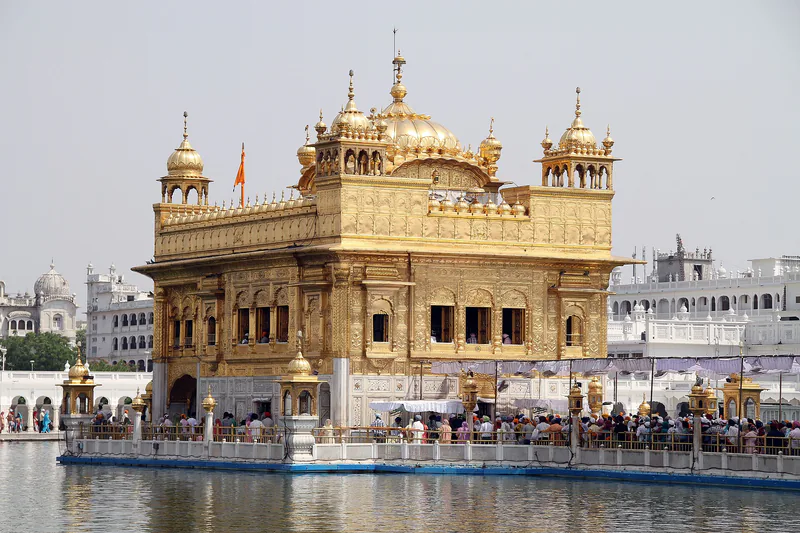
The temple's history reflects the city's turbulent past. Earlier temples were destroyed during invasions and conflicts in the late twelfth century and again later; a major temple rebuilt in the late sixteenth century was demolished in 1669 on the orders of the Mughal emperor Aurangzeb, and the Gyanvapi mosque was built on part of its site. The present temple was constructed nearby in 1780 under the patronage of Ahilyabai Holkar, the Maratha queen of Indore, and its spire and dome were covered with gold in the 1830s, a gift associated with the Sikh ruler Maharaja Ranjit Singh. In 2021 the Kashi Vishwanath Corridor project opened a broad passage between the temple and the river, clearing many older buildings. The relationship between the temple and the neighbouring mosque remains the subject of legal proceedings and political debate.
The city is full of other temples: to the goddess Annapurna, who feeds all who live in Kashi; to Durga; to the monkey god Hanuman at Sankat Mochan, associated with the poet Tulsidas; and to Kala Bhairava, Shiva's fierce form, regarded as the city's guardian and magistrate.
The Ganga and the Ghats§
The Ganga flows north at Varanasi, which is considered especially auspicious, and the city's crescent-shaped riverfront is lined for several miles with more than eighty ghats, flights of stone steps descending to the water, many built or rebuilt by Maratha and Rajput rulers in the eighteenth and nineteenth centuries. Pilgrims bathe at dawn to wash away sins, offer water to the sun and their ancestors, and fill small vessels with Ganga water to take home.
Among the most important are Dashashvamedh Ghat, where Brahma is said to have performed ten horse sacrifices and where an elaborate evening ceremony of lamps (Ganga aarti) now draws large crowds; Assi Ghat at the southern end; Panchganga Ghat, where five rivers are said to meet invisibly; and the cremation ghats. The Ganga itself is worshipped as a goddess who descended from heaven, through Shiva's hair, to purify the ashes of the dead.
Death and Liberation in Kashi: Manikarnika and the Houses of Death§
Varanasi is a tirtha, a "crossing place" between this world and the next, and its supreme promise concerns death. Hindus believe that anyone who dies within the sacred boundary of Kashi, whatever their caste or deeds, is granted liberation (moksha): Shiva himself whispers the "mantra of the crossing" (taraka mantra) into the ear of the dying. The doctrines of rebirth and release behind this belief are described in Dharma, Karma, Samsara and Moksha.
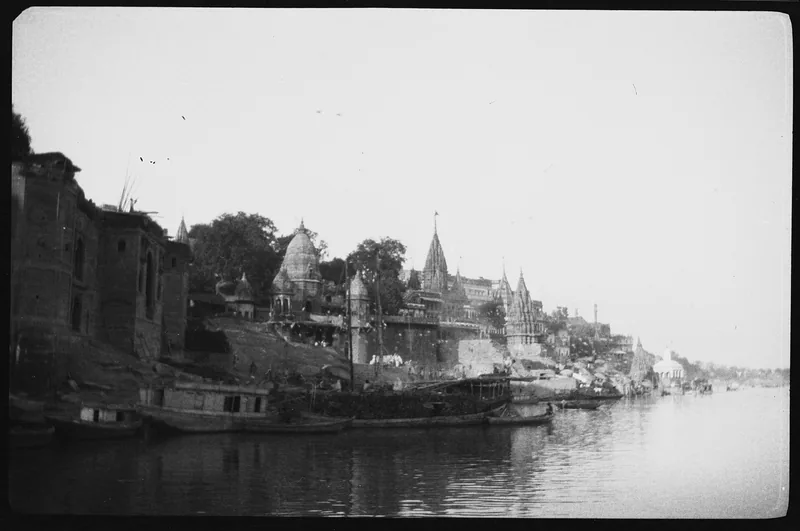
The principal cremation ground is Manikarnika Ghat, where, according to legend, an earring of Shiva or of the goddess fell into a pool dug by Vishnu; pyres burn there day and night. Harishchandra Ghat, named after a legendary king who served as a cremation-ground attendant, is the second cremation ghat. The cremation work is traditionally carried out by the Dom community, whose leader held a hereditary right over the sacred fire from which pyres are lit. The final rites of passage that take place here are described in Hindu Temples, Rituals and Festivals.
Elderly or terminally ill people have long come to Varanasi to spend their last days. Hospices such as the Kashi Labh Mukti Bhawan offer rooms for a limited stay to those expecting death. Some groups, including young children, ascetics and, traditionally, victims of certain diseases or snakebite, were not cremated but committed to the river, a practice now discouraged. The anthropologist Jonathan Parry's study of the city's funeral specialists remains a classic account of this world.
Pilgrimage, Learning and the Arts§
Pilgrims walk the Panchakroshi Yatra, a circuit of about eighty kilometres around the sacred zone, traditionally completed in five days with halts at shrines along the way. Others come to stay for long periods, and many renouncers of every order keep monasteries in the city; according to tradition, Adi Shankara taught here, as described in Adi Shankara.
For centuries Varanasi was the chief centre of Sanskrit learning in north India, home to families of grammarians, logicians and ritual specialists. The Government Sanskrit College was founded in 1791, and Banaras Hindu University, founded in 1916 by Madan Mohan Malaviya with the support of Annie Besant, became one of India's major universities. The city was home to the fifteenth-century poet-saint Kabir and to Ravidas, whose verses entered the Sikh scripture, as described in Sikhism and the Sant Tradition; Tulsidas composed part of his Hindi Ramcharitmanas here, and the open-air Ramlila of Ramnagar, across the river, still re-enacts it over a month each autumn. Varanasi is also renowned for its silk weaving and for a musical tradition that produced the shehnai master Bismillah Khan.
A City of Many Traditions and Modern Challenges§
Varanasi is sacred to more than one religion. Jains revere it as the birthplace of four Tirthankaras, including Parshvanatha, discussed in Parshvanatha. Sarnath remains a major Buddhist pilgrimage site with monasteries from across Asia, and the city has a large Muslim community, prominent in silk weaving, with its own mosques and Sufi shrines.
The city's festivals include Mahashivaratri, the great night of Shiva, and Dev Deepavali, the full moon of Kartika, when the ghats are lit with countless lamps. Modern challenges include crowding, pressure on the old city from redevelopment, and the pollution of the Ganga by sewage and industrial waste, the target of government programmes since the Ganga Action Plan of 1986. For believers, however, Kashi remains what its texts proclaim: the city of light where Shiva grants release.
Frequently asked questions§
Why do Hindus want to die in Varanasi?§
Hindus believe that Shiva grants liberation from the cycle of rebirth to everyone who dies in Kashi, whispering a saving mantra into the ear of the dying. For this reason many elderly people move to the city to spend their final days there.
What is the Kashi Vishwanath temple?§
It is the principal temple of Varanasi, dedicated to Shiva as Lord of the Universe and housing one of the twelve jyotirlingas. The present building was erected in 1780 by Ahilyabai Holkar after an earlier temple was demolished in 1669.
What happens at Manikarnika Ghat?§
Manikarnika is the main cremation ground of Varanasi, where pyres burn day and night. Families bring their dead to be cremated beside the Ganga, believing that cremation there helps the deceased attain liberation.
Sources and further reading§
- Banaras: City of Light — Diana L. Eck, 1982
- Death in Banaras — Jonathan P. Parry, 1994
- India: A Sacred Geography — Diana L. Eck, 2012
- Banaras Reconstructed: Architecture and Sacred Space in a Hindu Holy City — Madhuri Desai, 2017
- Culture and Power in Banaras: Community, Performance, and Environment, 1800–1980 — Sandria B. Freitag (ed.), 1989