Liber XXVII · Sikhism · Chapter VI: Sikh History
Maharaja Ranjit Singh and the Sikh Empire (1799–1849)
Maharaja Ranjit Singh, Lion of the Punjab: his rise from the Sukerchakia misl, the Sikh Empire, its army and court, the Golden Temple and the fall to Britain.

Maharaja Ranjit Singh (1780–1839), called Sher-e-Punjāb, "the Lion of the Punjab", united the Sikh chiefdoms of the Punjab into a single state that stretched from the Sutlej river to the Khyber Pass and from Multan to Kashmir. He took Lahore in 1799 and was proclaimed Maharaja in 1801; his kingdom, known to Sikhs as the Sarkār-i-Khālsā, was the last major Indian state to fall to the British, annexed in 1849, ten years after his death.
From the Sukerchakia Misl to Lahore§
In the late eighteenth century the Punjab was divided among a dozen Sikh confederacies, the misls, which had emerged from the wars against Mughal and Afghan rule described in Sikh History. Ranjit Singh was born on 13 November 1780 at Gujranwala, the son of Maha Singh, leader of the Sukerchakia misl. A childhood attack of smallpox left him blind in the left eye and his face pitted, features that European visitors later recorded with fascination. His father died in 1790, and the boy inherited the chiefship, at first under the guidance of his mother and of his mother-in-law, Sada Kaur, head of the powerful Kanhaiya misl.
In 1799 Ranjit Singh occupied Lahore, the historic capital of the Punjab, with the support of its inhabitants, who were weary of the rule of rival Sikh chiefs. On Vaisakhi in 1801 he was proclaimed Maharaja. He nevertheless avoided the trappings of personal kingship in his coinage and seals: his coins were struck in the name of Guru Nanak and Guru Gobind Singh, following earlier Sikh practice, and his government was styled the "State of the Khalsa". In 1802 he took Amritsar, the spiritual centre of the Sikhs, and over the following decades absorbed or subordinated the remaining misls.
Expansion of the Sikh Empire§
Ranjit Singh's conquests were steady and pragmatic. To the south-east, the Treaty of Amritsar with the British East India Company in 1809, negotiated by Charles Metcalfe, fixed the Sutlej as the limit of his expansion and left the Sikh states south of the river under British protection; Ranjit Singh honoured the treaty for the rest of his life. He turned instead north and west. In 1813 he obtained the Koh-i-Noor diamond from the exiled Afghan ruler Shah Shuja. Multan fell in 1818 after a long siege, Kashmir in 1819, and the Derajat and the Peshawar valley followed in the 1820s and 1830s, after hard fighting with Afghan and tribal forces. Peshawar was brought under direct rule in 1834, and the general Hari Singh Nalwa held the frontier until his death at Jamrud in 1837.
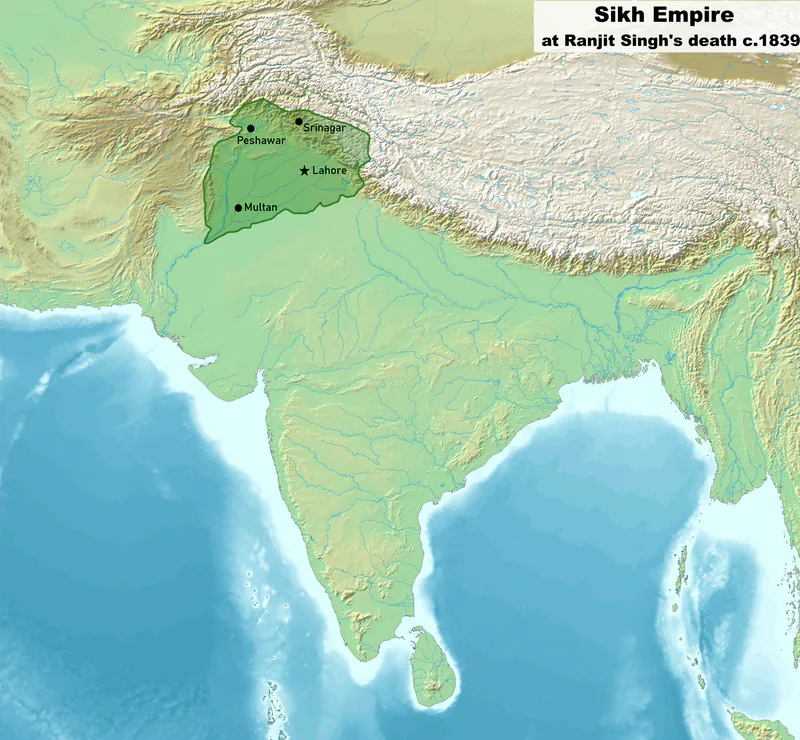
At its height the kingdom covered most of the modern Pakistani Punjab and Khyber Pakhtunkhwa, the Indian Punjab north of the Sutlej, Jammu, Kashmir and parts of Ladakh, the last conquered by the Dogra commander Zorawar Singh on behalf of Raja Gulab Singh. Estimates of its population vary widely, from about four million to more than ten million, but all agree that Sikhs were a minority, perhaps around a tenth; most subjects were Muslims, followed by Hindus.
The Khalsa Army and the European Officers§
The foundation of the Maharaja's power was his army. He combined traditional Sikh cavalry, including the irregular Akali or Nihang warriors, with infantry and artillery drilled on European lines. From 1822 he employed former officers of Napoleon's armies, notably Jean-Baptiste Ventura and Jean-François Allard, who raised a model brigade, the Fauj-i-Khās, with French-style drill and commands; later recruits included the Italian Paolo Avitabile, governor of Peshawar, and the Frenchman Claude Auguste Court, who modernised the artillery. Sikh, Punjabi Muslim, Hindu Dogra and Gurkha soldiers served in the regular army, which numbered by the late 1830s some tens of thousands of men with a large artillery park. British observers considered it the most formidable Indian army they faced.
Court, Administration and Religious Patronage§
Ranjit Singh's court at Lahore was cosmopolitan. His foreign minister and confidant was a Muslim, Fakir Azizuddin; the Dogra brothers Gulab Singh, Dhian Singh and Suchet Singh, Hindu Rajputs from Jammu, held great power, with Dhian Singh as chief minister; Brahmin and Khatri officials ran the revenue and treasury. The Maharaja was personally illiterate but remembered as shrewd, accessible and sparing of capital punishment. Contemporary accounts describe his love of horses, his receptions for European travellers and his famous discussions with visitors such as the French naturalist Victor Jacquemont.

He was a devout Sikh in public life and a generous patron of religious institutions of all communities. His most famous gift was the gilding of the Harmandir Sahib in Amritsar, whose upper storeys were covered in gilded copper and whose lower walls were faced with marble inlay during his reign, giving the shrine its English name, the Golden Temple. He also endowed gurdwaras at sites associated with the Gurus, including Patna and Nanded, and made gifts to Hindu temples, such as gold for the Kashi Vishwanath temple in Varanasi, and to Muslim shrines and mosques. Sikh tradition records that he submitted to punishment by the Akal Takht for breaches of Sikh discipline, an episode associated with Akali Phula Singh. Historians debate how far his state was "Sikh" in character: Khushwant Singh and others stress its religious tolerance and secular administration, while also noting the central place of the Khalsa in its legitimacy.
Death of the Maharaja and the Fall of the Kingdom§
Ranjit Singh died in Lahore on 27 June 1839 after a series of strokes. Several of his wives and attendants died on his funeral pyre, an act of sati that contemporary reports describe and that Sikh teaching condemns. His samādhi stands beside the Badshahi Mosque in Lahore.
The kingdom did not long survive him. His son Kharak Singh ruled briefly before his death in 1840; his grandson Nau Nihal Singh was killed on the day of his father's funeral when an archway collapsed on him; another son, Sher Singh, was assassinated in 1843 along with Dhian Singh. Power passed to the young Duleep Singh, born in 1838, with his mother, Maharani Jind Kaur, as regent, while the army's elected committees (panchāyats) grew increasingly independent. Rivalry among the court factions and British pressure led to the First Anglo-Sikh War of 1845–1846, fought at Mudki, Ferozeshah, Aliwal and Sobraon, which ended with the loss of territory and the sale of Kashmir to Gulab Singh. A rebellion at Multan in 1848 led to the Second Anglo-Sikh War and the hard-fought battles of Chillianwala and Gujrat. On 29 March 1849 the Punjab was annexed, and the Koh-i-Noor was taken for Queen Victoria.
Duleep Singh and the Memory of the Sikh Empire§
Duleep Singh was separated from his mother, converted to Christianity as a boy and lived as a country gentleman in England, at Elveden in Suffolk. Late in life he sought to reclaim his inheritance, was reconciled with Sikhism at Aden in 1886 and died in Paris in 1893. His story, retold in Christy Campbell's The Maharajah's Box (2000), and that of his mother, who joined him in England in the 1860s, became powerful symbols of loss for later generations, as discussed in Women in Sikhism.
For Sikhs today Ranjit Singh's reign is remembered as a golden age of Sikh sovereignty and cultural flowering. His equestrian statues stand in Indian cities, his golden throne is in the Victoria and Albert Museum in London, and his samādhi in Lahore receives Sikh pilgrims from India and around the world. Historians such as Jean-Marie Lafont and J. S. Grewal have reassessed the kingdom as a sophisticated early modern state, while the political scholar and statesman Amarinder Singh has written a detailed account of its last decade.
Frequently asked questions§
Why is Ranjit Singh called the Lion of the Punjab?§
The title Sher-e-Punjab reflects his success in uniting the Punjab and defending it against Afghan and British power. It became a popular epithet in his lifetime and remains his best-known name.
How large was the Sikh Empire?§
At its height it extended from the Sutlej to the Khyber Pass and from Multan to Kashmir and Ladakh. Estimates of its population range from about four to more than ten million, most of them Muslims and Hindus.
What happened to the Sikh Empire after Ranjit Singh?§
After his death in 1839 a series of short reigns, assassinations and court rivalries weakened the state. Two Anglo-Sikh wars followed, and the British annexed the Punjab in 1849.
Sources and further reading§
- Ranjit Singh: Maharaja of the Punjab — Khushwant Singh, 1962
- Maharaja Ranjit Singh: Lord of the Five Rivers — Jean-Marie Lafont, 2002
- The Last Sunset: The Rise and Fall of the Lahore Durbar — Amarinder Singh, 2010
- The Real Ranjit Singh — Fakir Syed Waheeduddin, 1965
- The Maharajah's Box — Christy Campbell, 2000
- The Sikhs of the Punjab — J. S. Grewal, 1990
- A History of the Sikhs — Khushwant Singh, 1963