Liber XXVII · Sikhism · Chapter VI: Sikh History
Banda Singh Bahadur: The Sikh Uprising and First Sikh Rule
Banda Singh Bahadur (1670–1716): the ascetic who met Guru Gobind Singh, led the Khalsa to Sirhind, founded Sikh rule at Lohgarh and was executed in Delhi.

Banda Singh Bahadur (1670–1716) was a former ascetic who, after meeting Guru Gobind Singh at Nanded in 1708, led the first great Sikh uprising against Mughal rule in the Punjab. Between 1709 and 1715 his forces took Samana and Sirhind, set up a capital at Lohgarh, struck coins in the name of the Gurus and briefly governed a territory between the Yamuna and the Sutlej, before he was captured and executed with hundreds of his followers in Delhi in 1716.
From Lachhman Dev to Madho Das§
Most accounts say that Banda was born in 1670 at Rajouri in the Jammu hills into a Rajput family and named Lachhman Dev. Tradition relates that as a young man he killed a pregnant doe while hunting and, shaken by the sight of the dying fawns, renounced the world. He became a bairāgī, a Vaishnava ascetic, under the name Janaki Das and later Madho Das, travelled widely, and eventually established a hermitage at Nanded on the Godavari river in the Deccan. Sikh sources describe him as a man with a reputation for yogic and occult powers.
These early details come mainly from later Sikh and Persian writings and differ in particulars, so historians treat them with some caution. What is clear is that he was a figure of standing among ascetics when the course of his life changed.
The Meeting with Guru Gobind Singh at Nanded§
In 1708 Guru Gobind Singh, who had travelled south with the camp of the emperor Bahadur Shah, came to Nanded. According to Sikh accounts, the ascetic tried to unsettle his visitor with his powers and failed, and then declared himself the Guru's bandā, "slave" or servant. The Guru gave him the name Banda Singh, though sources disagree over whether he received the Khalsa initiation with amrit.
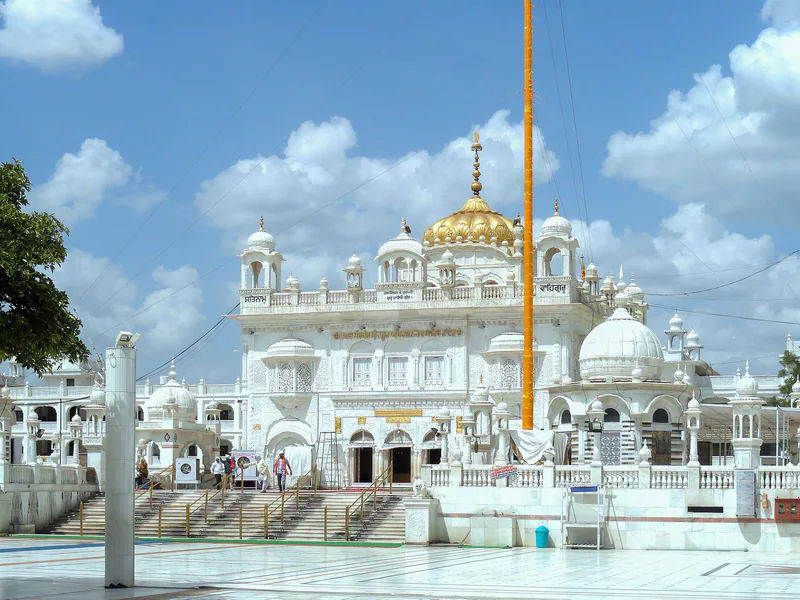
Before his death at Nanded in October 1708 the Guru sent Banda north with a small party of Sikhs, five arrows from his quiver, a standard and a war drum, and letters (hukamnāmās) asking the Khalsa of the Punjab to follow him. His task, as Sikh memory frames it, was to punish those responsible for the persecution of the community, above all Wazir Khan, the governor of Sirhind who had ordered the execution of the Guru's two younger sons.
The Campaign of 1709–1710: Samana and Sirhind§
Arriving in the Punjab in 1709, Banda drew together Khalsa Sikhs, many of them Jat peasants, together with others who resented Mughal revenue officials and local landlords. In November 1709 his forces sacked Samana, the home town of the executioners of Guru Tegh Bahadur according to Sikh tradition, and then took Sadhaura and other towns of the region.
The decisive encounter came in May 1710 at Chappar Chiri, near Sirhind. Wazir Khan was killed in the battle and, a few days later, Sirhind was taken and sacked. For the Sikhs the fall of Sirhind was an act of justice for the deaths of the Sahibzade; for Persian chroniclers of the time, who wrote with evident hostility, it was a scene of destruction. A tall victory tower now stands at Chappar Chiri, and the events are central to the Sikh memory of the period described in Sikh History: From the Gurus to Today.
Lohgarh and the First Sikh Rule§
Banda made his headquarters at Mukhlisgarh, a hill fort in the Shivalik foothills near Sadhaura, which he renamed Lohgarh, "fortress of iron". There he exercised a form of sovereign authority. He issued coins and a seal whose Persian legends attributed victory and sovereignty not to himself but to Guru Nanak and Guru Gobind Singh, a formula later echoed in Sikh coinage under the misls and the Sikh Empire. He appointed his own officials in the conquered districts and introduced a dating era from his victories.

Sikh tradition credits him with abolishing the old landlord system and giving the land to those who tilled it. Historians debate how far this was a deliberate policy and how far a result of the collapse of Mughal revenue administration, but most agree that his movement drew deeply on peasant grievances and that it overturned local hierarchies. Muzaffar Alam's work on the crisis of Mughal power in the Punjab places the uprising within a wider pattern of regional revolts, while J. S. Grewal and Purnima Dhavan emphasise the role of Khalsa identity in holding the movement together.
Mughal Reaction, Gurdas Nangal and Execution in Delhi§
The capture of Sirhind brought the emperor himself north. Bahadur Shah besieged Lohgarh in late 1710, but Banda escaped into the hills. The emperor issued an order, recorded in Persian sources, that Sikhs were to be killed wherever found. Fighting continued for several years under Bahadur Shah's successors, with Banda regaining and losing territory in the hills and the plains.
Under the emperor Farrukhsiyar the governor of Lahore, Abdus Samad Khan, finally trapped Banda and his followers at Gurdas Nangal, near Gurdaspur, in 1715. After a siege of about eight months, in which the defenders were reduced to starvation, they surrendered in December 1715. Banda and some seven hundred Sikhs were taken to Delhi and paraded through the city in March 1716. Over the following days the prisoners were executed in batches. Two English East India Company envoys then in Delhi, John Surman and Edward Stephenson, wrote in a letter that none of the condemned would renounce his faith to save his life, a detail that has become a fixed part of the Sikh memory of the event.
Banda himself was kept alive for some three months. In June 1716, near the Qutb Minar at Mehrauli, he was tortured and put to death; Sikh tradition, supported by Persian accounts, records that he was first made to watch the killing of his young son, Ajai Singh. He is remembered in the daily Ardas among those who gave their lives for the faith.
The Bandai Khalsa and Banda's Legacy§
Banda's leadership was not uncontested within the Panth. Some Sikhs objected to innovations attributed to him, including a vegetarian diet, red clothing and a new greeting, Fateh Darshan, in place of the Khalsa salutation. Tradition speaks of a division between his followers, the Bandaī Khalsa, and the Tat ("true") Khalsa, which looked to Guru Gobind Singh's widow, Mata Sundari, in Delhi. Sikh tradition says the dispute was settled at Amritsar around 1721 under Bhai Mani Singh by casting lots in the sacred pool. How much of this story reflects events and how much later partisan writing is uncertain.
His achievements, however, were lasting. For the first time the Khalsa had ruled territory and minted coins in the Gurus' name, and the idea of Khalsa sovereignty, rāj karegā khālsā ("the Khalsa shall rule"), took concrete form. The persecution that followed his fall drove the Sikhs into the jungles and hills for a generation, from which emerged the bands of the Dal Khalsa, the Nihang warrior tradition and the misl confederacies that prepared the way for Maharaja Ranjit Singh. In modern Punjab Banda is celebrated as a hero of resistance and a champion of the peasantry, and his story is retold in poetry, film and school textbooks. The historian Ganda Singh's biography of 1935 remains the classic study.
Frequently asked questions§
Who was Banda Singh Bahadur?§
He was a former Vaishnava ascetic, born in 1670, who became a follower of Guru Gobind Singh in 1708 and led a Sikh uprising in the Punjab. He conquered Sirhind in 1710 and established the first Sikh rule before being executed in Delhi in 1716.
Why did Banda Singh Bahadur attack Sirhind?§
Sirhind was governed by Wazir Khan, who had ordered the execution of Guru Gobind Singh's two youngest sons. Its capture in 1710, after Wazir Khan's death at Chappar Chiri, is remembered by Sikhs as an act of justice.
Was Banda Singh Bahadur a Guru?§
No. Sikhs regard him as a commander and martyr appointed by Guru Gobind Singh, not as a Guru. The Guruship had been vested in the Guru Granth Sahib and the Khalsa community.
Sources and further reading§
- Life of Banda Singh Bahadur — Ganda Singh, 1935
- The Crisis of Empire in Mughal North India: Awadh and the Punjab, 1707–48 — Muzaffar Alam, 1986
- When Sparrows Became Hawks: The Making of the Sikh Warrior Tradition, 1699–1799 — Purnima Dhavan, 2011
- The Sikhs of the Punjab — J. S. Grewal, 1990
- A History of the Sikhs — Khushwant Singh, 1963
- Martyrdom in the Sikh Tradition: Playing the "Game of Love" — Louis E. Fenech, 2000