Liber XXVII · Sikhism · Chapter VI: Sikh History
Sikh History: From the Gurus to Ranjit Singh and the Diaspora
Sikh history after the Gurus: Banda Singh Bahadur, the misls, Ranjit Singh's empire, British rule, gurdwara reform, Partition, 1984 and the diaspora.

Sikh history after the death of Guru Gobind Singh in 1708 is the story of a religious community that survived decades of persecution, built a kingdom in the Punjab under Maharaja Ranjit Singh, came under British rule in 1849, reformed its institutions in the early twentieth century, was divided by the Partition of 1947 and faced the trauma of 1984, while spreading into a worldwide diaspora. Throughout, the Khalsa ideals and the shrines of Amritsar have been focal points of Sikh identity.
Banda Singh Bahadur and the Eighteenth-Century Struggle§
Before his death at Nanded in 1708 (see Guru Nanak and the Ten Sikh Gurus), Guru Gobind Singh met an ascetic named Madho Das, who became his follower and was sent north as Banda Singh, "the Guru's servant", later honoured as Banda Singh Bahadur. Gathering Sikh peasants, he captured the town of Sirhind in 1710, where the Guru's younger sons had been put to death, and established a short-lived Sikh rule in parts of the Punjab, striking coins in the name of the Gurus and, by tradition, granting land to those who tilled it. Mughal armies besieged him at Gurdas Nangal in 1715; he and hundreds of his followers were taken to Delhi and executed in 1716.
For the following decades Mughal governors of Lahore attempted to suppress the Sikhs, at times offering rewards for their capture. Sikh bands survived in forests and hills and returned to Amritsar for the festivals of Vaisakhi and Diwali. Sikh memory preserves accounts of martyrs from this period, such as Bhai Mani Singh, executed in Lahore in the 1730s, and two great massacres: the "lesser holocaust" (chhoṭā ghallūghārā) of 1746 and the "great holocaust" (vaḍḍā ghallūghārā) of 1762, when the Afghan ruler Ahmad Shah Durrani's army killed many thousands of Sikhs, including women and children, near Malerkotla. In the same year he blew up the Harmandir Sahib, which the Sikhs rebuilt a few years later.
The Misls and the Sikh Confederacies§
The Sikh fighting bands organised themselves into a dozen or so confederacies called misls, each led by a chief (sardār), which combined in a larger force known as the Dal Khālsā. Leaders such as Nawab Kapur Singh and Jassa Singh Ahluwalia directed the struggle, and the confederacies met at Amritsar as the Sarbat Khālsā, the "entire Khalsa", to take collective decisions (gurmatā) in the presence of the Guru Granth Sahib, a practice that reflected the doctrine of the Guru Panth described in The Khalsa and the Five Ks.

As Mughal power collapsed and Afghan invasions weakened, the misls took control of most of the Punjab; in 1765 Sikhs occupied Lahore and struck coins in the name of the Gurus. The misls ruled a patchwork of territories, frequently rivalling one another, and they also built and endowed gurdwaras. Many Sikh families of later prominence trace their position to this era.
Maharaja Ranjit Singh and the Sikh Empire§
Ranjit Singh (1780–1839), chief of the Sukerchakia misl, took Lahore in 1799 and proclaimed himself Maharaja of the Punjab in 1801. Over the next three decades he united the misls under his rule and conquered Multan (1818), Kashmir (1819) and Peshawar, creating a state that stretched from the Sutlej river to the Khyber Pass. He modernised his army with European-style infantry and artillery, including the elite brigade known as the Fauj-i Khās, with the help of European officers, several of them veterans of Napoleon's wars, and it became one of the strongest forces in Asia. His court employed Hindus and Muslims as well as Sikhs in high office, and he ruled in the name of the Khalsa, calling his government the Sarkār-i Khālsā.
Ranjit Singh lavished patronage on Sikh shrines; the gilding that gave the Harmandir Sahib its popular name of Golden Temple was carried out under his rule. He also acquired the Koh-i-Noor diamond. After his death in 1839 the kingdom fell into a succession crisis, and two wars with the British East India Company (1845–1846 and 1848–1849) ended in annexation in 1849. The last Maharaja, the child Duleep Singh, was taken to Britain; the Koh-i-Noor passed to Queen Victoria.
British Rule, the Singh Sabha and Gurdwara Reform§
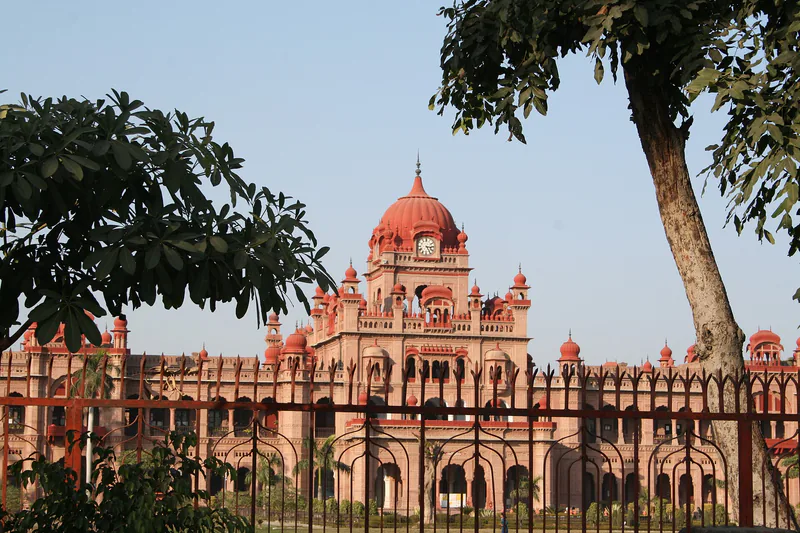
Under British rule Sikhs were recruited in large numbers into the Indian Army, which the British valued and which reinforced the importance of Khalsa identity, since Sikh soldiers were required to keep its outward forms. In 1873 the Singh Sabha movement was founded at Amritsar, followed by a more radical branch at Lahore. Its reformers, the "Tat Khalsa", worked to define Sikhism as a religion distinct from Hinduism, promoted education and Punjabi literature, founded Khalsa College at Amritsar in 1892 and secured legal recognition of the Sikh marriage rite in 1909. Historians such as Harjot Oberoi argue that the movement narrowed a previously more fluid range of Sikh identities; many Sikh scholars see it rather as a recovery of the Gurus' original teaching.
Many historic gurdwaras were then in the hands of hereditary custodians (mahants), some of whom ran them as private property with practices the reformers rejected. Between 1920 and 1925 the Gurdwara Reform Movement, led by the Akalis, used largely non-violent mass protests to win control of them. At Nankana Sahib in 1921 a mahant's men killed scores of reformers, and at Guru ka Bagh in 1922 Akali volunteers endured beatings without retaliating. The Sikh Gurdwaras Act of 1925 placed the main gurdwaras under the elected Shiromani Gurdwara Parbandhak Committee. In the same period Sikhs played a prominent part in the struggle for Indian independence, and many Sikhs were among the victims of the massacre at Jallianwala Bagh in Amritsar on Vaisakhi day, 1919.
Partition, Punjabi Suba and the Crisis of 1984§
The Partition of India in 1947 divided the Punjab between India and Pakistan. Sikhs lost their homes in the western Punjab, including Nankana Sahib, Guru Nanak's birthplace, and Lahore. Mass migration was accompanied by terrible violence among Muslims, Hindus and Sikhs; estimates of the dead across the Punjab range from about two hundred thousand to over a million. After independence, Sikh leaders campaigned for a Punjabi-speaking state, achieved in 1966 when the Indian Punjab was divided to create a smaller Sikh-majority Punjab, together with Haryana and Himachal Pradesh.
Disputes over river waters, the status of Chandigarh and greater autonomy grew in the 1970s and early 1980s, and the preacher Jarnail Singh Bhindranwale gained a large following; some militants called for a separate Sikh state, Khalistan. In June 1984 the Indian army stormed the Golden Temple complex in Operation Blue Star to remove Bhindranwale and armed militants who had fortified it. The Akal Takht was badly damaged and many people were killed, including pilgrims. On 31 October 1984 Prime Minister Indira Gandhi was assassinated by two of her Sikh bodyguards, and in the following days mobs killed thousands of Sikhs in Delhi and other cities; the official figure for Delhi alone is about 2,800. An insurgency and counter-insurgency in the Punjab followed until the mid-1990s, with heavy loss of life and serious human rights abuses reported on more than one side. These events continue to be debated and commemorated.
The Sikh Diaspora and Sikhs Today§
Sikh migration began under British rule, as soldiers, police and labourers went to Malaya, Hong Kong and East Africa, and pioneers reached British Columbia and California in the early twentieth century; the gurdwara at Stockton, California, founded in 1912, was the first in the United States. In 1914 the ship Komagata Maru, carrying mainly Sikh passengers, was refused entry at Vancouver, an episode for which the Canadian government formally apologised in 2016. Large-scale migration to Britain followed the Second World War and to Canada and the United States from the 1960s. Diaspora Sikhs have campaigned for the right to wear turbans and the Five Ks, and have also faced hate crimes, notably after 11 September 2001 and in the shooting at the Oak Creek gurdwara in Wisconsin in 2012.
Today Sikhs are prominent in Indian public life, in agriculture, the armed forces, business and politics; Manmohan Singh served as Prime Minister of India from 2004 to 2014. Sikhs in Canada, Britain and elsewhere have been elected to national parliaments. Sikh institutions, from the Akal Takht to local gurdwaras, continue to debate questions of authority, the calendar, caste, the role of women and the relationship between religion and politics, while the practices described in Gurdwara, Langar and Sikh Practice remain the shared heart of Sikh life.
Frequently asked questions§
Who was Maharaja Ranjit Singh?§
Ranjit Singh (1780–1839) was the Sikh ruler who united the Punjab and founded a kingdom with its capital at Lahore, which he ruled from 1799 until his death. He built a modern army, patronised Sikh shrines and employed people of all religions in his government. His kingdom was annexed by the British ten years after his death.
What happened in 1984 to the Sikhs?§
In June 1984 the Indian army attacked the Golden Temple complex in Amritsar to remove armed militants, causing many deaths and severe damage to the Akal Takht. After Indira Gandhi's assassination that October, thousands of Sikhs were killed in organised violence in Delhi and elsewhere, events that remain a source of grief and demands for justice.
Why did Sikhs settle in Canada and Britain?§
Sikh migration grew out of service in the British imperial army and police and opportunities in the colonies. Sikhs settled in British Columbia from the early twentieth century, and post-war labour shortages drew many to Britain from the 1950s; both countries now have large and long-established Sikh communities.
Sources and further reading§
- A History of the Sikhs — Khushwant Singh, 1963
- The Sikhs of the Punjab — J. S. Grewal, 1990
- Ranjit Singh: Maharaja of the Punjab — Khushwant Singh, 1962
- The Construction of Religious Boundaries: Culture, Identity and Diversity in the Sikh Tradition — Harjot Oberoi, 1994
- Amritsar: Mrs Gandhi's Last Battle — Mark Tully & Satish Jacob, 1985
- The Sikh Diaspora: The Search for Statehood — Darshan Singh Tatla, 1999